DOGE to Shutter DOJ Tax Division

I didn’t know this until this morning. And I’m surprised it hasn’t gotten more press attention. We know that DOGE is in the process of gutting the IRS. According to internal IRS estimates reviewed by The Washington Post, this internal sabotage is already estimated to have cost the U.S. Treasury more than $500 billion in revenues that otherwise would have been raised by April 15th. But it doesn’t stop at the IRS. DOGE is also in the process of essentially closing down the Tax Division at the Department of Justice.

Continue reading “DOGE to Shutter DOJ Tax Division”

No, President Trump, The Income Tax Wasn’t A Mistake. But It Was An Accident.

This story first appeared at ProPublica. ProPublica is a Pulitzer Prize-winning investigative newsroom. Sign up for The Big Story newsletter to receive stories like this one in your inbox.

In his Rose Garden speech launching a global trade war by announcing the most sweeping tariffs in modern history, President Donald Trump bestowed a history lesson on his audience that diverged from the factual record:

“Then in 1913, for reasons unknown to mankind, they established the income tax so that citizens, rather than foreign countries, would start paying the money necessary to run our government. Then in 1929, it all came to a very abrupt end with the Great Depression, and it would have never happened if they had stayed with the tariff policy; it would have been a much different story.”

So why did we institute an income tax? Were there any humans who knew what the reasoning was? And did the actions of 1913 lead to the Great Depression in 1929?

There is a clear consensus among historians on these points. No, the income tax was not a mistake.

But it was something stranger: both a 40-year struggle and an accident.

In 1913, the states ratified the 16th Amendment, which gave the federal government the power to “collect taxes on incomes, from whatever source derived.”

This was not the first income tax effort, however.

For a few short years during and after the Civil War, the United States imposed its first tax on income to help fund the massive costs of the war. Placed on relatively high incomes but only collecting a modest percentage, it was cast as both a way to generate needed revenue and a way to maintain fairness.

Yes, that’s right, one of the chief selling points of taxing income was that it was a way of achieving “equity” in the burdens of the war. Responding to allegations that only poor men were fighting and dying, President Abraham Lincoln and his Republican Party made sure the law required that the taxes people paid would be publicly disclosed. Unsurprisingly, the wealthy men of the dawning Gilded Age did not like seeing their tax information in the pages of The New York Times. Wealthy interests forced a repeal of the income tax in 1871, and the federal government returned to funding itself with proceeds from user fees and tariffs.

Efforts to rein in the rich persisted, however. Congress moved in 1894 to reintroduce an income tax. The populist Kansan politician William Jennings Bryan gave a famous speech on the floor of Congress. Responding to the argument that the wealthy would leave America if they had to pay such a tax, then proposed as 2% on the top incomes, he said:

“Of all the mean men I have ever known, I have never known one so mean that I would be willing to say of him that his patriotism was less than 2 per cent deep. … If ‘some of our best people’ prefer to leave the country rather than pay a tax of 2 per cent, God pity the worst.”

Congress passed the law. One year later, however, the Supreme Court controversially rejected it, 5-4, in the case of Pollock v. Farmers’ Loan and Trust Company. The party of Lincoln, now dominated by wealthy Northeastern interests, celebrated. Its 1894 platform had declared that an income tax “will bring odium on any party blind enough to support it” and predicted that party’s “funeral.”

Populists like Bryan didn’t give up. A young Democratic congressman from Tennessee named Cordell Hull said in his maiden speech on the floor in 1908, in which he proposed passing another income tax, that he was willing to risk the “odium and the funeral.”

Hull’s effort didn’t gather much momentum that time, but he didn’t give up. He obsessively talked with anyone and everyone about an income tax, so much so that when leaders of his own party saw him approaching, they “would turn and walk in another direction,” he later recalled.

Soon he would succeed, but only thanks to the help of the party that was against the income tax — the Republicans.

In 1909, the country was facing a severe drop in federal revenue and a widening deficit after the financial panic of 1907, which had ended only thanks to a bailout led by J.P. Morgan, the most powerful banker of the age. At the same time, with new responsibilities like trying to keep food and medicines safe and maintaining a growing empire abroad, the federal government’s needs were exploding. A few years earlier, Congress had allocated $1 billion in spending for the first time ever (about $30 billion in today’s dollars).

To address these issues, the Republican party turned to tariffs. Tariffs not only remained the cornerstone of Republican economic policy, they were also the key to the party’s political power. Each time a new tariff bill came up for consideration was like “throwing bananas in a cage of monkeys,” economist Henry George said. Lobbyists from every corner of American industry descended on the capital to push for lower imposts on their companies and, if possible, to have them raised on someone else.

Tariffs and levies on things like tobacco and alcohol were deeply unpopular with the public. They were regressive, costing working people a far greater percentage of their income than the rich. In one of his speeches, Hull attacked the new dominant class of oligarchs: “The world has never seen such colossal fortunes as we behold in the present age … the Carnegies, the Vanderbilts, the Morgans, and the Rockefellers, with their aggregated billions of hoarded wealth.”

Hull said, “It would seem that this class of people consider themselves almost immune from any kind of taxation.” He closed a speech with a warning to his congressional colleagues: “Public sentiment is becoming aroused.”

In Washington, lawmakers had a bounty of novel ideas for raising funds. Some members of Congress suggested an inheritance tax, others a corporate profits tax, and still others wanted some version of a stamp tax on commercial documents. As president, Theodore Roosevelt supported an income tax, though he didn’t do much to push it legislatively. Most Republican senators, many of whom were millionaires themselves, had mild aversions to some of the proposals and a particular loathing for the income tax.

Nelson Aldrich, the Senate majority leader from Rhode Island, a millionaire and the father-in-law of John D. Rockefeller Jr., was arguably the most powerful politician in the country at the time. Teddy Roosevelt nicknamed him the “King Pin.” In 1909, Aldrich was trying to pass a new tariff bill. Hull’s Democrats posed a problem for him, but not the only one. He also faced a rebellious faction within his own party, the progressive Republicans. These were largely Midwestern and Western leaders who argued for what they described as working people’s interests, as well as reforms to improve public safety and the strengthening of labor unions. They also supported an income tax.

Aldrich tried a series of legislative maneuvers to delay votes on anything about the income tax. The proponents were undeterred, and, as a next step, he and then-President William Taft put their weight behind a corporate income tax, contending that it would be a lesser evil than a personal income tax. The wealthy did not like it, but it passed surprisingly easily, leaving Republicans hopeful the income tax was dead. In a private letter to a friend, the president explained, “A good many people who are attacking [the corporate income tax] now will be glad to use it as a means of preventing the income tax later on.”

Taft proved to be overly optimistic. Supporters of the income tax kept pushing, seeking to raise money directly from the wealthy. A debate ensued about whether Congress could simply pass an income tax law or, since the Supreme Court had struck one down recently, whether a constitutional amendment was needed. Hull pointed out that the makeup of the court had changed and argued that a law could now pass muster with the justices.

Then, one progressive Republican proposed an income tax amendment.

Aldrich pounced on what he perceived as his opponents’ misstep. He threw his support to the measure as a means of placating the advocates for a national income tax. In exchange, enough lawmakers agreed to back Aldrich’s tariff bill.

Aldrich, of course, did not support the income tax amendment, but he believed it was too radical to be ratified by three-fourths of the states, the minimum required by the Constitution. Leading politicians assumed that the defeat of the amendment would likely kill the income tax for years, if not a generation.

Hull agreed with that analysis and was despondent. “It has long been understood that the Republicans never support a worthy cause until forced by public sentiment. Too stupid to devise and enact wholesome laws and to formulate and execute sound administrative policies, this piratical organization is wont to wait until Democrats point the way,” he said in a speech on the floor.

And so Nelson Aldrich, the senator who had done more than almost any other American politician in history to protect the wealthy, introduced what would turn out to be an historic measure to amend the Constitution and explicitly allow income taxes on the rich. A few days later, with little fanfare, the amendment passed the Senate by a unanimous vote of 77-0.

Soon after, Congress passed the Payne-Aldrich Tariff bill, giving Aldrich his victory.

But Aldrich had miscalculated and Hull had been too gloomy. After a slow start for the ratification movement, political winds shifted and enough states came around. The amendment was ratified four years later. Then it fell to Hull to almost singlehandedly write what became the 1913 income tax law.

Hull’s plan proved prescient. He had foreseen that if the United States ever became entangled in a war that involved attacks on shipping, imports would dry up and tariff revenue would plummet. When the United States joined the war against Germany in 1917, Congress had to raise income tax rates to generate the money needed to pay for the expense of sending soldiers to Europe.

So no, President Trump, the origins of the income tax are not lost to history.

But did the tax cause the Great Depression 16 years after its enactment, as Trump has argued? No serious economist thinks so. Here’s one data point: In the 1920s, Republicans regained the presidency. Andrew Mellon, one of the richest men in the country, became Treasury secretary. One of the main causes he worked for was lowering income taxes, and the lead-up to the worst economic calamity of the 20th century was actually marked by a decline in those tax rates.

The evidence is similarly clear on Trump’s argument that continued reliance on tariffs to fund the government would have averted the Great Depression. In June of 1930, President Herbert Hoover signed into law the Smoot-Hawley Tariff Act, significantly raising taxes on imported goods in hopes of boosting American industries and increasing domestic employment. Hoover brushed aside the arguments of his own economists who warned that other nations would respond with their own tariffs, touching off a trade war in which every country would lose.

Economists now agree that Hoover’s tariffs deepened the economic downturn that had begun with the 1929 stockmarket crash. President Franklin Delano Roosevelt gradually reduced the tariffs during his presidency, and his Democratic and Republican successors continued that pattern well into the 21st century.

Today’s situation has similarities to the pre-income-tax years. The American economy is again marked by wealth inequality, with the largest gap between rich and poor we’ve seen since the Gilded Age. We are having debates about how to reduce the federal deficit, about how to fairly and adequately tax the rich and about what the appropriate size of government would be. Last week, Trump reached back in history to restore U.S. tariffs to the Smoot-Hawley levels, triggering a global selloff in stock markets around the world.

Fired DOJ Pardon Attorney: Office Was Never Consulted On Trump’s Jan 6 Pardons

During a “shadow hearing” before congressional Democrats Monday evening, former U.S. pardon attorney Liz Oyer — who was fired last month in retaliation for her refusal to comply with a Trump-backed order to restore Mel Gibson’s gun rights — testified that her office was never consulted on Trump’s sweeping January 6 pardons. 

Continue reading “Fired DOJ Pardon Attorney: Office Was Never Consulted On Trump’s Jan 6 Pardons”

SCOTUS Launches Itself Into The Worst Of The Trump Cases

A lot of things happened. Here are some of the things. This is TPM’s Morning Memo. Sign up for the email version.

Where Does This Leave Us?

A rapid-fire series of Supreme Court interventions in two of the most pressing early Trump II cases has slowed down for now the prospect of a direct confrontation between President Trump and the judicial branch.

In the most urgent case, Chief Justice John Roberts issued an administrative stay that lifted the deadline of midnight last night for the Trump administration to facilitate the return of Kilmar Abrego Garcia, the man mistakenly deported to an El Salvadoran prison despite a court order explicitly barring his removal. Roberts’ move came as the 4th Circuit Court of Appeals sided with Abrego Garcia and set the Trump administration on a collision course with the judiciary. Still, Roberts set a tight briefing schedule (Abrego Garcia’s lawyers immediately filed their response), and the Supreme Court could rule at any moment.

Later in the day, the Supreme Court issued a very muddled and confusing decision in the adjacent Alien Enemies Act case – the other case that seems most likely to provoke Trump into an extra-constitutional showdown with the courts. By a 5-4 margin, with Justice Amy Coney Barrett joining the three liberal justices, the court threw U.S. District Judge James Boasberg under the bus with a hasty, procedurally irregular decision that brought withering retorts from the dissenters.

The particulars gets weedy pretty quick, but the high court said no one should be removed under the Aliens Enemies Act without notice and the opportunity for a hearing. Judging the justices on a curve, it’s hard not to feel some relief that the Supreme Court still finds value in notice and hearing as the bedrock of due process. That was the big takeaway from the decision, even if it carried all sorts of caveats and practical limitations.

Left undecided: the fate of the Venezuelan nationals already deported to the El Salvadoran prisons, whether the Alien Enemies Act properly applies to a criminal gang in peacetime, and whether those swept up in the deportations actually meet the requirements for removal. Those decisions will be left to individual judges to decide case by case, in Texas (in the most conservative federal circuit), where most of the habeas cases will have to be brought.

The high agitation of the dissenters suggests, however, that the way the majority got there had the effect of throwing open the barn door to further Trump depredations even as it overlooked the government’s egregious conduct in the case to this point.

I couldn’t help but wonder if the dissenting justices had already gotten a taste of what the majority has in store for the wrongfully deported Abrego Garcia. The two cases aren’t directly related, but they each overshadow the other in ways that put a finer point on the underlying legal and moral issues.

For more analysis:

  • Steve Vladeck: “But the more I read the Court’s Monday night ruling in Trump v. J.G.G., in which a 5-4 majority vacated a pair of temporary restraining orders entered by Chief Judge Boasberg in the Alien Enemy Act case, the more I think that this ruling really is a harbinger, and a profoundly alarming one, at that.”
  • Lee Kovarsky: “THE SUPREME COURT’S TdA OPINION IS TERRIFYING. Not because it’s wrong, although it is, but because of how comfortable the Court seems in abusing authority to get to what it must see as an institutionally desirable outcome.”

What About Boasberg’s Contempt Proceeding?

The Justice Department filed a snotty notice of the Supreme Court’s ruling on the Alien Enemies Act to Judge Boasberg and asked him to end his inquiry into whether the Trump administration violated his order blocking the deportations and should be held in contempt. Boasberg’s initial response did not tip his hand on the contempt proceedings. The Supreme Court did Boasberg no favors in depriving him of jurisdiction, but that alone should not be enough – in theory – to end the contempt proceeding.

DOJ Is Now Trump’s Personal Law Firm

The NYT has a pretty good rundown on how President Trump via Attorney General Pam Bondi is grinding down Justice Department attorneys. It’s written from the point of view of DOJ lawyers caught in the squeeze between their ethical obligations and threats to their careers.

‘I Will Not Be Bullied’

Fired U.S. pardon attorney Liz Oyer testified Monday at a shadow hearing held by congressional Democrats – but only after DOJ warned her not to testify and dispatched armed U.S. special marshals to her home to deliver the message.

Photo Of The Day

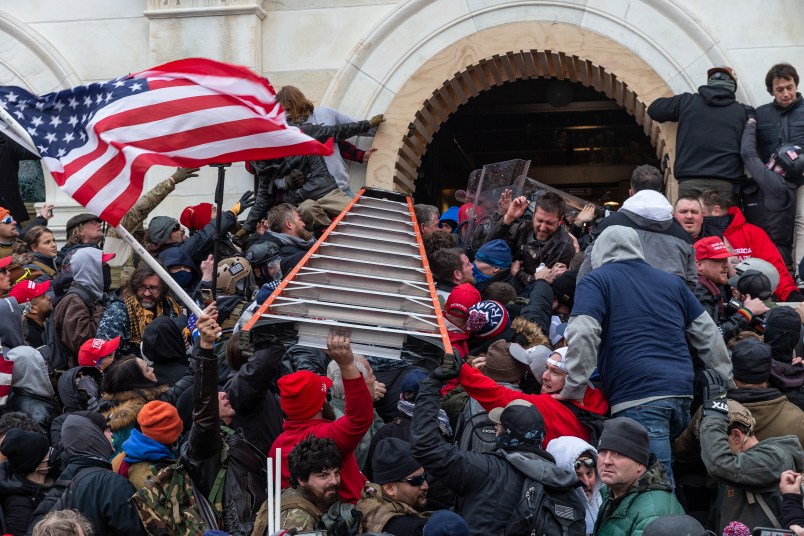
In case you missed it, acting D.C. U.S. Attorney Ed Martin gave the keynote address last month at an event attended by some of Jan. 6 seditionists who are appealing their convictions, Mother Jones reports:

Here is a photo from the event, to help give you a visual.

[image or embed]

— amanda moore 🐢 (@noturtlesoup17.bsky.social) April 7, 2025 at 1:05 PM

ONGOING: Trump’s Attack On Big Law

NYT: “One of Mr. Trump’s advisers has been in touch with [Cadwalader, Wickersham & Taft] to suggest that it sign a deal in which it would offer tens of millions of dollars in pro bono legal services to causes that the Trump administration supports.

DC Circuit: We Can’t Overturn SCOTUS Precedent

More on yesterday’s big decision by the D.C. Circuit Court of Appeals to reinstate the fired members of two independent agencies: Cathy Harris of the Merit Systems Protection Board and Gwynne Wilcox of the National Labor Relations Board.

Maine Is On The Frontline Of Trump’s Blue State Jihad

In the Trump administration’s ongoing bullying of Maine over trans athletes, the state is now suing the federal government over the Department of Agriculture’s move to freeze funding for the state, threatening the provision of school lunches.

The Destruction: Refugees And Fluoride Edition

  • Citing “drastic” government funding cuts, the U.S. Conference of Catholic Bishops’ Migration and Refugee Services, the largest refugee resettlement agency in the world, is ending its century-old program of resettling refugees fleeing war or persecution, the WaPo reports.
  • RFK Jr. is directing the CDC to change its recommendation supporting fluoride in drinking water.
  • REVERSAL: The National Park Service restored its original webpage on the Underground Railroad that included a previously deleted photo of Harriet Tubman.

DOGE Watch

DOGE will be able to access personal information of millions of union workers at the Education Department and OPM under a new order from the 4th Circuit Court of Appeals.

N.C. Supreme Court Intervenes In Election Case

The North Carolina Supreme Court paused a lower court order that would has the potential to reverse the outcome of the closely-watched and still unresolved 2024 election to the high court. Justice Allison Riggs and the State Election Board had filed an appeal seeking the stay.

Couldn’t Happen To A Nicer Guy

Former Wisconsin Supreme Court Justice Michael Gableman has agreed to give up his law license for three years over his repeated misconduct during his Big Lie-adjacent review of the state’s 2020 election for GOP lawmakers eager to find election fraud.

In Defense of Temporary Obsessions

From a delightful little essay by Ankita Shah: “In a world that wants mastery or monetisation as the outcome of every fleeting interest, temporary obsessions are little rebellions. Their purpose is to restore order in the playground that is your life.”

Do you like Morning Memo? Let us know!

DOGE Poised to Nix WMD Office at DHS

DOGE is on the verge of shuttering the Countering Weapons of Mass Destruction Office at the Department of Homeland Security. This is the office charged with preventing chemical, biological, radiological and nuclear weapons inside the United States. This is through a mix of intelligence, technology, preparedness, liaising with state and local policy, etc. (There’s more details on it here.) It’s an office with just over 250 federal employees and about twice that number of contractors.

Continue reading “DOGE Poised to Nix WMD Office at DHS”

Bitterly Divided Roberts Court Hands Trump Early Win On Alien Enemies Act

The Supreme Court tossed on Monday a series of restraining orders that barred the Trump administration from removing people under the Alien Enemies Act, in a 5-4 decision decided largely over whether the case was brought in the right place and form.

Continue reading “Bitterly Divided Roberts Court Hands Trump Early Win On Alien Enemies Act”

Johnson Already Doing Trump’s Veto Work For Him On Senate’s Bipartisan Tariff Bill

House Speaker Mike Johnson (R-LA) came out against even entertaining the idea of bringing to the House floor a Senate bill that would limit the President’s authority to unilaterally impose tariffs.

Continue reading “Johnson Already Doing Trump’s Veto Work For Him On Senate’s Bipartisan Tariff Bill”

Fired DOJ Attorney Testifies In Wake Of Trump Intimidation: I Won’t Be ‘Bullied’ To Hide ‘Corruption’ 

Former U.S. pardon attorney Liz Oyer, who was fired last month for refusing to comply with an order to restore Mel Gibson’s gun rights, spoke before congressional Democrats Monday on her recent termination and efforts by some in the DOJ and Trump’s administration to intimidate her out of showing up for that very testimony. 

Continue reading “Fired DOJ Attorney Testifies In Wake Of Trump Intimidation: I Won’t Be ‘Bullied’ To Hide ‘Corruption’ “

Senate Tariff Bill Must Become the Focus

This isn’t ripe yet. But it’s important to watch. Senators Cantwell and Grassley have a bill that would significantly reduce the president’s unilateral ability to impose tariffs. So far they have seven Republican co-sponsors. Axios has a piece up reporting that the White House has now issued a veto threat over the bill. That’s hardly surprising. The bill would radically, though not completely, scale back Trump’s power on what he is making the centerpiece of his presidency.

Continue reading “Senate Tariff Bill Must Become the Focus”

All Power Is Unitary

I want to take a moment to reiterate and explain an idea I’ve discussed many times here but which is particularly relevant in this moment: all power is unitary. What does this mean? Basically it means that a political actor’s relative power is the same everywhere. It’s not divided up into different buckets. You’re not losing power on one front and maintaining or increasing it everywhere else. That’s not how it works. Losses and gains in one place show up everywhere else. So Trump taking hits on the economy weakens him in the courts and with DOGE, Congress and everywhere else. It applies the same on the upside. If Trump is winning big battles in the courts, that empowers him everywhere else, even in areas that have nothing to do with the courts or the particular legal issue in question.

Continue reading “All Power Is Unitary”