Senate Republican leadership is trying to shore up votes for President Donald Trump’s $9.4 billion rescission request — the White House’s attempt to give some legitimacy to the Department of Government Efficiency’s rampage through the federal government.
But not everyone in the Senate Republican conference is on board with the cuts the White House is trying to force feed Congress via a constitutionally backwards rescissions package. A handful of senators are hoping to amend the package and water down the proposed cuts to make it more palatable.
I wanted to give you just a quick heads up. Next week we’re kicking off this year’s annual drive for the TPM Journalism Fund. This is always a critical effort for us every year. This is our sixth annual drive. This is, as you of course know, a bonkers years and a terrible one for the American Republic. But it’s focused us on our unique role in the news ecosystem, one that is even more critical in many ways since independence from any corporate overlord has become central to how an American news organization works in 2025. No news organization owned by a big, diversified corporation can be truly independent today because a big corporation is prey to the kind of regulatory harassment that is a central feature of Trumpism. In any case, more on that when we officially kick things off. But I just wanted you to keep an eye out for it next week.
Back when banner headlines mattered, this would have been plastered across the top of the every front page in America: President Trump is exacting decade-old retribution against former top government officials who now face criminal investigations by a Justice Department run out of the White House.
I don’t know how to say it any more clearly than that.
As Fox News first reported, former CIA Director John Brennan and former FBI Director James Comey are now the targets of federal criminal investigations related to their work probing Russia’s connections to the Trump campaign in the 2016 election. The Justice Department confirmed the investigations Wednesday in a highly unusual move in which it announced the probes before retreating behind the longstanding policy that it had just violated of not commenting on active investigations.
The purported wrongdoing by Brennan is allegedly lying to Congress about a 2017 intel community assessment of Russia’s pro-Trump role in the 2016 election and reportedly comes after a criminal referral by current CIA Director John Ratcliffe. It’s not clear what the spurious predicate is for the Comey investigation, assuming there is an ostensible “reason” for it.
Asked about the investigations, Trump denied any knowledge of them, before piling on:
But I will tell you, I think they’re very dishonest people. I think they’re crooked as hell. And maybe they have to pay a price for that. I believe they are truly bad people and dishonest people … So whatever happens, happens.
The White House press secretary lauded the investigations in a Fox News appearance. “I am glad to see that the Department of Justice is opening up this investigation,” Karoline Leavitt said.
If you’re waiting to draw your own conclusions until you see the outcome of these bogus investigations, you’ve been lulled into a sense of complacency. The trumped-up investigations are the wrongdoing. Bringing criminal charges would be an additional layer of wrongdoing, but, at this stage, the harassment, intimidation, and threat are the point. Brennan and Comey are the immediate targets, but it’s a warning to government officials past and present not to cross Trump.
We’re way past the threshold now and deep into the lawlessness.
Comey Targeted in Another Way
“The Secret Service had the former F.B.I. director James B. Comey followed by law enforcement authorities in unmarked cars and street clothes and tracked the location of his cellphone the day after he posted an image on social media in May that President Trump’s allies said amounted to a threat to assassinate the president,” the NYT reports.
OK, It’s ON!
The Trump White House’s push for a mid-decade redistricting in Texas to try to squeeze out a few more GOP seats and save the House in the 2026 election has succeeded. Texas Gov. Greg Abbott (R) included redistricting in the legislative agenda he released yesterday for a special session set for later this month.
Sign of the Times
A new survey by the Brennan Center reports that 46% of local election officials are concerned about political motivated investigations into election administration.
Trump Zeros in on Harvard’s Accreditation
The Trump administration told Harvard’s accreditor that it had concluded the university violated civil-rights laws by allegedly failing to protect Jewish students from antisemitic harassment, in a move that poses an existential threat to the school. The latest attack on higher ed came the same day that the Department of Homeland Security (DHS) announced it will subpoena Harvard for records about the enforcement of immigration laws with respect to its international students.
Canary Mission Used to Target Pro-Palestinian Students
The anonymous pro-Israel website Canary Mission was used by the Trump administration to identify pro-Palestinian students to target for deportation, according to documents and testimony that have emerged in the ongoing trial over the deportation policy.
Wrongfully Deported Man Confirmed at CECOT
In one of the lower-profile wrongful deportation cases, the Trump administration for the first time confirmed that Jordin Alexander Melgar-Salmeron is being detained at CECOT in El Salvador.
What stands out about the wrongful deportation of Melgar-Salmeron, a Salvadoran national, is that he was removed in violation of an appeals court order. His removal on May 7 within minutes of the Second Circuit’s order was the result of a confluence of administrative errors, the Trump administration has told the court.
But until yesterday, the administration had not been able to provide information on Melgar-Salmeron’s exact whereabouts
Jan. 6 Rally Organizer Found in Contempt of Court
Stop the Steal rally organizer Caroline Wren, a longtime GOP fundraiser, was found in contempt of court and fined $2,000 a day until she complies with a subpoena for records about the Jan. 6 event that preceded the attack on the Capitol. The subpoena arises in a lawsuit by Capitol police against Donald Trump, and Wren is a witness. “I don’t want to resort to incarceration if at all possible,” U.S. District Judge Donald Middlebrooks of South Florida said Wednesday in court, where Wren was a no-show.
Thread of the Day
What's up with Justice Jackson? She started making her mark and speaking out early, and some of her dissents are so pointed Kagan and Sotomayor don’t even join them. The far right is out for her, and even Republican justices are getting snarky. So what's up? Here’s my take 🧵
A new DHS policy that Secretary Kristi Noem must personally sign off on every contract and grant over $100,000 has hamstrung FEMA’s response to the devastating floods in Texas. “Noem didn’t authorize FEMA’s deployment of Urban Search and Rescue teams until Monday, more than 72 hours after the flooding began,” CNN reports.
Extremist Group Targets Weather Radars
After an Oklahoma TV station’s weather radar was vandalized Sunday night, the founder of an anti-government militia group confirmed that it was targeting Doppler radars.
“Absolutely,” Michael Meyer, the founder of Veterans On Patrol, told News9, the CBS affiliate in Oklahoma City.
Meyer told the station he had posted a warning sign that weather radars were being “targeted for elimination by victims of U.S. weather experimentation.”
A suspect was arrested Tuesday on unrelated charges but has not been charged for the radar sabotage.
Asked if his group was responsible for vandalizing News9’s radar, Meyer responded: “Veterans On Patrol is responsible for a lot more than that.”
Neil Jacobs, the nominee to run National Oceanic and Atmospheric Administration (which includes the National Weather Service), pledged to work to undo the DOGE Weather Service staffing cuts in testimony today before the Senate. To quote Government Executive magazine: “Nominee says he would work to undo the workforce cuts from the last few months, though the process could take time.”
There are plenty of legitimate questions swirling around the devastating flooding in Texas last weekend that left at least 100 people dead. They include questions about emergency alert funding decisions made by Texas’ Republican state legislature and about cuts to federal agencies implemented by the Trump administration that may have affected how the emergency response was handled. They also include questions raised in recent reporting from the Texas Tribune, which found the warning coordination meteorologist for the National Weather Service’s Austin/San Antonio office announced in April that he would retire early as a result of federal funding cuts.
This article first appeared at ProPublica, a Pulitzer Prize-winning investigative newsroom. Sign up for The Big Story newsletter to receive stories like this one in your inbox.
On July 4, the broken remnants of a powerful tropical storm spun off the warm waters of the Gulf of Mexico so heavy with moisture that it seemed to stagger under its load. Then, colliding with another soggy system sliding north off the Pacific, the storm wobbled and its clouds tipped, waterboarding south central Texas with an extraordinary 20 inches of rain. In the predawn blackness, the Guadalupe River, which drains from the Hill Country, rose by more than 26 vertical feet in just 45 minutes, jumping its banks and hurtling downstream, killing 109 people, including at least 27 children at a summer camp located inside a federally designated floodway.
Over the days and weeks to come there will be tireless — and warranted — analysis of who is to blame for this heart-wrenching loss. Should Kerr County, where most of the deaths occurred, have installed warning sirens along that stretch of the waterway, and why were children allowed to sleep in an area prone to high-velocity flash flooding? Why were urgent updates apparently only conveyed by cellphone and online in a rural area with limited connectivity? Did the National Weather Service, enduring steep budget cuts under the current administration, adequately forecast this storm?
Those questions are critical. But so is a far larger concern: The rapid onset of disruptive climate change — driven by the burning of oil, gasoline and coal — is making disasters like this one more common, more deadly and far more costly to Americans, even as the federal government is running away from the policies and research that might begin to address it.
President Lyndon B. Johnson was briefed in 1965 that a climate crisis was being caused by burning fossil fuels and was warned that it would create the conditions for intensifying storms and extreme events, and this country — including 10 more presidents — has debated how to respond to that warning ever since. Still, it took decades for the slow-motion change to grow large enough to affect people’s everyday lives and safety and for the world to reach the stage it is in now: an age of climate-driven chaos, where the past is no longer prologue and the specific challenges of the future might be foreseeable but are less predictable.
Climate change doesn’t chart a linear path where each day is warmer than the last. Rather, science suggests that we’re now in an age of discontinuity, with heat one day and hail the next and with more dramatic extremes. Across the planet, dry places are getting drier while wet places are getting wetter. The jet stream — the band of air that circulates through the Northern Hemisphere — is slowing to a near stall at times, weaving off its tracks, causing unprecedented events like polar vortexes drawing arctic air far south. Meanwhile the heat is sucking moisture from the drought-plagued plains of Kansas only to dump it over Spain, contributing to last year’s cataclysmic floods.
We saw something similar when Hurricane Harvey dumped as much as 60 inches of rain on parts of Texas in 2017 and when Hurricane Helene devastated North Carolina last year — and countless times in between. We witnessed it again in Texas this past weekend. Warmer oceans evaporate faster, and warmer air holds more water, transporting it in the form of humidity across the atmosphere, until it can’t hold it any longer and it falls. Meteorologists estimate that the atmosphere had reached its capacity for moisture before the storm struck.
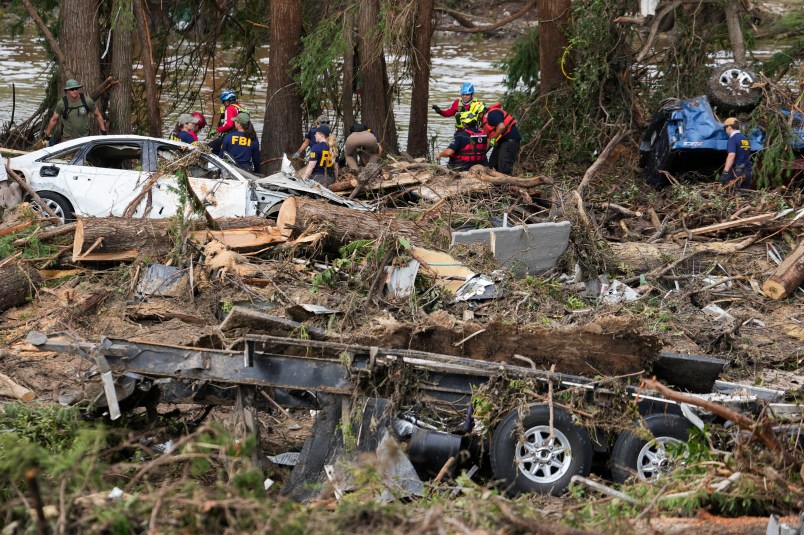
KERRVILLE, TEXAS – JULY 7: Search and rescue crews work to search a vehicles and debris along the Guadalupe River in Kerville, Monday, July 7, 2025. (Jason Fochtman/Houston Chronicle via Getty Images)
The disaster comes during a week in which extreme heat and extreme weather have battered the planet. Parts of northern Spain and southern France are burning out of control, as are parts of California. In the past 72 hours, storms have torn the roofs off of five-story apartment buildings in Slovakia, while intense rainfall has turned streets into rivers in southern Italy. Same story in Lombok, Indonesia, where cars floated like buoys, and in eastern China, where an inland typhoon-like storm sent furniture blowing down the streets like so many sheafs of paper. Léon, Mexico, was battered by hail so thick on Monday it covered the city in white. And North Carolina is, again, enduring 10 inches of rainfall.
There is no longer much debate that climate change is making many of these events demonstrably worse. Scientists conducting a rapid analysis of last week’s extreme heat wave that spread across Europe have concluded that human-caused warming killed roughly 1,500 more people than might have otherwise perished. Early reports suggest that the flooding in Texas, too, was substantially influenced by climate change. According to a preliminary analysis by ClimaMeter, a joint project of the European Union and the French National Centre for Scientific Research, the weather in Texas was 7% wetter on July 4 than it was before climate change warmed that part of the state, and natural variability alone cannot explain “this very exceptional meteorological condition.”
That the United States once again is reeling from familiar but alarming headlines and body counts should not be a surprise by now. According to the World Meteorological Organization, the number of extreme weather disasters has jumped fivefold worldwide over the past 50 years, and the number of deaths has nearly tripled. In the United States, which prefers to measure its losses in dollars, the damage from major storms was more than $180 billion last year, nearly 10 times the average annual toll during the 1980s, after accounting for inflation. These storms have now cost Americans nearly $3 trillion. Meanwhile, the number of annual major disasters has grown sevenfold. Fatalities in billion-dollar storms last year alone were nearly equal to the number of such deaths counted by the federal government in the 20 years between 1980 and 2000.
The most worrisome fact, though, may be that the warming of the planet has scarcely begun. Just as each step up on the Richter scale represents a massive increase in the force of an earthquake, the damage caused by the next 1 or 2 degrees Celsius of warming stands to be far greater than that caused by the 1.5 degrees we have so far endured. The world’s leading scientists, the United Nations panel on climate change and even many global energy experts warn that we face something akin to our last chance before it is too late to curtail a runaway crisis. It’s one reason our predictions and modeling capabilities are becoming an essential, lifesaving mechanism of national defense.
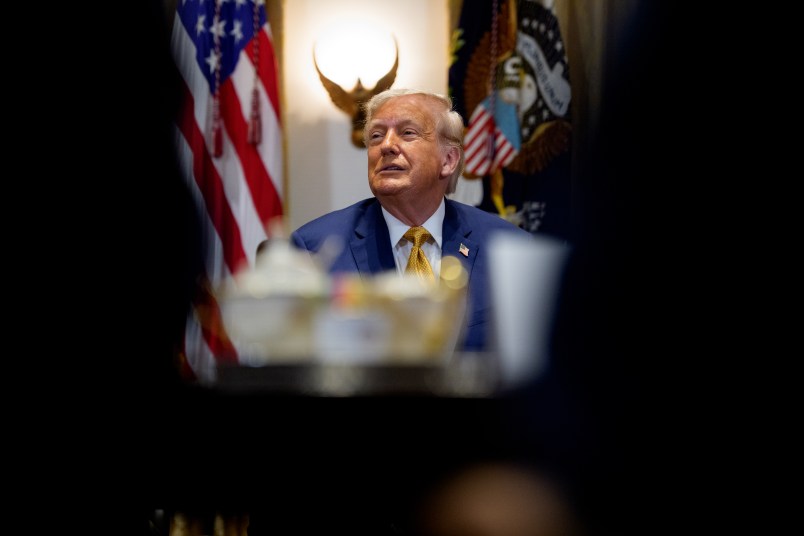
WASHINGTON, DC – JULY 08: U.S. President Donald Trump holds a Cabinet Meeting at the White House on July 08, 2025 in Washington, DC. Trump discussed the recent flash flooding tragedy in Central Texas where at least 109 people have died, and other topics during the portion of the meeting that was open to members of the media. (Photo by Andrew Harnik/Getty Images)
What is extraordinary is that at such a volatile moment, President Donald Trump’s administration would choose not just to minimize the climate danger — and thus the suffering of the people affected by it — but to revoke funding for the very data collection and research that would help the country better understand and prepare for this moment.
Over the past couple of months, the administration has defunded much of the operations of the National Oceanic and Atmospheric Administration, the nation’s chief climate and scientific agency responsible for weather forecasting, as well as the cutting-edge earth systems research at places like Princeton University, which is essential to modeling an aberrant future. It has canceled the nation’s seminal scientific assessment of climate change and risk. The administration has defunded the Federal Emergency Management Agency’s core program paying for infrastructure projects meant to prevent major disasters from causing harm, and it has threatened to eliminate FEMA itself, the main federal agency charged with helping Americans after a climate emergency like the Texas floods. It has — as of last week — signed legislation that unravels the federal programs meant to slow warming by helping the country’s industries transition to cleaner energy. And it has even stopped the reporting of the cost of disasters, stating that doing so is “in alignment with evolving priorities” of the administration. It is as if the administration hopes that making the price tag for the Kerr County flooding invisible would make the events unfolding there seem less devastating.
Given the abandonment of policy that might forestall more severe events like the Texas floods by reducing the emissions that cause them, Americans are left to the daunting task of adapting. In Texas, it is critical to ask whether the protocols in place at the time of the storm were good enough. This week is not the first time that children have died in a flash flood along the Guadalupe River, and reports suggest county officials struggled to raise money and then declined to install a warning system in 2018 in order to save approximately $1 million. But the country faces a larger and more daunting challenge, because this disaster — like the firestorms in Los Angeles and the hurricanes repeatedly pummeling Florida and the southeast — once again raises the question of where people can continue to safely live. It might be that in an era of what researchers are calling “mega rain” events, a flood plain should now be off-limits.
The Supreme Court, with only Justice Ketanji Brown Jackson dissenting, cleared the way for the Trump administration to proceed with mass layoffs of federal workers that will devastate governmental capacity.
The high court’s decision to stay a lower court order blocking the layoffs at 21 government agencies while the Trump administration appeals effectively greenlights the purges. It risks leaving some government services and capabilities so depleted that they won’t be able to be restored even if the workers ultimately prevail in court.
Jackson appears to be the only justice cognizant of those risks, and she let loose in a howl of a dissent that pegged the historical moment just right: “In my view, this was the wrong decision at the wrong moment, especially given what little this Court knows about what is actually happening on the ground.”
The decision by the other justices, Jackson warned, will “allow an apparently unprecedented and congressionally unsanctioned dismantling of the Federal Government to continue apace, causing irreparable harm before courts can determine whether the President has the authority to engage in the actions he proposes.”
Purge and Replace
Under the Trump administration, the Department of Energy has hired three scientists well known for their contrarianism about anthropogenic climate change, the NYT reports:
In a lightly sourced but mostly credible report, Fox News Digital says the Justice Department has launched criminal investigations into former CIA Director John Brennan and former FBI Director James Comey, two of President Trump’s longest-standing nemeses, for their roles in the Trump-Russia probe from his first term.
Key data points:
The investigation of Brennan is focused in part on whether he allegedly made false statements to Congress.
“CIA Director John Ratcliffe referred evidence of wrongdoing by Brennan to FBI Director Kash Patel for potential prosecution,” Fox reported.
Two sources described to Fox the FBI’s view of the duo’s interactions as a “conspiracy.”
This news comes after the CIA released last week a Ratcliffe-ordered revisionist report on the intel community’s 2017 assessment that Russia engaged in covert influence campaign to help Trump win in 2016.
Tulsi Gabbard Has Her Own Retribution Scheme Going
The task force that Director of National Intelligence Tulsi Gabbard set up to, among other things, enforce President Trump’s weaponization executive order wants access to the emails and chat logs of the major intel agencies, apparently as a way of punishing disloyalty, the WaPo reports:
The unprecedented interest in data by officials at the Office of the Director of National Intelligence startled some senior agency officials, who have expressed concerns about the counterintelligence and privacy risks of aggregating what could be a large amount of sensitive information that may include references to intercepts of electronic communications on overseas targets, said several U.S. officials and others familiar with aspects of the effort. …
Some senior intelligence officials are also privately concerned that the effort could be used to pursue perceived disloyalty to the Trump administration, including to identify individuals who implemented the policies of the previous administration.
Judge Takes Note of UN Report on El Salvador
The newly revealed UN report that El Salvador has pinned “jurisdiction and legal responsibility” for the U.S.-deported CECOT detainees on the United States continues to reverberate.
The report was filed in the original Alien Enemies Act case in D.C., but on her own initiative U.S. District Judge Stephanie Gallagher of Maryland immediately took notice of the report in a separate case.
Gallagher has been stonewalled for months by the Trump administration in the case of the Venezuelan man named Cristian wrongfully deported to El Salvador in March in violation of a pre-existing court-approved settlement agreement. She ordered the administration to facilitate Cristian’s return, but it has continued to provided vague and non-responsive status reports pointing the finger at El Salvador for not providing more information.
In a stern letter to the attorneys in the case, Gallagher wrote:
In status reports submitted pursuant to this Court’s June 5, 2025 Order, Defendants have repeatedly skirted this Court’s directive to provide information regarding the steps they have taken and will take to facilitate the return of Cristian to the United States. Instead, Defendants have repeatedly made oblique references to their request of “assistance” from the U.S. Department of State (DOS), which has “enter[ed] into negotiations to facilitate Cristian’s return” and “assumed responsibility on behalf of the U.S. Government for…diplomatic discussions with El Salvador.”
Gallagher ordered the Trump administration to explain to her by next Tuesday why, in light of the UN report, it keeps insisting that diplomacy by the State Department is required to facilitate Cristian’s return.
In the meantime, another new development suggests that the United States does have control over the detainees it sent to CECOT. Secretary of State Marco Rubio was working on a since-botched deal to exchange about 250 Venezuelan migrants that the U.S. has deported to El Salvador for several Americans and dozens of political prisoners held in Venezuela, the NYT reports.
Today in Strange Plots
WaPo: Canadian troops arrested in alleged plot to seize part of Québec
The Guardian: Ten charged with attempted murder after allegedly ambushing ICE agents in Texas on July 4
WaPo: A Marco Rubio impostor is using AI voice to call high-level officials
ICYMI
TPM’s Josh Kovensky examines the speech that Vice President JD Vance gave the Claremont Institute over the July 4 weekend, a newer and darker version of his brand of blood and soil nationalism.
MyPillow Guy Mike Lindell’s Lawyers Fined for AI Filings
A federal judge in Colorado fined lawyers for MyPillow founder Mike Lindell for egregiously error-filled filings in a defamation case against him by a Dominion Voting Systems Employee. The judge ruled that the lawyers’ explanations for the errors fell short and would not have occurred “absent the use of generative artificial intelligence or gross carelessness by counsel.”
The NAR is a loosely organized but influential charismatic Christian movement that shares similarities with Pentecostalism, especially in its belief that God actively communicates with believers through the Holy Spirit. Unlike traditional Pentecostalism, however, the organization emphasizes modern-day apostles and prophets as authoritative leaders tasked with transforming society and ushering in God’s kingdom on Earth. Prayer, prophecy and worship are defined not only as acts of devotion but as strategic tools for advancing believers’ vision of government and society.
After the shooting, the Christ for the Nations Institute issued a statement “unequivocally” denouncing “any and all forms of violence and extremism.” It stated: “Our organization’s mission is to educate and equip students to spread the Gospel of Jesus Christ through compassion, love, prayer, service, worship, and value for human life.”
But the shooting has drawn attention to the school and the larger Christian movement it belongs to. One of the most important aspects of NAR teachings today is what is called “the Seven Mountain Mandate.”
The Seven Mountain Mandate calls on Christians to gain influence, or “take dominion,” over seven key areas of culture: religion, family, education, government, media, business and the arts.
The Seven Mountains concept was originally proposed in 1975 by evangelical leader Bill Bright, the founder of Campus Crusade for Christ. Now known as “Cru,” the Campus Crusade for Christ was founded as a global ministry in 1951 to promote Christian evangelism, especially on college campuses.
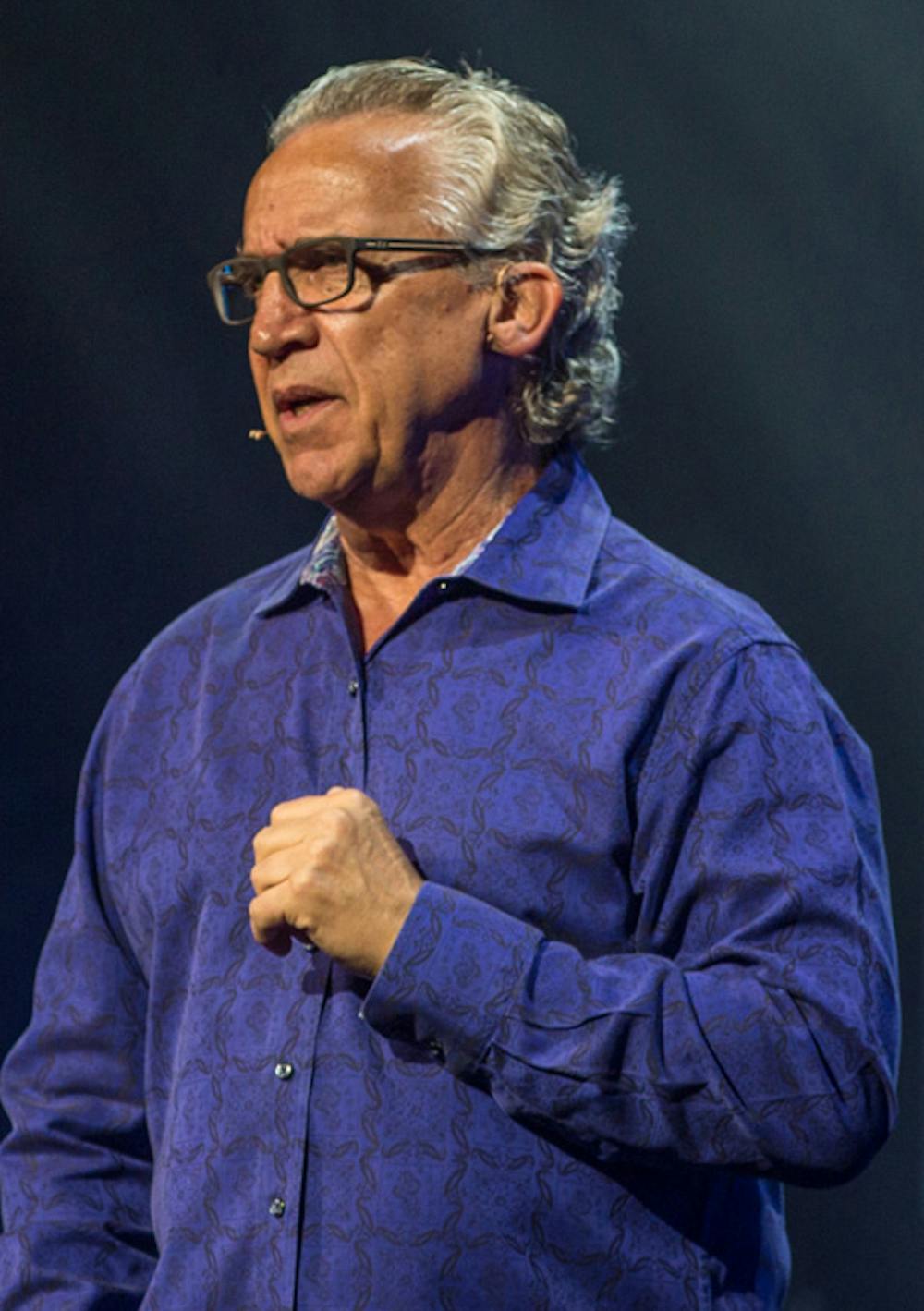
Since 1996, Bill Johnson, a senior leader of Bethel Church, and Johnny Enlow, a self-described prophet and Seven Mountains advocate, among others, have taken the original idea of the Seven Mountains Mandate and reshaped it into a more aggressive, political and spiritually militant approach. Spiritual militancy reflects an aggressive, us-vs.-them mindset that blurs the line between faith and authoritarianism, promoting dominion over society in the name of spiritual warfare.
Their version doesn’t just aim to influence culture; it frames the effort as a spiritual battle to reclaim and reshape the nation according to their vision of God’s will.
Lance Wallnau, another Christian evangelical preacher, televangelist, speaker and author, has promoted dominion theology since the early 2000s. During the 2020 U.S. presidential election, Wallnau, along with several prominent NAR figures, described Donald Trump as anointed by God to reclaim the “mountain” of government from demonic control.
In their book “Invading Babylon: The 7 Mountains Mandate,” Wallnau and Johnson explicitly call for Christian leadership as the only antidote to perceived moral decay and spiritual darkness.
NAR-aligned leaders have framed electoral contests as struggles between “godly” candidates and those under the sway of “satanic” influence.
Similarly, NAR prophet Cindy Jacobs has repeatedly emphasized the need for “spiritual warfare” in schools to combat what she characterizes as “demonic ideologies” such as sex education, LGBTQ+ inclusion or discussions of systemic racism.
In the NAR worldview, cultural change is not merely political or social but considered a supernatural mission; opponents are not simply wrong but possibly under the sway of demonic influence. Elections become spiritual battles.
This belief system views pluralism as weakness, compromise as betrayal, and coexistence as capitulation. Frederick Clarkson, a senior research analyst at Political Research Associates, a progressive think tank based in Somerville, Massachusetts, defines the Seven Mountains Mandate as “the theocratic idea that Christians are called by God to exercise dominion over every aspect of society by taking control of political and cultural institutions.”
The call to “take back” the culture is not metaphorical but literal, and believers are encouraged to see themselves as soldiers in a holy war to dominate society. Some critics argue that NAR’s call to “take back” culture is about literal domination, but this interpretation is contested.
Many within the movement see the language of warfare as spiritually focused on prayer, evangelism and influencing hearts and minds. Still, the line between metaphor and mandate can blur, especially when rhetoric about “dominion” intersects with political and cultural action. That tension is part of an ongoing debate both within and outside the movement.
At the same time, the Seven Mountains Mandate doesn’t depend on centralized leadership or formal institutions. It spreads organically through social networks, social media – notably podcasts and livestreams – and revivalist meetings and workshops.
André Gagné, a theologian and author of “American Evangelicals for Trump: Dominion, Spiritual Warfare, and the End Times,” writes about the ways in which the mandate spreads by empowering local leaders and believers. Individuals are authorized – often through teachings on spiritual warfare, prophetic gifting, and apostolic leadership – to see themselves as agents of divine transformation in society, called to reclaim the “mountains,” such as government, media and education, for God’s kingdom.
This approach, Gagné explains, allows different communities to adapt the action mandate to their unique cultural, political and social contexts. It encourages individuals to see themselves as spiritual warriors and leaders in their domains – whether in business, education, government, media or the arts.
The framing of the Seven Mountains Mandate as a divinely inspired mission, combined with the movement’s emphasis on direct spiritual experiences and a specific interpretation of scripture, can create an environment where questioning the mandate is perceived as challenging God’s authority.
Slippery slope
These beliefs have increasingly fused with nationalist rhetoric and conspiracy theories.
The ‘Appeal to Heaven’ flags symbolize the belief that people have the right to appeal directly to God’s authority when they think the government has failed. Paul Becker/Becker1999 via Flickr, CC BY
A powerful example of NAR political rhetoric in action is the rise and influence of the “Appeal to Heaven” flags. For those in the New Apostolic Reformation, these flags symbolize the belief that when all earthly authority fails, people have the right to appeal directly to God’s authority to justify resistance.
To be clear, its leaders are not calling for violence but rather for direct political engagement and protest. For some believers, however, the calls for “spiritual warfare” may become a slippery slope into justification for violence, as in the case of the alleged Minnesota shooter.
Understanding the Seven Mountains Mandate is essential for grasping the dynamics of contemporary efforts to align government and culture with a particular vision of Christian authority and influence.
As you have probably seen, Attorney General Pam Bondi has announced that there’s no there there with the whole Jeff Epstein saga: no list, no hidden group of the world’s most powerful men having sex with minors, no prostitution ring, etc. etc. etc. Of course MAGA has gone into paroxysms with claims that Bondi, Kash Patel and Dan Bongino may be part of the Deep State themselves. I confess to as much schadenfreude as the next red blooded American seeing MAGA eat itself alive over this latest turn of the conspiracy theory. But is it possible that none of this stuff was ever true in the first place or that it’s perhaps been wildly exaggerated?
There are several layers to my conclusion that today’s remarks from President Trump’s agriculture secretary are among the most creatively maniacal I’ve heard yet from the administration.