A bit of professional disappointment since we were also tipped about this and were hoping to get on it tomorrow. (D’oh!) But the Washington Post beat us to it. The gist is what’s important. Eric Schnabel, the chief operating office of the National Institutes of Health (NIH) — ground-zero of the Trump war on science research -— was fired and literally escorted off the premises yesterday apparently directing a hefty sole-source contract to a company which employs his wife. It seems Trish Duffy Schnabel often goes by her maiden name and he may have thought that was strong enough OpSec to get away with it.
Schnabel, a 25 year Army vet, had always raised concern and harrumphs within the non-toady echelon at NIH because he apparently had no scientific or biomedical background, despite science and biomedicine playing a rather large role in the NIH brief.
President Trump has reportedly been calling some of the highest profile and, typically, most loyal MAGA influencers in recent days to tell them to stop talking about the infamous Epstein files and his administration’s botched handling of their release. This comes as more and more Republicans in Congress try to walk a tightrope, supporting the president while also not saying anything that might upset the online hordes of Trump supporters whose votes they need.
Is it a harmonic convergence? Is the Rep. Corey Mills (R-FL) alleged assault case finally coming into focus? Let me try to explain the moving parts here. Remember back in February, D.C. police went to home of Mills responding to reports that he had assaulted a woman who D.C. publications delicately noted was not his wife. Prosecuting something like this in D.C. is in the hands of the U.S. Attorney for D.C., who, at the time, was Jan. 6 attorney Ed Martin. Through some mix of Martin doing Mills a solid and the D.C. police spoiling the case because of who Mills was, charges were never brought. So, big win for Mills, as D.C. goes. You can’t be charged with a crime in Washington, D.C. if you’re a Republican these days. I don’t make the rules.
Last night, Daily Beast reporter Roger Sollenberger posted on Twitter that Mills is being evicted from his D.C. apartment on which he owes $85,000. The rent is $20,833 a month.
Senate Republicans will tweak President Donald Trump’s $9.4 billion rescission request — the White House’s attempt to give a figleaf of legitimacy to the Department of Government Efficiency’s rampage through the federal government — in order to get key Senate GOP holdouts onboard.
This story first appeared at ProPublica, a Pulitzer Prize-winning investigative newsroom. Sign up for The Big Story newsletter to receive stories like this one in your inbox.
The Internal Revenue Service is building a computer program that would give deportation officers unprecedented access to confidential tax data.
ProPublica has obtained a blueprint of the system, which would create an “on demand” process allowing Immigration and Customs Enforcement to obtain the home addresses of people it’s seeking to deport.
Last month, in a previously undisclosed dispute, the acting general counsel at the IRS, Andrew De Mello, refused to turn over the addresses of 7.3 million taxpayers sought by ICE. In an email obtained by ProPublica, De Mello said he had identified multiple legal “deficiencies” in the agency’s request.
Two days later, on June 27, De Mello was forced out of his job, people familiar with the dispute said. The addresses have not yet been released to ICE. De Mello did not respond to requests for comment, and the administration did not address questions sent by ProPublica about his departure.
The Department of Government Efficiency began pushing the IRS to provide taxpayer data to immigration agents soon after President Donald Trump took office. The tax agency’s acting general counsel refused and was replaced by De Mello, who Trump administration officials viewed as more willing to carry out the president’s agenda. Soon after, the Department of Homeland Security, ICE’s parent agency, and the IRS negotiated a “memorandum of understanding” that included specific legal guardrails to safeguard taxpayers’ private information.
In his email, De Mello said ICE’s request for millions of records did not meet those requirements, which include having a written assurance that each taxpayer whose address is being sought was under active criminal investigation.
“There’s just no way ICE has 7 million real criminal investigations, that’s a fantasy,” said a former senior IRS official who had been advising the agency on this issue. The demands from the DHS were “unprecedented,” the official added, saying the agency was pressing the IRS to do what amounted to “a big data dump.”
In the past, when law enforcement sought IRS data to support its investigations, agencies would give the IRS the full legal name of the target, an address on file and an explanation of why the information was relevant to a criminal inquiry. Such requests rarely involved more than a dozen people at a time, former IRS officials said.
Danny Werfel, IRS commissioner during the Biden administration, said the privacy laws allowing federal investigators to obtain taxpayer data have never “been read to open the door to the sharing of thousands, tens of thousands, or hundreds of thousands of tax records for a broad-based enforcement initiative.”
A spokesperson for the White House said the planned use of IRS data was legal and a means of fulfilling Trump’s campaign pledge to carry out mass deportations of “illegal criminal aliens.”
Taxpayer data is among the most confidential in the federal government and is protected by strict privacy laws, which have historically limited its transfer to law enforcement and other government agencies. Unauthorized disclosure of taxpayer return information is a felony that can carry a penalty of up to five years in prison.
The system that the IRS is now creating would give ICE automated access to home addresses en masse, limiting the ability of IRS officials to consider the legality of transfers. IRS insiders who reviewed a copy of the blueprint said it could result in immigration agents raiding wrong or outdated addresses.
“If this program is implemented in its current form, it’s extremely likely that incorrect addresses will be given to DHS and individuals will be wrongly targeted,” said an IRS engineer who examined the blueprints and who, like other officials, spoke on condition of anonymity for fear of retribution.
The dispute that ended in De Mello’s ouster was the culmination of months of pressure on the IRS to turn over massive amounts of data in ways that would redefine the relationship between the agency and law enforcement and reduce taxpayers’ privacy, records and interviews show.
In one meeting in late March between senior IRS and DHS officials, a top ICE official made a suggestion: Why doesn’t Homeland Security simply provide the name and state of its targets and have the IRS return the addresses of everyone who matches that criteria?
The IRS lawyers were stunned. They feared they could face criminal liability if they handed over the addresses of individuals who were not under a criminal investigation. The conversation and news of deeper collaboration with ICE so disturbed career staff that it led to a series of departures in late March and early April across the IRS’ legal, IT and privacy offices.
They were “pushing the boundaries of the law,” one official said. “Everyone at IRS felt the same way.”
The Blueprint
The technical blueprint obtained by ProPublica shows that engineers at the agency are preparing to give DHS what it wants: a system that enables massive automated data sharing. The goal is to launch the new system before the end of July, two people familiar with the matter said.
The DHS effort to obtain IRS data comes as top immigration enforcement leaders face escalating White House pressure to deport some 3,000 people per day, according to reports.
One federal agent tasked with assisting ICE on deportations said recent operations have been hamstrung by outdated addresses. Better information could dramatically speed up arrests. “Some of the leads that they were giving us were old,” said the agent, who spoke on condition of anonymity because he was not authorized to speak with the press. “They’re like from two administrations ago.”
In early March, immigrants rights groups sued the IRS hoping to block the plan, arguing that the memorandum of understanding between DHS and the IRS is illegal. But a judge in early May ruled against them, saying the broader agreement complied with Section 6103, the existing law regulating IRS data sharing. That opened the door for engineers to begin building the system.
The judge did not address the technical blueprint, which didn’t exist at the time of the ruling. But the case is pending, which means the new system could still come under legal review.
Until now, little was known about the push and pull between the two agencies or the exact technical mechanics behind the arrangement.
The plan has been shrouded in secrecy even within the IRS, with details of its development withheld from regular communications. Several IRS engineers and lawyers have avoided working on the project out of concerns about personal legal risk.
Asked about the new system, a spokesperson for IRS parent agency the Treasury Department said the memorandum of understanding, often called an MOU, “has been litigated and determined to be a lawful application of Section 6103, which provides for information sharing by the IRS in precise circumstances associated with law enforcement requests.”
At a time when Trump is making threats to deport not only undocumented immigrants but also U.S. citizens, the scope of information-sharing with the IRS could continue to grow, according to documents reviewed by ProPublica and sources familiar with the matter: DHS has been looking for ways to expand the agreement that could allow Homeland Security officials to seek IRS data on Americans being investigated for various crimes.
Last month, an ICE attorney proposed updating the MOU to authorize new data requests on people “associated with criminal activities which may include United States citizens or lawful permanent residents,” according to a document seen by ProPublica. The status of this proposal is unclear. De Mello, at the time, rejected it and called for senior Treasury Department leadership to personally sign off on such a significant change.
The White House described DHS’ work with the IRS as a good-faith effort to identify and deport those who are living in the country illegally.
“ProPublica continues to degrade their already terrible reputation by suggesting we should turn a blind eye to criminal illegal aliens present in the United States for the sake of trying to collect tax payments from them,” White House spokesperson Abigail Jackson said in a statement after receiving questions about the blueprint from ProPublica.
She pointed to the April MOU as giving the government the authority to create the new system and added, “This isn’t a surveillance system. … It’s part of President Trump’s promise to carry out the mass deportation of criminal illegal aliens — the promise that the American people elected him on and he is committed to fulfilling.”
In a separate statement, a senior DHS official also cited the court’s approval of the MOU, saying that it “outlines a process to ensure that sensitive taxpayer information is protected while allowing law enforcement to effectively pursue criminal violations.”
How the System Works
The new system would represent a sea change, allowing law enforcement to request enormous swaths of confidential data in bulk through an automated, computerized process.
The system, according to the blueprint and interviews with IRS engineers, would work like this:
First, DHS would send the IRS a spreadsheet containing the names and previous addresses of the people it’s targeting. The request would include the date of a final removal order, a relevant criminal statute ICE is using to investigate the individual, and the tax period for which information is sought. If DHS fails to include any of this information, the system would reject the request.
The system then attempts to match the information provided by the DHS to a specific taxpayer identification number, which is the primary method by which the IRS identifies an individual in its databases.
If the system makes a match, it accesses the individual’s associated tax file and pulls the address listed during the most recent tax period. Then the system would produce a new spreadsheet enriched with taxpayer data that contains DHS’ targets’ last known addresses. The spreadsheet would include a record of names rejected for lack of required information and names for which it could not make a match.
Tax and privacy experts say they worry about how such a powerful yet crude platform could make dangerous mistakes. Because the search starts with a name instead of a taxpayer identification number, it risks returning the address of an innocent person with the same name as or a similar address to that of one of ICE’s targets. The proposed system assumes the data provided by DHS is accurate and that each targeted individual is the subject of a valid criminal investigation. In effect, the IRS has no way to independently check the bases of these requests, experts told ProPublica.
In addition, the blueprint does not limit the amount of data that can be transferred or how often DHS can request it. The system could easily be expanded to acquire all the information the IRS holds on taxpayers, said technical experts and IRS engineers who reviewed the documents. By shifting a single parameter, the program could return more information than just a target’s address, said an engineer familiar with the plan, including employer and familial relationships.
Engineers based at IRS offices in Lanham, Maryland, and Dallas are developing the blueprint.
“Gone Back on Its Word”
For decades, the American government has encouraged everyone who makes an income in the U.S. to pay taxes — regardless of immigration status — with an implicit promise that their information would be protected. Now that same data may be used to locate and deport noncitizens.
“For years, the IRS has told immigrants that it only cares that they pay their taxes,” said Nandan Joshi, an attorney with the Public Citizen Litigation Group, which is seeking to block the data-sharing agreement in federal court. “By agreeing to share taxpayer data with ICE on a mass basis, the IRS has gone back on its word.”
The push to share IRS data with DHS emerged while Elon Musk’s DOGE reshaped the engineering staff of the IRS. Sam Corcos, a Silicon Valley startup founder with no government experience, pushed out more than 50 IRS engineers and restructured the agency’s engineering priorities while he was the senior DOGE official at the agency. He later became chief information officer at Treasury. He has also led a separate IRS effort to create a master database using products from Silicon Valley giant Palantir Technologies, enabling the government to link and search large swaths of data.
Corcos didn’t respond to a request for comment. The White House said DOGE is not part of the DHS-IRS pact.
Sen. Ron Wyden, the ranking Democrat on the Senate Committee on Finance, which oversees the IRS, told ProPublica the system being built was ripe for abuse. It “would allow an outside agency unprecedented access to IRS records for reasons that have nothing to do with tax administration, opening the door to endless fishing expeditions,” he said.
The Treasury Inspector General for Tax Administration, the department’s internal watchdog, is already probing efforts by Trump and DOGEto obtain private taxpayer data and other sensitive information, ProPublica reported in April.
The Trump administration continues to add government agencies to its deportation drive.
DOGE and DHS are also working to build a national citizenship database, NPR reported last month. The database links information from the Social Security Administration and the DHS, ostensibly for the purpose of allowing state and local election officials to verify U.S. citizenship.
And in May, a senior Treasury Department official directed 250 IRS criminal investigative agents to help deportation operations, a significant shift for two agencies that historically have had separate missions.
Because the final version of the legislation moved swiftly through the Senate and the House, estimates regarding the number of people likely to lose their health insurance coverage were incomplete when Congress approved it by razor-thin margins. Nearly 12 million Americans could lose their health insurance coverage by 2034 due to this legislation, according to the nonpartisan Congressional Budget Office.
Work requirements target people eligible for Medicaid through the Affordable Care Act’s expansion. They tend to have slightly higher incomes than other people enrolled in the program.
Medicaid applicants who are between 19 and 64 years old will need to certify they are working at least 80 hours a month or spending that much time engaged in comparable activities, such as community service.
When these rules have been introduced to other safety net programs, most people lost their benefits due to administrative hassles, not because they weren’t logging enough hours on the job. Experts like me expect to see that occur with Medicaid too.
Many of those who aren’t kicked out of Medicaid would also face new copayments of up to $35 for appointments and procedures — making them less likely to seek care, even if they still have health insurance.
And an additional 1.4 million would lose coverage because they may not meet new citizenship or immigration requirements.
In total, these changes to Medicaid would lead to more than 8 million people becoming uninsured by 2034.
The new policies also make it harder for states to pay for Medicaid, which is run by the federal government and the states. They do so by limiting the taxes states charge medical providers, which are used to fund the states’ share of Medicaid funding. With less funding, some states may try to reduce enrollment or cut benefits, such as home-based health care, in the future.
Losing Medicaid coverage may leave millions of low-income Americans without insurance coverage, with no affordable alternatives for health care. Historically, the people who are most likely to lose their benefits are low-income people of color or immigrants who do not speak English well.
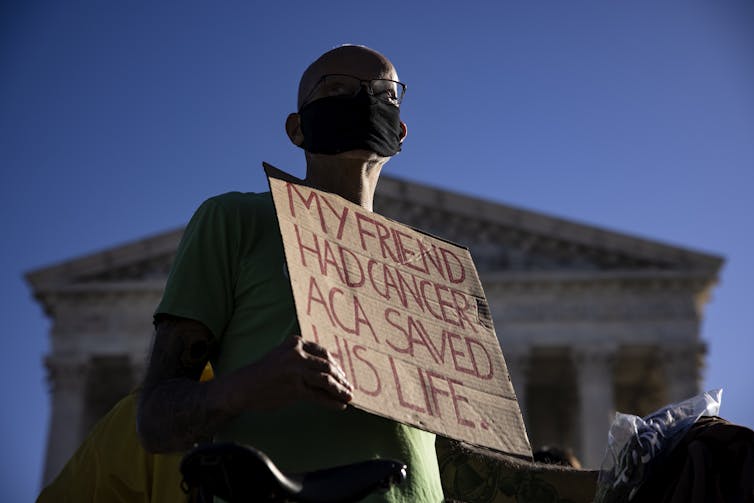
A supporter of the Affordable Care Act stands in front of the Supreme Court building on Nov. 10, 2020. Samuel Corum/Getty Images
Should they exit, there would be fewer choices and higher premiums for people getting their insurance this way. It could also mean that some counties could have no ACA plans offered at all.
Ramifications for the uninsured and rural hospitals
Having to struggle to pay the kinds of high medical bills people without insurance face takes a physical, mental and financial toll, not just on people who become uninsured but also their families and friends. It also harms medical providers that don’t get reimbursed for their care.
Public health scholars like me have no doubt that many hospitals and other health care providers will have to make tough choices. Some will close. Others will offer fewer services and fire health care workers. Emergency room wait times will increase for everyone, not just people who lose their health insurance due to changes in Trump’s tax and spending package. https://www.youtube.com/embed/BVpTQLw_QRQ?wmode=transparent&start=0 Rural hospitals play a crucial role in health care access.
Republicans tried to protect rural hospitals by designating $50 billion in the legislative package for them over 10 years. But this funding comes nowhere near the $155 billion in losses KFF expects those health care providers to incur due to Medicaid cuts. Also, the funding comes with a number of restrictions that could further limit its effectiveness.
What’s next
Some Republicans, including Sens. Mike Crapo and Ron Johnson, have already indicated that more health care policy changes could be coming in another large legislative package.
Moving forward, spending on Medicare, the insurance program that primarily covers Americans 65 and older, could decline too. Without any further action, the CBO says that the law could trigger an estimated $500 billion in mandatory Medicare cuts from 2026 to 2034 because of the trillions of dollars in new federal debt the law creates.
The D.C. Circuit Court of Appeals has slow-rolled a contempt of court inquiry into the Trump administration for so long that the alleged culprit for the contemptuous conduct has been nominated to an appeals court seat, had his confirmation hearing, and is now on the verge of being confirmed.
Emil Bove — the Trump personal lawyer turned Trump Justice Department official — has emerged as the key figure who allegedly issued the orders in the original Alien Enemies Act (AEA) case that led U.S. District Judge James Boasberg to find probable cause for contempt of court. It was Bove who allegedly said that DOJ may have to consider pushing forward with the AEA deportations by telling the courts “Fuck you.” Bove’s nomination to a lifetime seat on the bench is set for a vote Thursday morning before the Senate Judiciary Committee.
The DC appeals court — a three-judge panel composed of Trump appointees Gregory Katsas and Neomi Rao and Obama appointee Cornelia Pillard (who opposed the move) — placed an administrative stay on Boasberg’s contempt proceedings way back on April 18. What is usually supposed to be a short-term pause in the case has now dragged on for nearly three months.
In that time, former DOJ career lawyer Erez Reuveni has revealed bombshell internal DOJ emails and texts. Those documents show that Bove, in his role as principal associate deputy attorney general, gave the green light for continuing with the March 15 removals of Venezuelan nationals to CECOT in El Salvador under the Alien Enemies Act in spite of Boasberg’s order blocking the deportations and directing the planes carrying the detainees to turn around. (For his part, Bove denies violating any court orders, and the Justice Department has made the preposterous argument that Boasberg’s written order didn’t include the direction to turn the planes around and that trumped his oral demand that they do so.)
In slow-rolling the contempt inquiry, the DC appeals court hasn’t just enabled Bove (who has engaged in other egregious conduct at DOJ). It has hung Boasberg out to dry, done nothing to staunch the Trump administration’s blatant defiance of court orders in other cases, and has left the judicial branch more exposed to a rogue executive determined to expand his power at the expense of the judiciary.
District courts have done a lot of hard work in trying to rein in Trump’s lawless rampage, but they have been failed repeatedly by higher courts. Few examples stand out as starkly as what the D.C. appeals court has done to hamstring Boasberg and the rule of law in the Alien Enemies Act case.
Profiles in Courage
The Justice Department’s Federal Programs Branch — which defends legal challenges to administration policies — has lost nearly two-thirds of its staff under President Trump, Reuters reports: “The seven lawyers who spoke with Reuters cited a punishing workload and the need to defend policies that some felt were not legally justifiable among the key reasons for the wave of departures.”
100% Not Normal
The federal judges in the Northern District of New York have declined to extend the appointment of interim U.S. Attorney John A. Sarcone III, who has emerged among the many Trump interim U.S. attorneys as a particularly ridiculous figure. Sarcone failed to win appointment by the district’s judges after he previously announced, apparently falsely, that they had extended his appointment. District judges can appoint U.S. attorneys in some circumstances under the Vacancy Reform Act.
TPM Journalism Fund Drive Kicks Off Today!
A quick note from me to ask for your support this year for the TPM Journalism Fund. We’re kicking off the annual drive today, and we’re already off to a roaring start toward our goal of $500,000.
We intend to keep Morning Memo free and open to non-members, but we can’t do it without your support. We offer several ways to sustain TPM financially: buy a membership or contribute to the Journalism Fund — or both! We’re offering a special discount on memberships right now, so if you’re not in a position to contribute to the Journalism Fund, you can become a member for only $25.
I’ll have more to say in the coming days about the current historic moment, the collapse of journalism and publishing, and the community we’ve built here specifically to navigate rough waters together like we’re encountering right now in our politics. But for now thanks for your support if you’ve already given. And please consider becoming a member and/or contributing to the TPM Journalism Fund. We appreciate you!
Mass Deportation Alert: Sweeping New Detention Policy
The Trump administration has abruptly changed policy and exposed millions of undocumented immigrants to prolonged detention as they fight deportation, a process that usually takes months or years.
The policy change of now deeming migrants who came to the country illegally as ineligible for a bond hearing to secure their release while their cases are heard came in a July 8 memo obtained by the WaPo:
Since the memos were issued last week, the American Immigration Lawyers Association said members had reported that immigrants were being denied bond hearings in more than a dozen immigration courts across the United States, including in New York, Virginia, Oregon, North Carolina, Ohio and Georgia. The Department of Justice oversees the immigration courts.
The new policy dramatically widens the pool of undocumented immigrants subject to detention no matter how long they have lived in this country.
Another Devastating Supreme Court Decision
The Supreme Court cleared the way for the Trump administration to use mass layoffs to dismantle the Department of Education. The decision came without explanation on the court’s emergency docket. Of the 17 emergency applications to the high court from the Trump administration, it has ruled on 15 – and all 15 rulings have been in Trump’s favor, Georgetown law professor Steve Vladeck notes.
The three liberal justices joined in a powerful dissent by Justice Sonia Sotomayor:
When the Executive publicly announces its intent to break the law, and then executes on that promise, it is the Judiciary’s duty to check that lawlessness, not expedite it. Two lower courts rose to the occasion, preliminarily enjoining the mass firings while the litigation remains ongoing. Rather than maintain the status quo, however, this Court now intervenes, lifting the injunction and permitting the Government to proceed with dismantling the Department. That decision is indefensible. It hands the Executive the power to repeal statutes by firing all those necessary to carry them out. The majority is either willfully blind to the implications of its ruling or naive, but either way the threat to our Constitution’s separation of powers is grave. Unable to join in this misuse of our emergency docket, I respectfully dissent.
In related news, 24 states and DC have sued the administration to try to unfreeze nearly $7 billion in education funding that they were due to receive on July 1. The funding freeze is already adversely impacting school and provider budgets that relied on the federal monies.
The Purges: Crippling Gov’t Capacity Edition
CNN: Thousands of HHS employees across its numerous agencies were terminated by email Monday afternoon in a planned purge that had been held up for some by court rulings adverse to the Trump administration.
Nature: In an unprecedented move, NIH is disinviting dozens of scientists who were nominated during the Biden administration from taking their positions on advisory councils that make final decisions on grant applications for the agency.
NBC News: Veteran diplomats baffled by the mass layoffs of more than 1,300 State Department employees, about 15% of its domestic workforce.
Hegseth Probes Zero In on His Aide and Lawyer
Two separate internal Pentagon probes of Defense Secretary Pete Hegseth’s use of Signal group chats and handling of classified material has focused on his senior aide, Ricky Buria, and his personal attorney, Tim Parlatore, Politico reports.
Quote of the Day
“Bondi is in a great headspace.” – an unnamed DOJ official speaking about the attorney general’s feelings on the Jeffrey Epstein memo controversy
While the Democratic Party by and large has, in recent years, kept its distance from the conspiracy theories related to the death of convicted sex offender Jeffrey Epstein, individual lawmakers and party officials are now leaping into the rift forming over the saga within the MAGA movement, and attempting to stoke the infighting.
This article is part of TPM Cafe, TPM’s home for opinion and news analysis. It was originally published at The Conversation.
After much back-and-forth over several months, President Donald Trump announced on July 9, 2025, that he planned to levy a 50% tariff on Brazilian exports to the United States. While Brazilian authorities, along with leaders of most other countries, have been expecting new tariffs given their centrality to Trump’s economic agenda, the announcement seemingly caught Brazilian officials off guard, as trade negotiations between the two nations were still ongoing.
Brazil President Lula da Silva was quick in reacting, stating his country could respond in kind, if tariffs indeed come into effect on Aug. 1.
There has been much speculation about the reasons behind Trump’s decision and timing, with some onlookers noting the proximity to the recent meeting of the BRICS nations, a grouping of emerging economies, including Brazil, which had already drawn Trump’s ire. Others argued that this was a protective measure to defend key U.S. industries, such as steel, which have been facing continued difficulties against cheaper products from Brazil.
The clearest answer, however, came from Trump himself.
In a letter to Lula, the U.S. president indicated that his main grievance with Brazil is in fact the trial that former Brazilian President Jair Bolsonaro faces in front of that country’s highest court. The former far-right firebrand is charged for refusing to recognize the result of the last presidential election in October 2022 and for allegedly having led an attempted coup against the democratic institutions and rule of law in January 2023. If convicted, Bolsonaro and some of his closest associates could face long prison sentences.
A history of meddling
The only economic rationale mentioned in Trump’s letter, that of a deficit that his country is said to face with Brazil, is belied by the numbers. The U.S. has sustained consistent surpluses in trade with the South American nation for close to two decades now.
And Steve Bannon, Trump’s former adviser, active cheerleader and primary conduit between the Trump camp and Bolsonaro, was even more blunt than the U.S. president. In an interview with one of Brazil’s main news site, he stated: “Stop the trial and we will reverse the tariffs.”
As the history of U.S.-Latin American relations ably demonstrates, this is far from the first time Washington has meddled in the region in order to satisfy its own political proclivities. Indeed, particularly during the Cold War, a slew of U.S. decision-makers actively intervened to support friendly right-wing regimes or to otherwise remove from power administrations considered unacceptably independent.
This was nonetheless the first time in recent history that the official U.S. position is that a foreign nation should face harsh economic punishment unless its current government illegally circumvent the judicary’s constitutional role to stop a major investigation against someone accused of high crimes.
Trump-Bolsonaro: Mutual admiration
Of course, Trump’s overt support for Bolsonaro is not surprising, nor new. Their relationship of mutual admiration and ideological affinity hearkens back to the latter’s first presidential campaign in 2018, when he was labeled, to great reciprocal delight, the “Trump of the Tropics.”
During the subsequent two years when their terms coincided (2019-2000), both men pledged to have a mutual special relationship, though to little consequence – no consequential bilateral projects were put in place.
Both leaders also share the experience of having failed to obtain a second consecutive term and having supported the derailment of the peaceful transfer of power.
Now that Trump is back in power, Bolsonaro hopes that the U.S. president will come to his rescue.
Seeking to obtain explicit support, Bolsonaro’s third son, Eduardo, a member of Brazil’s lower house of congress and his family’s most eloquent international voice, took a leave from his legislative duties and moved to the U.S. early this year. He did so to lobby on behalf of his father based on the fallacious argument that Lula is a left-wing dictator, that Bolsonaro faces a politically motivated trial, and that the U.S. government should act against Lula’s administration.
Given Trump’s tariff notice and the explicit reasons he gave for it, it seems safe to assume that Eduardo’s actions paid dividends.
Which direction will Brazil head?
Like the U.S., Brazil is deeply fractured along left and right political lines. So it was no surprise that the local reactions to Trump’s announcement manifested along ideological camps.
Despite their leader’s legal travails, Bolsonaro’s supporters remain very influential in politics, the media and among important economic areas, such as the agribusiness sector. Whether Trump’s decision will serve to help people rally around and in support of Lula and against a case of foreign interference is unclear. Lula’s initial pronouncement that Brazil would respond in kind was seen favorably among his supporters, though the opposition and many in the media pinned the blame on Lula for not being able to forge compromise with the Trump administration.
Key industrialists in the powerful state of Sao Paulo, where Bolsonaro’s powerful ally Tarcisio de Freitas serves as governor, will be the first ones affected by the new tariffs. But the pain will likely spread into other activities, including in the countryside.
And given that the bulk of the country’s agricultural exports go to China rather than to the U.S., the important question is whether these powerful exporters will act pragmatically and work with Lula to enlarge trade with the Asian giant and other countries, or whether they will continue to act ideologically and continue to support Bolsonaro’s enduring partnership with Trump against their own economic interests.
Dialogue has been a hallmark of Brazil’s diplomacy, and even in the middle of these latest heated diplomatic exchanges, Lula reiterated his willingness to negotiate. It is unclear, though, whether the Trump adminstration’s actions in Latin America will be conducted on the basis of rationality and actual numbers, or if they will indeed bring back some old ideologically driven behaviors of picking sides in the internal political disputes of foreign nations. Should one consider at face value Trump’s latest letter, there is reason for concern.
So I mentioned in today’s BackChannel that it kind of beggared belief we were only hearing about these Wolff/Epstein interview tapes and their contents now. But then I heard from TPM Reader MH who said he remembered hearing some of the tapes. What? Readers get so confused. But then MH comes up with a link and it turns out the Daily Beast actually had a lot of this from Wolff and actually snippets of the audio tapes themselves. That came out just a few days before the 2024 election. Then I heard from TPM Reader JW about a podcast Wolff was doing at the time that went into the same stuff. (Okay, so part of my theory or reason for caution is out, I guess.) From what I can tell, all of this was sort of lost in the mad rush of the final days before the election and sort of became moot after it. In the standard way, the campaign said it was fake news and “election interference” and that was kind of it.
All this said, the Epstein wildfire engulfing MAGA just continues apace.