


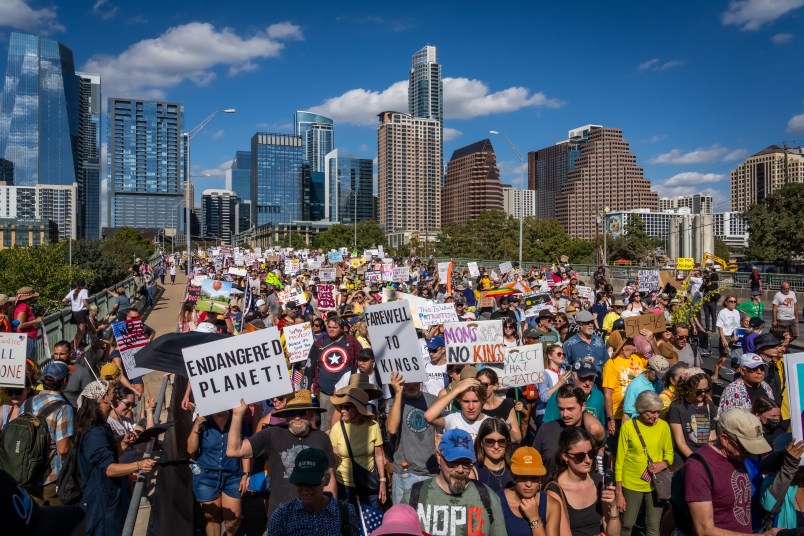
The turnout and character of the weekend’s No Kings demonstrations speak for themselves and at great volume. But I wanted to say something about the naming and the focus of No Kings, which is emerging as something between a protest and a protest movement. It is a great good fortune for the country and the anti-Trump opposition that it has emerged in the way that it has, by which I mean the name itself, a deceptively resonant name and slogan with the deepest possible roots in American history. This brings with it a critical inclusivity, which grows out of the name itself and the lack of those specific and lengthy sets of demands that often characterize and ultimately fracture such movements.
I’ll say a few things here that favorably distinguish No Kings from what we might call “traditional” liberal or left-leaning protests. That includes some of those that featured prominently during the first Trump administration. I’m not disparaging those. It’s simply that this is a specific moment in history and requires an especially broad tent. Its purpose and specific character must be different.
When I say “broad tent” there I’m sure it raises some people’s hackles, with the idea of watering down opposition or questing after inoffensiveness and notional median voters. But that’s the cleverness and the deft nature of the message. Is No Kings about the politicized Justice Department? Or violent ICE paramilitaries and Kavanaugh stops? Or a dictatorial presidency? Or gutting and corrupting the civil service? Or election rigging? Or military invasions of American cities? Or the flagrant corruption we see across all the Trump administration? It’s about all of it. And if there are some parts of it that are more important to you than others, that’s fine.
The jagged and total nature of the onslaught against the American Republic creates a clarity: We all know what we’re talking about. You don’t need to explain. The imperfect but orderly and generally lawful old way versus this. And when you say “No Kings,” you’re saying I don’t want this. I don’t accept presidential despotism. I’m here ready to show my face and say publicly that I will never accept it.
Even when I say “the old way” I can feel all those hoary and sectarian arguments threatening to rush forth and trample the moment. Was the “old way” really good? Is that “old way” enough? Wasn’t the old way sliding inevitably into this new way? Can we really say that Trumpism is new? Weren’t the roots of this always there? Wasn’t it ever thus? Yes, and.
There is both a truth and a logic to rooting opposition to Trumpism in the oldest political ideas baked into American civic culture. It is a collateral, a potent weapon that anyone would be a fool not to use as a tool to oppose Trumpism because Trumpism is so inimical to almost all the civic ideas, if not always the reality, most deeply embedded in American civic and political culture. Anyone who has ever read the Federalist Papers knows that anywhere between a third and a half of them are about Donald Trump. All the rhetoric and ideational world of the Revolutionary period and the second revolution of the Civil War rejects in a virtuous and unceremonious peristalsis the images of toadyism and sycophancy that are at the heart of the MAGA world. How could you not lean into that advantage? Those disagreements about America’s past or its future are real and ripe for discussion. The power of No Kings is that it makes them all secondary to the crisis of the moment and pulls a broad majority of the country into opposing this.
It is an inclusiveness and broad-tentedness that manages to be both elastic and uncompromising. That’s rooted in the signature message.
I don’t know if the phrase No Kings caught on before the demonstrations were organized around it. My understanding is that Indivisible (an absolutely essential organization that is far more influential and critical than you may even realize) took the lead in bringing it together and then partnered with other well-known progressive or liberal organizations in bringing it to fruition.
No Kings has prioritized what we might call an orderly and normie vibe to their events. They’ve also put a focus on deescalation techniques to avoid events either being infiltrated by troublemakers, or knocked off the rails by people who prefer a different kind of protest culture, or simply getting overheated in the way that can happen when you get tens of thousands of people together. In our last podcast, Kate Riga and I talked about what role this plays in peoples’ impression of the protests, how they appear to non-participants and those floating uncommitted voters who will determine the future. In this kind of environment, there is obviously a big plus to providing no avenues or excuses for MAGA to demonize the opposition or present it as dangerous or as a threat. Trump’s lackeys on Capitol Hill ended up looking absurd with all their claims about “hate America rallies” and “pro-terrorist Democrats.” But there’s another part of the collective visuals that are even more important.
The No Kings demonstrations speak for themselves by their breadth and size, and just as much the fact that millions of Americans are perfectly willing and ready to stand in public saying they won’t stand for this. They’re unbowed and their numbers are massive. They stand squarely in the most formative and basic traditions of the American Republic: no Kings. They make clear that Donald Trump’s conquest of the American Republic is far from complete and is in fact unlikely to ultimately succeed.