In discussions of modern wars, Americans obsess about “exit strategies”. How do you avoid getting “bogged down?” How do you know when the mission is finished? How do you avoid “mission creep?” These are very much Great Power questions. They’re all questions you ask about what are fundamentally wars of choice. They’re framed as questions of duration and sustainability, questions a Great Power asks when there are likely multiple draws on blood or treasure in various parts of the world, fears of over-extension and over-commitment. Other countries don’t have the luxury of these kinds of questions; it’s built into the Great Power equation. Ukraine has no “exit strategy.” They’re being invaded. They’re fighting to control their own territory and sovereignty. In a way, at least if you place yourself in the world of Greater Russian nationalism where Vladimir Putin and his entourage live, Russia doesn’t have one either. They’re trying to reclaim “their” territory or something between a national and imperial possession. They’ll fight until they get it.
But talk of “exit strategies” is really a way of asking what the goals are that led you to start a war in the first place. If the goal of your military action is clear, your exit strategies should be straightforward. Indeed, you shouldn’t need a “strategy” at all. When your goals are met, you’re done and you leave. Or at least you stop using military force. If you know what your goal is, you fight until you’ve a) achieved your goal or b) realized through battlefield reverses that your goal is unattainable. If your goal is unclear, all the inherent forward momentum of superior military force drives you forward.
There are few modern wars in which the U.S. has launched an all-out war, which this certainly is, with so little clarity about what it is we are even trying to accomplish. The Iraq War of 2003 is certainly a pretty good example of that. But what we were trying to achieve in Iraq was comparatively clear: we wanted to topple the government of Saddam Hussein and replace it with another one. When the moment of invasion came in March 2003, really no one had any question that this was the only outcome the United States would accept. Just why that was so important was much, much fuzzier, and what kind of government we’d put in its place even more so. But the immediate goal of the war was clear: there was no way the U.S. would allow Hussein to remain in power.
How about here? We’re demanding now “unconditional surrender.” That appears to be our current war aim. But we’ve also said it’s eliminating Iran’s nuclear program, degrading its missile armory, creating an opening for a domestic opposition to take power, reacting to an imminent threat. Most notably, the U.S. doesn’t appear to be deploying the kind of force that has much chance of achieving this goal.
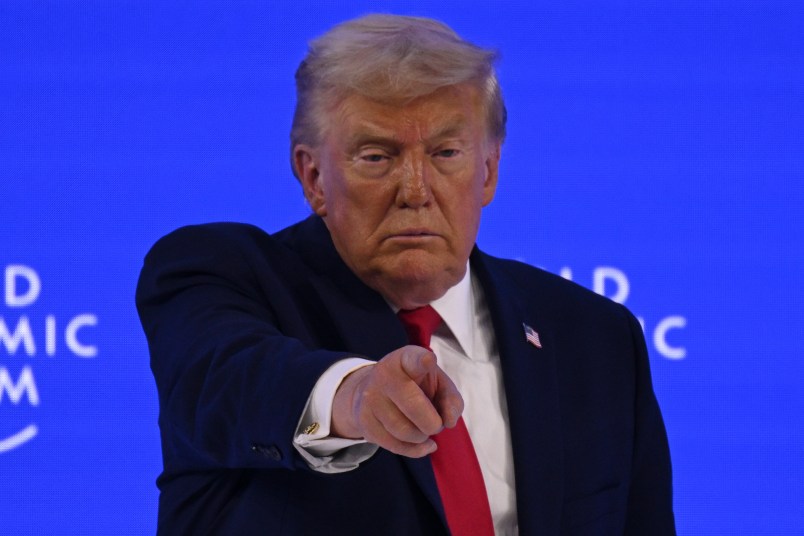
A friend of mine commented last night on just how little visibility we seem to have into any part of the war zone — just how little we’re seeing from inside Iran or also, in terms of missile hits, inside Israel. The private sector sources of satellite information have announced a 96-hour hold on imagery of damage to U.S. bases in the region. (If that’s a demand from the U.S. government, it’s an understandable one. But it leaves the public with even less visibility.) President Trump has made a series of increasingly totalizing demands which now appear to amount to unconditional surrender by the current government and an agreement to allow Trump to choose the future leader of Iran. (Notably, this approach to Trump’s electoral prerogative seems to assume a permanent leader, not someone elected by a future democratic government. Obvious, but worth saying out loud and tells you a lot. And Iran named Mojtaba Khamenei, son of killed Ayatollah Ali Khamenei, as Iran’s new supreme leader after Trump called him an “unacceptable choice.”) If our aim is really unconditional surrender and Iran becoming a U.S. vassal state, it sounds like any exit could be very far off.
And why is defining war aims so difficult? We’re not the first power to have difficulty with this. But it’s a product of the vastly superior military power the U.S. has enjoyed for going on 40 years — figure 1989-90 as the turning point. (Note to get your bearings: that that is approaching as long a period of time as the Cold War itself.) And before that, the U.S. was one of two Great Powers with that kind of military heft within its own sphere. When you have that kind of totally disproportionate military power, you don’t think as clearly about the specific goals you’re trying to achieve. There’s plenty more military power where that came from, so you can improvise. There’s not a huge amount of need, at the level of civilian decision-makers, to finely calibrate and align costs and goals. The resort to military force becomes more a consequence of frustration — national or presidential frustration — when some unacceptable behavior is defined, recognized and then not easily resolved. Like many physically strong people, if they can’t easily get what they want by asking, they resort to force.
That’s been a problem for the U.S. for a long time. It’s wildly more so when U.S. power is so tightly chained to the will and impulses of a single person. Trump started this war as part of the international acting-out he’s been at for the last few months, a way of compensating for reverses at home. If we look at his statements and U.S. actions leading up to the beginning of the war, the impulse or the goal seems simply to be in charge, for Iran to do what Trump says. He’s even stated explicitly that this should be going how it did in Venezuela, where the next in command steps forward and agrees to an indefinite period of vassalhood under not so much the U.S. but Donald Trump himself. What remains of the Iranian state leadership does not seem interested in that. But the desire to be in charge is more a characterological impulse than any kind of military goal. Indeed, it leaves the initiative all in the hands of the adversary. Only the other side can tell you when you’ve gotten what you want. The U.S. keeps fighting until Iran agrees Trump is in charge or the government falls and is replaced by someone who will say that. That’s not only a hard challenge. It’s also a classic example of goals military planners don’t like. You want something clear that you can achieve at your own initiative, without someone else having to agree to anything: blow up the base, occupy the country, cut off exports. These are concrete things a superior military force can achieve through its own actions. This war is probably just about Donald Trump being in charge. That’s not a clear or definable goal. It leaves the initiative in the hands of whoever currently controls the Iran state and military. It’s a recipe for unclarity.