DOJ Describes Plan To Denaturalize Citizens on Scale That Has Never Been Tried

This article is part of TPM Cafe, TPM’s home for opinion and news analysis. It was originally published at The Conversation.

The Trump administration wants to take away citizenship from naturalized Americans on a massive scale.

While a recent Justice Department memo prioritizes national security cases, it directs the department to “maximally pursue denaturalization proceedings in all cases permitted by law and supported by the evidence” across 10 broad priority categories.

Denaturalization is different from deportation, which removes noncitizens from the country. With civil denaturalization, the government files a lawsuit to strip people’s U.S. citizenship after they have become citizens, turning them back into noncitizens who can then be deported.

The government can only do this in specific situations. It must prove someone “illegally procured” citizenship by not meeting the requirements, or that they lied or hid important facts during the citizenship process.

The Trump administration’s “maximal enforcement” approach means pursuing any case where evidence might support taking away citizenship, regardless of priority level or strength of evidence. As our earlier research documented, this has already led to cases like that of Baljinder Singh, whose citizenship was revoked based on a name discrepancy that could easily have resulted from a translator’s error rather than intentional fraud.

A brief history

For most of American history, taking away citizenship has been rare. But it increased dramatically during the 1940s and 1950s during the Red Scare period characterized by intense suspicion of communism. The United States government targeted people it thought were communists or Nazi supporters. Between 1907 and 1967, over 22,000 Americans lost their citizenship this way.

Everything changed in 1967 when the Supreme Court decided Afroyim v. Rusk. The court said the government usually cannot take away citizenship without the person’s consent. It left open only cases involving fraud during the citizenship process.

After this decision, denaturalization became extremely rare. From 1968 to 2013, fewer than 150 people lost their citizenship, mostly war criminals who had hidden their past.

Senator Joseph McCarthy (R-WI) stokes the Red Scare during the 1950s. (Getty Images)

How the process works

In criminal lawsuits, defendants get free lawyers if they can’t afford one. They get jury trials. The government must prove guilt “beyond a reasonable doubt” — the highest standard of proof.

But in most denaturalization cases, the government files a civil suit, where none of these protections exist.

People facing denaturalization get no free lawyer, meaning poor defendants often face the government alone. There’s no jury trial — just a judge deciding whether someone deserves to remain American. The burden of proof is lower — “clear and convincing evidence” instead of “beyond a reasonable doubt.” Most important, there’s no time limit, so the government can go back decades to build cases.

As law professors who study citizenship, we believe this system violates basic constitutional rights.

The Supreme Court has called citizenship a fundamental right. Chief Justice Earl Warren in 1958 described it as the “right to have rights.”

In our reading of the law, taking away such a fundamental right through civil procedures that lack basic constitutional protection — no right to counsel for those who can’t afford it, no jury trial, and a lower burden of proof — seems to violate the due process of law required by the Constitution when the government seeks to deprive someone of their rights.

The bigger problem is what citizenship-stripping policy does to democracy.

When the government can strip citizenship from naturalized Americans for decades-old conduct through civil procedures with minimal due process protection — pursuing cases based on evidence that might not meet criminal standards — it undermines the security and permanence that citizenship is supposed to provide. This creates a system where naturalized citizens face ongoing vulnerability that can last their entire lives, potentially chilling their full participation in American democracy.

The Justice Department memo establishes 10 priority categories for denaturalization cases. They range from national security threats and war crimes to various forms of fraud, financial crimes and, most importantly, any other cases it deems “sufficiently important to pursue.” This “maximal enforcement” approach means pursuing not just clear cases of fraud, but also any case where evidence might support taking away citizenship, no matter how weak or old the evidence is.

This creates fear throughout immigrant communities.

About 20 million naturalized Americans now must worry that any mistake in their decades-old immigration paperwork could cost them their citizenship.

A two-tier system

This policy effectively creates two different types of American citizens. Native-born Americans never have to worry about losing their citizenship, no matter what they do. But naturalized Americans face ongoing vulnerability that can last their entire lives.

This has already happened. A woman who became a naturalized citizen in 2007 helped her boss with paperwork that was later used in fraud. She cooperated with the FBI investigation, was characterized by prosecutors as only a “minimal participant,” completed her sentence, and still faced losing her citizenship decades later because she didn’t report the crime on her citizenship application — even though she hadn’t been charged at the time.

The Justice Department’s directive to “maximally pursue” cases across 10 broad categories — combined with the first Trump administration’s efforts to review over 700,000 naturalization files — represents an unprecedented expansion of denaturalization efforts.

The policy will almost certainly face legal challenges on constitutional grounds, but the damage may already be done. When naturalized citizens fear their status could be revoked, it undermines the security and permanence that citizenship is supposed to provide.

The Supreme Court, in Afroyim v. Rusk, was focused on protecting existing citizens from losing their citizenship. The constitutional principle behind that decision — that citizenship is a fundamental right which can’t be arbitrarily taken away by whoever happens to be in power — applies equally to how the government handles denaturalization cases today.

The Trump administration’s directive, combined with court procedures that lack basic constitutional protections, risks creating a system that the Afroyim v. Rusk decision sought to prevent — one where, as the Supreme Court said, “A group of citizens temporarily in office can deprive another group of citizens of their citizenship.”

This article is republished from The Conversation under a Creative Commons license. Read the original article.

The Conversation

‘Patriot’ Investors and Their Dollars Are Soon Parted

Earlier today, I read this piece by TPM fave Will Sommer which explained that Hugh Hewitt, one-time Josh antagonist, has been pitching his listeners on giving their money to what might be generously described as a fake bank which promised a totally credible 13% annual return when Hugh’s listeners purchased “First Liberty Notes” for a minimum purchase of $25,000. It was all a way to get out from under the “woke” banking system and build a “patriot economy” and do a lot of other cool stuff. It was all the work of a right-wing darling by the name of Brant Frost IV. Apparently the fake bank, First Liberty Building & Loan (no FDIC insurance), was a key part of the Georgia GOP ecosystem.

In any case, as Will explained, things had taken an unexpected turn — at least for the purchasers of “Liberty Notes” — when the company’s website suddenly disappeared and was replaced with a notice which announced that the owners were cooperating with federal authorities to close the business down. (Doesn’t sound promising!) Now, just a few moments ago, I got an alert about this article in The Atlanta Journal Constitution which reports that the SEC has charged First Liberty with running a $140 million Ponzi scheme.

From the AJC …

Continue reading “‘Patriot’ Investors and Their Dollars Are Soon Parted”

Trump Wants ‘Alpha’ Twitter Troll Who Says ‘Straight White Males’ Are Persecuted to be Ambassador to Malaysia

Nick Adams had a story to tell. 

On Oct. 12, 2023, the MAGA influencer turned to the site formerly known as Twitter to regale his followers with a 685 word post about a very real date with a woman that he supposedly went on. According to Adams, he ordered his usual and totally believable two-and-a-half plus pounds of meat and, as he settled in to enjoy the massive portion, there was a problem. As he put it, “the girl would not stop talking.” Adams said he had a waiter move his date to another location.

“I am an alpha male, and I would like to enjoy this stunning piece of meat in peace,” he said.

Continue reading “Trump Wants ‘Alpha’ Twitter Troll Who Says ‘Straight White Males’ Are Persecuted to be Ambassador to Malaysia”

DHS Cancels Extreme Weather Comms Grant While Bodies Still Being Recovered in Texas

As more than a hundred fatalities have been confirmed in Texas flash floods and some 170 remain missing, Department of Homeland Security Secretary Kristi Noem has both denied that DOGE cuts to the National Weather Service played a role in the tragedy and also focused on the importance of timely and effective communications about extreme weather events, which she says wasn’t up to par. Coverage of the Texas flash flood calamity has made clear that it’s not just the work of forecasters that is critical. You can have a timely and accurate forecast but it does little good if it isn’t effectively communicated to local authorities in the effected areas. That “last mile” communication is critical and it seems like there were breakdowns on that front both with county officials and possibly on the National Weather Service side, where a senior position in charge of liaising with local officials was vacant at the time of the floods. But even as the rescue workers were searching for bodies in Texas on Tuesday, DHS canceled a $3 million grant aimed at ensuring precisely those kinds of “last mile” communications.

Continue reading “DHS Cancels Extreme Weather Comms Grant While Bodies Still Being Recovered in Texas”

Senate GOP May Water Down White House’s Attempt to Formalize DOGE Rampage

Senate Republican leadership is trying to shore up votes for President Donald Trump’s $9.4 billion rescission request — the White House’s attempt to give some legitimacy to the Department of Government Efficiency’s rampage through the federal government.

But not everyone in the Senate Republican conference is on board with the cuts the White House is trying to force feed Congress via a constitutionally backwards rescissions package. A handful of senators are hoping to amend the package and water down the proposed cuts to make it more palatable.

Continue reading “Senate GOP May Water Down White House’s Attempt to Formalize DOGE Rampage”

A Heads Up and More to Come

I wanted to give you just a quick heads up. Next week we’re kicking off this year’s annual drive for the TPM Journalism Fund. This is always a critical effort for us every year. This is our sixth annual drive. This is, as you of course know, a bonkers years and a terrible one for the American Republic. But it’s focused us on our unique role in the news ecosystem, one that is even more critical in many ways since independence from any corporate overlord has become central to how an American news organization works in 2025. No news organization owned by a big, diversified corporation can be truly independent today because a big corporation is prey to the kind of regulatory harassment that is a central feature of Trumpism. In any case, more on that when we officially kick things off. But I just wanted you to keep an eye out for it next week.

[INSERT BANNER HEADLINE ON TRUMP RETRIBUTION HERE]

A lot of things happened. Here are some of the things. This is TPM’s Morning Memo. Sign up for the email version.

As Bad as It Gets

Back when banner headlines mattered, this would have been plastered across the top of the every front page in America: President Trump is exacting decade-old retribution against former top government officials who now face criminal investigations by a Justice Department run out of the White House.

I don’t know how to say it any more clearly than that.

As Fox News first reported, former CIA Director John Brennan and former FBI Director James Comey are now the targets of federal criminal investigations related to their work probing Russia’s connections to the Trump campaign in the 2016 election. The Justice Department confirmed the investigations Wednesday in a highly unusual move in which it announced the probes before retreating behind the longstanding policy that it had just violated of not commenting on active investigations.

The purported wrongdoing by Brennan is allegedly lying to Congress about a 2017 intel community assessment of Russia’s pro-Trump role in the 2016 election and reportedly comes after a criminal referral by current CIA Director John Ratcliffe. It’s not clear what the spurious predicate is for the Comey investigation, assuming there is an ostensible “reason” for it.

Asked about the investigations, Trump denied any knowledge of them, before piling on:

But I will tell you, I think they’re very dishonest people. I think they’re crooked as hell. And maybe they have to pay a price for that. I believe they are truly bad people and dishonest people … So whatever happens, happens.

The White House press secretary lauded the investigations in a Fox News appearance. “I am glad to see that the Department of Justice is opening up this investigation,” Karoline Leavitt said.

If you’re waiting to draw your own conclusions until you see the outcome of these bogus investigations, you’ve been lulled into a sense of complacency. The trumped-up investigations are the wrongdoing. Bringing criminal charges would be an additional layer of wrongdoing, but, at this stage, the harassment, intimidation, and threat are the point. Brennan and Comey are the immediate targets, but it’s a warning to government officials past and present not to cross Trump.

We’re way past the threshold now and deep into the lawlessness.

Comey Targeted in Another Way

“The Secret Service had the former F.B.I. director James B. Comey followed by law enforcement authorities in unmarked cars and street clothes and tracked the location of his cellphone the day after he posted an image on social media in May that President Trump’s allies said amounted to a threat to assassinate the president,” the NYT reports.

OK, It’s ON!

The Trump White House’s push for a mid-decade redistricting in Texas to try to squeeze out a few more GOP seats and save the House in the 2026 election has succeeded. Texas Gov. Greg Abbott (R) included redistricting in the legislative agenda he released yesterday for a special session set for later this month.

Sign of the Times

A new survey by the Brennan Center reports that 46% of local election officials are concerned about political motivated investigations into election administration.

Trump Zeros in on Harvard’s Accreditation

The Trump administration told Harvard’s accreditor that it had concluded the university violated civil-rights laws by allegedly failing to protect Jewish students from antisemitic harassment, in a move that poses an existential threat to the school. The latest attack on higher ed came the same day that the Department of Homeland Security (DHS) announced it will subpoena Harvard for records about the enforcement of immigration laws with respect to its international students.

Canary Mission Used to Target Pro-Palestinian Students

The anonymous pro-Israel website Canary Mission was used by the Trump administration to identify pro-Palestinian students to target for deportation, according to documents and testimony that have emerged in the ongoing trial over the deportation policy.

Wrongfully Deported Man Confirmed at CECOT

In one of the lower-profile wrongful deportation cases, the Trump administration for the first time confirmed that Jordin Alexander Melgar-Salmeron is being detained at CECOT in El Salvador.

What stands out about the wrongful deportation of Melgar-Salmeron, a Salvadoran national, is that he was removed in violation of an appeals court order. His removal on May 7 within minutes of the Second Circuit’s order was the result of a confluence of administrative errors, the Trump administration has told the court.

But until yesterday, the administration had not been able to provide information on Melgar-Salmeron’s exact whereabouts

Jan. 6 Rally Organizer Found in Contempt of Court

Stop the Steal rally organizer Caroline Wren, a longtime GOP fundraiser, was found in contempt of court and fined $2,000 a day until she complies with a subpoena for records about the Jan. 6 event that preceded the attack on the Capitol. The subpoena arises in a lawsuit by Capitol police against Donald Trump, and Wren is a witness. “I don’t want to resort to incarceration if at all possible,” U.S. District Judge Donald Middlebrooks of South Florida said Wednesday in court, where Wren was a no-show.

Thread of the Day

What's up with Justice Jackson? She started making her mark and speaking out early, and some of her dissents are so pointed Kagan and Sotomayor don’t even join them. The far right is out for her, and even Republican justices are getting snarky. So what's up? Here’s my take 🧵

Senator Sheldon Whitehouse (@whitehouse.senate.gov) 2025-07-09T15:49:35.122Z

Noem’s Micromanaging Slows FEMA in Texas Floods

A new DHS policy that Secretary Kristi Noem must personally sign off on every contract and grant over $100,000 has hamstrung FEMA’s response to the devastating floods in Texas. “Noem didn’t authorize FEMA’s deployment of Urban Search and Rescue teams until Monday, more than 72 hours after the flooding began,” CNN reports.

Extremist Group Targets Weather Radars

After an Oklahoma TV station’s weather radar was vandalized Sunday night, the founder of an anti-government militia group confirmed that it was targeting Doppler radars.

“Absolutely,” Michael Meyer, the founder of Veterans On Patrol, told News9, the CBS affiliate in Oklahoma City.

Meyer told the station he had posted a warning sign that weather radars were being “targeted for elimination by victims of U.S. weather experimentation.”

A suspect was arrested Tuesday on unrelated charges but has not been charged for the radar sabotage.

Asked if his group was responsible for vandalizing News9’s radar, Meyer responded: “Veterans On Patrol is responsible for a lot more than that.”

Do you like Morning Memo? Let us know!

Welp

Neil Jacobs, the nominee to run National Oceanic and Atmospheric Administration (which includes the National Weather Service), pledged to work to undo the DOGE Weather Service staffing cuts in testimony today before the Senate. To quote Government Executive magazine: “Nominee says he would work to undo the workforce cuts from the last few months, though the process could take time.”

Here’s the piece.

There’s Always Going to be a Conspiracy Theory

There are plenty of legitimate questions swirling around the devastating flooding in Texas last weekend that left at least 100 people dead. They include questions about emergency alert funding decisions made by Texas’ Republican state legislature and about cuts to federal agencies implemented by the Trump administration that may have affected how the emergency response was handled. They also include questions raised in recent reporting from the Texas Tribune, which found the warning coordination meteorologist for the National Weather Service’s Austin/San Antonio office announced in April that he would retire early as a result of federal funding cuts.

Continue reading “There’s Always Going to be a Conspiracy Theory”

The Texas Flash Flood Is a Preview of the Chaos to Come

This article first appeared at ProPublica, a Pulitzer Prize-winning investigative newsroom. Sign up for The Big Story newsletter to receive stories like this one in your inbox.

On July 4, the broken remnants of a powerful tropical storm spun off the warm waters of the Gulf of Mexico so heavy with moisture that it seemed to stagger under its load. Then, colliding with another soggy system sliding north off the Pacific, the storm wobbled and its clouds tipped, waterboarding south central Texas with an extraordinary 20 inches of rain. In the predawn blackness, the Guadalupe River, which drains from the Hill Country, rose by more than 26 vertical feet in just 45 minutes, jumping its banks and hurtling downstream, killing 109 people, including at least 27 children at a summer camp located inside a federally designated floodway.

Over the days and weeks to come there will be tireless — and warranted — analysis of who is to blame for this heart-wrenching loss. Should Kerr County, where most of the deaths occurred, have installed warning sirens along that stretch of the waterway, and why were children allowed to sleep in an area prone to high-velocity flash flooding? Why were urgent updates apparently only conveyed by cellphone and online in a rural area with limited connectivity? Did the National Weather Service, enduring steep budget cuts under the current administration, adequately forecast this storm?

Those questions are critical. But so is a far larger concern: The rapid onset of disruptive climate change — driven by the burning of oil, gasoline and coal — is making disasters like this one more common, more deadly and far more costly to Americans, even as the federal government is running away from the policies and research that might begin to address it.

President Lyndon B. Johnson was briefed in 1965 that a climate crisis was being caused by burning fossil fuels and was warned that it would create the conditions for intensifying storms and extreme events, and this country — including 10 more presidents — has debated how to respond to that warning ever since. Still, it took decades for the slow-motion change to grow large enough to affect people’s everyday lives and safety and for the world to reach the stage it is in now: an age of climate-driven chaos, where the past is no longer prologue and the specific challenges of the future might be foreseeable but are less predictable.

Climate change doesn’t chart a linear path where each day is warmer than the last. Rather, science suggests that we’re now in an age of discontinuity, with heat one day and hail the next and with more dramatic extremes. Across the planet, dry places are getting drier while wet places are getting wetter. The jet stream — the band of air that circulates through the Northern Hemisphere — is slowing to a near stall at times, weaving off its tracks, causing unprecedented events like polar vortexes drawing arctic air far south. Meanwhile the heat is sucking moisture from the drought-plagued plains of Kansas only to dump it over Spain, contributing to last year’s cataclysmic floods.

We saw something similar when Hurricane Harvey dumped as much as 60 inches of rain on parts of Texas in 2017 and when Hurricane Helene devastated North Carolina last year — and countless times in between. We witnessed it again in Texas this past weekend. Warmer oceans evaporate faster, and warmer air holds more water, transporting it in the form of humidity across the atmosphere, until it can’t hold it any longer and it falls. Meteorologists estimate that the atmosphere had reached its capacity for moisture before the storm struck.

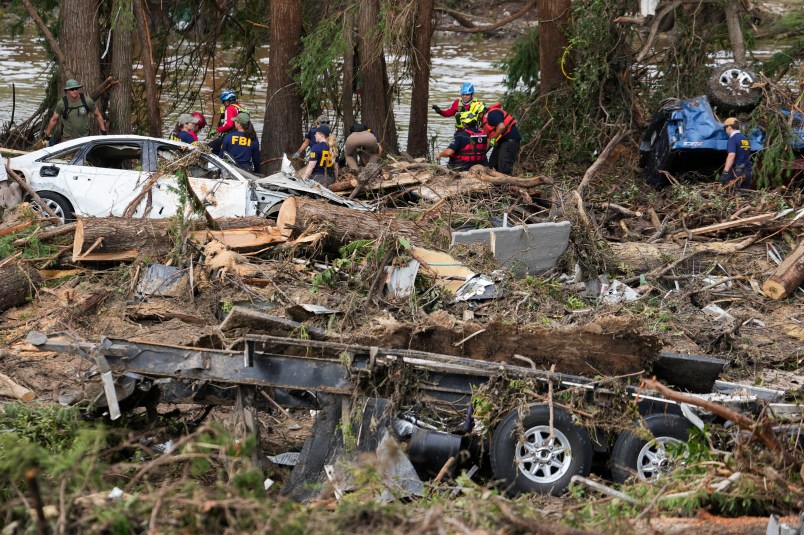
KERRVILLE, TEXAS – JULY 7: Search and rescue crews work to search a vehicles and debris along the Guadalupe River in Kerville, Monday, July 7, 2025. (Jason Fochtman/Houston Chronicle via Getty Images)

The disaster comes during a week in which extreme heat and extreme weather have battered the planet. Parts of northern Spain and southern France are burning out of control, as are parts of California. In the past 72 hours, storms have torn the roofs off of five-story apartment buildings in Slovakia, while intense rainfall has turned streets into rivers in southern Italy. Same story in Lombok, Indonesia, where cars floated like buoys, and in eastern China, where an inland typhoon-like storm sent furniture blowing down the streets like so many sheafs of paper. Léon, Mexico, was battered by hail so thick on Monday it covered the city in white. And North Carolina is, again, enduring 10 inches of rainfall.

There is no longer much debate that climate change is making many of these events demonstrably worse. Scientists conducting a rapid analysis of last week’s extreme heat wave that spread across Europe have concluded that human-caused warming killed roughly 1,500 more people than might have otherwise perished. Early reports suggest that the flooding in Texas, too, was substantially influenced by climate change. According to a preliminary analysis by ClimaMeter, a joint project of the European Union and the French National Centre for Scientific Research, the weather in Texas was 7% wetter on July 4 than it was before climate change warmed that part of the state, and natural variability alone cannot explain “this very exceptional meteorological condition.”

That the United States once again is reeling from familiar but alarming headlines and body counts should not be a surprise by now. According to the World Meteorological Organization, the number of extreme weather disasters has jumped fivefold worldwide over the past 50 years, and the number of deaths has nearly tripled. In the United States, which prefers to measure its losses in dollars, the damage from major storms was more than $180 billion last year, nearly 10 times the average annual toll during the 1980s, after accounting for inflation. These storms have now cost Americans nearly $3 trillion. Meanwhile, the number of annual major disasters has grown sevenfold. Fatalities in billion-dollar storms last year alone were nearly equal to the number of such deaths counted by the federal government in the 20 years between 1980 and 2000.

The most worrisome fact, though, may be that the warming of the planet has scarcely begun. Just as each step up on the Richter scale represents a massive increase in the force of an earthquake, the damage caused by the next 1 or 2 degrees Celsius of warming stands to be far greater than that caused by the 1.5 degrees we have so far endured. The world’s leading scientists, the United Nations panel on climate change and even many global energy experts warn that we face something akin to our last chance before it is too late to curtail a runaway crisis. It’s one reason our predictions and modeling capabilities are becoming an essential, lifesaving mechanism of national defense.

WASHINGTON, DC – JULY 08: U.S. President Donald Trump holds a Cabinet Meeting at the White House on July 08, 2025 in Washington, DC. Trump discussed the recent flash flooding tragedy in Central Texas where at least 109 people have died, and other topics during the portion of the meeting that was open to members of the media. (Photo by Andrew Harnik/Getty Images)

What is extraordinary is that at such a volatile moment, President Donald Trump’s administration would choose not just to minimize the climate danger — and thus the suffering of the people affected by it — but to revoke funding for the very data collection and research that would help the country better understand and prepare for this moment.

Over the past couple of months, the administration has defunded much of the operations of the National Oceanic and Atmospheric Administration, the nation’s chief climate and scientific agency responsible for weather forecasting, as well as the cutting-edge earth systems research at places like Princeton University, which is essential to modeling an aberrant future. It has canceled the nation’s seminal scientific assessment of climate change and risk. The administration has defunded the Federal Emergency Management Agency’s core program paying for infrastructure projects meant to prevent major disasters from causing harm, and it has threatened to eliminate FEMA itself, the main federal agency charged with helping Americans after a climate emergency like the Texas floods. It has — as of last week — signed legislation that unravels the federal programs meant to slow warming by helping the country’s industries transition to cleaner energy. And it has even stopped the reporting of the cost of disasters, stating that doing so is “in alignment with evolving priorities” of the administration. It is as if the administration hopes that making the price tag for the Kerr County flooding invisible would make the events unfolding there seem less devastating.

Given the abandonment of policy that might forestall more severe events like the Texas floods by reducing the emissions that cause them, Americans are left to the daunting task of adapting. In Texas, it is critical to ask whether the protocols in place at the time of the storm were good enough. This week is not the first time that children have died in a flash flood along the Guadalupe River, and reports suggest county officials struggled to raise money and then declined to install a warning system in 2018 in order to save approximately $1 million. But the country faces a larger and more daunting challenge, because this disaster — like the firestorms in Los Angeles and the hurricanes repeatedly pummeling Florida and the southeast — once again raises the question of where people can continue to safely live. It might be that in an era of what researchers are calling “mega rain” events, a flood plain should now be off-limits.