

The attorney who penned memos arguing that the Trump campaign should create fake slates of electors after losing the 2020 election will appear before a Georgia grand jury later this month.
Continue reading “Trump Election Attorney To Testify Before Fulton County Grand Jury”MAGA-Loving AG Hopeful Tied To Election Machine Breach Scheme In Michigan
Matthew DePerno, the Trump-endorsed candidate for Michigan attorney general, spearheaded a plot to seize multiple vote tabulators in pursuit of MAGA election fraud conspiracy theories, according to Michigan Attorney General Dana Nessel (D) and records obtained by Reuters.
Continue reading “MAGA-Loving AG Hopeful Tied To Election Machine Breach Scheme In Michigan”New Pics Provide Receipts Of Trump’s Document Toilet-Flushing Habits
A lot of things happened. Here are some of the things. This is TPM’s Morning Memo.
Good Morning, Everyone!
New York Times reporter Maggie Haberman confirmed her disgusting scoop on Trump’s tendency to flush documents down the toilet–a blatant violation of the Presidential Records Act–with photos she recently shared with Axios, which published the pics just this morning.
- The photos reportedly show two different toilets with Trump’s notes just chillin’ at the bottom of the bowl:
- Trump had denied Haberman’s toilet report when it came out earlier this year, insisting it was a “fake story” that was “simply made up by a reporter in order to get publicity for a mostly fictitious book.”
- Trump’s destructive handling of classified White House docs (which, in addition to toilet-flushing, includes ripping them to pieces and improperly stashing them at his Mar-A-Lago resort) is being investigated by the Justice Department and the House Oversight Committee.
Senate Passes Historic Climate Bill
Senate Democrats successfully passed their sweeping reconciliation bill on climate investment, taxes and drug pricing, aka the Inflation Reduction Act of 2022, on Sunday:
- Senate Republicans stripped a provision in the bill that would’ve put a $35 cap on insulin for private insurers. However, the $35 cap provision on insulin for people 65 and older on Medicare survived.
- The House will likely take up the bill on Friday, when the chamber is back in session.
Biden Tests Negative For COVID
White House physician Kevin O’Connor reported on Sunday that Biden had tested negative for COVID-19 for a second consecutive day earlier that morning, clearing him for travel and allowing him to resume his schedule.
Indiana Passes Near-Total Abortion Ban
Indiana Gov. Eric Holcomb (R) late Friday signed the state GOP-controlled legislature’s ban on abortion that has only limited exceptions for rape, incest and the pregnant person’s health.
Secret Service Hands Over Agents’ Cell Numbers
The Secret Service has turned over agents’ personal cell phone numbers to investigators probing the Jan. 6 Capitol attack, ABC News and CNN report.
- The Secret Service gave the numbers specifically to the House Jan. 6 Committee, according to ABC News. CNN’s report is more vague about to whom exactly the agency handed over the numbers.
Fetterman To Return To Campaign Trail
On Friday, Democratic Pennsylvania Senate nominee John Fetterman will be holding his first campaign rally since suffering a stroke just a few days before his primary in May.
- The rally will be in Erie, which Fetterman described in his announcement as the state’s “most important bellwether county” in an election.
- Fetterman’s been crushing GOP rival and New Jersey celebrity Mehmet Oz in the polls despite his absence on the campaign trail: A July 28 Fox News poll put the Democrat at 11 points ahead of the Jerseyan (Fetterman’s also been thoroughly owning Oz online).
Mastriano Looking To Weasel Out Of Testifying In Front Of Jan. 6 Panel
Doug Mastriano, Pennsylvania’s hardcore MAGA gubernatorial nominee, sent a letter to the House Jan. 6 Committee via his lawyer on Friday threatening to pull out of his agreement to sit in for a deposition unless the lawyer can record the session. The committee’s really not likely to go for that.
Jury Rocks Alex Jones With $49.3 Million Verdict In Sandy Hook Case
The jury in the Texas defamation trial by the parents of a Sandy Hook victim against far-right conspiracy monger Alex Jones decided on Friday that Jones must pay $45.2 million in punitive damages to the parents after repeatedly lying about their child’s death being a false flag operation.
- The jury had awarded the parents $4.1 million in compensatory damages on Thursday, bringing the total to $49.3 million.
- The trouble ain’t over yet for Jones: He still has two more defamation trials coming up in which juries will decide how much he’ll have to pay out to the Sandy Hook families he and his fans terrorized for years.
Pro-Impeachment GOPer Survives Primary
Rep. Dan Newhouse (R-WA), one of the 10 Republicans who voted to impeach Trump over the Jan. 6 attack, has won his primary.
- It’s too early to tell if Rep. Jaime Herrera Beutler (R-WA), a fellow pro-impeachment Washington Republican, will make it through her primary.
- Rep. Peter Meijer (R-MI), the other pro-impeachment Republican who had a primary on Tuesday, was defeated by election denier John Gibbs.
GOP Chooses Milwaukee To Host 2024 Convention
GOP chair Ronna McDaniel announced on Friday that the 2024 Republican National Convention will be held in Milwaukee, Wisconsin.
Do you like Morning Memo? Let us know!
Good Lord
I’m sure we’ll have a lot more on this tomorrow. But if I’m understanding this right, the attorney general of Michigan, Dana Nessel, has just had to recuse herself and ask for a special counsel because the Michigan state police has referred to her a potential felony charge against her general election opponent, Matthew DePerno.
Continue reading “Good Lord”Gutting the SALT Deduction is Terrible Policy
With SALT deductions again — at least momentarily today — at the center of a Senate legislation battle, I wanted to write out in one place why reducing the SALT deduction is terrible policy, even though many progressives don’t seem to realize it. The SALT deduction is the part of the federal tax code that allows you to deduct state and local taxes when calculating your federal tax bill. Critics argue that the benefits go mainly to wealthy and very wealthy people. And that is true as far as it goes. But that’s going to be true in almost any revision of graduated income taxes. The key is that in many blue states it hits a lot of middle and upper middle class families too.
Now, boohoo for them right? Well, if it’s them versus subsidizing people’s out of control insulin costs, sure. But it’s not. That’s not the trade off. Here we get to the myopia of progressive opposition to or lack of support for SALT deductions. The SALT deduction was originally gutted in the 2017 Trump tax cut bill. That was done in part to make up revenue lost by giving huge tax cuts to the extremely wealthy. But that wasn’t the main reason. The authors of the bill correctly believed that gutting the SALT tax was a direct attack on the (mostly) blue states with high-tax/high-service governance. We all know that some states put more into health care, unemployment insurance, education, social services than others — all the basic stuff mostly or partly paid for at the state level. That high-tax/high service model is what’s behind that. States that follow the low-tax/low-service model not only have fewer benefits. They also rely more on federal subsidies to provide what services and benefits they do provide. Which is to say that, in most cases, they rely on transfers from blue states to red states to cover part of the bill for their already stingy social safety nets.
Continue reading “Gutting the SALT Deduction is Terrible Policy”Democrats’ Sweeping Climate, Health Care And Tax Bill Has Passed The Senate
Senate Democrats on Sunday passed sweeping legislation containing provisions to address climate change, health care and taxes, a huge step forward on the party’s agenda after more than a year of halting negotiations.
Continue reading “Democrats’ Sweeping Climate, Health Care And Tax Bill Has Passed The Senate”Trump’s Grievance Feedback Loop
Democrats are now in a reasonably strong position to hold the Senate and perhaps expand their majority. A major reason for that is that Donald Trump took it upon himself and was largely allowed to pick the candidates. Almost all of them are terrible candidates: Oz, Vance, Masters, Walker. These are simply terrible candidates. They could win. But it will be in spite of their terribleness not because of it. Kelly, Warnock, Fetterman, Ryan are all pretty good candidates. In some cases, in terms of their fit for the state in question, they are near-perfect candidates. Tim Ryan may be the best example of that even though he’s the least likely of the four to win. But all would be in much more challenging contests if they were opposed by even generic, non-crazy-sounding Trumpite Republicans.
Continue reading “Trump’s Grievance Feedback Loop”The Week In Pictures
Here’s a look back at some of TPM’s top stories this week …
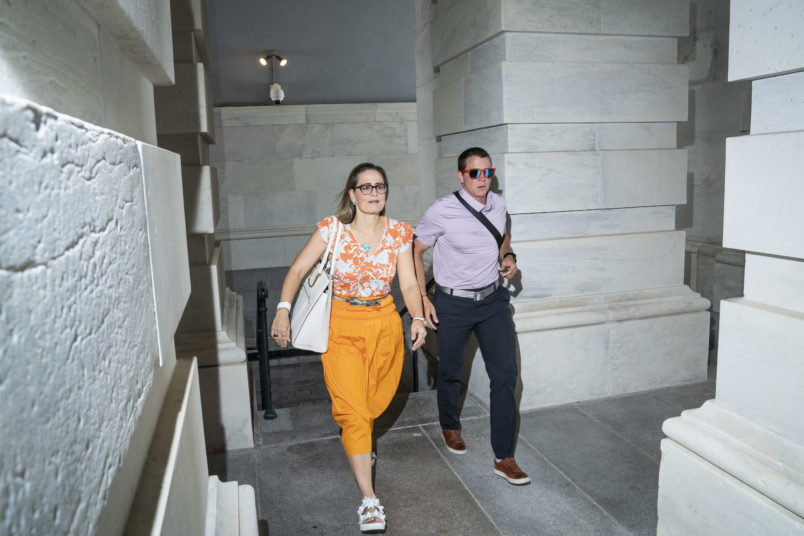
Sinema And Manchin Are Both, Finally, On Board
GOP Deepens Its Romance With Orbánism

DOJ Sues Idaho For Its Abortion Ban

Attempt To Strip Kansans Of Abortion Rights Crashes And Burns

Boosters Of Trump’s Lie That The 2020 Election Was Stolen Win Primaries Across US

System Malfunction: Fox Tries To Attack WH Over Report Showing Massive Job Growth
The Labor Department dropped a surprising monthly jobs report for July on Friday showing that U.S. employers added a whopping 528,000 jobs last month while unemployment dropped to 3.5 percent, bringing employment back to its pre-pandemic level.
Now allow Fox News to explain how President Joe Biden and the White House screwed up here.
Continue reading “System Malfunction: Fox Tries To Attack WH Over Report Showing Massive Job Growth”Now We Finally Know: Notorious Kremlin-Linked Oligarch Paid For Giuliani’s Trips
Rudy Giuliani had his travel expenses covered by an indicted Ukrainian oligarch’s company as he sought dirt on President Biden, the New York Times reported this week.
Continue reading “Now We Finally Know: Notorious Kremlin-Linked Oligarch Paid For Giuliani’s Trips”