The last detainees inside the grim “Alligator Alcatraz” immigrant detention camp spearheaded by Florida Gov. Ron DeSantis (R) are reportedly set to leave the facility.
An appeals court ruled 7-4 Friday evening that most of President Donald Trump’s tariffs, a series of which he imposed by executive order under emergency powers granted by The International Emergency Economic Powers Act, are unlawful.
The first is the report that Sen. Joni Ernst (R-IA) will soon announce she will not run for re-election. This isn’t a total surprise. There were signs this was coming. But it’s still an important development and one that signifies something larger. She’s now the second Republican senator up for reelection next year who has opted to retire. The first was Sen. Thom Tillis in North Carolina. Not long after this Ernst news was reported, we learned that conservative Wisconsin Supreme Court Justice Rebecca Bradley is also opting not to run for reelection next year. It’s hard for me to imagine that Ernst’s final decision wasn’t impacted by Tuesday’s blow out win by Catelin Drey in an Iowa state senate special election race, in what is normally a strongly pro-Trump district.
It goes without saying that both Ernst and Bradley likely realized that these were at least going to be difficult races — Democrats have won four of the last five Wisconsin court races. And quite possibly they’d lose. But this also reminds us that one of the usual factors in a blow out or wave election cycle is that a non-trivial number of incumbents see what’s coming and retire. That tends to magnify the wave party’s advantage because the in-party has an even harder time holding a seat without the power of incumbency.
Now I’m not predicting a wave election. Iowa certainly will still be a very challenging race even without Ernst in it. My point is simply that a lot of the building blocks of a wave get determined well before any votes get counted. The people who speak with the most credibility and authority about the political environment going into 2026 are Republican incumbents. And they’re starting to speak pretty clearly. It started with the Spring town halls, or the lack thereof.
GOP Rep. Jeff Hurd of Colorado was apparently just a no-show at his own town hall on Wednesday. Technically it wasn’t a town hall but rather a public meeting in which Hurd would meet with members of the Montezuma County Commission. Point being, it wasn’t one of these things where Democrats put on a town hall because the member won’t call one. It was one he was involved in organizing. Anyway, apparently Hurd found out shortly before arriving that more than a hundred people had shown up because just after the event began, Montezuma County Commission Chair Jim Candeleria announced that Hurd wouldn’t be able to make it because an aide he was traveling with had a “medical emergency”.
No word on how the dog is doing after it ate Hurd’s homework.
Congressional Democrats point to skyrocketing odds of a government shutdown Friday after President Trump announced that he’ll unilaterally take back money Congress had already appropriated for foreign aid, according to multiple outlets.
I’m a little surprised that the refusal of CDC Director Susan Monarez to go quietly and the resignations of other top CDC officials seemed to eclipse rather than to amplify the FDA anti-science decision to restrict the access of healthy Americans to the annual COVID booster.
The shift away from mass immunization for COVID by making healthy people under 65 ineligible for it without a scientific basis for doing so and outside the normal process has adverse health implications for millions of Americans.
What’s it mean for you and your family? Here’s an initial survey of landscape:
CVS is holding back on rolling out the annual COVID booster in 16 jurisdictions that require approval from the CDC’s Advisory Committee on Immunization Practices, which isn’t scheduled to meet until next month and was stacked by RFK, Jr., with vax skeptics. The jurisdictions are: Arizona, Colorado, D.C., Florida, Georgia, Kentucky, Louisiana, Maine, Massachusetts, Nevada, New Mexico, New York, North Carolina, Pennsylvania, Utah, Virginia, and West Virginia.
If the CDC ratifies the FDA decision, as expected, then insurers and employers will not be required to cover the annual COVID booster for those under 65 without an underlying condition. The uninsured out-of-pocket cost for a COVID vaccine is about $225.
More Fallout From The CDC Massacre
Politico: Monarez would not cross ‘red lines’ before she was fired, confidant says
WaPo: CDC leaders who resigned said RFK Jr. undermined vaccine science
NYT: Inside the C.D.C., a Growing Sense of Despair
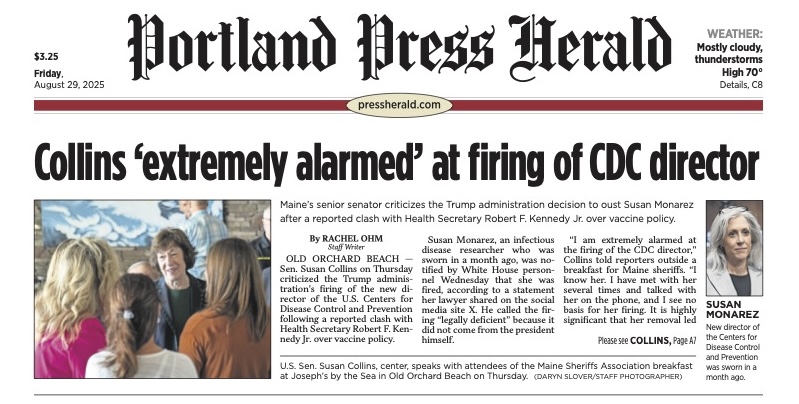
Susan Collins Is Fucking Alarmed Again
Maine Sen. Susan Collins (R), who voted to confirm Robert F. Kennedy, Jr., as HHS secretary, is a parody of herself:
Sandwich Thrower Charged With Misdemeanor
After a D.C. grand jury refused to indict the Subway sandwich thrower, U.S. Attorney Jeanine Pirro’s office charged him with a misdemeanor. While that is a more appropriate charge, it is still part of a larger pattern of pursuing federal charges during the Trumpian occupation of the District of Columbia rather than handling them in D.C. Superior Court.
[T]hey’re going to have to hire the kind of people who are going to be looking at these videos that are coming out of ICE — terrorizing families, arresting children and pulling grandmothers out of their homes. They’re going to be hiring people who look at those videos and say: That’s what I want to do for a living. …
What I think we are seeing right now is Trump is attempting to build his own paramilitary force. They want people whose first and ultimate loyalty in this job is going to be to the president.
Good Read
Anna Merlan at Mother Jones: “The Most Transparent Administration In History” Refuses to Say Who’s Behind Their Batshit Social Media
The Authoritarian Checklist
Political scientist Don Moynihan: “The consolidation of Trump’s power has happened very quickly, more rapidly than we have seen in other examples of competitive authoritarian systems. His success is driven by two factors. First, Trump learned a lot from his first term and had personnel with detailed plans in place for his second term. Second, people in institutions decided to accept the new arrangements.”
The Fed’s Lisa Cook Sues to Block Her Firing by Trump
U.S. District Judge Jia Cobb of Washington, D.C., will oversee Federal Reserve Board member Lisa Cook’s lawsuit seeking to overturn her firing by President Trump.
Judge Overturns Kari Lake’s Ouster of VOA Director
U.S. District Judge Royce Lamberth of Washington, D.C., ruled that Kari Lake did not have the authority to remove Michael Abramowitz as the Voice of America’s director and issued a permanent injunction blocking his removal.
For the Legal Nerds …
This is very in the weeds, but important. The D.C. Circuit Court of Appeals did some very unusual maneuvering late yesterday that seems to have reversed its own course and re-opened the door to challenging the Trump administration’s unlawful freezing of foreign aid. That’s as simply put as I can make it. For a deeper dive:
Chris Geidner: The D.C. Circuit’s realpolitik orders in the foreign aid funding case
Bloomberg’s Zoe Tillman: Appeals Court Keeps Fight Alive Over Trump Foreign Aid Freeze
Georgetown law professor Marty Lederman: “This was an extraordinarily shrewd *and* principled resolution by the en banc court, in a case in which the various arguments in the trial court and on appeal were *almost* hopelessly entangled and hard to parse.”
Meanwhile … Carbon Emissions Continue to Soar
Susan Crawford: If we’re serious about risk assessment, two recent pieces of climate news should be grabbing at least as much attention as the AI bubble on Wall Street.
Grist: The Trump administration is trying to revive the climate change “debate.”
American Meteorological Society: The Trump Department of Energy’s recent attempt to synthesize climate science has five foundational flaws.
Hard To Believe It’s Been 20 Years
My own sense of the passage time used to be detailed, sequential, and reassuringly clear in my own mind. Then COVID hit, and I still haven’t been able to reconstitute the mental file drawer of life and world events. So I was dumbfounded not just that it’s been 20 years since Hurricane Katrina swamped New Orleans but also that it’s been a decade since we published this piece by my high school classmate Cheryl Wagner on Katrina’s 10th anniversary. Cheryl, who wrote a book on her post-Katrina experience, captured the mix of ambivalence, aversion, and avoidance that some survivors feel about remembering. It holds up well as an antidote to the onslaught of anniversary content.
See You Back Here Tuesday
No Morning Memo on Labor Day, but we’ll roar back from the summer lassitude starting on Tuesday.
This article is part of TPM Cafe, TPM’s home for opinion and news analysis. It was originally published at The Conversation.
Most of the world observes International Workers’ Day on May 1 or the first Monday in May each year, but not the United States and Canada.
Instead, Americans and Canadians have celebrated Labor Day as a national holiday on the first Monday in September since 1894, 12 years after the first observance of Labor Day in New York City.
The celebrations aren’t the same.
In much of Europe, Asia, Africa and Latin America, the event commonly called May Day honors workers’ political and economic power, often with demonstrations by socialist or workers’ parties and tributes to national labor rights. America’s Labor Day features labor union parades in many places, but for most Americans, it’s less about organized labor and more about barbecues, beach days and back-to-school sales.
Both holidays, however, arose during the same period, in the U.S. nearly 150 years ago, in the midst of an explosive labor uprising in America’s industrial heartland. Their founding united native-born and immigrant workers in an extraordinary alliance to demand an eight-hour workday at a time when American workers toiled an average of 10 or more hours daily, six days a week.
The call for shorter hours was rooted in a big idea: that workers’ days belonged to them, even if employers owned their workplaces and paid for their work. That idea inspired the loftiest goals of a growing labor movement that spanned from Chicago and New York to Stockholm and Saint Petersburg. And the labor activism of the late 1800s still casts a distant light on Labor Day today, carrying a vital message about the struggle for control of workers’ daily lives.
I’m a historian at the University of Illinois Chicago, where I study the history of labor. The fight for shorter hours is no longer a top issue for organized labor in the U.S.. But it was a crusade for the eight-hour day that brought together the diverse coalition of labor groups that created Labor Day and May Day in the 1880s.
On Labor Day, U.S. beaches are crowded with people who spend the late-summer holiday relaxing and having fun. One such destination is Chincoteague Island, Va., seen here on Labor Day weekend in 2018. Bastiaan Slabbers/NurPhoto via Getty Images
Labor Day’s radical roots
Led by socialist-leaning trade unions, Labor Day’s founders included skilled, native-born craft workers defending control over their trades, immigrant laborers seeking relief from daylong drudgery, and revolutionary anarchists who saw the quest for control of the workers’ day as a step toward seizing factories and smashing the state.
They originally chose Sept. 5, 1882, for the first Labor Day to coincide with a general assembly in New York City of what was then the largest and broadest association of American workers, the Knights of Labor. Two years later, labor leaders moved the annual event to the first Monday in September, giving the majority of workers a two-day weekend for the first time.
As Labor Day parades and picnics spread, many American cities and states soon made it an official holiday. But since few employers gave workers the day off in its early years, Labor Day likewise became “a virtual one-day general strike in many cities,” according to historians Michael Kazin and Steven Ross.
American roots of May Day
My students come from working-class, mostly immigrant families, and Chicago’s history of labor conflict is all around our downtown campus in the heart of what were once meatpacking plants, stockyards and crowded immigrant neighborhoods.
My office is about 12 blocks from the spot – surrounded today by upscale office buildings – where the eight-hour movement reached a bloody climax in the battle of Haymarket Square. May Day commemorates that battle.
On May 1, 1886, unions of skilled workers organized by their crafts or trades led a nationwide general strike for the eight-hour day. They were joined by radical socialists, militant anarchists and many members of the Knights of Labor. More than 100,000 workers took part across the country.
The most dramatic demonstrations happened in Chicago, which had become the second-largest city in the U.S. after years of swift growth. Nearly 40,000 striking Chicago workers shut down much of that burgeoning industrial, agricultural and commercial hub. Three days later, a bomb thrown at a rally in Haymarket Square killed seven police officers, sparking a sweeping nationwide crackdown on labor activism.
And they were honoring the memory of the eight labor activists who had been tried and convicted for the Haymarket bombing solely on the basis of their speeches and radical politics, in what was widely viewed as a rigged trial. Four “Haymarket martyrs” had been hanged and a fifth died by suicide before he could be executed.
An earlier labor win
Though May 1 had long been associated with European celebrations of springtime, its modern meaning has deeper American roots that precede the Haymarket tragedy. It was on that date in 1867 that workers in Chicago celebrated an earlier victory.
At the end of the Civil War, campaigns for an eight-hour workday arose in cities across the country, championing a common interpretation of the abolition of slavery: for many workers, emancipation meant that employers purchased only their labor, not their lives.
Employers might monopolize workers’ means of making a living, but not their hours and days.
The movement led to laws declaring an eight-hour day in six states, including Illinois, where the new rule went into effect on May 1, 1867. But employers widely disobeyed or circumvented the laws, and states failed to enforce them while they lasted, so workers continued to struggle for a shorter workday.
Seizing the day
In the 19th century, American workers’ labor came to be measured by how long they worked and how much they were paid. While they were divided by their widely different wages, they were united by the generally uniform hours at each workplace.
The demand for a shorter workday without a pay cut was designed to appeal to all wage earners no matter who they were, where they were from, or what they did for a living.
Labor leaders said shorter hours meant employers would have to hire more people, creating jobs and boosting hourly pay. Spending less time on the job would enable workers to become bigger consumers, spurring economic growth.
Having “eight hours for work, eight hours for rest, and eight hours for what we will,” a popular labor movement refrain, would also leave more time for education, organization and political action.
Most broadly, the fight for shorter hours encapsulated workers’ struggle to control their own time, both on and off the job. That far-reaching struggle included efforts to limit the number of years people spent earning a living by ending child labor and creating pensions for retired workers – a topic I’m currently researching.
Benjamin Franklin famously said, “Time is money,” meaning that time off costs money that workers could be making on the job. But the message of the movement for a shorter workday was that the worth of workers’ lives could not be calculated in dollars and cents.
Diverging holidays
In the Haymarket battle’s aftermath, the alliance of radicals and reformers, factory operatives and skilled artisans, U.S.-born workers and immigrant laborers began to come apart. And as union leaders in the American Federation of Labor parted ways with socialists and anarchists, each side of the divided workers’ movement claimed one of the two labor days as its own, making the holidays appear increasingly opposed and losing sight of their shared foundation in the campaign for a shorter workday.
Conservative politicians and employers hostile to unions began to equate labor organizing with bomb throwing. In response, trade unions seeking acceptance as part of American industry and democracy displayed their allegiance on Labor Day by waving the American flag, singing patriotic songs and portraying themselves as proud, native-born Americans as opposed to foreign workers with subversive ideas.
Many political radicals and the immigrant workers among whom they found much of their following, meanwhile, came to identify more with the international workers’ movement associated with May Day than with American business and politics. They disavowed May Day’s origins among American trade unions, even as many trade unions distanced themselves from the radical roots of Labor Day. By the turn of the century, May Day moved further from the center of American culture, while Labor Day became more mainstream and less militant.
20th-century gains and losses
In the 20th century, labor unions won shorter hours for many of their members across the country. But they detached that demand from the broader agenda of workers’ autonomy and international solidarity.
Workers’ productivity did keep climbing as Keynes predicted, and their wages rose apace – until the 1970s. But their work hours did not decline, leaving the three-hour day a forgotten vision of what organized labor might achieve.
This story first appeared at ProPublica, a Pulitzer Prize-winning investigative newsroom. Sign up for The Big Story newsletter to receive stories like this one in your inbox.
In late July, Missouri state troopers walked into St. Louis County government headquarters and seized the cellphone of one of the most prominent Democratic officials in this solidly red state.
Two days later, a grand jury indicted Sam Page, the St. Louis County executive. Acting as a special prosecutor, Missouri Attorney General Andrew Bailey, a Republican, secured two felony counts of stealing by deceit and two election-law violations.
For Bailey, bringing felony charges against the leader of the state’s biggest blue stronghold added to the resume of a MAGA warrior who had already interviewed for a key position in President Donald Trump’s administration.
Less than three weeks later, Trump tapped Bailey to help run the FBI. He’ll serve as co-deputy director with Dan Bongino, a former Secret Service agent and conservative podcast host. Bailey said he’ll resign as Missouri’s attorney general on Sept. 8 to take the post. A spokesperson said he was not taking questions from the media.
The case against Page was the latest in a string of legal strikes against Democrats by Bailey, bringing the full weight of the state on a political adversary. It wasn’t about bribery or self-dealing. Page, the top elected official in a county with about 1 million residents, wasn’t accused of stealing a dime for himself.
Instead, the charges turned on something mundane: the printing and mailing of flyers weeks before about a measure on the ballot in April — the kind of informational material local governments often send to voters and the sort of action that experts said had never led to criminal charges in Missouri.
The election asked voters to give the County Council the power to fire the county’s department heads and its top attorney. Page spent more than $25,000 of taxpayer money to print and mail flyers to voters outlining the measure. The flyer at issue did not overtly tell voters to vote no, but it listed groups that opposed it, including the police board and NAACP, and it quoted a state judge’s ruling that the ballot language was misleading and unfair. It also suggested that a yes vote would allow directors to be fired for political reasons or in emergencies and that a no vote would maintain stable leadership.
Documents filed in the case against Page also showed that he did not follow a county lawyer’s advice to make some changes to the flyer. Bailey alleged that the flyer crossed the line from providing information, which is legal, to urging a no vote, which he said was an unlawful use of tax dollars — and, in his view, grounds to seek felony charges.
If convicted on the most serious count, Page could face three to 10 years in prison and $10,000 in fines. He could also face removal from office and sanctions against his medical license; he’s an anesthesiologist, though he doesn’t currently practice full time.
“Public officials must follow the law,” Bailey wrote in a news release, “and my Office will work to ensure that they always do.”
Attorney General Pam Bondi appointed Ed Martin, who had worked as an attorney in Missouri, to head the U.S. Department of Justice’s Weaponization Working Group and to investigate two prominent Democrats, New York Attorney General Letitia James and U.S. Sen. Adam Schiff of California, on allegations of mortgage fraud.
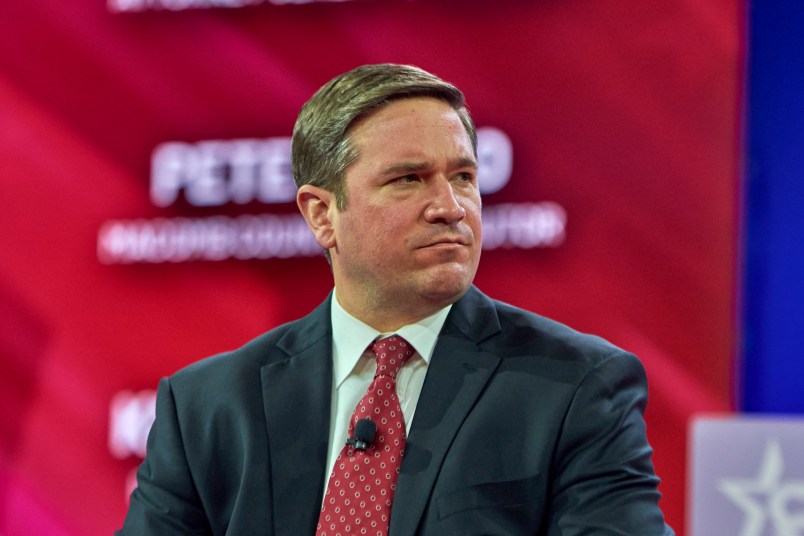
Andrew Bailey during the 2024 Conservative Political Action Conference the Gaylord National Convention Center in Fort Washington, Maryland, Thursday, Feb. 22, 2024. (Photo by Dominic Gwinn / Middle East Images / Middle East Images via AFP) (Photo by DOMINIC GWINN/Middle East Images/AFP via Getty Images)
“Bailey really was auditioning for that role, or something like it, and what better way to show loyalty than to do exactly what Trump wants on the federal level, but replicated on the state level,” said Paul Nolette, the director of the Les Aspin Center for Government at Marquette University. “It’s a template for what type of approach Bailey is going to take on the federal level. Political opponents are going to get targeted.”
Bailey has called himself a defender of the rule of law, portraying his high-profile lawsuits and investigations in Missouri as necessary to protect the state from what he has described as illegal or unconstitutional actions by the federal government and abandonment of the rule of law by the left.
Page became county executive in 2019 after a federal corruption case toppled his predecessor, Steve Stenger. Page had led a bipartisan bloc on the County Council against Stenger, who was sentenced to nearly four years in federal prison for a pay-to-play scheme that steered county contracts to political donors. (St. Louis County wraps around — but does not include — the much smaller independent city of St. Louis.)
The cooperative spirit collapsed as Page set St. Louis County on the aggressive end of Missouri’s response to the COVID-19 pandemic, issuing early emergency orders limiting gatherings and indoor dining. That stance put him at odds with state officials who were moving to curb local power.
Despite this and other political battles, Page has twice won countywide elections — first in 2020 to finish Stenger’s term, then in 2022 to a full four-year term. He has said he will decide by the end of the year whether to run again in 2026. He is scheduled to be arraigned on Friday.
“I don’t think I did anything wrong,” he said in brief remarks to local news reporters at a ribbon-cutting for a county road project.
A Page spokesperson referred questions to his lawyer, Jeff Jensen, a former U.S. attorney in Missouri during Trump’s first term. Jensen did not respond to requests for comment.
Many have questioned the legitimacy of the case and whether Bailey’s successor, Catherine Hanaway, will see it through. Hanaway, also a former U.S. attorney, as well as a former speaker of the Missouri House of Representatives, did not respond to questions.
“It certainly seems, based on my reading of it, a stretch,” said Peter Joy, a law professor at Washington University in St. Louis and an expert in legal ethics and trial practice. “It would be an uphill battle for the state to make this charge stick.”
Ken Warren, a political scientist and pollster at Saint Louis University, said the charges were “totally phony” but that “the more outrageous you are, the more you are going to attract the attention of Donald Trump.”
“Let’s say the same thing occurred but the county executive happened to be a Republican,” Warren said. “Would Bailey go after him? Of course not.”
Missouri has become a proving ground of sorts for Trump appointees. Martin — a longtime state GOP insider with a record of stoking controversies — was named the U.S. attorney for Washington, D.C. After it became apparent he couldn’t win Senate confirmation, he was moved to the administration’s pardon office and the Justice Department’s weaponization group.
John Sauer, a former Missouri solicitor general and anti-abortion activist who last year helped bankroll a campaign to defeat Missouri’s abortion rights ballot issue, defended Trump’s claim to presidential immunity before the Supreme Court. Now, as U.S. solicitor general, he serves as the federal government’s top advocate before the Supreme Court.
Will Scharf, who lost a primary bid last year to unseat Bailey, pivoted straight into Trump’s legal inner circle. Then there’s Billy Long. The six-term ex-congressman was confirmed in June as IRS commissioner — despite having once pushed to abolish the agency — amid scrutiny over his ties to questionable tax-credit plans. He was recently ousted and said he will become ambassador to Iceland.
That roster of loyalists is no accident. Over the past two decades, Missouri has moved from being a competitive bellwether state to a deep-red stronghold, with a political environment that rewards the kind of hard-line conservatism and culture-war ethos that Trump prizes.
John Danforth, a Republican who served as Missouri’s attorney general from 1969 to 1976 and then as a U.S. senator until 1995, said the office has shifted dramatically from its core mission. Under him, he said, the job was to represent state agencies, handle every felony appeal, respond to legal opinion requests and manage litigation with a small staff. Asked about a move last year in which Bailey investigated a St. Louis-area school district after a student was beaten during school hours — blaming its diversity policies and removal of resource officers for safety failures — Danforth said, “I wouldn’t have done it.”
As the state has shifted right, many races are effectively decided in the primary. Candidates don’t need to win over most voters, according to political experts and observers — just the small, very political group that shows up for low-turnout, winner-take-all primaries. That favors hard-line candidates.
Nowhere is that change clearer than in the attorney general’s office.
Bailey is a U.S. Army veteran who served two tours in Iraq as an armored cavalry officer. He started his career as an assistant Missouri attorney general, then worked as a prosecutor. He joined the governor’s office as deputy general counsel in 2019 and later served as general counsel to then-Gov. Mike Parson.
His politicization of the attorney general’s office follows a path blazed by two predecessors, Josh Hawley and Eric Schmitt, who each used relatively brief tenures as the state’s attorney general to launch themselves into the U.S. Senate. In Hawley’s case, out-of-state political consultants were embedded in the office from his first weeks on the job, directing taxpayer-funded staff, shaping his policy rollouts and boosting his national profile ahead of his Senate run. Schmitt used the office to wage headline-grabbing legal fights, from suing China over COVID-19 to challenging pandemic restrictions, elevating his profile as he prepared his own Senate campaign.
Neither Hawley nor Schmitt could be reached for comment.
After Schmitt was elected to the Senate in November 2022, Parson announced that he would appoint Bailey to fill the vacancy. That set up a high-profile Republican primary last year against Scharf, a candidate with backing from the conservative establishment. Bailey won 63% of the vote and cruised to an easy general-election victory in November.
Within a week, Bailey was interviewing with Trump for the job of U.S. attorney general in the new administration.
With no Democrats holding statewide office and a GOP supermajority in the legislature, Bailey has turned his fire on Democratic officials in Missouri’s two largest cities. He pressured St. Louis Circuit Attorney Kim Gardner to resign by filing a lawsuit to remove her from office that alleged willful neglect of duty and a failure to prosecute violent crimes, and he recently sought to remove St. Louis Sheriff Alfred Montgomery, accusing him of misconduct. Gardner repeatedly denied any wrongdoing before resigning; later she acknowledged misusing some public funds. Montgomery has denied wrongdoing and has refused to resign.
Kansas City Mayor Quinton Lucas has also been a frequent target: Bailey threatened a Missouri Human Rights Act investigation into Lucas and his staff after a city-run social media account, responding to a speech by the Kansas City Chiefs football player Harrison Butker about women being homemakers, named the suburb where Butker lived. The city deleted the post and apologized. Bailey framed the post as discrimination against Christians.
Last year, Lucas suggested the city could benefit from asylum-seeking immigrants joining the local workforce, then clarified that he meant immigrants who were in the U.S. legally. Bailey — who had sued the Biden administration over what he called an “illegal” parole program for migrants from Cuba, Haiti, Nicaragua and Venezuela — accused Lucas of trying to involve Missouri businesses in a “fundamentally unlawful program.” He posted a letter on the social media platform X calling Lucas’ comments “wildly irresponsible” and said he was “putting him on notice that it is a Class D felony to knowingly transport an illegal alien in the State of Missouri.”
Lucas responded in a statement then that Bailey’s letter was “a political campaign press release with no legal effect.”
“It’s not effective lawyering,” Lucas said in a recent interview. “It’s a whole new branch of lawyering that I, as a lawyer, didn’t grow up knowing, which is: If you get a story out, who cares if you drag people through the mud?”
Bailey, on the other hand, has stepped up to defend Republican allies. His office intervened to defend three GOP state senators who were sued for false light invasion of privacy after wrongly identifying a Kansas man as the shooter at a Super Bowl parade honoring Kansas City’s NFL team — and falsely calling him an undocumented immigrant.
Two of the senators called the lawsuits frivolous, while Bailey has argued the posts were protected by legislative immunity, as the senators were acting in their official capacity.
Lawsuits against two of the officials, who are represented by the Missouri deputy solicitor general, a high-ranking lawyer in the attorney general’s office, remain pending in federal court.
For a guy whose political career is largely based on the reality TV one-liner “You’re fired,” President Trump sure had a hard time firing CDC Director Susan Monarez.
What may have confounded the White House, beyond its own ineptitude, is that Monarez is the first Senate-confirmed CDC director ever, as a result of a new post-pandemic law. She serves at the pleasure of the president, not of HHS Secretary Robert F. Kennedy, Jr., who is her boss, but has less power over her than if she were a run-of-the-mill political appointee.
Kennedy asked for Monarez’s resignation, and she refused, according to reports. He tried to fire her, and her attorneys said nope, sorry, the president has to fire her. The White House then announced it had fired her, and her attorneys again said nope, sorry, you’re not the president.
Let’s assume the White House already has or will sometime today figure out that a Senate-confirmed official who refuses to resign has to be fired by the president himself. He may be stumbling over himself in the precise process, but Monarez is gone.
Four other top CDC officials resigned in protest over the same RFK, Jr. anti-vax and pseudoscience madness that prompted Monarez’s revolt:
Dr. Debra Houry, the chief medical officer
Dr. Demetre Daskalakis, director of the National Center for Immunization and Respiratory Diseases;
Dr. Daniel Jernigan, the director of the National Center for Emerging and Zoonotic Infectious Diseases; and
Dr. Jen Layden, director of the Office of Public Health Data, Surveillance and Technology
It’s a devastating loss of institutional capacity and years of nonpartisan service in advancing public health.
Quote of the Day
Dr. Demetre Daskalakis, director of the National Center for Immunization and Respiratory Diseases, in his resignation letter:
The intentional eroding of trust in low-risk vaccines favoring natural infection and unproven remedies will bring us to a pre-vaccine era where only the strong will survive and many if not all will suffer. I believe in nutrition and exercise. I believe in making our food supply healthier, and I also believe in using vaccines to prevent death and disability. Eugenics plays prominently in the rhetoric being generated and is derivative of a legacy that good medicine and science should continue to shun.
The recent shooting at CDC is not why I am resigning. My grandfather, who I am named after, stood up to fascist forces in Greece and lost his life doing so. I am resigning to make him and his legacy proud. I am resigning because of the cowardice of a leader that cannot admit that HIS and his minions’ words over decades created an environment where violence like this can occur. I reject his and his colleagues’ thoughts and prayers, and advise they direct those to people that they have not actively harmed.
IMPORTANT: RFK Jr. Restricts Access To COVID Vax
The personnel debacle at the CDC appears to be a direct result of Kennedy’s announcement (via X!) of the FDA decision to restrict access to the annual COVID vaccine to certain groups of eligible recipients, bypassing the normal process for vaccine approvals, disregarding the established science, and overriding the opposition of the public health community.
While it’s true that on its face Kennedy’s announcement suggests there may be many easy workarounds to obtain the COVID vaccine despite the new restrictions, the limitations represent precisely the scenario his critics and the public health sector have been warning about for months. Longtime experts with sterling reputations and an adherence to science and public policy particulars have been sidelined in favor of Kennedy’s shoot-from-the-hip bombast, his anti-vax biases, and the crowd of grifters, quacks, and charlatans, whom he attracts and elevates.
Under Kennedy, science has taken a backseat to conspiracists, opportunists, and snake-oil salesman. The result is now a nationwide limitation on access to a vital vaccine that has saved countless lives over the past five years.
Thread Of The Day
#NIH is hanging by a thread. The #CDC has been decimated. #RFK Jr. and Russell #Vought are psychopaths–I don't say this frivolously–they are cold, calculating, inflicting violence on millions through public policy. It is where we are right now. These men are not normal. 1/
I can’t immediately think of any recent precedent for Senate-confirmed officials to be sacked as quickly as President Trump has canned IRS Commissioner Billy Long and the CDC’s Susan Monarez. They lasted mere weeks after going through the resource-intensive process of Senate confirmation.
The vetting, the background checks, interviews with individual senators, committee staff time and resources, the hearings themselves: It’s a formal constitutional process that even in the current degraded state of the GOP-controlled Senate still requires an investment and commitment from senators.
Not only that, but deals are struck, accommodations made, and horses traded to line up the votes and get nominations through the Senate. All of that is blown up if the president is willy nilly firing his Senate-confirmed appointees within weeks of their final approval from senators.
On the backend is the prospect of either another round of confirmation hearings for the next nominee or more ominously a series of interims, actings, and dual-hat appointments to bypass the Senate entirely. Even if you’re a Trump-captured Republican senator reluctant to speak out or do anything, this pattern has to give you pause.
Trump’s Firing of the Fed’s Lisa Cook Not Easy To Reverse
Another gentle warning that the pretextual firing of Lisa Cook as a member of the Federal Reserve Board — while an egregious threat to the rule of law and the economy — may very well stand:
Columbia University law professor Lev Menand: “The White House has good reason to think, based on Wilcox, that the court won’t side with Ms. Cook, at least during the pendency of the litigation, and possibly also following full review.”
Georgetown law professor Marty Lederman: “[I]f the Supreme Court ultimately rules for Trump on the nonconstitutional questions … in a way that permits him to remove Cook, that would be, in effect, the end of statutorily guaranteed independence of the Federal Reserve, because it wouldn’t be difficult for any President to articulate some “cause” for removal of virtually any Fed Governor who doesn’t vote to regulate interest rates in accord with the President’s preferences.”
The NYT’s Adam Liptak: “In removing the leaders of other independent agencies, Mr. Trump has given no reasons, saying he has the unilateral constitutional authority to control the executive branch, even in the face of congressional efforts to shield officials from political interference. … But with the Fed, Mr. Trump has tried something new.This time, he explained in a letter to Ms. Cook on Monday, there was “sufficient cause” to remove her.”
USAF Approves Giving Ashli Babbitt A Military Funeral
In a reversal from a Biden administration decision, the Air Force will give military funeral honors to Ashli Babbitt, the Jan. 6 rioter shot and killed in the Capitol. Under Secretary of the Air Force Matthew Lohmeier notified Babbitt’s family of the decision in an Aug. 15 letter, which was shared by the right-wing group Judicial Watch and reported by The Hill.