The Trump administration has flooded Minneapolis with thousands of immigration enforcement officials who have killed, shot and brutalized its inhabitants.
Protests have ramped up accordingly. Videos show ICE officers using force against the protesters, in some cases reportedly tauntingthem with ICE officer Jonathan Ross’ killing of U.S. citizen Renee Good last week. Minnesota Gov. Tim Walz (D) has put the National Guard on standby.
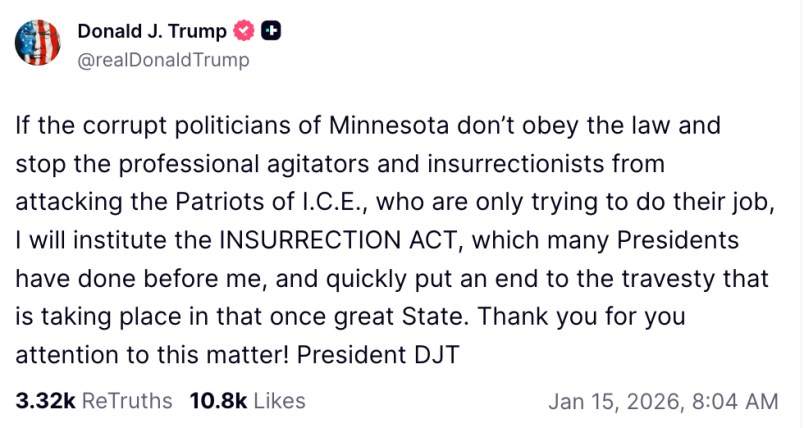
And Thursday morning, President Trump posted on Truth Social: “If the corrupt politicians of Minnesota don’t obey the law and stop the professional agitators and insurrectionists from attacking the Patriots of I.C.E., who are only trying to do their job, I will institute the INSURRECTION ACT…”
The Trump administration’s pressure campaign to get red states across the country to engage in midcycle redistricting has hit another roadblock.
A panel of federal judges rejected a Trump DOJ and California Republican Party request to block California’s new map on Wednesday — once again calling into question the efficacy of the Trump administration’s larger gerrymandering crusade. And although Republicans may appeal, experts tell TPM that given the precedent of a recent Supreme Court ruling upholding Texas’ gerrymandered map, it would be unusual for the Supreme Court to step in.
In a 2-1 ruling on Wednesday, a panel of federal judges ruled in favor of Democratic California Gov. Gavin Newsom, and rejected Republicans’ argument that the maps were racially gerrymandered, specifically to favor Latino voters.
“We find that Challengers have failed to show that racial gerrymandering occurred, and we conclude that there is no basis for issuing a preliminary injunction,” Judge Josephine Staton, a Barack Obama appointee, wrote.
“Having carefully reviewed and weighed the relevant evidence, we find that the evidence presented reflects that Proposition 50 was exactly what it was billed as: a political gerrymander designed to flip five Republican-held seats to the Democrats,” Staton continued.
In response to Republicans’ passage of a new gerrymandered map in Texas last year, Newsom worked with Democratic state lawmakers to spearhead a voter referendum known as Prop 50, allowing lawmakers to temporarily bypass the state’s independent map-drawing commission and approve new congressional district lines for several Republican-dominated and swing districts in the state.
Voters approved Prop 50 this past November, paving the way for new congressional maps that will likely flip five Republican-held seats in California for Democrats in the U.S. House — offsetting the impact of Texas’ maps that are expected to flip five Democratic seats for Republicans.
Wednesday’s ruling comes against the backdrop of a recent Supreme Court ruling that approved the use of a gerrymandered map in Texas for the midterm elections.
Wednesday’s ruling explicitly mentioned that California’s map is similar to Texas’ in that both are partisan, but not racially gerrymandered. That earlier Texas ruling seems to have laid the groundwork for Wednesday’s ruling on California’s map.
Last month, the Supreme Court put on hold a lower court ruling that had initially blocked Texas’ gerrymandered maps from being used in the midterms, finding instead that the District Court’s decision was made too close to the midterm elections. The Supreme Court also ruled that Texas’ map was indeed partisan, but not racially gerrymandered. The court found that a partisan motivation for the new congressional maps was acceptable, but a racial motivation for the map would violate the Fourteenth and Fifteenth Amendments.
In a concurring opinion on the Texas map, Justice Sam Alito, who was joined by Clarence Thomas and Neil Gorsuch, referenced California specifically, writing that “the impetus for the adoption map (like the map subsequently adopted in California) was partisan advantage pure and simple.”
Given this context, it is unlikely that the Supreme Court would step in and rule that California’s process was different than Texas’, experts say.
“The facts on the ground for the plaintiffs in Texas were always much stronger. And SCOTUS said there, despite an extraordinarily thorough opinion from the trial court, ‘not strong enough,’” Justin Levitt, professor of law at Loyola Marymount University, told TPM. “It’s not really credible for the Court to say that a much weaker set of facts in California are strong enough.”
Because of some family travel I’m doing, we’ve rescheduled this week’s podcast til tomorrow, Friday. So it should be in your podcast feeds sometime Friday afternoon.
A 2-1 conservative majority on a federal appeals panel on Thursday reversed a ruling that had blocked federal officers from arresting Mahmoud Khalil, handing the Trump administration a win in its effort to crack down on and in some cases remove pro-Palestinian voices from the country.
The ruling is unlikely to take immediate effect, as attorneys for Khalil are expected to ask a full session of the Third Circuit Court of Appeals to rehear the case. But it marks a defeat for the pro-Palestine activist, whose nighttime detention by ICE agents last year over his pro-Palestine advocacy was an early, high-profile example of the administration’s swift crackdown on those it regards as political opponents.
A week after an agent with Immigration and Customs Enforcement (ICE) fatally shot a Minneapolis woman, half of American women are in favor of abolishing the law enforcement agency altogether, according to one new poll.
Dismantling ICE was a policy embraced by a number of Democratic politicians under President Donald Trump’s first administration, particularly the progressive Squad made up largely of women of color legislators. But whether to double down on a renewed push to abolish the agency is a divisive issue within the party.
I was in the midst of preparing a Morning Memo arguing that Minneapolis is shaping up to be the catalyzing moment that President Trump was looking for to justify doing what he has wanted to do since his first term: invoke the Insurrection Act … when he posted exactly that to Truth Social:
For months, Trump has been trying to instigate civil unrest that would provide the pretext for a U.S. military crackdown on protestors by provoking clashes with federal agents first in Los Angeles, then in Portland, and finally in Chicago. I’ve been puzzling over why he may succeed in Minneapolis when he failed elsewhere, but I don’t think it has much to do with Minnesotans or the elected Democrats in the blue state, but rather with the escalating use of violence that culminated with the shooting of U.S. citizen Renee Good which, critically, was captured on video from multiple angles.
That eruption of violence, while spontaneous, was an entirely foreseeable result of a mass deportation policy built on provocation, retribution against blue states, a rotten policing culture, inadequate training of new agents, machismo, and swaggering belligerence operating under the color of law.
The bellicosity of thousands of masked armed agents swarming the streets of Minneapolis has been amplified, echoed, and reinforced by the highest officials in the land, including President Trump, rather than tamped down.
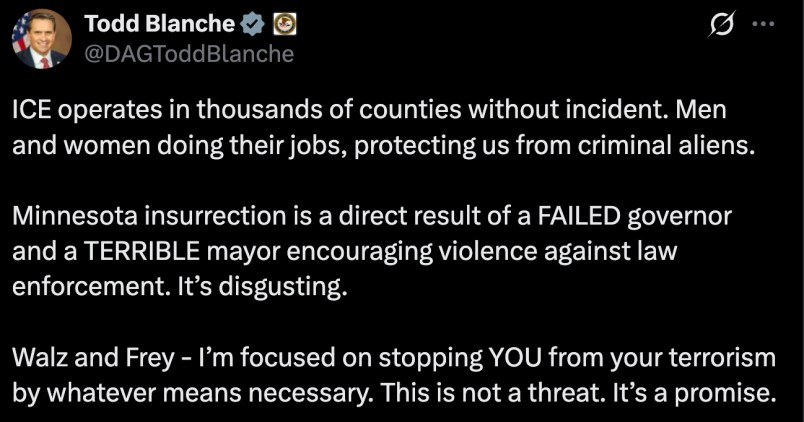
Last night, in a startlingly provocative social media post after another shooting involving a federal agent, deputy Attorney General Todd Blanche called the protests there an “insurrection,” baselessly accused Minnesota elected Democratic leaders of “terrorism” for “encouraging violence against law enforcement,” and threatened to “take whatever means necessary” to stop them. Not whatever legal means or whatever constitutional means or whatever prosecutorial means but a bare “whatever means.” Whatever that means.
Blanche’s Rambo rhetoric came the same evening that Minnesota Gov. Tim Walz gave a brief six-minute televised address to the state. “This long ago stopped being a matter of immigration enforcement. Instead, it’s a campaign of organized brutality against the people of Minnesota by our own federal government,” Walz said.
In a remarkably stark assessment of the clash between a blue state and the Trump administration, Walz warned the people of Minnesota: “Donald Trump wants this chaos. He wants confusion. And, yes, he wants more violence on our streets. We cannot give him what he wants. We can, we must, protest loudly, urgently, but also peacefully. … We cannot and will not let violence prevail.”
The latest rhetorical clash came on an evening when a federal agent in Minneapolis shot an undocumented Venezuelan man in the leg. Both men were hospitalized after the incident. According to official account from the Department Homeland Security — which has been notoriously unreliable throughout the nationwide mass deportation operation — the agent was chasing the man after he fled a traffic stop and crashed his vehicle:
The law enforcement officer caught up to the subject on foot and attempted to apprehend him when the subject began to resist and violently assault the officer. While the subject and law enforcement were in a struggle on the ground, two subjects came out of a nearby apartment and also attacked the law enforcement officer with a snow shovel and broom handle.
As the officer was being ambushed and attacked by the two individuals, the original subject got loose and began striking the officer with a shovel or broom stick.
Fearing for his life and safety as he was being ambushed by three individuals, the officer fired a defensive shot to defend his life. The initial subject was hit in the leg.
Like Blanche, the DHS statement also accused Walz and Minneapolis Mayor Jacob Frey of “actively encouraging an organized resistance to ICE and federal law enforcement officers.”
Protests erupted after the latest shooting incident, and protestors clashed with state and federal law enforcement. “For several hours Wednesday evening, law enforcement and about 200 demonstrators confronted each other in the street, with chemical irritants and flash bangs being deployed and some protesters vandalizing vehicles at the end of the night,” the Star Tribune reported.
We are edging closer to crossing that fateful line when the military is called to put down civil unrest that has not just been provoked but sought after by a president eager to use retributive violence against his political foes while DHS puts out snuff videos that are, as Greg Sargent put it, “consciously depicting the unleashing of ICE on wicked, urban, cosmopolitan, non-MAGA America as a sustained act of cleansing, restorative violence.”
Chart of the Day
The Star Tribune had an insane graphic about the presence of immigration enforcement in Minneapolis. There are more immigration officers in the metro right now than local police officers.
Mary Moriarty, the top prosecutor in Minneapolis, said that lack of access to the federal investigation was “not a complete barrier” to the prosecution of the ICE agent on state charges for the shooting of Renee Good.
The six federal prosecutors in the Minnesota U.S. Attorney’s Office who resigned rather than investigate the political activities of Good’s widow have been deemed “fired” by at the direction of Attorney General Pam Bondi, the NYT reports: “That move cut off pay and benefits they would otherwise have received for weeks after having resigned.”
Mass Deportation Watch
Minnesota Public Radio: Minnesotans describe their encounters with ICE, being detained: ‘I was flooded with fear’
NYT: How ICE Crackdowns Set Off a Resistance in American Cities
WaPo: ICE and activists clash over doxing and privacy, in court and streets
TPM’s Kate Riga: Justice Ketanji Brown Jackson takes a swipe at “Kavanaugh stops” in unrelated dissent
AP: US apologizes for mistake in deporting 19-year-old Babson College freshman Any Lucia Lopez Belloza, but defends her removal.
Quote of the Day
“For those who were there, imagine the flood in New Orleans but instead of federal neglect it’s federal violence. Again and again. And wracked with rage and sadness, people are showing up for each other, again and again.”–Minnesota author Michael Tisserand, who wrote a book about being displaced from New Orleans by Hurricane Katrina, on the federal occupation of his home state
Hot tips? Juicy scuttlebutt? Keen insights? Let me know. For sensitive information, use the encrypted methods here.
For a few hours, we didn’t know why several top prosecutors, including the recent acting head of the office, Joe Thompson, resigned from the U.S. Attorney’s Office in Minnesota in the wake of the shooting of Renee Good. As David Kurtz explains here, it appears to have been a reaction to freezing local authorities out of the investigation into Good’s death combined with an order to open a criminal investigation into the activism of Good’s widow, Rebecca Good. So we know what this was about, or we’re as close as we’re going to get to knowing. But often in these cases, we don’t ever find out the full picture. Or we don’t find out precisely why the person resigned. I’ve been thinking about this. And the whole terrain is similar to the gravitation surrounding other big scandals. At the beginning, at least, you can’t really see what’s at the center of the scandal, but you can see the force of the gravity around it. There’s something similar to these firings
The DC US Attorney’s Office Takes Up Trump Retribution
The Wall Street Journal reported yesterday that when a group of U.S. attorneys gathered at the White House last week for an event, President Trump berated the group for being “weak” and not “moving fast enough to prosecute his favored targets,” in WSJ’s words. Trump’s outburst, during which he also called the group of U.S. attorneys ineffective, happened during a photo shoot, according to the Journal. He reportedly told the group gathered that they weren’t doing enough to help Attorney General Pam Bondi and Deputy Attorney General Todd Blanche do their work. It’s been clear for some time that Trump believes DOJ leadership’s job is to serve as his personal lawyers and, as such, to enact his own personal retribution.
Justice Ketanji Brown Jackson bemoaned in a dissent that the Court’s majority had, in a Wednesday opinion, crafted a “bespoke” doctrine allowing candidates to challenge voting laws with far more leeway than it had even been willing to give victims of law enforcement violence.
Mass resignations at the Justice Department over its handling of the fatal ICE shooting of Renee Good extended into a second day and spread from Washington, D.C., to Minnesota.
In D.C., the number of reported resignations in the criminal section of the DOJ’s Civil Rights Division rose from four to six — a reaction to the decision by assistant Attorney General Harmeet Dhillon not to investigate the Minneapolis shooting. Most of the resignations were by supervisor-level prosecutors, according to CBS News, which had previously reported that career prosecutors in the section had offered to drop all of their work to help investigate the shooting. The Civil Rights Division had already been decimated under Dhillon.
In the Minnesota U.S. Attorney’s Office, an additional six career prosecutors — a majority of the leadership team — resigned over the decision to squeeze state investigators out of the federal investigation into the incident and a related DOJ request to investigate Good’s widow for her protest activities, according to the Star Tribune.
Among the resignations in Minnesota was Joe Thompson, who as the first assistant U.S. attorney was the No. 2 in the office and had previously served as acting U.S. attorney. Ironically, Thompson was the lead prosecutor on the big fraud case in the state that had swept up a number of Somali-Americans and was loudly trumpeted by President Trump and the right wing. The chief of the criminal division also resigned.
Mr. Thompson strenuously objected to the decision not to investigate the shooting as a civil rights matter, and was outraged by the demand to launch a criminal investigation into Becca Good, according to the people familiar with the developments, who were not authorized to discuss them publicly.
The resignation of Thompson and the others is all but certain to cripple the fraud prosecution in similar fashion to how key resignations in the Eastern District of Virginia hobbled the attempts to prosecute James Comey and Letitia James.
Mass Deportation Watch: Somali Edition
Somali refugees in Minnesota legally in the country are being rounded up and shipped to detention centers in Texas, according to reports and refugee advocates.
Good Read
Journalist Laura Jedeed applied to work for ICE and after minimal vetting was offered a job.
Fed Subpoenas Came After Trump Blasted US Attorneys
D.C. U.S. Attorney Jeanine Pirro’s subpoenas to the Federal Reserve on Friday came the day after President Trump blasted a roomful of U.S. attorneys at the White House for being weak and slow in pursuing his vindictive prosecutions, the WSJ reports.
In related news, the NYT reports that Main Justice was “stunned” by Pirro’s Fed subpoeanas:
Senior officials at the department were stunned, and annoyed, that Ms. Pirro did not consult them on an investigation of such international importance, the officials with knowledge of her actions said. …
Ms. Pirro’s decades-long relationship with Mr. Trump gives her the self-confidence to make consequential decisions without first seeking sign-off from her superiors.
Pirro continues to act like the subpoena is all the Feds’ fault for not responding to her earlier demand for documents, telling the NYT: “The drama is all Powell.”
DOJ Defends Halligan in Screed Against Judge
In an unhinged filing in response to a direct court order, the Trump DOJ went off on U.S. District Judge David J. Novak, a Trump appointee in Richmond, Virginia.
Novak had ordered former Trump personal attorney Lindsey Halligan to explain why she persists in identifying herself as U.S. attorney in the Eastern District of Virginia even after another federal judge had ruled her appointment invalid.
In its response — over the names of Attorney General Pam Bondi, deputy Attorney General Todd Blanche, and Halligan, among others — the Justice Department savaged Novak, accusing him of:
violating the Rules of Criminal Procedure;
launching a “quest”;
fundamentally “misunderstanding” the ruling invaliding Halligan’s appointment;
flouting Supreme Court precedent and “elementary” legal principles;
engaging in “a gross abuse of power and an affront to the separation of powers”;
being “flat wrong”;
operating under a “misimpression”;
making a “rudimentary legal error”;
blinded by a “fixation” that is is “untethered from how federal courts actually operate”;
making “a fundamental category error.”
I eagerly await Novak’s response to this scorched-earth approach to willfully refusing to abide by court orders.
Quote of the Day
“If you told him Martians came and stole votes, he’d be inclined to believe it.”—Sen. Lindsey Graham (R-SC) on Donald Trump’s 2020 election loss, in transcripts of secret grand jury testimony from the Georgia election interference case obtained by the NYT
Oops …
A Trump administration effort to prove widespread illegal voting by undocumented immigrants is coming up short.
The Retribution: Elissa Slotkin Edition
Sen. Elissa Slotkin (D-MI) said prosecutors are now involved in investigating the video she and other members of Congress made urging members of the military and the intelligence community to abide by their legal obligation not to follow unlawful orders.
Slotkin had previously announced in November that she had learned she and the others were the target of an FBI counterterrorism investigation over the video she organized. On Tuesday, Slotkin said the Senate sergeant-at-arms was approached by D.C. U.S. Attorney Jeanine Pirro’s office about scheduling an interview with her or her private counsel.
“I’ve studied this kind of political authoritarianism in other countries my entire professional life,” Slotkin told the NYT. “I just can’t believe I am talking about it in my own country.”
Thread of the Day
A quick assessment of the Office of Legal Counsel permission slip for U.S. military action in Venezuela — without a congressional approval — a redacted version of which was released yesterday:
1/DOJ OLC's memo on the #Venezuela attack makes clear that that in the Executive's view, there's nothing left of Congress' Art. I power to decide whether the nation goes to war. Congress needs to push back hard on this.More to come, but a few initial observations:www.justice.gov/olc/media/14…
If you’re piecing together how the oral arguments went yesterday in the two trans athletes cases before the high court, let me recommend:
TPM’s Kate Riga: Right-Wing Justices Warm to Idea that Trans Minority Too Small to Challenge Sports Ban
LawDork Chris Geidner: SCOTUS likely to allow state trans sports bans, but a changed tone could signal a narrow ruling
RIP
The Post-Gazette’s announcement that it will cease operations in May threatens to make Pittsburgh the largest city in the country without a real daily newspaper, Joshua Benton writes:
While there are debates to be had about what it means to be a “city without a newspaper,” the largest thus far is probably Youngstown, Ohio — another Rust Belt burg just across the Ohio line. But metro Pittsburgh’s almost six times the size of metro Youngstown — this would be a new scale of loss.
To be clear, the Post-Gazette will shut down entirely, not merely cease printing and shift to digital publishing.
Hot tips? Juicy scuttlebutt? Keen insights? Let me know. For sensitive information, use the encrypted methods here.