


Justice Ketanji Brown Jackson bemoaned in a dissent that the Court’s majority had, in a Wednesday opinion, crafted a “bespoke” doctrine allowing candidates to challenge voting laws with far more leeway than it had even been willing to give victims of law enforcement violence.
She wrote that the plaintiff in Los Angeles v. Lyons had sued “forty-some years ago,” seeking a ban on life-threatening chokeholds after having been subjected to one by the police that almost killed him. The Court in 1983 found that Adolph Lyons didn’t have enough of a reason to believe that he’d be put in the same chokehold again, and ruled that he didn’t have standing.
On the other hand, Wednesday’s majority opinion in Bost v. Illinois Board of Elections — led by Chief Justice John Roberts — found that candidates for office had standing to challenge election laws without having to show an injury. Their “interest in a fair process” is enough to let them sue.
“The bare assertion of an interest in general fairness, absent the showing of any real and immediate harm, is apparently cognizable only if asserted by candidates for office,” Jackson snarked.
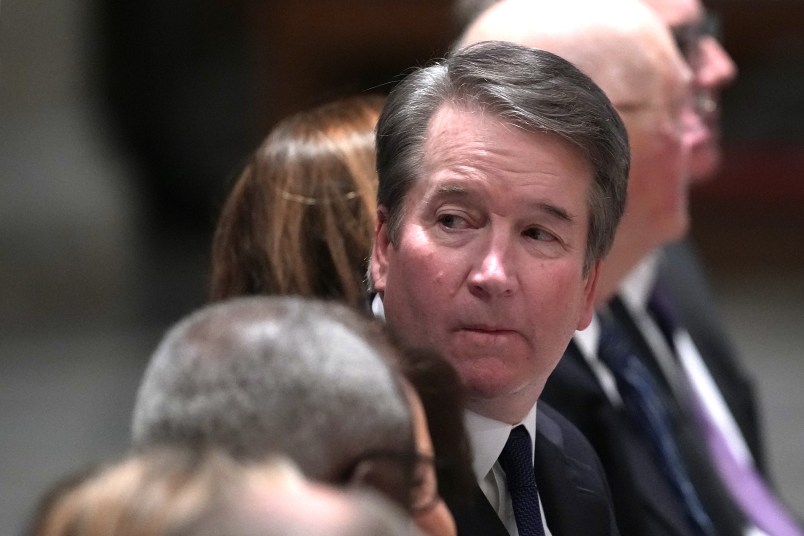
She lamented that the Court hadn’t given Lyons such wide latitude, pointing out the downstream effects of preventing plaintiffs from suing to prevent future law enforcement abuses. One of the effects she cited was so-called “Kavanaugh stops,” which gave ICE the greenlight to detain people who appear Latino “without reasonable suspicion of unlawful presence.” The stops, now frequently used, emerged from an infamous Justice Brett Kavanaugh concurrence in Noem v. Vasquez Perdomo last September.
Justice Sonia Sotomayor joined Jackson in her dissent. Justice Amy Coney Barrett wrote a concurring opinion, joined by Justice Elena Kagan, that agreed that Rep. Michael Bost (R-IL) had standing to challenge Illinois’ grace period for receiving mail-in ballots, but due to the expense of monitoring the extra days of ballot counting.
“I cannot join the Court’s creation of a bespoke standing rule for candidates,” Barrett wrote. “Elections are important, but so are many things in life.”
The case created odd bedfellows. Bost, an election denier, was supported by Judicial Watch, the right-wing group that frequently advances voter fraud conspiracy theories. But the ACLU and League of Women Voters took his side too, pushing for greater leeway for candidate-led election challenges.
Read the ruling here:




Kavanaugh is big sad that he got his name put on something and it’s the only thing that people are going to remember him for. Not even the awesome chugs he used to do.
keep the drum roll about the corrupt court going. Kavanaugh with right wing court colleagues showing their cruel bigoted hearts.
The trumpistas on the Court are utterly shameless, probably incapable of shame.
SCOTUS is really becoming the Billionaire’s Boys Club.
We need a Court of all women justices.
Can you just image the hue and cry over that!!