“You will no longer be abandoned, lonely or scared … You will be protected, and I will be your protector … Women will be happy, healthy, confident and free …You will no longer be thinking about abortion.” You’ve probably heard some combination of these lines and others more than once by now. Donald Trump first posted them on social media sites and then added them to the scripted part of his speech at a rally in Pennsylvania on Monday night. They’ve been greeted with a mix of consternation and mockery. I don’t want to speak for women. But I think it’s safe to say that any woman who has some meaningful investment in abortion rights and reproductive rights generally would find these words some mix of chilling, infuriating, bizarre and absurd. As I read them they essentially say, Only I can be and I will be your total protector. In fact, you will be so totally protected that you will cease to be who you are. Especially coming from a man known to be a serial predator and court-adjudicated rapist — “rape” being the ordinary word, according to the judge in the case, for the acts Trump was found to have committed — these words seem to describe less being protected than engulfed.
Perhaps most simply the words are, as a number of observers have put it, creepy.
If you, like me, are generally skeptical of anything that deprioritizes collective action to hasten the energy transition, then you’ll find the Heatmap project’s approach reassuring. It explicitly recognizes the limitations of individual action:
Trying to zero out your personal carbon footprint, in other words, is a fool’s errand. What you can do, however, is maximize the degree to which you’re building a new, post-fossil-fuel world.
The six broad category recommendations are:
If you need a car, get an EV
Go zero-carbon power at home
Give your home an energy efficient renovation
Electrify your appliances
Drive less, bike (or walk or scoot) more
Know the big 2 climate food rules
There’s more in the package, but you get this gist. It’s a worthy project from some clear-eyed folks who consistently manage not to be smug or precious about the climate challenges we face.
Jan. 6 Judge Shuts Down Trump’s Latest Delay Tactic
U.S. District Judge Tanya Chutkan has ruled, over objections from Donald Trump, that Special Counsel Jack Smith’s brief on presidential immunity due tomorrow can exceed the page limit set by rule. Smith had asked to be allowed to file a massive brief of no more than 180 pages given the complexity of the legal and factual issues the Supreme Court has tasked Chutkan with evaluating before the case proceeds.
Punchbowl has a good rundown of the tensions in play during Ukraine President Volodymyr Zelensky’s visit to the United States this week. On the one hand, his country’s existence depends on pro-Russia Donald Trump not winning in November. On the other hand, any critiques of Trump-Vance put the few remaining but essential hawkish Republicans in a bind. It’s a tightrope for Zelensky.
Stick A Fork In Trump’s Nebraska Chicanery
Nebraska Gov. Jim Pillen (R) announced he will not call a special legislative session to change how the state allocates its electoral votes.
Bernie Moreno’s Self-Own On Abortion
GOP Senate nominee Bernie Moreno’s incendiary remarks about abortion, women over 50, and women’s concerns being a “little crazy” has thrust abortion rights to the forefront of one of the most closely watched Senate races in the country.
2024 Ephemera
Kamala Harris will give a major speech in Pittsburgh today on her economic policy plans.
NYT: News Outlets Brace for Chaos on Election Night (and Perhaps Beyond)
WSJ: Could Republican Rep. Anthony D’Esposito’s Alleged Affair Affect the Control of Congress?
Trump Assassination Attempt: Florida
The latest developments:
New charges: A newly unsealed five-count federal indictment against alleged golf course gunman Ryan Wesley Routh charges him with the attempted assassination of a major presidential candidate, Donald Trump. Routh is scheduled to be arraigned on Monday.
This didn’t age well: The indictment adds to the original federal weapons charges against Routh that the feds had used to detain him while they prepared a broader set of charges. Trump had falsely claimed Monday that the original weapons charges showed the feds were “mishandling and downplaying” the incident.
History appreciates irony: The attempted assassination case against Routh was randomly assigned to … U.S. District Judge Aileen Cannon.
Trump Assassination Attempt: Pennsylvania
The latest developments:
A preliminary Senate report released today documents some of the Secret Service failures in the lead up to the July assassination attempt on Trump in Pennsylvania.
The Senate report expands upon and amplifies many of the previously reported breakdowns in planning, communications, and coordination for securing the Trump campaign rally.
Trump is planning to return next month to the scene of the attempted assassination to hold another campaign rally at the Butler Farm Show fairgrounds.
‘Trump Train’ Civil Trial Ends With Mixed Verdict
Austin American-Statesman: “A Texas jury on Monday found that a San Antonio man violated the Ku Klux Klan Act but cleared five other defendants of liability in a two-week trial over a ‘Trump Train’ convoy in Central Texas that swarmed a Joe Biden-Kamala Harris bus along one of the state’s busiest highways in October 2020.”
Violent Crime Is Down But Right-Wing Media Ignores It
CNN: “The FBI on Monday reported that violent crime dropped across the US last year, registering the steepest annual decline in murders in decades. But the report was almost entirely ignored by right-wing media outlets, which have pushed a false narrative that crime is surging under President Joe Biden.”
Government Shutdown Averted
Both the House and Senate are expected to pass by the end of today legislation to fund the government until late December – then recess and not return to DC until after the election.
Cold War Throwback
“Continuity of government” was one of those Cold War notions that nerdy kids like me obsessed over back in the day (confession: Within the last month, a friend sent me a photo of the Greenbrier Bunker, which was to have housed Congress in the event of a nuclear attack, so my nerd days are not really in the past.) COG was back in the spotlight in the immediate aftermath of the 9/11 attack and morphed into a meme after Vice President Dick Cheney kept scooting off to a “secure, undisclosedlocation.” But perhaps the most pressing threat to Congress is more mundane and grim: incidents like the 2017 congressional baseball practice shooting:
Over the past 15 years, members of Congress have survived two near-deadly shootings, a train crash with dozens of them on board, and a Capitol riot that had hundreds of lawmakers fearing for their lives.
Despite those incidents, the institution is wholly unprepared for a catastrophic event that kills or incapacitates multiple members — even if that hypothetical tragedy results in a major power shift: changing which party holds the majority in the House or Senate.
A quick update on the Nebraska electoral vote situation. As I noted yesterday, the key hold out in the state legislature, Mike McDonnell (R), said he was a definitive no. That pretty much signaled the end of the effort. Since they need his vote. Since then Sen. Deb Fischer also said it was over. And now Gov. Jim Pillen (R) has said he will no longer call a special legislative session to make the change. Given the nature of Trumpism, I don’t think anything is ever truly done. In Trumpism, an election result amounts to no more than an advisory opinion. But this looks as close as one gets to done. Done enough to take it off the front burner of concerns.
It was a gamble when abortion rights groups in Ohio pushed to get an initiative protecting the procedure on the ballot in 2023, rather than waiting for the high-octane 2024 presidential cycle.
I’ve been trying to get my head around a number of issues going on in the campaign. So today I’m just going to flag a few things to keep an eye on.
First, we have something that we’ve discussed a few times. Earlier this year, as part of the Trump campaign’s full takeover of the RNC, Trump’s campaign took field organizing away from the RNC and essentially outsourced it to a series of super PACs including Turning Point USA and Elon Musk’s America PAC. (Musk’s group is run by a team of former DeSantis campaign staffers.) That seemed to many like a risky and possibly self-destructive idea. In modern politics, ground operations are the main role of the national political parties during a presidential campaign. They have experience at it. Why would you hand it off to super PACs, which are often long on dollars but can lack basic institutional knowledge and experience?
Ohio Republican Senate candidate Bernie Moreno attacked suburban women in his state who support access to abortion on Friday, calling them “a little crazy” while questioning why older women are even worried about access to the procedure during a county town hall.
At a campaign rally Monday in Pennsylvania, Donald Trump creepily tried to reassure women voters that he’s not only not a threat but will be their “protector”:
“I always thought women liked me. But the fake news keeps saying women don’t like me.”
“You will be protected, and I will be your protector.”
“Women will be happy, healthy, confident and free.”
“You will no longer be thinking about abortion.”
The president who ushered in the overturning of Roe v. Wade, bragged about sexually assaulting women, and was found liable for sexual abuse now realizes that the legacy of the Dobbs decision that his three Supreme Court nominees made possible could wind up being be his own election defeat in November.
The scramble Trump has been engaged in for months to blur his position on abortion so as to give his women supporters incentive to stay in his column while not alienating his evangelical base is now reduced to a plaintive cry of “I always thought women liked me.”
You know, the left has a lot of single issue voters. Sadly, by the way, there’s a lot of suburban women, a lot of suburban women that are like, ‘Listen, abortion is it. If I can’t have an abortion in this country whenever I want, I will vote for anybody else.’ … OK. It’s a little crazy by the way, but — especially for women that are like past 50 — I’m thinking to myself, ‘I don’t think that’s an issue for you.’
Trump Escalates His Jihad Against Immigrants
Trump’s “blood and soil” rhetoric against legal immigrants in Ohio prompted the crowd at his Pennsylvania rally to begin chanting “Send them back.”
In recent days, Trump has broadened his attack on Haitian refugees from his initial focus on Springfield, Ohio, to include the small Pennsylvania town of Charleroi. He repeated those attacks at yesterday’s rally.
Election Security Watch
Georgia: Anna Bower offers a gentle corrective on how much mischief the MAGAified state election board can really stir up in the post-election phase (the quick-read version is here).
Ohio: A local election board voted not to use the county sheriff for security during in-person absentee voting after his dehumanizing Facebook post in which he said people with Kamala Harris yard signs should have their addresses recorded so that immigrants can be sent to live with them if she wins the presidency.
Nebraska Hangs Tough Against Trump Pressure
It looks like a key state lawmaker in Nebraska won’t budge, potentially spelling the end of Donald Trump’s effort to change the rules late in the game in order to harvest one additional Electoral College vote.
2024 Ephemera
Hung out to dry: Donald Trump hasn’t given a dime to the cash-strapped National Republican Congressional Committee, which is responsible for holding the GOP’s House majority.
Melania got paid though: The former first lady was paid $237,500 for a speech at an April event of the Log Cabin Republicans, but the group said it didn’t put up the money and it’s not clear who did.
Judd Legum reports that he received Trump campaign internal documents – including a letter dated Sept. 15 – from a conduit named “Robert” who was shopping materials purloined in Iran’s hack of the Trump campaign.
The late date of the letter from an attorney representing Trump to three people at the New York Times (its authenticity was separately confirmed by the newspaper) suggests that the hack has continued past the initial revelations of its existence. The “Robert” who reached out to Legum appears, but is not confirmed, to be the same person who provided hacked materials to other news organizations.
I Miss Run Of The Mill Public Corruption
Back before democracy itself was regularly on the ballot, TPM’s bread and butter was public corruption – an endemic but not existential threat to democracy so long as it’s kept under control. (I grew up in Louisiana and cut my teeth as a journalist there, so I’m familiar with the perils of out-of-control corruption.) Now I have what almost amounts to nostalgia when we get stories like that of former Rep. George Santos (R-NY) or this new revelation about his former New York House delegation colleague Anthony D’Esposito (R-NY) involving patronage and sexual peccadilloes:
Shortly after taking the oath of office, the first-term congressman hired his longtime fiancée’s daughter to work as a special assistant in his district office, eventually bumping her salary to about $3,800 a month, payroll records show.
In April, Mr. D’Esposito added someone even closer to him to his payroll: a woman with whom he was having an affair, according to four people familiar with the relationship. The woman, Devin Faas, collected $2,000 a month for a part-time job in the same district office.
Payments to both women stopped abruptly several months later, in July 2023, records show, around the time that Mr. D’Esposito’s fiancée found out about his relationship with Ms. Faas and briefly broke up with him, according to the four people.
It hearkens to a earlier, simpler time, another thing Trump ruined for all of us.
A War Both Sides Hoped To Avoid
David Ignatius: Sadness and dread as the next Lebanon war looms
Love This Kind Of Stuff
Hayes Manor plantation house — East Water Street vicinity, Edenton vicinity, Chowan County, North Carolina. VIEW FROM SOUTHWEST (REAR). 1940 photograph from the HABS—Historic American Buildings Survey images of North Carolina.
A rare original copy of the Constitution discovered in a historic North Carolina home in 2022 is set to be sold at auction this week. One expert told the NYT that it was “probably the most important copy of the Constitution that would exist.”
It was found by appraiser Ken Farmer, of Antiques Roadshow fame, in a home in Edenton that was once owned by Samuel Johnston, who served North Carolina as variously governor (1787-1789), president of the ratifying conventions of 1788 and 1789, and first U.S. senator (1789-1793).
On April 8, a shocking article appeared under the banner of the “Washington Post.” The headline declared that President Joe Biden, who was at the time running for a second term, “needs migrants” to win the election. It went on to allege that Biden and the Democratic Party had “smuggled over 320,000 illegals by plane through several airports last year” to secure victory and further a nefarious agenda.
This article is part of TPM Cafe, TPM’s home for opinion and news analysis. It was originally published at The Conversation.
Many Americans will find on their November 2024 ballot a space to vote for an important office: local sheriff. While there are exceptions, sheriffs have a long history of using their power to maintain a particular, unequal balance of power in society, often along racial and class lines.
A recent example of this arose on Sept. 13, 2024, when Bruce Zuchowski, sheriff of Portage County, Ohio, posted a message on a Facebook page headed by a graphic that included his official portrait and which was labeled with his official title. Zuchowski called for the public to write down the addresses of people who have campaign signs supporting Democratic nominee Vice President Kamala Harris in their yards.
That way, he said, when immigrants arrive and need housing, “We’ll already have the addresses of the … families … who supported their arrival.”
The post, which Zuchowski later claimed appeared on his “personal Facebook page,” used derogatory terms for immigrants and for Harris. It also included screenshots of two Fox News stories about migrants in Aurora, Colorado, and Springfield, Ohio, which are both places that former President Donald Trump, the Republican nominee, and his running mate JD Vance have falsely claimed to be sites of dangerous activity by immigrants.
The header of a page Sheriff Bruce Zuchowski claimed is a ‘personal’ Facebook page shows him in uniform and carries his full title. Screenshot of a Facebook page
Sheriffs in the U.S. don’t often get national news attention, but Zuchowski’s request was covered in The Washington Post, NBC News and The Guardian, among others.
There are more than 3,000 sheriffs elected at the county level in the United States, each of whom has authority and autonomy to both set and enforce law enforcement policy. For example, sheriffs in many states can decide whether their deputies will wear body cameras and what happens to the footage recorded during routine stops.
Zuchowski’s post, which vilifies immigrants and targets people who support immigrant rights, is just part of that long history of sheriffs using their power as a tool of social control, as we document in our book.
In the wake of Zuchowski’s post, The Portager, a news website in his community, reported residents saying the sheriff’s post constituted voter intimidation. Some residents have called for investigations of the sheriff’s office by local, state and national agencies, including the Department of Justice’s civil rights division.
So far, the Ohio Secretary of State’s Office says the sheriff has broken no laws.
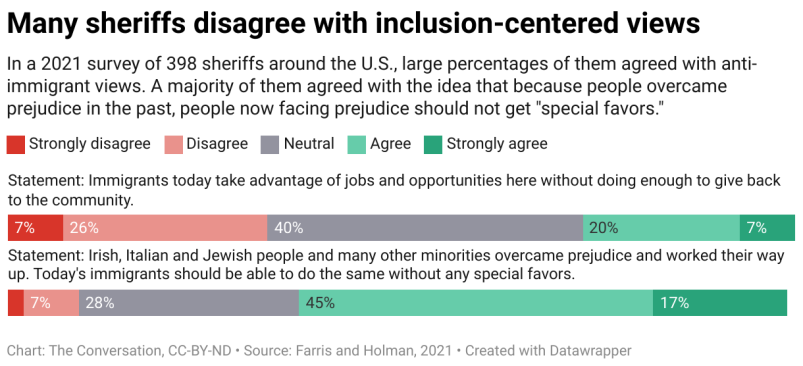
In both our book and previous work, we document through two national surveys how variations in sheriffs’ views on race and ethnicity may shape their office’s policies and practices.
In our research, we have found that sheriffs’ negative attitudes toward immigrants are statistically correlated to their offices’ anti-immigrant policies. For instance, sheriffs with more negative attitudes are more likely to have an official policy to check the immigration status of crime victims and witnesses. That relationship held even after we controlled potential influence of other factors such as political partisanship and the share of the native-born population in a sheriff’s county.
Similarly, as we show in our book, sheriffs with racist views were less likely to report to us their deputies have been trained to reduce racial and ethnic bias in traffic enforcement. That issue is a problem in Portage County, according to the local NAACP, which in 2023 released a report claiming the sheriff’s office unfairly targets Black drivers.
Since his initial post, Zuchowski has defended himself on social media, writing:
“If the citizens of Portage County want to elect an individual who has supported open borders (which I’ve personally visited Twice!) and neglected to enforce the laws of our Country … then that is their prerogative. With elections, there are consequences. That being said … I believe that those who vote for individuals with liberal policies have to accept responsibility for their actions! I am a Law Man … Not a Politician!”
Despite Zuchowski’s claims, he is indeed a politician. Like other sheriffs in the United States, he was elected by voters. He was the Republican nominee in 2020 and is running for reelection in 2024.
Like sheriffs across the country, Zuchowski had extensive law enforcement experience, including working in the Portage County Sheriff’s Office prior to running to head the office. We found that more than 85% of sheriffs worked for the previous sheriff before seeking election. And like most other sheriffs, Zuchowski is a whiteRepublicanman. We and others find that more than 90% of sheriffs are white and over 98% are men.
Across the United States, sheriffs will ask voters for their support this fall to remain in office. In most counties, these elections are uncompetitive: Sheriffs usually run either unopposed or against weak candidates.
In this way, Portage County is an exception. Zuchowski’s first election was a competitive race for an open seat, and he faces a challenger to his reelection bid in the 2024 election. His Democratic opponent, Jon Barber, is similarly a white man with a law enforcement background.
But Barber’s campaign website highlights another common challenge for voters: how to pick a good sheriff. His site focuses on transparency, accountability and community policing, with no discussion of immigration. Voters don’t get a clear message about any substantive differences that might exist between the two candidates.
Will Zuchowski’s comments matter for voters? Elsewhere around the country, voters have reelected sheriffs who have made anti-immigrant and racist comments.