How DOJ’s ‘Brashest Enforcer’ Is Key to the Abrego Garcia Case

Remember This Name

A new Bloomberg piece on a key figure in the Trump DOJ could have real-world, on-the-ground implications for Kilmar Abrego Garcia’s vindictive prosecution claim.

The subject of the profile is 33-year-old associate deputy attorney general Aakash Singh, who works in the office of Todd Blanche and is described as DOJ’s “brashest enforcer” in transmitting the demands of the Trump White House to the 94 U.S. attorneys around the country.

“He’s brought an unprecedented move-fast-and-break-things approach to steering contentious cases that have drawn rebukes from judges and juries and alarmed top prosecutors,” Bloomberg reports, citing a conference call Singh led last month with U.S. attorneys where he declared President Trump to be their “chief client.”

After Singh was endorsed for a role at Main Justice by right-wing bomb-thrower Mike Davis, he “reported to the deputy AG’s office 13 months ago and quickly became an omnipresent figure prodding US attorneys’ offices for information far more frequently than chief prosecutors had experienced in prior administrations,” according to Bloomberg.

It’s a great profile on its own terms, with lots of granular detail and nuance, but it is also very relevant to Abrego Garcia’s claims of vindictive prosecution in his criminal case in Nashville, where a key evidentiary hearing is scheduled for next week. Singh is perhaps the central figure in the vindictive prosecution saga.

Here’s the backstory on Singh’s controversial role …

After months of slow-rolling the production of documents sought last year by Abrego Garcia, the Trump DOJ finally coughed up relevant materials for the judge in the case to review last fall. After reviewing the documents, U.S. District Judge Waverly D. Crenshaw Jr. ordered on Dec. 3 that they must be turned over to Abrego Garcia (emphasis mine): “The documents that must be produced connect back to Blanche because the documents suggest that Singh had a leading role in the government’s decision to prosecute and Singh works in Blanche’s office.”

The Trump DOJ has argued that interim U.S. Attorney Robert McGuire solely made the decision to prosecute Abrego Garcia, and the inquiry should stop there. But after reviewing the documents, Crenshaw was unconvinced: “These documents show that McGuire did not act alone and to the extent McGuire had input on the decision to prosecute, he shared it with Singh and others.”

Crenshaw’s order lists the various internal DOJ documents at issue and Singh’s role overseeing McGuire’s handling of the case, which in many ways mirrors Bloomberg’s description of Singh’s MO. Here are the Singh-related documents from Crenshaw’s order:

  • April 27, 2025: “Aakash Singh email requests time to discuss Abrego’s cooperating witness with Assistant Attorneys General in Tennessee, Alabama and Texas, including McGuire.”
  • April 28, 2025: “Aakash Singh receives Tennessee Highway Patrol report on Abrego.”
  • April 30, 2025: “Aakash Singh receives email from Assistant Attorneys General in Tennessee, Alabama and Texas regarding Abrego’s cooperating witness and his appearance before the grand jury.”
  • April 30, 2025: “Emails between Aakash Singh, McGuire and Jacob Warren, regarding criminal charges arising from the November 2022 Abrego traffic stop. Singh writes ‘It’s a top priority.’ McGuire writes ‘we want the high command looped in.'”
  • May 18, 2025: “Aakash Singh receives an email update on Abrego indictment, grand jury testimony, whether indictment will be sealed or open that states: ‘We’re working over the weekend to finalize an indictment that we will send to you tomorrow night or first thing Monday.’”
  • May 20, 2025: “Aakash Singh requesting memo from McGuire and others.”

Abrego Garcia was indicted on May 21, 2025.

This generally matches with how Bloomberg describes Singh’s micromanagement of U.S. attorneys, “an unwelcome deviation from decades of apolitical norms” in which they reported directly to the deputy attorney general but still had considerable autonomy:

[Singh’s] emails ordering case-specific data, such as listing all investigations fulfilling various Trump policies, and with single-day deadlines, have proven particularly problematic. Complying with those demands has meant late nights for supervisors redirected from reviewing search warrants or advancing significant prosecutions, several DOJ lawyers said.

Some since departed US attorneys’ offices leaders said the process felt like overt bullying, as they saw no evidence Singh found utility in the data.

In anticipation of the evidentiary hearing on his vindictive prosecution, Abrego Garcia subpoenaed Singh and other top DOJ officials, including Blanche, to testify. The Trump DOJ has fought tooth and nail to keep them from having to testify.

For now, Judge Crenshaw has punted on whether to enforce those subpoenas. He has given the Justice Department a chance at next week’s evidentiary hearing to prove it didn’t engage in a vindictive prosecution. If it fails to prove it, Abrego Garcia wins. If it does establish a good faith basis for the prosecution, Crenshaw will consider letting Abrego Garcia make his case by enforcing his subpoenas and forcing Singh and other DOJ higher-ups to testify.

I’m planning on attending the evidentiary hearing in Nashville next week in person and look forward to bringing you that coverage. More on all of this next week.

Trump Banner Defaces Main Justice

The Destruction: DOJ Edition

Because President Trump has broken the Justice Department, criminal defendants in real cases are not being prosecuted, the AP reports: “A growing number of defendants are beginning to escape accountability, as the remaining prosecutors are forced to dismiss some cases, kill others before charges are filed and seek plea agreements and delays.”

The lead example in the AP story: A 12-time convicted felon was scheduled to stand trial next month on methamphetamine trafficking charges but walked after the prosecutor on his case retired and U.S. Attorney Daniel Rosen couldn’t find a replacement.

Mixed News on Mandatory Detentions

The Trump administration’s unilateral reinterpretation of the long-standing law for when undocumented immigrants already in the country can be detained — a position that has been nearly universally rejected by district court judges — found new life from another appeals court yesterday.

For those catching up, this new unmoored interpretation led to (i) the flood of habeas cases that has inundated federal courts; (ii) dozens of judges in hundreds of cases ordering migrants freed from detention; and (iii) the Trump DOJ becoming so overwhelmed by the staggering new caseload that it has missed deadlines, ignored court orders, and in at least one instance been found in contempt of court.

In oral arguments, a three-judge panel of the 8th Circuit Court of Appeals — which includes Minnesota — was “friendly” to the Trump administration position that the law allows it to detain all undocumented immigrants without bond hearings. The uber-conservative 5th Circuit Court of Appeals has already sided with the Trump administration’s interpretation.

Meanwhile, U.S. District Judge Sunshine S. Sykes of Riverside, California, who previously certified a class action case to challenge the administration’s interpretation of the statute, issued a new order for DHS to provide notice to thousands of immigrants detained nationwide that they can join a lawsuit against the government and get either a hearing or be immediately released, the NYT reports.

Sykes was particularly miffed that the administration continued to detain migrants under its interpretation even though she had set aside an immigration court’s ruling that ratified that interpretation:

Respondents have far crossed the boundaries of constitutional conduct. Somehow, even after the judicial declaration of law that the DHS was misguided in its act of legal interpretation that nullified portions of a congressionally enacted statute, Respondents still insist they can continue their campaign of illegal action. The shameless submission that is Respondents’ Opposition deliberately seeks to erode any semblance of separation of powers.

Thread of the Day

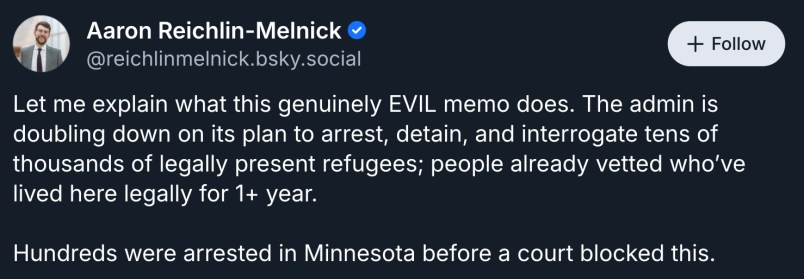
Immigrant advocate Aaron Reichlin-Melnick explains the impact of a new DHS memo, first reported by Chris Geidner:
Only the Best People

The anesthesiologist husband of Labor Secretary Lori Chavez-DeRemer has been barred from the department’s D.C. headquarters after at least two female staff members complained that he had sexually assaulted them, the NYT reports. One of the alleged incidents was reportedly caught on a secrity camera, and the D.C. police sexual assault unit is investigating:

After the women described the incidents to investigators, Dr. [Shawn] DeRemer was barred from entering the Labor Department’s premises, according to people familiar with the decision, who asked not to be identified because of the sensitivity of the allegations and ongoing investigations surrounding the department.

The Labor Department under Chavez-DeRemer has been a hot mess, with most of the scrutiny on the secretary herself, not her husband:

The inspector general’s office is investigating a formal complaint that Ms. Chavez-DeRemer was having an inappropriate sexual relationship with a subordinate — a member of her security detail — and abusing her office by taking staff to strip clubs, drinking alcohol on the job and taking personal trips at taxpayer expense. Her lawyer has denied the allegations.

Neither of them responded to the NYT for its article.

The Corruption: Crypto Edition

WSJ: Pardoned Binance Founder Hobnobs With Trump Sons and Administration Officials at Mar-a-Lago Crypto Fest

Amazon Tops Walmart

A landmark in the history of American capitalism: Amazon’s annual revenues in 2025 surpassed Walmart’s for the first time, dethroning it as the largest U.S. company by revenue.

Graffiti of the Day
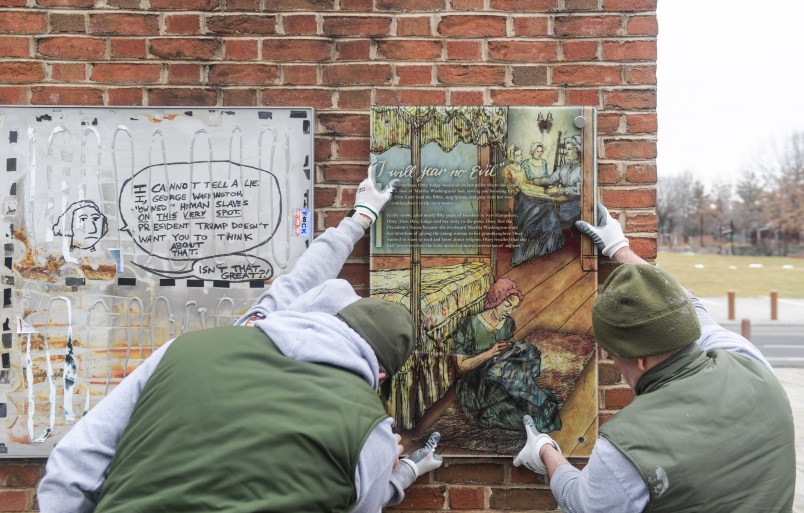
PHILADELPHIA, PENNSYLVANIA – FEBRUARY 19: Staff with the National Parks Service replace the plaques that were part of the ‘Freedom and Slavery in the Making of a New Nation’ exhibit at the President’s house on February 19, 2026 in Philadelphia, Pennsylvania. On January 22nd the exhibit was removed as part of the Trump administration’s policies, and on President’s day U.S. District Judge Cynthia Rufe ordered the exhibit’s restoration.(Photo by Matthew Hatcher/Getty Images)

Hot tips? Juicy scuttlebutt? Keen insights? Let me know. For sensitive information, use the encrypted methods here.
Why Federal Gov’t Unions Saw a More Than 6% Increase in Membership in 2025

As President Donald Trump’s actions targeting federal government unions and employees make their way through the courts, new data from the Bureau of Labor Statistics suggests the president’s show of force against American public servants may have backfired.

Since last March, Trump has moved to abruptly end union protections for hundreds of thousands of government workers. At the same time, largely through the Department of Government Efficiency, or DOGE, the administration in 2025 fired tens of thousands of federal workers while tens of thousands more retired, quit, or accepted the DOGE “fork in the road buy out.” Data from the BLS January jobs report shows the federal government shed 324,000 jobs between January 2025 and January 2026.

Despite this, the number of federal employees who are union members increased by 6.4% between 2024 and 2025, according to the annual BLS Union Members Summary published Wednesday. The number of federal workers who are represented by unions, which means that a worker might be covered by a union contract but not a member, increased by 3.2%.

The increase in union membership and representation likely stems completely from a galvanized federal workforce whose members sought workers rights protections amid attacks from the Trump White House, Celine McNicholas, director of policy at the Economic Policy Institute, told TPM. 

“It’s folks actively choosing to join their union, and it does make a little bit of intuitive sense if you think about it, while all of these attacks have been going on,” McNicholas said. “Those lawsuits trying to defend folks’ right to their jobs or their rights to collective bargaining are being led by the unions themselves.”

Trump’s March executive order applied a national security provision in the U.S. Code to a wide swath of previously excluded departments and agencies to invalidate collective bargaining for more than 300,000 employees. Departments included in that order ranged from the Department of Veterans Affairs, to the Food and Drug Administration, from the Animal and Plant Health Inspection Service to the Federal Communications Commission. Departmental response was swift. Last summer, the VA, the Environmental Protection Agency and FEMA, among others, announced an end to their collective bargaining agreements. But just as promptly came the legal reactions from federal unions. Six unions, including the American Federation of Government Employees, sued the administration and a U.S. District judge issued an injunction halting the order. By August, though, a three-judge panel of the 9th U.S. Circuit Court of Appeals lifted the injunction, granting the Trump administration license to continue bulldozing federal workers’ rights while the case played out in court. ​​ 

A diverse array of unions have filed at least 16 lawsuits fighting Trump’s attacks on federal collective bargaining, according to a litigation tracker by Just Security, a law and policy journal based out of the New York University School of Law. Beyond defending their right to unionize, unions are behind at least 30 total lawsuits challenging the Trump administration.

Access to the union law firm is one reason Peter Cantwell, president of the National Association of Independent Labor (NAIL), believes his union membership has increased “manyfold” since January 2025. Cantwell also attributed the membership boost to the work of his staff and local presidents. NAIL represents thousands of federal employees across 20 locals working at the EPA, the Department of Defense, the Department of Transportation, and the Department of Commerce. 

Cantwell said his membership increased 50% beginning in early 2025, driven, to his surprise, by early and mid-career employees.

“Employees know and understand we provide persistent and quality assistance when unfortunate challenges arise in employment,” Cantwell told TPM via email. “While times are challenging in [f]ederal [e]mployment, employees still want to do the nation’s business with all the legal protections Congress has provided and SCOTUS has affirmed.”

While the Department of Homeland Security has made much ado about its massive federal law enforcement hiring spree, McNicholas said the hiring of a few thousand extra immigration and customs agents is not responsible for the bump in federal union members. This is for a few reasons, McNicholas said. First, Immigration and Customs Enforcement announced the hiring of 12,000 new officers in 2025, a “historic 120% manpower increase,” ICE said in a press release, but a paltry figure in light of the millions of federal workers employed nationwide. Their hiring and union representation wouldn’t make a dent in the BLS figures, McNicholas suggested. Next, the funding for increased ICE and Customs and Border Protection officer hiring came more than halfway through the year with Trump’s tax cuts and defense spending bill, the One Big Beautiful Bill Act. As the BLS report is annual, McNicholas wouldn’t expect a late-in-the-year hiring spree to impact its data. And finally, the federal government moves slowly. McNicholas said she’d seen reports of newly hired federal law enforcement who still hadn’t received benefits.

Meanwhile, federal unions have scored some legal wins against the Trump administration over the last year. In November, Judge Paul Friedman of the U.S. District Court for D.C. temporarily paused the Trump administration’s attempt to cancel collective bargaining rights for workers at the United States Agency for Global Media, home to Voice of America. In December, Judge Susan Illston of the U.S. District Court for Northern California ruled that Trump’s firing of federal workers during the historically long government shutdown violated a continuing resolution passed by Congress, ordered the administration to reinstate workers and paused further cuts.

In response to the BLS union report, which showed overall union membership in 2025 up slightly year over year, Liz Shuler, president of the AFL-CIO, said union-busting bosses are failing. 

“These numbers confirm what we’ve seen in the labor movement: Workers have felt President Trump’s billionaire-first agenda in action and are hungry to take back their power,” Shuler said in a release. 

McNicholas said taxpayer dollars are funding the president’s legal defense against the tens of suits brought by unions, as well as the hundreds of suits filed to challenge Trump’s myriad executive orders.

“I’ve heard many a union organizers say nothing motivates workers to speak up and demand representation like a terrible boss,” McNicholas said, “and I would argue Trump is the ultimate terrible boss.” 

A Ground-Level Report on ICE’s Gulag Buildout

Courtesy of an anonymous TPM Reader, I wanted to share a fascinating, if mundane document with you. This is a report from the city of Social Circle, Georgia (a very conservative area) reporting on their discussions with the Department of Homeland Security about the department’s plans to build an ICE facility in the city. It contains a remarkable degree of transparency about the city’s discussions with DHS, a helpful reminder of the resilience or the promise of local self-government.

But what caught my attention is the slapdash way in which DHS is really trying to run roughshod over local jurisdictions and generating resistance for reasons quite separate from political opposition to ICE’s mass deportation program. I really recommend taking a few moments to read it.

Awaiting the Supreme Court Decision That Could ‘Completely Erase’ the ‘Civil Right Movement’s Crowning Achievement’

A set of Supreme Court decision days, beginning Friday, could feature a body blow to the United States’ multiracial democracy. 

Louisiana v. Callais “could completely erase all, or most, of the gains of the civil rights movement’s crowning achievement,” Wendy Weiser, vice president for democracy at the Brennan Center, told reporters Thursday. 

The Court could use the case to shred what remains of the Voting Rights Act, hobbling the section of the law under which voting rights groups challenge district maps that dilute minority voters. Prior to the Act’s passage, Black voting power and political representation, particularly in the South, was all but nonexistent. The right has worked for years to return to that place, and, after more than a decade of chipping away at voter protections, the Court seemed poised during October oral arguments to finish the job.

All three branches of government are currently working in tandem to unravel voting protections and impose new restrictions, just months before a midterm cycle Republicans fear will go poorly for them. In addition to the Court likely killing what remains of the Voting Rights Act, congressional Republicans have coalesced behind the SAVE Act to add onerous proof of citizenship and photo identification requirements nationwide. Only the Senate filibuster stands in the way of its passage.  

If the SAVE Act gets to President Trump, Weiser said, it would be “the first time the U.S. Congress passed a voter suppression law.” 

The House is also set to vote on the Make Elections Great Again Act, which is even more pernicious and would ban universal mail-in voting, counting ballots after Election Day and ranked-choice voting.

Meanwhile, the Trump administration is trying to impose voter restrictions via executive action (unsuccessfully, so far), has been the primary engine behind pushing red states to redistrict and raided the Fulton County, Georgia election office. Allies have urged Trump to deploy ICE or the military to polling places, a scheme transparently aimed at intimidating Democratic voters into staying home. 

Fair Fight’s Lauren Groh-Wargo cited an old episode of Steve Bannon’s podcast Thursday, where he and a guest ticked off the three ways Republicans had to manipulate elections to guarantee one-party rule in the United States: execute mid-decade redistricting, gut Section 2 of the Voting Rights Act and tinker with the census. 

When Louisiana v. Callais comes down, as soon as Friday, Bannon and co. may have come closer to realizing their vision.

It Could Also Be the Tariffs Ruling  

Court-watchers have cycled through breathless anxiety to anticlimactic comedown since late last year, waiting for a major Court decision on the legality of Trump’s indiscriminate spray of tariffs. The tariffs stretch the limits of executive power, have serious economic ramifications and, potentially, array the right-wing Court majority in opposition to a president it is much more comfortable supporting.

Alito Eying the Exits? 

It’s become conventional wisdom that Justice Samuel Alito will step down at the end of this Court term for a reason: Republicans fear that they’ll lose control of the Senate. If they do, the 75-year-old Alito might have to hang on until at least 2028 for another right-wing judge to get confirmed in his place — even longer if Democrats win either the White House or the Senate. 

Add to that another fairly obvious signal: Alito has a book coming out in October (a favored gambit of older political figures to get out ahead of the legacy-defining), and that his wife Martha-Ann has been musing in public over him getting “free of this nonsense” since at least 2024.  

The only possible motivation for Alito to stay is the megalomania that drives members of Congress to cling to their seats until they die. But he knows better than anyone that his vision of America is only possible if the Court stays in the grip of the right, and that requires clearing the way for a young justice crafted in his image.   

…And Is Thomas?

The calculus that applies to Alito applies equally to his 77-year-old brother-in-ideology. Thomas isn’t writing a book, as far as I know, leaving us without one of Alito’s major tells. But if Thomas doesn’t also depart this summer, he’ll be taking quite an actuarial gamble.

In Case You Missed It

Morning Memo: America’s True Exceptionalism: A Culture of Impunity

The Franchise: A Setback for the DOJ’s Push To Get State Voter Rolls

The Backchannel: CEOs Joined Trump’s Corruption. It Will Soon Be Time for Consequences.

Yesterday’s Most Read Story

Trump’s Fave Snarling Spox Exits Stage Right

What We Are Reading

U.S. Gathers the Most Air Power in the Mideast Since the 2003 Iraq Invasion — Lara Seligman, Michael R. Gordon, Alexander Ward and Shelby Holliday, the Wall Street Journal

Wastewater testing reveals high levels of cocaine in Nantucket, Massachusetts — Richard Luscombe, The Guardian

We Have Learned Nothing About Amplifying Morons — Emanuel Maiberg, 404 Media

“Who the Fuck Are These Men?” How extremists reconquered Idaho—and how some locals are fighting back. — Michael Edison Hayden, Mother Jones

CEOs Joined Trump’s Corruption. It Will Soon Be Time for Consequences.

I mentioned the other day that the insider D.C. sheets are helpful guides to when a new idea or bit of news is breaking into the elite D.C. conversation. I saw another example of that today, and it’s a window onto a critical topic, a critical part of the restoring democracy to-do list in the coming years. Semafor’s Liz Hoffman has a piece on the shifting “political pendulum.” What she’s referring to in this context is all those corporations who moved decisively in 2025 to get on the MAGA bandwagon. We think mostly about the tech monopolies. Their leaderships are high profile. In many cases, their structure ensures that the founder maintains total control over the corporations, despite being a public company. So when Mark Zuckerberg starts showing up a UFC matches with Trump or Don Jr. you know where Facebook is placing its bets. But for anyone paying close attention, this corporate shift goes way beyond the highly personalized leadership of the tech monopolies.

A Setback for the DOJ’s Push To Get State Voter Rolls

Happy Thursday, and welcome back to The Franchise. 

The Franchise is our newly resurrected weekly newsletter covering elections and voting rights as the Trump administration continues its assault on election administration, the franchise and democracy. 

We’re glad you’re here. 

This week, we’ll be looking at updates in the Department of Justice’s floundering campaign to get sensitive voter data from states across the country, Texas Attorney General Ken Paxton’s new voter fraud tip line (yikes), and, of course, the latest in the never-ending redistricting battle.

Let’s get into it. 

DOJ Voter Roll Campaign Faces (Another) Setback

West Virginia’s Republican Secretary of State, Kris Warner, is pushing back against the DOJ’s demand to hand over voter rolls to the federal government. 

As a reminder, for months now, Trump’s Justice Department has been demanding that at least 44 states and Washington, D.C. hand over sensitive voter roll information, including social security numbers and driver’s license numbers. If this sounds like a highly unusual demand, that’s because it is. 

The DOJ has not said what exactly they plan to do with this information. Either way, it’s not information they are entitled to. 

So now some secretaries of state — Democratic and Republican alike — are pushing back and refusing to comply. 

In a letter sent last week to Eric Neff, a lawyer in the DOJ’s voting section, Warner explained that  “West Virginia law protects the sensitive and personally identifiable information of its voters, and the Secretary of State takes seriously his responsibility to safeguard such information from unauthorized disclosure.” 

Meanwhile, Nebraska and Alaska are among the few states that have complied with the DOJ’s demand. In doing so, Alaska agreed to potentially remove voters from the rolls who have been flagged by the DOJ. The agreement, per reporting from the Alaska Beacon, states: “the Justice Department will securely notify you or your state of any voter list maintenance issues … i.e., that your state’s (list) only includes eligible voters.”

Ken Paxton’s Useless Election Fraud Tip Line 

GOP Texas Attorney General and current Senate candidate Ken Paxton has launched an election fraud email tipline ahead of the midterm elections as a way to “protect the integrity of every legal vote.” This tip line will likely do everything but that. 

More specifically, it will breed even more baseless election fraud claims and scare voters into thinking there is something wrong with our election system. 

Unsurprisingly, Paxton, in his advisory, points to a favorite Republican election fraud talking point — the myth of non-citizen voting. It’s a narrative that has been disproven countless times, as TPM has reported, and there are also safeguards in place to protect against it. But Republicans refuse to put it to rest. 

“Significant growth of the noncitizen population in Texas and a pattern of partisan efforts to illegally weaponize voter registration and the voting process to manipulate electoral outcomes have created urgent risks to local, state, and federal elections,” Paxton’s advisory reads. 

Elections experts counter that this “tip line” seems completely pointless and counterintuitive.

“Examples of voter fraud and non-citizen voting, which it looks like is sort of a primary focus of this tip line, are so exceedingly rare as almost non-existently rare,” Michael McNulty, Policy Director for Issue One, explained. “So the question is what is the real purpose of these types of efforts?”

“What this can do is basically invite allegations based on disinformation, based on baseless claims,” he added.  

And Justin Levitt, professor of law at Loyola Marymount University, had this to say about Paxton’s new initiative. 

“He’s welcome to launch a website on extraterrestrial sightings too, and I suspect the information it collects will be just as valuable.” 

Around the States: Redistricting 

Virginia

The Virginia Supreme Court ruled last Friday that a statewide referendum on the state’s Democratic-led redistricting proposal can take place in April. 

Although it’s a win for Democrats, who are spearheading the redistricting proposal, the state high court still has yet to rule on whether or not the proposal is legal. 

A county circuit blocked Virginia’s redistricting effort last month. Democrats then appealed this ruling to the state court of appeals, which then sent the case to the state Supreme Court. The state Supreme Court has yet to make a final ruling on the matter. 

On Wednesday, the RNC filed a lawsuit against Virginia election officials as a way to block April’s referendum, arguing that both the special election and the proposal are unconstitutional. 

Utah 

Utah Republicans have gathered enough signatures for a ballot measure that would repeal a 2018 anti-gerrymandering law which established the state’s independent redistricting commission. 

As a reminder, in November, a judge rejected a GOP-favoring gerrymandered map. The judge instead approved a map that creates three Republican districts and one safely Democratic district.

On Wednesday, a panel of federal judges heard arguments about whether or not Utah’s congressional map can remain in place. 

Colorado

A Democratic organization, Coloradans for a Level Playing Field, introduced a redistricting proposal on Wednesday, plunging Colorado into the ongoing redistricting battle. 

The group introduced four versions of a November ballot measure to pave the way for Democratic-favoring congressional maps for 2028 and 2030. If approved, the maps would likely flip Republican districts into Democratic districts. 

“Colorado can do nothing and remain a target of Trump’s retribution, or we can join these states in countering the power grab with temporary maps that will help keep our elections on a level playing field — while reaffirming our commitment to independent redistricting for the long term,” the group said in a statement.

New York

In a win for Democrats, a New York Appellate Court ruled on Thursday that a new redistricting proposal can move forward. The new map will likely give Democrats an additional seat in this year’s midterms. 

In Other Election News

Deranged Trump Ally Blows Half His Campaign Cash on Own Book (The Daily Beast)

Republicans are eyeing major election changes. Trump’s mail voting crackdown isn’t one of them. (Politico)
Fulton County officials say FBI seizure of election records violated U.S. Constitution (CBS News)

America’s True Exceptionalism: A Culture of Impunity

What Accountability Looks Like

The overnight news brings fresh evidence that America is exceptional among developed nations in its inability and unwillingness to hold the powerful to account even in the most egregious cases.

South Korea became the second country in the past six months to sentence a former head of state to a stiff prison sentence for couping. After being convicted earlier in the day, former President Yoon Suk Yeol was sentenced to life in prison with labor for leading an insurrection and conspiring with military officials to impose martial law in December 2024.

It took 14 months for South Korea to mete out justice for subverting the country’s constitution. In Brazil, it took 33 months from Jair Bolsonaro’s January 2023 attempt to overturn his election loss through force until his conviction. Bolsonaro is now serving a 27-year prison sentence.

The stunning overnight arrest of King Charles’ brother Andrew — and the police search of royal properties — in apparent connection with the Jeffrey Epstein scandal stands in sharp contrast to the U.S. handling of the scandal. It appears that the U.K. investigation of Andrew Mountbatten-Windsor on suspicion of misconduct in public office is focused not on Epstein’s child sex trafficking but on Andrew’s alleged sharing of government documents with Epstein while the then-prince served as a trade envoy.

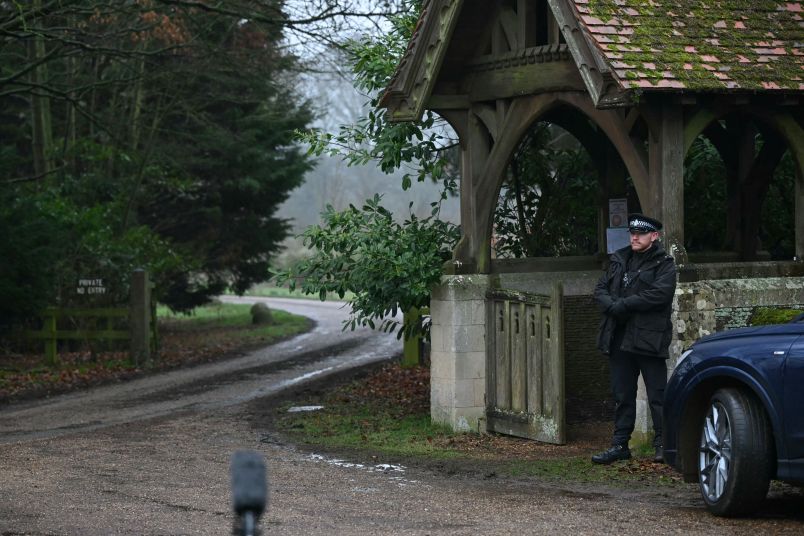
A policeman stands at an entrance to Wood Farm on the royal family’s Sandringham Estate in Norfolk, eastern England on February 19, 2026, where former prince Andrew was arrested earlier in the day. Britain’s royal family was in crisis on February 19 as former prince Andrew was in police custody after being arrested on suspicion of misconduct for his links to late US sex offender Jeffrey Epstein. (Photo by JUSTIN TALLIS / AFP via Getty Images)

While the fallout from the Epstein scandal, particularly the Trump DOJ’s release of its voluminous Epstein files (ironically, in an effort to placate the ravings of right-wing conspiracists) has been comparatively limited in the United States, ending some corporate careers, it is sweeping up officials abroad in corruption investigations:

  • United Kingdom: Peter Mandelson, the fired U.K. ambassador to the United States, is under investigation for allegedly passing on market-sensitive government information to Epstein. Two of his properties were searched by police earlier this month. Within days of the news of the criminal investigation, Prime Minister Keir Starmer’s chief of staff Morgan McSweeney resigned, taking responsibility for Starmer’s 2024 appointment of Mandelson as ambassador.
  • Norway: Former Prime Minister Thorbjørn Jagland was charged last week with “gross corruption” over his Epstein ties. His arrest and the search of three of his properties came only after the Council of Europe revoked his diplomatic immunity. The married diplomats Mona Juul and Terje Rød-Larsen are also under investigation for “aggravated corruption” for their dealings with Epstein. In both cases, the alleged corruption did not involve child sex trafficking but allegations of financial benefits from Epstein. Juul was suspended then resigned earlier this month as Norway’s ambassador to Jordan and Iraq.
  • France: Former Culture Minister Jack Lang and his daughter are under criminal investigation for the Epstein ties through an offshore company in the U.S. Virgin Islands, while the French foreign minister launched a separate administrative investigation of senior French diplomat Fabrice Aidan amid allegations that while he worked at the United Nations he shared diplomatic documents with Epstein.

Taking in the news of the former prince’s arrest, the writer Julian Sanchez wryly observed: “So SCOTUS, with its fabricated-out-of-thin-air immunity doctrine, has actually made American presidents less accountable than LITERAL royalty.”

The Police Statement on Andrew’s Arrest

In keeping with U.K. policy, the police did not name Andrew in its official statement on his arrest:

Thames Valley Police has opened an investigation into the offence of misconduct in public office. 

As part of the investigation, we have today (19/2), at approximately 8am, arrested a man in his sixties from Norfolk on suspicion of misconduct in public office and are carrying out searches at addresses in Berkshire and Norfolk. 

The man remains in police custody at this time.  

We will not be naming the arrested man, as per national guidance. Please also remember that this case is now active so care should be taken with any publication to avoid being in contempt of court. 

Assistant Chief Constable Oliver Wright said: “Following a thorough assessment, we have now opened an investigation into this allegation of misconduct in public office.  

“It is important that we protect the integrity and objectivity of our investigation as we work with our partners to investigate this alleged offence. 

“We understand the significant public interest in this case, and we will provide updates at the appropriate time.” 

King Charles: ‘The Law Must Take Its Course’

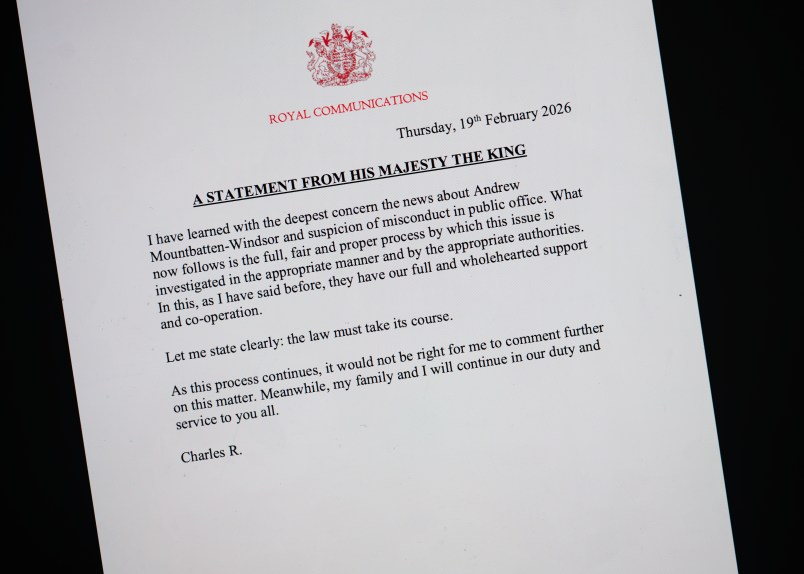
LONDON, ENGLAND – FEBRUARY 19: In this photo illustration, a statement from His Majesty King Charles III via communications at Buckingham Palace pledges his “full and wholehearted support and co-operation” to the “appropriate authorities” in response to the arrest of his brother, Andrew Mountbatten-Windsor, on suspicion of misconduct in public office on February 19, 2026 in London, England. (Photo by Gareth Cattermole/Getty Images)

Trump Detentions Overwhelm Trump DOJ

The spectacle of President Trump’s mass deportation operation didn’t make provisions for humanely detaining thousands of additional migrants or for processing their hundreds of habeas claims in court. The Trump DOJ has been overwhelmed by the case load, partly the result of poor planning, partly from a manpower shortage of the administration’s own making. But whoever is to blame, the burden still falls on migrants least able to absorb it:

MINNESOTA

In what may be the first contempt citation of a Trump II official, U.S. District Judge Laura Provinzino of St. Paul held a DOJ lawyer in civil contempt of court and imposed a $500 a day sanction on him until he abides by her order to return the identification documents of a migrant shipped to Texas and then released without his papers or a way to get back to Minnesota (which was also a violation of the judge’s order).

Matthew Isihara, reportedly a military JAG who was imported to help the U.S. Attorney’s Office with the caseload from Operation Metro Surge, told the judge he’d been assigned nearly 130 cases in the past month. “I don’t think it is acceptable,” Isihara said in court. “I believe the volume of work over the last few weeks has exceeded the capacity of any one AUSA.”

While U.S. Attorney Daniel Rosen denounced the judge’s sanction as “a lawless abuse of judicial power,” it seemed to get the job done. Attorneys for the migrant told Fox9’s Paul Blume that DOJ gave them a tracking number for the overnight delivery of his identification paperwork and that they expect to receive it today, before the $500/day sanction kicks in.

NEW JERSEY

In a remarkably contrite filing, Associate Deputy Attorney General Jordan Fox told a federal judge that the Trump DOJ had violated court orders some 54 times between Dec. 5 and Feb. 12 in New Jersey alone. The filing, first reported by Politico, suggested that the Trump DOJ is overwhelmed by habeas cases even in states that haven’t been specially targeted by President Trump’s mass detention operation.

The cataloging of the violations was ordered by U.S. District Judge Michael Farbiarz.

“I understand Your Honor’s concerns about these extremely important issues with constitutional implications,” wrote Fox, who is the chief of staff to Deputy Attorney General Todd Blanche.

Slavery Exhibit Still Not Restored

The Trump administration defied a federal judge’s order to immediately restore exhibits about slavery at the site of President George Washington’s one-time home in Philadelphia, prompting the exasperated judge to set a Friday deadline for the restoration of the exhibits. The Trump administration has appealed the judge’s decision, but didn’t ask for her to stay her order pending appeal until last night, after she set the Friday deadline.

‘Paleo-Confederate’ Prays with Hegseth

Defense Secretary Pete Hegseth invited Christian nationalist pastor Doug Wilson to lead a worship service at the Pentagon, which promptly posted about it:

Hegseth’s full embrace of the Idaho pastor who calls himself a “paleo-Confederate” comes after the two met last year when Wilson delivered a sermon at Hegseth’s Tennessee church, as TPM first reported.

Hot tips? Juicy scuttlebutt? Keen insights? Let me know. For sensitive information, use the encrypted methods here.
You Don’t Need to Be Found Guilty for the Justice System to Ruin Your Life 

This excerpt is part of TPM Cafe, TPM’s home for opinion and news analysis. 

A question at the center of our political moment is what happens when state power operates without meaningful accountability? We are living through a period of profound distrust in institutions, from courts to law enforcement to political leadership, and in today’s political climate,  where arguments about “law and order” often crowd out conversations about fairness, it is worth asking who bears the cost of that momentum. 

Below, I tell the story of Jannell, a Bronx public school employee charged with felony insurance fraud based largely on a mistaken date and a false prosecutorial theory.  Her case was eventually dismissed. But it took years — and in the meantime she lost her job, her stability, and nearly her life.

In a time when debates about crime, public safety, and prosecutorial authority dominate headlines, Jannell’s story — excerpted from my new book The Price of Mercy: Unfair Trials, A Violent System, and a Public Defenders Search for Justice — shows how easily ordinary people can be swept into the machinery of accusation. Unfortunately, this is not a unique story of sensational miscarriage of justice, it reflects routine damage inflicted by a dysfunctional “justice” system. Jannell’s story is a reminder that the system’s reach is already vast and has profound collateral consequences, even if the defendant’s case is dismissed or if they are found not guilty. 

Continue reading “You Don’t Need to Be Found Guilty for the Justice System to Ruin Your Life “