


The agents were on the hunt, but as they staked out the hallway in 26 Federal Plaza looking for immigrants to detain, they had other prey in mind.
“I’ve never had kangaroo. I want to try,” said Samantha Camlica, an agent with Immigration and Customs Enforcement (ICE) who has developed a reputation for aggression among the regular observers who monitor the court.
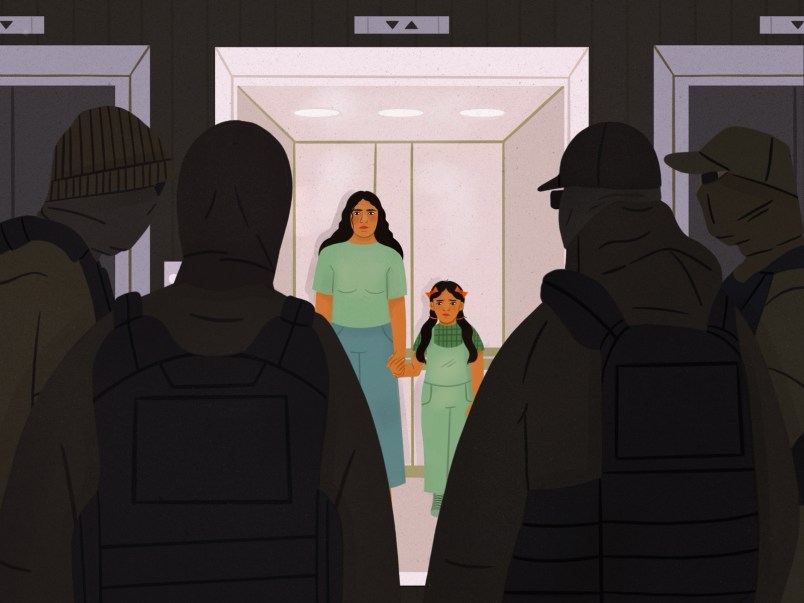
The other four agents flanking the corridor with her on that morning late last month were wearing masks. Camlica, who has declined to comment for this series, was the only one in the group whose affiliation was clearly visible.
Amid President Donald Trump’s mass deportation campaign, ICE officers have been assisted by personnel from a slew of other federal agencies as they round up undocumented migrants. In New York City, more than anywhere else in the country, those detentions have taken place in the halls of 26 Federal Plaza and other courthouses as immigrants show up for required check-ins and hearings.
Another one of the agents volunteered that they had been offered dog meat on a trip to Korea.
“The translator said ‘roof roof,’” the agent explained.
Camlica noted she doesn’t “get how people could be vegetarian or vegan.”
“I like meat too much,” she said.
While the masked agents are a constant, menacing presence for the immigrants in the halls, they are not always an active one. On some days, no one is taken. Others have long lulls filled with quiet or aimless conversation. Then, suddenly there will be an explosion of activity and shouting as someone is grabbed and dragged into a stairwell.
As they mused about eating meat, Camlica and the other agents were on the verge of one of these violent moments that would see a young Venezuelan man pulled away from his parents. It would also activate a partnership between activists and Rep. Dan Goldman (D-NY), who have developed a method for quickly responding and trying to secure the release of immigrants who are taken.
I was at the courthouse that morning and spent time with the family in the first crucial hours after their son was grabbed. The situation revealed the surreal, threatening environment in the courts, and how some of these detentions seemingly operate outside the rule of law. It also showcased the system Goldman and other advocates have built to bring detainees justice.
On the day of this particular detention, the agents at 26 Federal Plaza spent over 20 minutes discussing meats. Their conversation segued into a broader one about international foods and travel.
One man stood at least a head taller than all the others in the group. He was apparently from Puerto Rico.
“Have you had chicharron?” he asked his colleagues. “In Puerto Rico, it’s the skin of the pig.”
Camlica, who said she has family from Turkey, countered with some of that country’s delicacies.
“In Turkey, they use the intestines for, like, a gyro. It’s so good,” Camlica said, adding, “I think anything in any other country is better. In Turkey, I’ll get Snickers and it’s so much better than here.”
The group then turned to their enjoyment of Mexican grocery stores, both north and south of the border.
Their idle chatter included no acknowledgment of the inherent tension between enjoying the fruits of diversity while removing immigrants from the country. While they didn’t take the moment to reflect on their work, the migrants who passed through the halls were acutely aware of what the agents were there to do. One Ecuadoran woman walked up to me after taking a bathroom break in the hall.
“Are those ICE?” she whispered nervously, gesturing towards the masked figures flanking the corridor.
After leaving court, a family of four walked by the agents on their way to the elevators. The father let out an audible gasp once they made it past them.

Another agent arrived and had a whispered consultation with Camlica. He seemed particularly jumpy, rubbing his hands together and shifting on his feet. I followed him as he departed to another side of the floor and ended up outside a courtroom. That morning, the encrypted chat channels used by the court observers were buzzing with the news that the Trump administration had fired judges who had worked at 26 Federal Plaza. In the hallways, their names on the court calendar had been taped over with the names of their replacements.
Immigration judges are overseen by the Justice Department, and some of those who have been fired believe the administration is systematically eliminating jurists who are more lenient as part of the push to step up deportations. Outside that courtroom, I got a sense of what that looks like in practice as I overheard Judge Karen Nazaire-Francois dressing down a lawyer whose client was not present at the hearing. According to the attorney, they had provided psychiatric evaluations verifying that their client had difficulty coming to court and facing the masked officers after being diagnosed with post traumatic stress disorder related to experiences in their home country. Nazaire-Francois confirmed she had received the evaluation and was unmoved.
“Counsel, I have never waived the presence of anyone especially due to a psychological report,” she said. “I expect everyone to come to court.”
Nazaire-Francis subsequently issued a removal order meaning that, wherever they are, if they do encounter ICE, this person could be quickly deported.
“The court finds the respondent has abandoned the opportunity to seek relief from removal,” the judge said.
According to advocates, more and more immigrants are avoiding Manhattan’s immigration courts due to the threat of detention from the masked agents in the halls. Missing appearances can result in their case being removed, which cuts off legal pathways to citizenship. As a result, many of the underground legal clinics that provide assistance to migrants try to help them file motions enabling them to appear via online video rather than in person. However, when the next case began that morning, I overheard from the hall as Nazaire-Francois made clear that remote appearances are not tolerated in her courtroom.
“I do not approve Webex, so I do not understand why you’re on Webex,” the judge said.
Data compiled by Syracuse University’s Transactional Records Access Clearinghouse shows Nazaire-Francois has denied nearly 90 percent of the asylum applications she reviewed in the first eleven months of this year. That’s well above the average denial rate of immigration judges across the country. It’s also far higher than Nazaire-Francois’ own denial rate prior to Trump’s second term.
While it seemed like a foregone conclusion, I was unable to learn the outcome of the case with the rejected Webex appearance. A masked guard from Paragon Systems, a private contractor that provides security at federal buildings around the country, arrived and informed me and a group of observers who were standing in the hall that the judge had decided we were not allowed to be there.
“She’s not allowing you in the courtroom, so you guys have to go,” the guard said.
Soon after I departed, I got a call from Peter Melck Kuttel, an advocate who works with a local church and has helped lead efforts to monitor cases at Manhattan’s courts. Kuttel informed me that, after I left, the group of agents who had been discussing their appetites in the halls took a young Venezuelan man as he walked out of a court appearance.
“It was bad,” Kuttel said. “He fought.”
“In Venezuela, if they take you, you don’t come back. In Venezuela, when they take you, you are dead. This left me with the same impression.”
Enayda, the mother of a 20-year-old Venezuelan man who was detained
Over the past few months, Kuttel and some of the other court watchers have come up with a standard operating procedure when someone is taken. They immediately head to one of Rep. Goldman’s district offices, located across the street from 26 Federal Plaza in another building that also houses immigration courts. Goldman has opened up the space to serve as what the congressman calls a “whole triage center” for detainees and their families.
On that day last month, I walked into Goldman’s office to find Kuttel and Jessica, a volunteer from the advocacy group New Sanctuary Coalition, sitting with the two parents who had just lost their son. Due to the fact the family has ongoing immigration cases and stated concerns about facing retaliation in their home country, I am not referring to the date of the detention or the full names of the volunteers and attorneys who worked on their behalf. I also agreed to identify the parents and their son by pseudonyms; Andrés, Eneyda, and Andrés Jr.
Kuttel was on scene when the ICE agents took Andrés Jr., who is 20 years old. According to Kuttel, Camlica came up to Andrés Jr. and “grabbed him” after another agent held the doors of the elevator to prevent the family from getting on board.
“He resisted. He ended up getting pushed into the wall and pinned up against the elevator,” Kuttel said. “And then that was the last we saw of him.”
Kuttel quickly introduced himself to the young man’s parents. Despite not speaking Spanish, he was able to convince them to come with him to the congressman’s office. He also sent a message to Jessica: “Come to Goldman’s right now. Bring a priest.”
“I was like, I can’t manifest a priest out of thin air, but I will come,” Jessica recounted earlier this week. “Hopefully, that’s good enough.”
Jessica, who works in real estate, first decided to get involved with NSC, which runs court accompaniment programs and legal clinics, during Trump’s first term. Kuttel reached out to her because she could speak Spanish with the family and, thanks to her NSC training, had the experience needed to serve as a “friend” who could file documents on behalf of Andrés Jr.
In Goldman’s office, Eneyda and Andrés explained that their asylum case had been separated from their son’s and that, just before he was taken, the court ordered them to provide additional documentation. That paperwork was now required for the family to rejoin their cases and continue the asylum application. Andrés Jr. had been taken despite the fact they had an ongoing case.
The combination of the detention and the judge’s order set off a scramble as Jessica, Peter, and other attorneys assembled in the congressman’s office worked to simultaneously submit the necessary documents while filing a habeas corpus petition on behalf of Andrés Jr. The petition was crucial. If successful, it would ensure the young man had a day in court where prosecutors would be required to show legal justification for his detention.
I came into the room as the team was beginning to work on the case. Andrés and Eneyda were seated on a small couch in front of the congressman’s office. Andrés was shellshocked and silent. Jessica had her arm around Eneyda, who was sobbing.
“In Venezuela, if they take you, you don’t come back,” Eneyda said in Spanish. “In Venezuela, when they take you, you are dead. This left me with the same impression.”

In an interview earlier this month, Eneyda, who serves as the family’s de facto spokesperson, said she went into shock as ICE took her son.
“I blacked out. I don’t remember everything,” she said. “I was walking and my mind wasn’t there.”
Eneyda doesn’t remember getting on the elevator to exit the building. Despite her shock — and the language barrier — she said Kuttel convinced her to follow him to Goldman’s office.
“I understood that he wanted to calm me, that he was going to help,” Eneyda said.
Eneyda also explained why the sight of government agents grabbing her son had her fearing the worst. According to her, life in the family’s home country of Venezuela was defined by “witch hunts” and regular people being asked to denounce each other. Eneyda said she and her husband owned a small store and tried to stay out of politics. They nevertheless found themselves on the wrong side of the ruling party after some of their five children took part in demonstrations related to ongoing food shortages.
“We became involved, without planning to, in protesting. It was really our kids who began protesting in the street. We didn’t know that they had planned to start demonstrating,” Eneyda said. “The day came when a commission of the PSUV — and this is the government’s party there — they began to make accusations and they began to tell us that we couldn’t accept or permit our kids to come into the neighborhood because they were against the government.”
For Eneyda and Andrés, this essentially meant they were going to be part of the opposition too.
“We told people, and we said it very clearly, that our kids had the right to believe what they wanted,” said Eneyda. “We had a group of people who were aligned with us. We didn’t know who their leaders were, but they were very discontented with the system and we began to meet.”
According to Eneyda, Andrés became a “strong voice” in the group, which was focused on community work and advocating for people to have freedom of speech and travel.
“This brought a lot of repercussions that we never could have imagined,” Eneyda said.
Over time, three of their closest colleagues — a man who worked on youth sports, another who focused on substance abuse, and a woman who Eneyda described as “like a sister” — passed away in unclear circumstances, Eneyda said.
“This made it clear to us that the fight wouldn’t be — this wouldn’t be easy,” she added.
Soon, Eneyda felt that the “totally diabolical” system of the government’s “absolute power” and network of “unscrupulous people who sell out others” to curry favor had her family in the crosshairs.
“It got to a point where the harassment was so bad we had to live secretly in our house. We couldn’t make a sound. We couldn’t make any noise,” said Eneyda. “There were people who would come to the door calling us criminals. They assaulted my husband. They tried to kill him.”
Fearing for their lives, Eneyda said they made the decision to leave Venezuela in early 2022.
“God had a different plan for us,” she explained.
Eneyda had seen government campaigns warning that anyone who tried to leave or got their passport stamped “would be considered a traitor to the country.” They opted to covertly cross the border and walk to the United States. This began a long journey that, in her telling, lasted over six months and included all manner of dangers — overflowing rivers, gangs, and an encounter with a crocodile.
“We went through the jungle. We crossed bit by bit. … It’s not easy,” Eneyda said. “My kids didn’t want to say anything, but of course they were afraid.”
Eneyda said the family, like many migrants from Latin America, traversed the Darién Gap, a particularly treacherous stretch of thick forest that blocks all roads between North and South America. The notorious passage is an unavoidable obstacle for many migrants to the U.S.
“Come to Goldman’s right now. Bring a priest.”
A text message from immigration advocate Peter Melck Kuttel to a New Sanctuary Coalition volunteer, urging her to rush to Rep. Dan Goldman’s office.
These tales of political persecution and terror in the jungles are hard to verify. For Jessica, the volunteer who worked with the family, the fact they made it into the U.S. without legal documents speaks for itself. She noted it takes a lot to make someone leave their home, “literally traverse half or more of a continent,” and then “come into a new country where you don’t speak the language.
“Had they been living in a stable country with a secure environment, they would not be here,” she said.
A little over a week after Andrés Jr. was taken, the family had their day in court. The habeas petition had been successful.
Jessica and Kuttel met them outside the federal courthouse in Foley Square. When the pair of volunteers asked how they were feeling, Eneyda said simply, “with faith.”
Upstairs, Eneyda, Andrés and the volunteers were joined by their attorneys. With the help of Goldman and the advocates, they had a pro bono team from one of Manhattan’s most prominent white-shoe law firms.
“It’s hard not to have my son in my hands,” Eneyda said.
“Hopefully, we have a good judge,” one of the attorneys replied as they filed into the courtroom.
Kuttel, who is at 26 Federal Plaza nearly every day, kept marveling at how this seemed like a “real court” when compared with the chaotic scenes playing out in front of the immigration judges.
“A stenographer!” he exclaimed. “I’m like a kid in a candy store.”
The room was nearly empty apart from a pair of reporters and law students who were there to observe the proceedings. As U.S. District Judge Ronnie Abrams entered and sat behind the bench, everyone stood. Andrés Jr. came in afterwards. He was flanked by three marshals and had his hands cuffed by his waist. Under a floppy haircut, he offered a smile to his parents, who had been instructed by the attorneys not to try to touch or speak to him.
After his lawyers had a brief chance to confer with the young man, one of them began to make the case that he had been illegally detained.
“But for the actions of selfless volunteers who filed a petition before your honor … it’s highly likely our client would have been held incognito in a detention facility in the south, moved to another country, or, worse still, sent back to the country his family fled,” the lawyer said.
The attorney noted that Andrés Jr. was taken while the family had a legal proceeding underway and said they still had not “seen a copy of the arrest warrant.” They also noted that ICE had alleged he had a criminal history, namely, an arrest for assault and burglary.
“The reason he was not arraigned is literally four days after his arrest those charges were dismissed,” said the lawyer, adding that ICE withheld this information.
From the bench, Abrams wondered aloud whether ICE “didn’t have the most up to date information.” She suggested that must be the case because there was no “reason to believe” the prosecutor who was representing the agency had “intentionally misled the court.”
Andrés Jr.’s lawyer went on to characterize the situation as an “unjust detention.” He noted the young man is enrolled in a high school program designed for “newcomers” to the country.
“My client was deprived of his due process right,” the attorney said. “He belongs in school. He poses no danger to the community. Respectfully, we request his immediate release.”
The prosecutor put up little resistance and told the judge it was “fair” to say they had not been informed that the past charges against Andrés Jr. had been dismissed. After hearing this, Abrams ordered his immediate release and thanked the people who had worked on Andrés Jr.’s behalf for intervening.
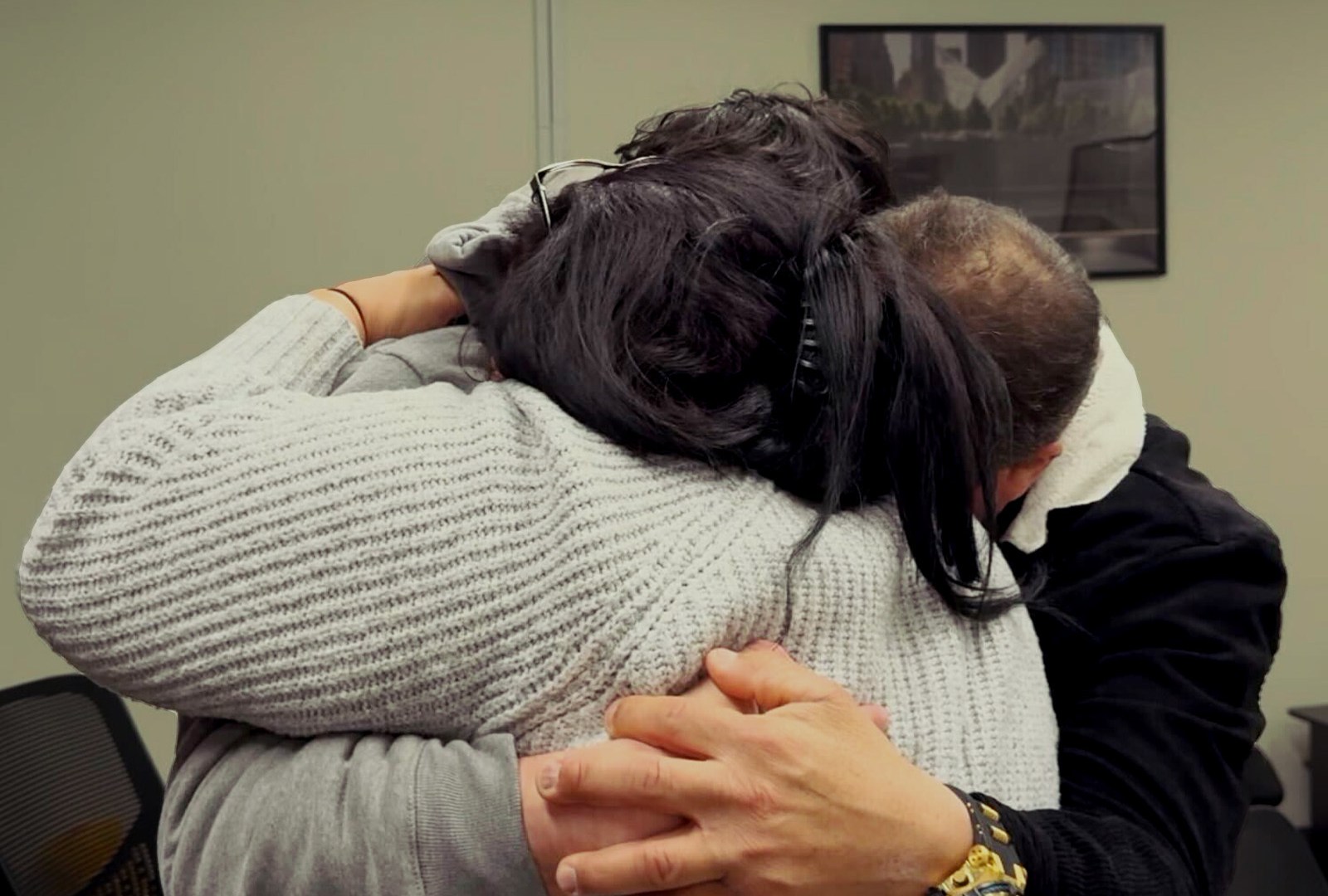
Eneyda and Andrés sobbed and hugged Jessica, while Andrés Jr. was escorted out of the room, still in cuffs. Jessica explained to the parents that the young man’s lawyer was headed to the facility where he was being held in an effort to fast-track the release. “Everything’s a process, but you can be happy,” she said. “He’s going to get out.”
As the family anxiously waited in Goldman’s office, Jessica got a phone call indicating there was a final wrinkle. Andrés Jr. was still in detention and, according to his attorneys, ICE was being “difficult.”
Kuttel said Goldman and his staff would get involved.
“Tell the lawyer the congressman will call and give them a kick in the ass,” Kuttel said. “This is why we’re here, just in case we need to get a sitting congressman who happens to sit on the Homeland Security Committee involved.”
Goldman’s staffers gathered data and proceeded to send out a series of calls and emails. Their intervention apparently did the trick. Within an hour, Andrés Jr. walked into the congressman’s office. His parents pulled him into an embrace. Their bodies shook with joyous cries.
Off to the side, Kuttel was pleased with what he calls the “habeas machine” and the fact it scored a court victory against ICE in a matter of days.
“If we get a habeas within two hours of detention, that’s how quickly we can turn it around,” Kuttel said, adding, “When it works, it works.”
When she spoke with me days later, Eneyda described Kuttel, Jessica, the congressman, and the lawyers who worked on the case as “angels that God sent.”
“I feel a deep gratitude for what they did. … They helped us. They helped us. … A congressman we didn’t know, he was there. … He simply moved things forward,” she said through tears. “The truth is, there aren’t enough words to say how grateful we are in every way.”
Jessica, who has worked on more cases than she can count, was left with what she described as “mixed emotions.” While Jessica was “obviously thrilled” for the family, she was haunted by the thought of the past incidents where the “habeas machine” had not been in place and incidents elsewhere involving migrants who don’t have access to help.
“The right decision was made, and it just seemed so clear in court that this was wrong, but it also feels like it’s wrong for so many other people,” Jessica said. “The fact that the courts could just declare this was obviously wrong — how many people are a victim of this same thing?”





Meat shaming? Seriously? Has the reality-based community fallen so far? I’ll probably come back and finish the article later. Probably. Although I fail to understand why the dietary discussions of the ICE goons were so terribly important.
Of the United States???
No. These are homeless guys getting out of the cold.
We’re well on the way to becoming a third world country. Where laws, procedures, and those entrusted to carry out the legal procedures have all been scrubbed.
This family isn’t the dangerous criminals Trump claimed he was deporting. It really concerns me that regular immigration judges are being replaced with those who don’t care about legalities and procedure.
When they are not grabbing migrants in the hallways, they stand in the hallways to strike fear into anyone who dares walk past them.
“the inherent tension between enjoying the fruits of diversity while removing immigrants from the country”
You say “inherent tension”, I say pathological hypocrisy.