


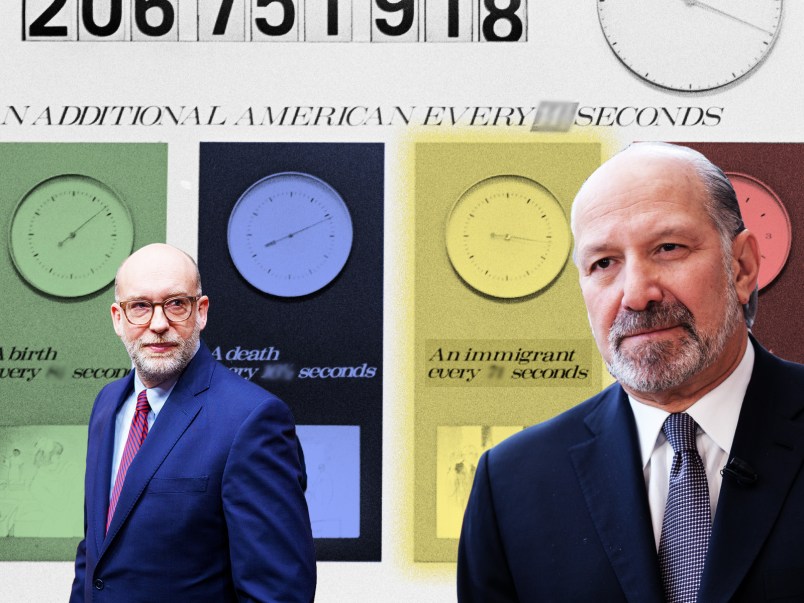
When the members of the 120th Congress take their seats come January, they will quickly have a chance to oppose — or let stand — the unprecedented changes and dramatic proposals from President Donald Trump’s administration at the Census Bureau. Those changes, if enacted, will have an enormously consequential impact on how political power is distributed in the U.S., and could grant greater representation in the House of Representatives and the Electoral College to Republican-voting states. That’s by design.
Republicans in control of the White House, and hyper-partisan researchers and political appointees installed at the Census Bureau, have long and openly advocated for a redistribution of power via the Bureau’s most massive undertaking, the decennial census. The most significant initiative unfolding thus far is a multi-pronged proposal to exclude most noncitizens from the population count taken every ten years, which is used to determine how many members of Congress each state gets, a process called apportionment.
There’s also the Census Bureau’s proposed rule to stop collecting race and ethnicity data on the decennial census, the Commerce Department’s banning of an established statistical privacy method seemingly based on right-wing misinformation, and a sketchy proposal to change the way usual residence is recorded that experts told TPM is “a bad idea.”
The comment period for the proposed rule to exclude most immigrants from enumeration and stop recording race and ethnicity closes just before Election Day.
As the minority party, Democrats in the 119th Congress don’t have as many options to exercise oversight with teeth. But if the projected blue wave manifests across the country in November, the political party power shift will afford a Democratic Congress the power to blunt what Trump’s Census Bureau is up to.
A Brand New Bill to Block Census Changes
Preparation for the decennial census happens years before enumerators come knocking on your door. By April 2027, the Commerce Secretary will have to submit the topics the decennial survey will cover, including its plans to add a question about immigration status. One year later, the Commerce Department is required to share with Congress the full scope of the questions that will be on the census.
Despite this requirement, Congress has no legal authority to approve or block a submission, Terri Ann Lowenthal, a census expert and consultant who previously served as staff director of the House Census Oversight Subcommittee, told TPM.
“Congress must act affirmatively if it doesn’t like what the submission is,” said Lowenthal
That means Congress could pass legislation to limit a number of Commerce Department actions. Members could introduce laws to overturn Census Bureau proposed or final rules, including the most controversial proposals being pushed through now.
That’s not likely to go far, though, with a presidential administration that would veto any attempt to rein in its own proposals and without the necessary two-thirds vote to overturn a presidential veto.
Tucking a Limitation Provision in an Appropriations Bill
More difficult for a president to veto, said Lowenthal, is a limiting provision folded into a larger appropriations bill.
While Congress isn’t supposed to legislate within an appropriations bill, members can include clauses that limit a department’s spending unless certain requirements are met.
“If there is a provision on an appropriations bill that says the Census Bureau cannot spend money on the census unless it collects data on race and ethnicity…,” said Lowenthal, “the president, if he doesn’t like that, would have to veto the whole Commerce, Justice, Science appropriations bill.”
This approach has recent precedent.
In March 2024, Sen. Bill Hagerty (R-TN) tried to amend an omnibus spending package to inject limits for spending on the decennial census unless citizenship data was collected on the census and noncitizens were excluded from the apportionment count. Sen. Lisa Murkowski (R-AK) crossed party lines to help defeat the provision.
But appropriations is a notoriously long and complicated process, with omnibus bills taking months to be negotiated and to pass.
“The windows of opportunity to finish planning and start preparations for the next census and finalize the design are closing fast,” Lowenthal said.
It’ll Fall to the Courts
Some questions will inevitably fall to the Supreme Court.
Enumeration and apportionment are constitutional issues and experts have repeatedly told TPM the Census Bureau proposal to remove most immigrants from the count violates the 14th Amendment. The president’s allies have advanced an alternate reading of the 14th Amendment’s text that experts believe to be deeply flawed. Given that issue’s importance and the tight timeline the 2030 census is now on, the Supreme Court could expedite its consideration of any case challenging the constitutionality of the proposal.
“I think it’s fair to assume that as soon as the Office of Management and Budget approves a final rule … the lawsuits will start,” said Lowenthal.
What Congress Has Been Up to So Far
The congressional committees charged with Census Bureau oversight are the Senate Homeland Security and Governmental Affairs and the House Oversight and Government Reform Committee. The Senate committee also has a subcommittee specifically dedicated to the census.
A new congress in January will switch up which party and which officials lead the committees.
Rep. Robert Garcia (D-CA), the top Democrat on the House Oversight Committee, is expected,should Democrats win, to become chairman of the committee and will then have subpoena power.
Sen. Rand Paul leads the Senate Homeland Security and Governmental Affairs Committee. While he pushed for Bureau updates to the way the census counts deployed servicemembers ahead of the 2020 census, Paul has not spoken publicly about recent changes at the Bureau. His office did not respond to a TPM request for comment.
Retiring Sen. Gary Peters (D-MI) is the top Democrat on the Senate committee. In August, Peters told TPM the Constitution required the census to count every person.
“Any effort that undermines a comprehensive and accurate count risks depriving communities in Michigan and across the country of the democratic representation and federal resources they deserve,” he said.
He’s retiring, and will be replaced by whoever wins the faceoff between Democratic candidate Abdul El-Sayed and Republican Mike Rogers. It’s unclear who will inherit the top spot on the committee.
Sen. Andy Kim is the top Democrat on the Senate Homeland Security and Governmental Affairs census subcommittee.
“The census is enshrined in our Constitution and not up for political debate,” Kim said in a September statement about the Bureau’s plans to exclude most immigrants from the population count.
A spokesperson for Kim did not respond to TPM requests for comment about additional action the senator or his subcommittee planned to take should Democrats win a Senate majority.
When he was the Missouri attorney general in 2018, Sen. Josh Hawley (R-MO) supported adding a citizenship question to the 2020 census. Hawley now chairs the Senate Census Subcommittee. His office did not respond to a TPM request about changes at the Bureau or plans for subcommittee oversight.
Rep. James Comer (R-KY) leads the House Oversight and Government Reform Committee. Comer has not acknowledged the widespread changes and irregularities at the Census Bureau. His office did not return a TPM request for comment. Facing reelection, he’s projected to hold on to his seat.
Dems on the House Oversight Committee sent a letter to acting Census Bureau director George Cook demanding answers about its noncitizen voting brief. Garcia, the committee’s top Democrat, was joined by Rep. Raja Krishnamoorthi (D-IL), who lost his primary, and Rep. Maxwell Frost (D-FL).
It’s unclear whether the Census Bureau ever responded. Spokespeople for Garcia, Krishnamoorthi and Frost did not respond to TPM requests for comment about whether the Census Bureau responded to the Sept. 4 letter, and about whether the committee or Garcia planned any additional action.




Once again, this “administration” has arrogated to itself powers that are not in the Constitution. The census is meant to count people, regardless of their status. Some would probably want to classify non-citizens as 3/5ths of a person. It’s been done before.
The new report [June 2026] finds that New York City’s immigrant population remains steady at 3.1 million, with new neighborhood hubs emerging across the five boroughs and the city’s foreign-born population continuing to grow more diverse. Immigrants continue to drive New York City’s culture and economy, with foreign-born New Yorkers making up more than one-third of the city’s
population and 43% of its workforce. Nearly half of all New Yorkers speak a language other than English at home, and two-thirds of all city residents are first- or second-generation New Yorkers.
The percentage of non-citizens among NYC’s immigrant population is probably fairly large. If they are not counted in the 2030 census, NYC will lose representation in the House and its fair share of federal funds. As the city deteriorates, will Lutnik and his wife want to continue to live in their Manhattan townhouse? Will Cantor Fitzgerald and its employees consider relocating to Miami Beach?
Funny how we’ve been conducting a nation wide census since 1790. And when we had slavery those slaves were counted as whole persons. So all people were counted. A few changes have been made since 237, but the counting of who is here hasn’t.
As 3/5. But they were counted.
Article 1, Section 2, Clause 3:
> Representatives and direct Taxes shall be apportioned among the several States which may be included within this Union, according to their respective Numbers, which shall be determined by adding to the whole Number of free Persons, including those bound to Service for a Term of Years, and excluding Indians not taxed, three fifths of all other Persons [italics added].
Superseded by the 14th Amendment, Section 2 of which begins,
Representatives shall be apportioned among the several States according to their respective numbers, counting the whole number of persons in each State, excluding Indians not taxed.
The Article 1 version specifically includes indentured servants among those to be counted, many of whom would have been non-citizens. The 14th Amendment speaks of “persons,” not citizens. Both are specific about those Indians who are not to be included in the count. If at any time those drafting and passing these sections of the Constitution had intended to exclude non-citizens from the count, the texts would have specified their exclusion.