



Before the Trump administration issued its rule aiming to reshape the Census around accruing political power for the right, it had a problem: internal dissent.
Per records obtained by TPM, the Treasury Department pushed back on a portion of the rule that contains some of the proposal’s furthest-reaching ambitions. The Trump administration wants to change what the Census means by “usual residence.” In the past, the Census has defined a respondent’s residence as where the person might “live and sleep most of the time.” Under the new rule, the Census would narrow it to a place “consistent with, and evidenced by, their tax records.”
TPM obtained internal track changes showing input from Commerce, Treasury, and the White House’s Executive Office of the President. They offer a rare look into closely held internal legal deliberations over how to shape a rule that aims to transform the Census.
The rule change and the Bureau’s insistence on using tax information despite Treasury feedback appears to be part of the agency’s stated intention of laying the groundwork to exclude certain noncitizens from the 10-year population count — in part by redefining “usual residence.” The Census Bureau is also weighing the addition of an unprecedented immigration status question, which, experts told TPM, would be similar to but potentially even more harmful than the Trump I attempt to add a citizenship question to the 2020 Census.
The Bureau’s rule proposes excluding nearly all immigrants except lawful permanent residents from the population count used to allot congressional representation to states, a process called apportionment. It does so by arguing that “allegiance” to the U.S. should form a greater part of the definition of “usual residence,” excluding immigrants in a manner that diverges from how the census, courts, and lawyers have long understood the 14th Amendment.
The new rule criticizes the Census’ current definition of usual residence as an imposition that equates U.S. citizenship with that of foreigners. The definition “did not call for any difference in treatment between foreign citizens present in the United States legally and those present illegally,” the proposed rule states.
“The counting of illegal aliens for apportionment purposes has also been heavily criticized within the Federal government itself,” the rule continues.
Republicans have looked for ways to exclude immigrants from state population counts used for dividing political power among states for generations.
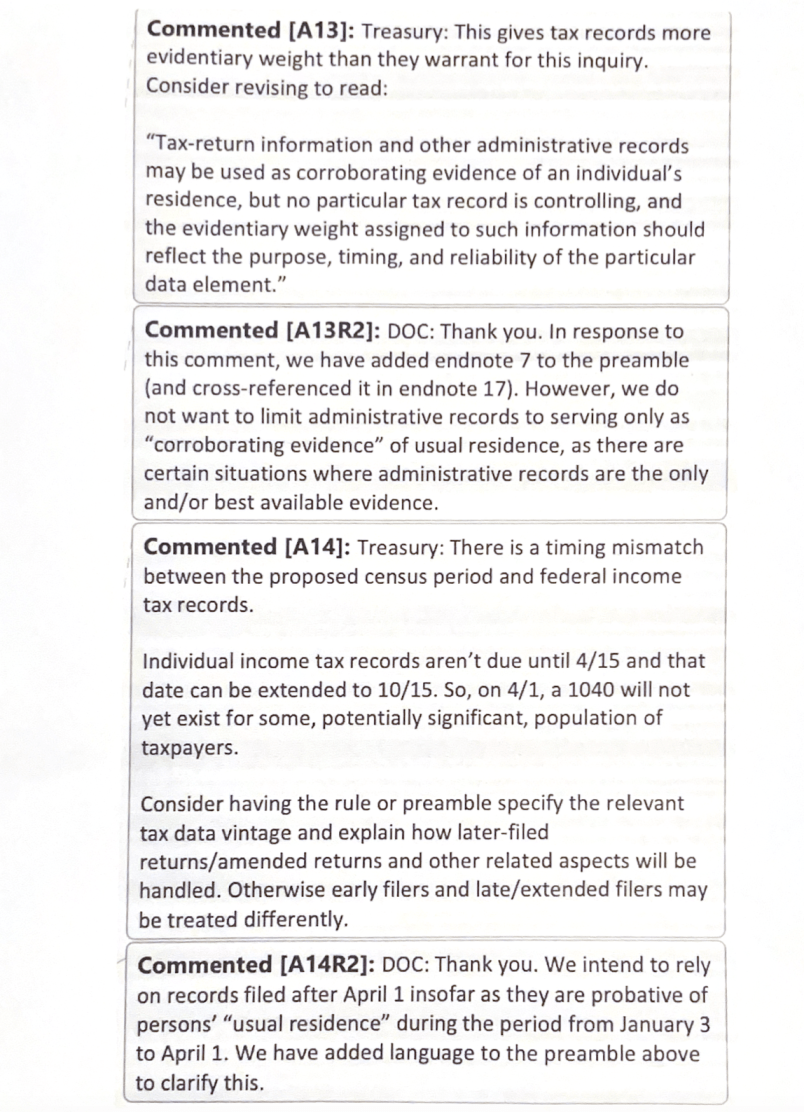
In one exchange, which experts told TPM they found deeply surprising, Treasury officials tried to dramatically pull back Commerce’s plan for residence. Instead, Treasury offered a far more attenuated approach, in which tax records might provide further proof of a person’s address, but would not themselves establish the address.
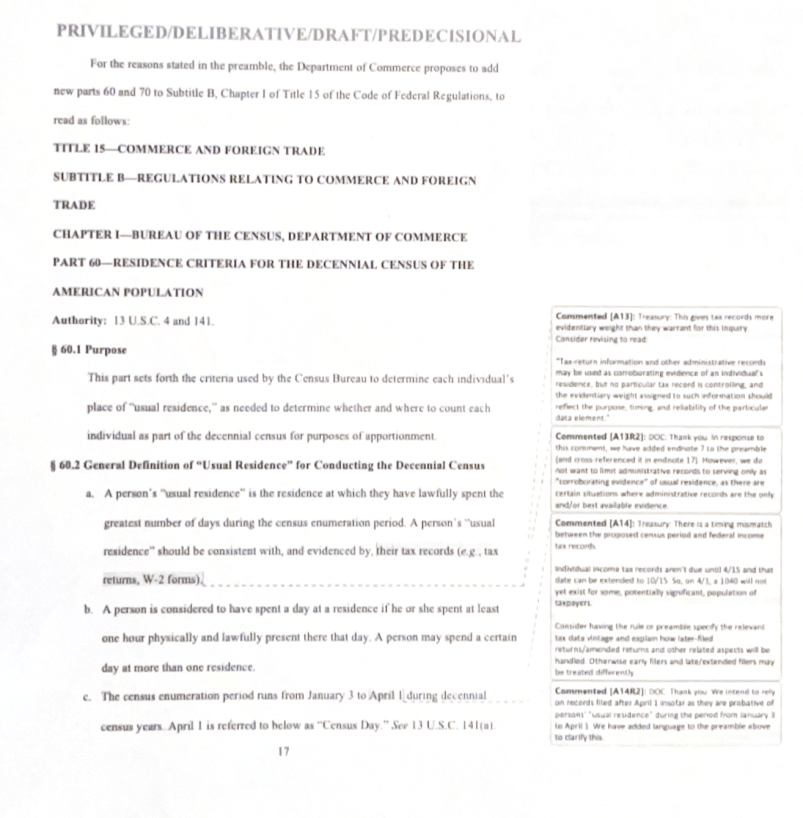
Tax return information, Treasury officials wrote, “may be used as corroborating evidence of an individual’s residence, but no particular tax record is controlling, and the evidentiary weight assigned to such information should reflect the purpose, timing, and reliability of the particular data element.”
Commerce rejected that.
“We do not want to limit administrative records to serving only as ‘corroborating evidence’ of usual residence, as there are certain situations where administrative records are the only and/or best available evidence,” a comment in response reads.
Commerce is now proposing a rule that, experts say, could lead to a serious undercount in the 2030 Census. It would also add to the work of the Census without using reams of other data already available to the government, some experts said.
Commerce, Treasury, and the White House didn’t return requests for comment.
“Why are they fixated on these tax records when they already have access to all these other administrative records that in combination give them much better coverage than just the tax records alone?” Barry Johnson, a former Chief Data and Analytics Officer at the IRS and current Non-Resident Fellow at the Urban Institute, told TPM.
Johnson, who also ran Statistics of Income at the IRS, said that when he first heard about the idea he couldn’t quite believe it was real.
“At first, I thought it was a mistake because it seemed like such a bad idea,” he added.
Johnson and others told TPM that tax data is limited in what it can tell the Census. It can reflect multiple locations for one person; someone who uses a P.O. Box as their tax address – or uses that of their accountant’s – would be counted in the wrong place, with potentially dozens — or even hundreds or thousands — of different people counted in the same location.
Populations like the homeless might fail to appear in a tax-based count.
Relying solely on tax records could create a distorted count along other dimensions, too. After 2020, the Census modeled what a count based entirely on records that are already in the government’s possession would look like. Compiling 31 different administrative documents, the study produced a count that included more non-U.S. citizens while potentially excluding some residents of rural areas. Overall, the study undercounted U.S. citizens by three million, leaving a larger number of immigrants than the actual 2020 Census counted.
That relied on a mix of records; tax information was only one part.
Research about the use of tax information in connection to usual residence largely studied “the challenges of using it,” Amy O’Hara, a former Census Bureau executive who led a Bureau administrative data unit, told TPM. O’Hara’s own research had explored using tax information in the 2030 Census.
Past studies have questioned whether the Bureau has the legal authority to use administrative data this way, and whether that data can lawfully be used for population counting at all.
“It was just expected that there would be ongoing research and feedback from the public and the scientific community about taking this step,” she said.
Administrative data contain myriad discrepancies which would require staff to make consequential decisions, which O’Hara worries won’t be made with transparency and fairness.
“There could be administrative data that has my name with or without the apostrophe,” said O’Hara, who now leads the Massive Data Institute at Georgetown University’s McCourt School of Public Policy. “And if they didn’t want to count me, they could say that there is a discrepancy there and potentially drop the records.”
Lack of transparency about those decisions, O’Hara said, “could lead to a systematic undercount of people in the administrative data, depending on what those decision rules are.”
Census officials also set an “unprecedented ‘reference period,’” which ends on April 1, before tax day and well before legally permissible extension dates, data experts Meeta Anand, Beth Jarosz, and Chris Dick, wrote in a post for dataindex.us, a collaborative tracking federal data changes. The result of that proposed reference period would count people at their winter residences, which may not correspond with their usual residences, the experts wrote.
“The anticipated effect of this proposed rule is that it would shift population from colder, northern states to southern ‘snowbird’ destinations.”
A former long-time Census Bureau employee, who worked at the agency under Trump II and spoke to TPM on the condition of anonymity for fear of retaliation, said that using administrative records could dramatically impact apportionment and the redrawing of voting districts, since federal tax data doesn’t correspond directly to other datasets.
That type of conversation, the former Census employee said, would have typically gone before a formerly apolitical research committee, which recently removed charter language barring political interference and has yielded its responsibilities to political appointees.
O’Hara, who reviewed screenshots from deliberations contained in the draft rule, said the Census Bureau’s policy proposal was imprecise. The Bureau’s published rule doesn’t define the term “dependents,” while the IRS definition of a dependent is specific and relies on criteria regarding financial support. The Bureau rule highlights W-2 forms, but those are filed by individuals, not by the entire households the decennial Census is required to count, O’Hara said.
“I think it is business as usual for the administration,” O’Hara said. “In my experience an agency like Census would have done a lot more editing and reading for clarity before they publish.”







Of course they did.
Hey, Treasury, we’re going to do this.
Treasury: You shouldn’t do that for reasons 1-4.
That’s ok, we’re going to do it anyway.
Treasury: It’s not giving you what you’re looking for
We don’t care! Thanks for your input!
All this messing around with the Census is just stupid. The people demanding these changes have no idea how complex having census at all. I’m so tired of their shit.
I’M DONE. Blue states should prepare to leave the union.
I thought they were trying to take us back to the 1950s, but it is the 1850s they appear to be shooting for. These RW cretins will not be happy until only white male landowners have the franchise all to themselves.
Like my dear mother always said:
“Figures don’t lie, but liars sure can figure.”