


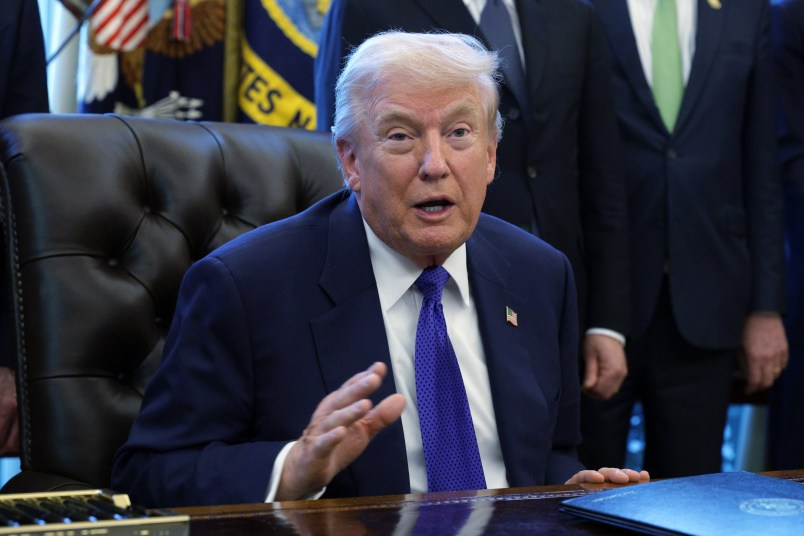
I had a moment of insight or perhaps revelation early in this war when the blockage of the Strait of Hormuz first became central in the news and President Trump was publicly debating whether he would use the U.S. Navy to escort ships through it. Would he, won’t he? Will it happen tomorrow? What will he decide. Then I was watching a YouTube show about maritime shipping. In passing the host, Sal Mercogliano, noted that, at that time at least, there weren’t any U.S. naval vessels in the Persian Gulf at all. And the kind of ships you need, in the numbers you’d need, were hundreds of even thousands of miles away. That made perfect sense since for the kind of war the U.S. is currently fighting we don’t need naval vessels anywhere near that close to the combat zone, and when they are that close they become much more vulnerable to attack. But the point is that the whole debate about whether Trump was about to do that any time in the near future was entirely contained within Trump’s Truth Social world. It wasn’t connected to any of the hard realities of whether any of that was even possible.
I said it was a moment of revelation because I saw how much of an alternative reality Trump was able to create with his constant Truth Social broadsides and general chatter. If that is what’s being discussed I want to hear a mention, even in mainstream non-news-junkie reporting that basic and publicly knowable facts like this mean that none of this can even happen in the time frame Trump was talking about. It shifted my view of the entire situation.
This also connects to the points I’ve made about the economic repercussions of this conflict. One part is that everyone who needs to make plans about economic repercussions is really clear that significantly higher inflation and lower growth is already baked into the global economy. Even if everything stopped today on a dime, a huge amount is already baked in. I heard from someone in the basic-necessities consumer goods space recently, and they’re already building significantly higher inflation into their planning models. Today the Organization for Economic Co-operation and Development released a new report which projects that U.S. inflation will be 4.2% this year, up 1.2 percentage points from what was predicted in December. (There are similar downward revisions for growth, both globally and in the U.S..)
They also note a significant “downside” risk if the conflict goes on longer. In other words, this still assumes the conflict will wind down pretty quickly — something that is pretty uncertain even though the White House clearly wants to wind it down. Or at least the part of the White House brain that is focused on the economy and the midterm elections. That said, it’s not really clear that the different White House brains are talking to each other. They further note that they expect that central banks will be able to contain a lot of the effect. But those revisions assume this relative containment.
Some of this is just in the nature of above-the-fold news reporting. Big mainstream media news organizations aren’t reporting for news obsessives. They’re reporting for people with relatively casual connections to the news. That’s how it works. They’re not going to go into nitty-gritty details. But there’s more going on here than that. Trump is still able to mostly operate in this fake world of his own conversations with himself. And it carries a lot of the media with him. Joke’s still ultimately on him. The public is mad and getting madder about inflation. And this case is unique or nearly so inasmuch as this isn’t about unfolding trends in the global economy or the disjointed unclogging of supply lines and employment trends in the aftermath of COVID. Trump did this. Trump started this war as entirely a war of choice and largely on impulse, because Venezuela was fun for him and he wanted more. As I’ve written, he’s also doing all of this as a kind of elaborate presidential self-soothing, running wildly with his more or less unconstrained military powers while he sinks deeper into unpopularity at home. But here it’s crystal clear where this started, how and why it started, as something he did. And, as the public mostly sees, for no good reason.
It’s important to see the realities this war has created with clear eyes. If you had a war in southern Michigan, it would have a big impact on the car industry. If you have a war in the Persian Gulf, that’s going to have big impact on global energy supplies. That’s just how it is. That’s why U.S. presidents have always been wary of doing what Trump just did. Politically and electorally, the joke is on Trump. But the collateral damage is everyone’s. All of us need to stretch and exercise the muscles it takes not to be spellbound by Trump’s spectacle of drama.