


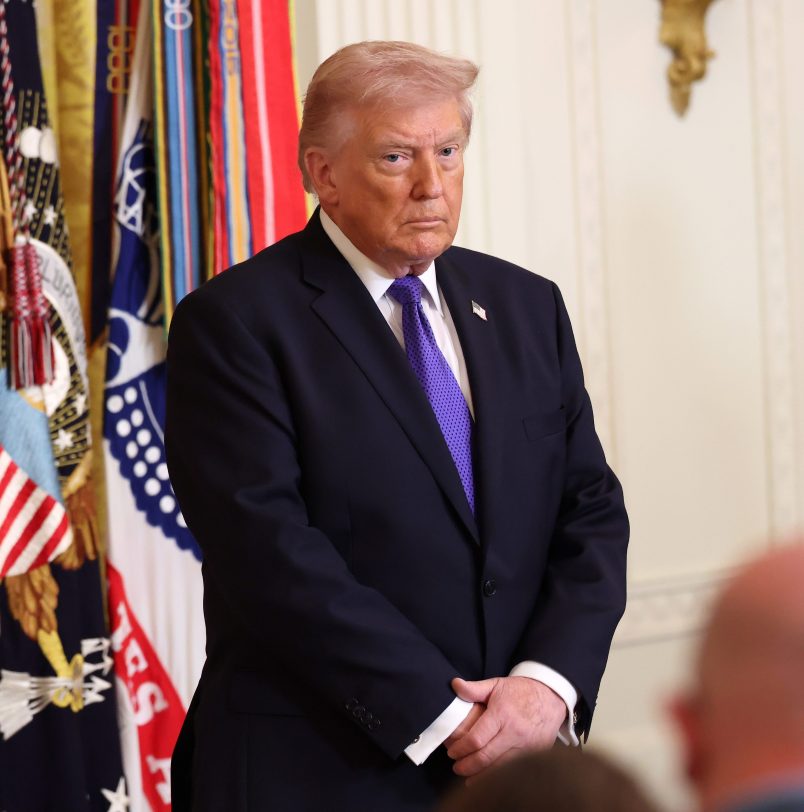
Our friend John Judis had an essay over the weekend in NOTUS airing the provocative and audacious claim that Trump is a world-historical figure in the way that the German philosopher Hegel used the term. This is a proposition sure to drive many to distraction. And perhaps for good reason. But as I told John in an email I largely agree with him, but with an important exception or difference in the way he articulated the claim. Before getting to that, let me give a very, very brief outline of the concept.
The idea here is not that the figures in question — an Alexander or Caesar or Bonaparte, the figures Hegel thought of — are good people. It’s not even that they necessarily have any articulate awareness of their role in history. It’s that there are some individuals who have an intuitive sense of the opportunities of the historical moment. They then acquire power and force huge changes that drive the course of history in dramatically new directions, directions that are essentially impossible to undo. The key is there’s really no going back from the changes these people make.
When I considered this I decided that it’s actually quite similar to an argument that I’ve made here a number of times. And that is that the old order is categorically shattered. There’s no going back. This is the real takeaway of the Biden presidency. I still think it will likely be judged more generously in the future than it is today. But big picture it was a failure, as would be any effort to simply turn back the tide of Trumpism or reconstitute the political world we knew before Trump. That world, that political order is gone. We know that not only because of all the things Trump has destroyed but also because that old order was feeble and vulnerable enough for Trump and Trumpism to be able to destroy it. Last fall, I said, at first jokingly but then with growing seriousness, that the greatest proof case of Trump’s claim of a corrupt American elite was the ease by which he scythed through it.
When Democrats or a broad civic democratic coalition retakes power their goal has to be not going back to 2015 or treating Trump as some kind of historical accident — something that still seemed plausible in 2020. It has to be to create something different, new and better.
But there’s another world-historical figure to consider besides Alexander, Caesar, Napoleon: Adolf Hitler.
Now, in saying this it may sound like I’m jumping into that cringiest version of resistance equation: Trump is the new Hitler. I’m not. Hegel, of course, didn’t know about Adolf Hitler. But he checks really all of his boxes. For the moment I want to set aside the Holocaust and most of the things we now associate with him, all the things which have made Hitler for many the literal embodiment of evil, the historical figure the moral and ideological verdicts about whom cannot be questioned. Put that all to the side. The upshot of Hitler’s reordering of the world order was to create an entirely new one. But it wasn’t the one he intended. Hitler’s dozen years on the world stage ended up creating not a global fascist order but a world in which the U.S. became the dominant but contested (by the Soviet Union) power and remade much of the world in the image of liberal democracy.
In other words, I think it’s right that Trump intuitively grasped the fragile and failing parts of the post-Cold War order that were vulnerable and exploitable. He proceeded to remake a lot of the world order with the power he gained from those intuitions and insights. But that doesn’t mean that Trumpism is the future. John gets a lot of mileage with quotes from Hakeem Jeffries and other high-profile Democrats which suggest that Trump is self-immolating and that come 2028 everything will go back to the way it used to be.
I don’t know how much those guys really believe that. If they do, they’re wrong. But I think most of us who have seriously considered the matter know that the old system is shattered. There’s no going back to the world most of us knew for most of our lives. But that doesn’t tell us a lot about the world we’re moving into.
The challenge for those of us who believe in civic democracy in the United States is that the future at home is far more mutable than that abroad. I’ve told people for a decade that my greatest fears about Trumpism were never what happens at home but what happens beyond our borders. At home we can choose to undo everything that happened in the last decade. I’m not saying that will happen. It’s quite unlikely. But we really are mostly in charge of our destiny at home. The situation beyond our borders is very different.
No matter what happens in 2028, it is impossible to imagine that the U.S. is able to put back the world order as it existed in 2016. No allies can possibly trust the US to play the role it played since the early 1990s and in a broader way since the late 1940s. The U.S. had the wealth and power to create a new world order in the late 1940s. It doesn’t remotely have that today. Maintaining something is a far lighter lift than creating something new. That means that a vast amount of the advantage, power and insulation from the vicissitudes of history we had is gone. That sucks.
It would be foolish to deny the transformative impact Trump has had on the history of our time. It’s vast. We just don’t know yet where that transformation is leading.