


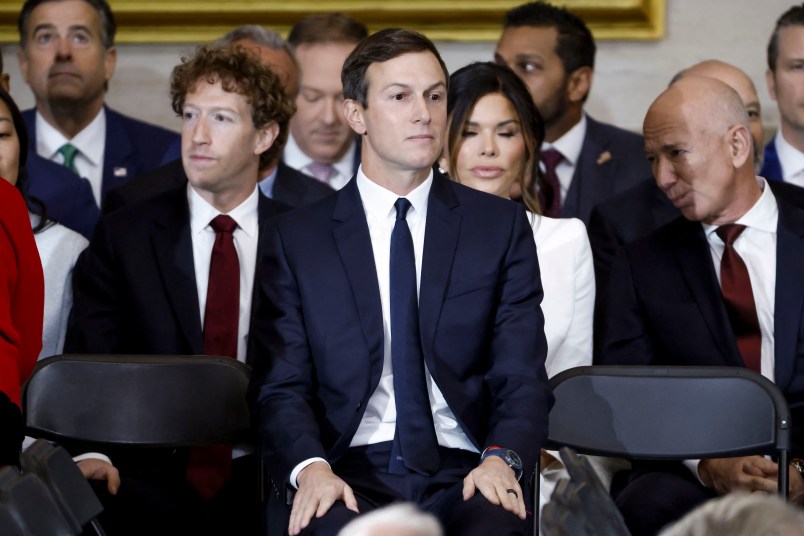
Today, I want to share some additional thoughts with you on this ranging topic of tech lords and predators, the conquistadors and pirates in our midst. It’s a point that is perhaps the most visible part of the current moment, but because of that, paradoxically, hardest to see clearly. It’s been more than a century since the men at the highest pinnacles of the American economy so visibly and directly intervened in the country’s politics. An element of that is the highly personalist nature of the big tech monopolies. Mark Zuckerberg isn’t just a CEO or plurality owner. He is Facebook. He’s the founder, the driving mind since the beginning. I believe that voting rights are structured in such a way at Meta that in terms of control as opposed to equity stakes he is in total control. Meta cannot be taken away from him. Whether or not voting rights are precisely the same, a similar story prevails at Amazon, Google, certainly X and all of Musk’s companies. We haven’t seen anything like that since the Gilded Age and the Robber Barons, when big names like Carnegie, Vanderbilt, Morgan and Rockefeller similarly owned, drove and personified the great corporate behemoths and monopolies of the day.
For many decades, certainly since the Second World War, even the more politically- and ideologically-minded corporations kept their political spending and their exertions in the background. Perhaps they gave most of their money to Republicans but they’d give to Democrats too just to keep them mostly on side.
What we began to see in the late Biden administration and then to an almost mind-boggling degree through 2025 is not just the big tech titans cozying up to Trump and doing so visibly, but making themselves what we might call main characters in the American Political Cinematic Universe. There’s really nothing like it in our history. I know many friends who are into MMA and the UFC. My sons are into it. Not my thing. But great if it’s yours. But if you’re Mark Zuckerberg and you take ringside seats at a UFC match with Trump friend and UFC CEO Dana White, you’re sending a very clear and specific message and you’re sending it far outside the channels where most traditional political messaging takes place. Even more if you put White on your board. And the same applies to going on Joe Rogan’s show and talking about a rights movement for “high testosterone males.” Yes, Zuckerberg got into MMA before the so-called “vibe shift.” But not in this politics-inflected way. We’ve seen countless examples of this in so many different contexts, starting with that unforgettable inauguration image where the seats of greatest distinction were reserved for the centi-billionaire tech titans. Government of, by and for them.
One of the things I’ve noticed most conspicuously over the last year is how new to politics a lot of these guys seem to be. Yes, Musk was a contributor to politics before his rightward turn. And a pretty good case has been made that his now flamboyant and open white nationalism was at least always latent in his worldview, going all the way back to his youth in South Africa. But I’m not talking about ideological predilections. I mean American politics, a system that has certain patterns, longstanding arguments, interest groups, traditions, etc. Again and again over the last year, I’ve seen Musk or Zuckerberg or David Sacks or even Jeff Bezos say something and thought, “You’re really new to politics, aren’t you? Like you’re really hitting all of this cold with very little sense of what happened two years ago let along 10 or 20.”
Now the thing about being a centi-billionaire is that you can be pretty ignorant, pretty dumb. And there’s an app for that. It’s called money. Money will take care of a lot of that. But not everything.
I started thinking about this more when I began to realize just how unpopular AI is, a point I mentioned a week or so ago. I know all the reasons AI is unpopular among some people, particularly in my world. It’s bad for the climate; it’s bad for the arts; it’s bad for the political economy; it’s bad for people who get annoyed hearing grown men talk about sentience and cognition with the sophistication of a first grader. But I’m also used to working on the assumption that outside of my world — one of people very up on politics, generally well-educated and with cosmopolitan social and cultural sensibilities — people can and quite frequently do think very differently. So I found myself surprised just how widespread hostility to AI is.
Different segments of American society aren’t necessarily against AI for just the reasons I am. But they have their own different reasons. For a huge cross section of Americans, AI is the thing the bosses are going to use to lay you off. It’s the early 21st century version of offshoring. And quite a few of the Americans who see it through that prism are Trumpers. If it’s not laying you off, it’s jacking up your utility rates so they can run the data crunching plantations that are going to take your job. When I first thought about this I wondered: are the billionaires damaging the brand of AI? Or is AI damaging the brand of the billionaires? But for the centi-billionaires who are staking everything on AI I’m not sure it matters. We’re already seeing signs that 2026 Republicans are going to try to sic an angry public on the tech boys, blaming them for jacking up electricity prices or layoffs tied to AI.
And this is one component of a larger point that’s been on my mind. Again, the tech oligarchs have made themselves big, visible parts of the American Political Cinematic Universe. That is a very precarious place for major corporate leaders to be. That’s why they are almost never, ever there. But they are. They are all in on AI. And they are all in on Trump. And both of those things right now are very unpopular. And I mean very unpopular. It’s hard to know in every case whether a particular oligarch is really down with Trump or just trying to go with the flow. But Trump demands things that make these distinctions not terribly relevant in terms of brand perceptions and brand damage. They’re all in for AI. They’re all in for Trump. And you can’t learn that just by reading the Wall Street Journal or small political magazines. You learn it on TikTok and Twitter and Facebook. Do they know that part of the health premiums going through the roof for a lot of people is going to be on them, just because they’re so prominent in our current political landscape as part of team Trump?
I don’t think the tech boys have much sense that politics shifts both ways, that what happened in the winter of 2024/25 wasn’t permanent. Indeed, it didn’t last through 2025. Do they know what it’s like to be holding the bag for a significant amount of main force political backlash? And not just worrying about Democrats being in power but having Republicans trying to stay in office trying to shift the ire in their direction? I have very little sense that that’s the case.
And this is a factor that goes beyond what happens in 2026. I was talking to TPM Reader BF a few days ago about this question of the tech oligarchs as latter day nabobs. They can fund campaigns. They can fund every friendly campaign twice over. They could hire private armies. But are they liked? Not really. And is anyone for them? One could imagine an alternate universe in which different tech titans associated with different mass political movements, funded that party’s or movement’s organizations, funded associated charities. The kind of thing where you could have big chunks of the population really devoted to this or that oligarch. But that’s not how any of this is working out. Their bases of support are actually fragile and narrow. I think a lot of them thought that if Trump’s with you, that’s all that matters. But I don’t think that’s the case, especially since most of these guys have decades of life and dreams of building up further riches stretching out before them after Trump leaves the stage.