


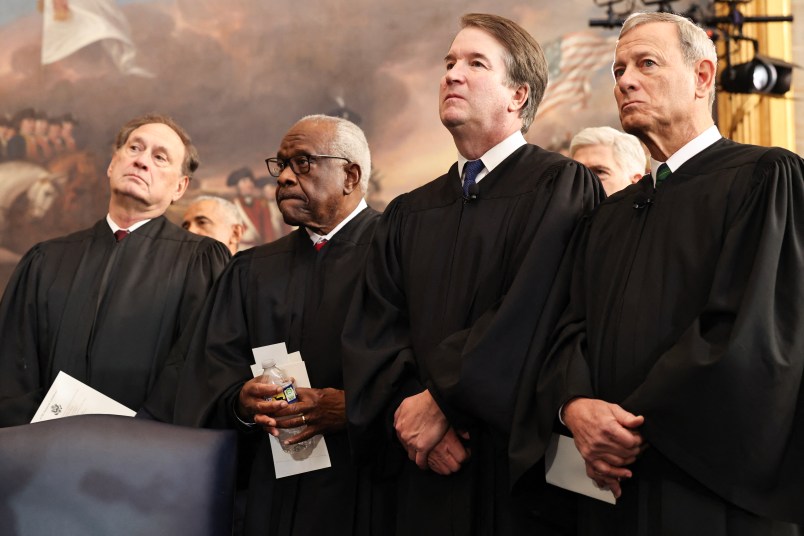
Yesterday, Lauren Egan — who authors The Bulwark’s newsletter about Democrats — sent out a newsletter edition entitled “Get Ready for the Dem Court-Expansion Litmus Test.” (Egan tends to be fairly dismissive of Democrats’ intentions, with a kind of mainstream media vibe.) Today Chief Justice John Roberts is complaining that the public is misinformed thinking that the Supreme Court is made up of corrupt political actors. As I’ve written repeatedly, there are deep inertia pools of opposition to Supreme Court reform. It’s a much heavier, though just as critical, lift than contesting the gerrymandering wars or abolishing the filibuster. But these and other hints show that a movement and a coherent push are beginning to take shape.
Calling something a “litmus test” is always a bit of a dig. It suggests not a reasoned political demand but a kind of unthinking, unreasoned box checking, groupthink. But a central point for the Trump opposition to embrace is to speak with actions and political power rather than allowing elite gatekeepers to divert them into debates about propriety or semantics. So yes, call it a litmus test or really whatever you want. No Democrat should get elected to any federal office without a credible plan to reform the Supreme Court and rid it of its corruption, along with the willingness to enact such a plan. Importantly, this is a cause any and every Democratic voter can help advance with their actions, at town halls, in conversations with elected officials, in small donor giving, on social media. You don’t need to be in a position to pass laws yourself. You don’t need to write six-figure checks. You can simply add to the chorus of Democratic opinion and become part of convincing the people in office that it’s the only way forward and the only way for them to stay in office. It’s already starting to happen. It turns out the depths of the Court’s corruption provide powerful motivation and encouragement.
As for Roberts, in advance of actual reform the next best thing is making the threat or reality of accountability hit home for the authors of the corruption. So it should hearten you every time the Chief Justice has a whine-fest like this. He hears you. The Supreme Court descended to this level of corruption because of a total lack of accountability. Checks and balances are at the heart of the American system. Opposing centers of power and paths for political accountability are built into the system. There are complex reasons why there’s so comparatively little of that for the federal judiciary generally and the High Court specifically. They’re mostly centered on the perception that the judiciary is the weakest branch and thus least in need of protection against. Because of that, the first big abuses of power went unanswered. That only increased the appetite for greater abuses of power. There was no counter-force, no threat of accountability to keep the appetite to abuse the Court’s power in check.
Any institution is susceptible to individual bad actors. The institution itself becomes corrupt when individual acts of corruption become commonplace, accepted and open. The current Supreme Court is like a municipal government which has gone from individual officials taking the occasional bribe to one in which bribery is pervasive and public, where they’re openly solicited and accepted.
As I wrote last week, I think we’ve gone past the point where the threat of accountability can restrain this Court’s corruption. That might have worked in 2012 or perhaps as late as the late teens. I think that window has closed. But we still shouldn’t see a bright line between the credible threat of reform and a thorough house-cleaning taking place. It is critically important that Democrats be building Court-reforming majorities in 2026 and have it be a major part of legislative action in the next Congress, even if actual reform is basically impossible with a Republican president in place. The threat of accountability shapes behavior. Ideally, that threat would spur members of the Court to curtail their corrupt actions, generating a kind of race to 2029 in which members of the corrupt majority tried to deprive the reform movement of oxygen by making reform less necessary.
Is that likely? Can the problem be solved without changes to the structure, membership and size of the Court? I doubt it. But this is the kind of thing you allow to play out. Have multiple paths to achieving the goal. The point is that the threat of accountability and reform creates incremental steps toward achieving the goal, not only in building consensus and power to enact reform but in curtailing corrupt behavior. It’s not a binary either/or.
The key point is that democratic self-government in the United States is simply not possible with this level of corruption so deeply embedded into the architecture of the federal government. You can’t have meaningful elections if the consequences of elections are routinely tossed out by what amounts to an unaccountable Guardian Council controlled by one political party.