


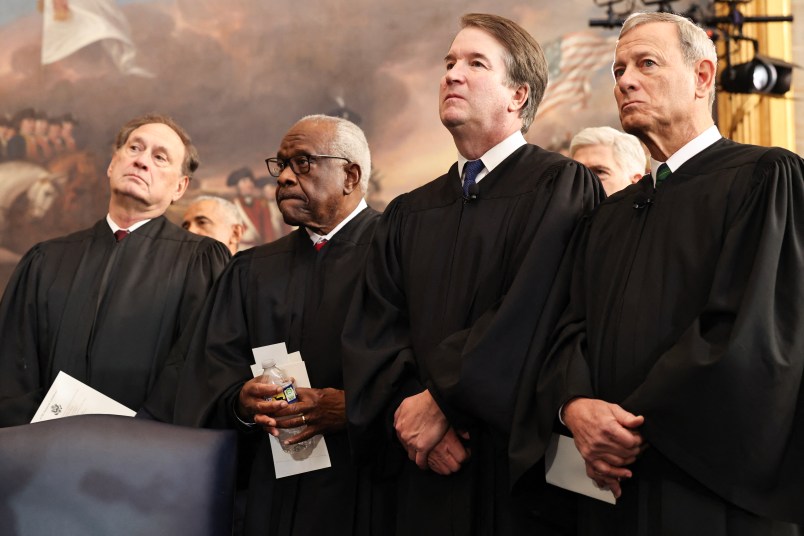
Here’s a brief follow up on yesterday’s post about the corrupt Supreme Court. Yesterday I noticed law professor Steve Vladeck arguing on Bluesky that civic democrats are making a mistake by seeking to “fix” the Court by, as he puts it, “permanently weakening it as an institution.” The gist of his argument is that you constrain the Court by “forcing it to look over its shoulder” as it decides case. In a post on the topic, he writes, “as compared to a time when Congress controlled things like when the Court sits; where it sits; which cases it hears; the Court’s budget; and what the justices must do when not hearing cases (i.e., ride their circuits), today’s Court can do just about whatever it wants, whenever it wants, and all without realistically having to look over its shoulder.”
I told him that I actually agree with the concept of having the court “look over its shoulder” — that you have a series of teeth in place to react to overreach. I’m not sure about the best method of applying that pressure. But I agree with the general principle. Or, rather, I did agree with it — but I think we’ve missed the window for that kind of intervention from Congress. (You can see our brief exchange here.)
Join TPM to get full-access to our reporting, newsletters, and other member-only features.