In Major Shift, Trump Admin Prioritizes Fight Against ‘Left-Wing Terror’ Over Islamic Extremism

Inside Rubio’s Confab on Lefty Terrorism

The Trump administration’s effort to create a new bogeyman of left-wing terrorism has now resulted in a major policy change unveiled by Secretary of State Marco Rubio Thursday in a speech to officials from more than 60 countries whom he gathered in D.C.

Declaring Islamic terrorism “severely diminished,” Rubio said the counterterrorism apparatus must be retooled to confront the supposed threat from “far-left terror,” Reuters reports.

“We can and we must identify and map this threat and rebuild our counterterrorism architecture to defeat it,” Rubio said, marking a dramatic shift away from the post-9/11 posture of U.S. counterterrorism efforts.
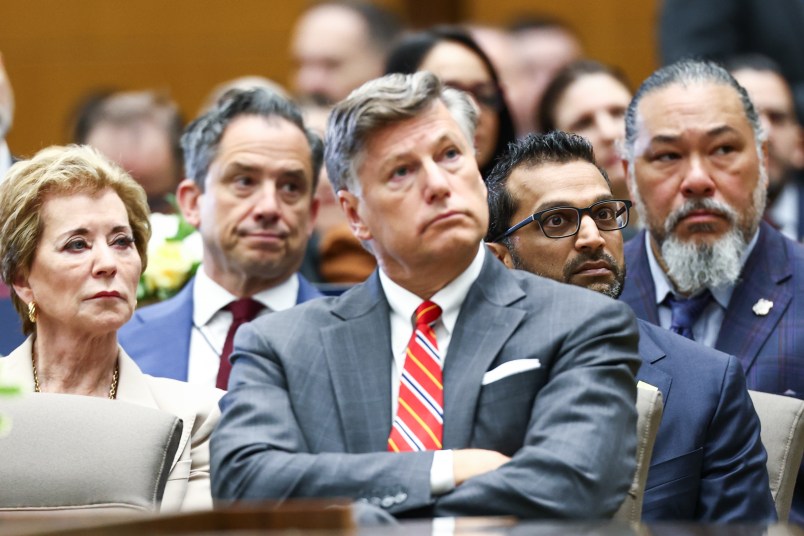
WASHINGTON, DC – JULY 16: U.S. Secretary of Education Linda McMahon, U.S. Deputy U.S. Secretary of State Christopher Landau, and FBI Director Kash Patel listen as Secretary of State Marco Rubio delivers opening remarks during the Ministerial on the Resurgence of Political Terrorism at the State Department on July 16, 2026 in Washington, DC. Rubio was joined by Secretary of the Treasury Scott Bessent and White House Deputy Chief of Staff Stephen Miller as they discussed the rise of far-left political terrorism as a transnational threat. (Photo by Finn Gomez/Getty Images)

To this point, the administration has aimed to elevate political protestors and progressive groups and activists into a vast far-left “antifa” conspiracy at home — and link it up with imagined fellow travelers abroad with wild and unsubstantiated claims of international coordination and connections. Establishing a (flimsy) link to international terrorism — a related effort which has been spearheaded by White House counterterrorism czar Sebastian Gorka and Rubio — seems intended to invoke counterterrorism powers under U.S. law that simply don’t exist for combating domestic terrorism.

What made Rubio’s remarks especially notable was how he broke new policy ground in prioritizing the purported left-wing terror threat of MAGA fever dreams while deprioritizing the decades-old real-world threat from radical Islamists. Later in the day, Rubio announced a new visa restriction policy “targeting far-left terrorist and other aligned groups.”

Rubio’s speech was a tour de force of disinformation, unsubstantiated conspiracy theories, and guilt by associations. He threw around terms like “Marxist” and “communist” while baselessly alleging that Iranian proxy networks are “intimately tied” to leftist militant groups and claiming that the George Floyd protests was left-wing terrorism that had been swept under the rug.

“They can call themselves anti-capitalist or anti-imperialist, communist, anarchist or Marxist,” Rubio said, according The Guardian. “It’s always the same. It is a poisonous resentment cloaked in the language of equality and justice liberation — an overwhelming need to tear down, to wreck, what is beautiful and what is right on behalf of people who are only filled with ugliness and have nothing else to offer the world through violence and through terror.”

But it was White House deputy chief of staff Stephen Miller who trafficked in the most reductionist and dehumanizing rhetoric in his speech to the gathered foreign officials:

The invention of a new turbocharged left-wing terrorism threat is bad enough by itself, but the real aim is to then conflate it with domestic political opposition to Trump and the exercise of constitutionally protected rights to dissent and protest. It’s a regime-protection racket, but now it’s coming at the additional expense of redirecting U.S. counterterrorism resources from actual threats to made-up ones.

The Latest on the Fatal Ice Shootings …

Maine

  • The ICE agent who shot and killed Columbia national Johan Sebastián Durán Guerrero in a Monday traffic stop has been identified as David Brouillette, an Army veteran with an alleged history of mental illness, violent outbursts, and domestic abuse, some of his family members told the AP.
  • Brouillette’s ex-wife Ashley told the Portland Press Herald that he called her after the shooting to ask her to vouch for his character and that she refused. “He was asking me to lie for him and to cover for his character,” Ashley Brouillette said. “I told him that I was not going to lie for him. And then he tried to say that it was a justified shooting because the guy tried to hit him with his car.”

Houston

  • The family of Lorenzo Salgado Araujo, the Mexican national shot and killed by ICE in a July 7 traffic stop, says the baggies found in the work van he was driving didn’t contain meth but salt. “Our understanding is that this was granulated salt, which is paired with lemon and water as a homemade electrolyte mix used by outdoor workers in extreme Texas heat, not methamphetamine or any other illicit substance,” said an attorney representing the family.
  • Controversial Houston U.S. Attorney Aaron Reitz issued an unusual public statement commenting on the case that appeared intended in part to tamp down public outrage but at the same time was heavily coded in anti-immigrant language and also mentioned “several small bags of a white, crystal-like substance” in the van.
  • In an interview on CNN, the Houston district attorney cast doubt on the FBI’s suspicion that meth was in the van: “Based on the information we have regarding who Mr. Salgado was, and just eyeballing the evidence as it was collected yesterday, we don’t believe that they are drugs,” Sean Teare said.

Quote of the Day

“It doesn’t matter whether or not there were drugs. It has no bearing on why Mr. Salgado and the other three individuals were targeted. It has no bearing whatsoever on whether or not the use of force that killed Mr. Salgado was justified.”—Harris County District Attorney Sean Teare

Sign of the Times

President Trump’s longtime teleprompter operator is under investigation for allegedly using his inside knowledge of the president’s speeches to win more than $100,000 on prediction markets. Gabriel Perez, who is on unpaid administrative leave, is in talks with the Commodity Futures Trading Commission to settle the settle allegations against him, ABC News reports.

Shrewd Audience

A quick anecdote from seeing Christopher Nolan’s The Odyssey last night. I’ll leave the reviews to others since movie blockbusters aren’t really my thing, but there was a memorable moment before the film even started.

It wasn’t clear at first if what was on screen was a trailer or an ad. It featured a slideshow of striking visuals with voiceovers intended to represent a diverse range of ordinary folks asking thoughtful and sometimes hard questions about AI. At the end, it was revealed to be an advertisement when the Anthropic and Claude logos appeared on screen — and the small audience in the theater immediately and spontaneously booed all around me.

It was especially striking because it didn’t feel in the moment like a blanket anti-AI reaction, but a more nuanced rejection of the pretense than any AI company could purport to act as a convener or moderator of the AI debate. Or maybe it was both.

This was a D.C. audience, perhaps inured to the constant barrage of reputational ads that target audiences in the nation’s capital, but even that sort of hard-boiled skepticism is more than I usually see in public settings. This is the ad in question, which you may have already seen because it’s gotten quite a bit of coverage.

See You Back Here Monday

News? Tips? Feedback? Please let me know. For sensitive information, use the encrypted methods here.

The Brief: Trump’s Primetime Address Backfires

Thanks for reading this last month as we soft-launch what we’re now calling “The Brief.” I’m taking a week off to bring my toddler to the beach. I’ll be back July 27. If you’re enjoying this morning dispatch, we’ll have the option for you to sign up for it as a newsletter by early August. See you all soon. Stay cool, and breathe fresh air if you can find any.

Primetime Flop

Trump’s election speech last night, which Democrats, election administrators, and Republican legislators were dreading (each for somewhat different reasons), was a dud. Trump insinuated, lied and selectively presented information as he sought to cast doubt on the 2026 midterms and again undermine 2020, but he did so while covering well-worn ground. Despite fears, he didn’t order anything new, beyond demanding Congress pass the SAVE America Act voter suppression bill — a demand he makes in some form nearly daily.

Continue reading “The Brief: Trump’s Primetime Address Backfires”

The ‘Doom’ Computer Game Was Part Of Trump’s Wild And Baseless ‘Election Security Nightmare’

Things got really weird during President Donald Trump’s big speech on “election security” Thursday night. 

Continue reading “The ‘Doom’ Computer Game Was Part Of Trump’s Wild And Baseless ‘Election Security Nightmare’”

A Must Read and Truly Horrifying Story

The AP has just posted a detailed investigation into the background of David Brouillette, the recently hired ICE agent who shot and killed Johan Sebastián Durán Guerrero in Maine. It’s genuinely horrifying on more levels than are easy to describe. Brouillette was hired during ICE’s recent hiring spree, as the agency attempted to rapidly staff up to manage a program of mass deportation. Brouillette has a long history of severe mental illness, a lengthy history of violence against at least two wives as well as his children, stalking, a seemingly endless list of restraining orders, violent threats against other family members and more.

Continue reading “A Must Read and Truly Horrifying Story”

Trump’s Big Speech

The big announcement of a “prime-time,” “Oval Office” “address” was typical Trump, encouraging Americans to live in his world. In the end, none of what he said was new. He did make the ill-founded claims about non-citizens on voter rolls, described in that “draft press release” which was covered by Politico and which Josh noted below. He also said some stuff about China acquiring voter files that we’ve known for years. He did not even go so far as to baselessly allege votes were changed, or that the election was otherwise stolen, as so many predicted he would. He of course concluded with a demand that the Senate pass the SAVE America Act.

We’ll look through the documents his government released and share any interesting or amusing details. More soon.

How Politico’s Negligence and Ignorance Helped Float Another DHS Lie

Voting rights, voter intimidation and the politics of voting have been central themes of TPM reporting going back more than 25 years. Over a quarter century you develop a lot of institutional knowledge. Today we’re seeing some of the most egregious journalistic negligence, sloppiness and ignorance helping propel forward the Trump White House’s assault on the integrity of the 2026 midterms. The piece I want to point you to this evening is Politico’s claim that DHS found “thousands of non-citizens on voter rolls in California and three other states.”

This claim is almost certainly false for reasons I’ll explain. I want to briefly summarize the multiple levels of journalistic negligence in Politico’s reporting.

Continue reading “How Politico’s Negligence and Ignorance Helped Float Another DHS Lie”

If Fetterman Were Going to Change Parties, He Might Act Like He’s Acting Now

Sen. John Fetterman (D-PA) is re-arousing suspicion that he may intend to switch parties, something he’s tepidly denied he’ll do in the past. 

Continue reading “If Fetterman Were Going to Change Parties, He Might Act Like He’s Acting Now”

Can the New Progressive Wave That’s Reshaping the Democratic Party Win in a Rural Red State?

As a smoke jumper, Sam Forstag fought a relentless game of inches. 

The job is a hard one. Firefighters who parachute in when blazes break out deep in the forest need to build a barrier to beat back the flames. They use chainsaws and other tools to cut down to the hard mineral soil, creating a fire line with no fuel to keep feeding the inferno. It’s grueling work that can be set back in an instant by a fresh bolt of lightning. And Forstag learned all too well that, even when the forecast seems set to turn wet in a way that might help fend off the flames, you can’t rely on weather to help hold the line. 

“The rains don’t always come,” Forstag explained in a conversation with TPM on Tuesday.

Now, after winning a different kind of fight and earning the Democratic Party nomination for one of Montana’s two House seats, Forstag finds himself in the center of another firestorm. The recent stretch of Democratic primary races were defined by candidates like Forstag — progressive outsiders who have challenged the party establishment.

In especially high-profile races in New York City and Denver, Colorado, candidates backed by socialist organizations defeated moderate Democrats with entrenched bases of support. Data indicates this wave was propelled by new voters who expanded the electorate. While these victories have been met with excitement in some circles, others have likened the progressive insurgency to the GOP Tea Party movement and argue it could have dire consequences. 

Forstag shares some similarities with the candidates who pulled off shock wins in blue cities. He was an underdog against a former gubernatorial nominee. Forstag also drew endorsements from Sen. Bernie Sanders (I-VT) and Rep. Alexandria Ocasio-Cortez (D-N.Y.), which led to his bid being widely seen as a test for the kind of new left messaging that’s helped define this cycle for Democrats. 

All of this puts Forstag at the center of some of the most interesting and crucial conversations in politics right now. And, while the new left wave has clearly scored in staunchly blue territory, Forstag’s campaign poses an interesting question: Can a progressive outsider experience similar success in a largely rural red state?

For his part, Forstag rejects the premise Montana doesn’t have the potential to swing. He cited the state’s history of union activity and more recent shifts in statewide representation.

“Montana just saw its first Republican supermajority in state history in 2023. Like, Montana is not a deep red state,” said Forstag. “I mean within the last 12 or 13 years, we had a 50-50 split in our state legislature. Two years ago we had a Democratic U.S. senator. We had a Democratic governor until, what, 2020? This is a brand new phenomenon that Democrats are being wiped out.”

Forstag blames the recent growth of the GOP in his state and more broadly on what he continually describes as a “disconnect” between Democratic politicians and voters. He is adamant that the party needs a new approach. 

“The Democratic Party has really fucked everything up. We are in a position where we have no power at the federal level and all of this happened as we have one of the least popular presidents ever elected in office because we could not offer a more hopeful alternative or solution,” Forstag said. “I mean, at the end of 2024, we had a president telling us all that the economy is better than we think it is. Well, I don’t think there’s any better articulation of a disconnect between our political leaders and what life is like on the ground.” 

As Forstag sees it, the party’s main mistake was failing to address the economic challenges faced by voters in rhetorical or concrete terms.  

“At the end of 2024, I was making $19 bucks an hour jumping out of airplanes for the federal government in a community where you cannot find a home for less than a half million dollars — and I was seven years in,” he explained. “Some of these guys and gals are 20-plus years in making the same wage on the same job. And if that is your situation, then your life did not improve under four years of Democratic control.”

Forstag cited rising rents and private equity buying up mobile homes in his home state as “all people talk about when I go to a bar in Missoula.” 

“Rent has doubled or tripled over the last 10 years in Missoula. It’s worse in … Bozeman, in my district. It’s worse in the Flathead Valley,” he said, later adding, “This is what normal people are dealing with on a day-to-day basis and it’s this fundamental disconnect, right?”

Sam Forstag appears in a campaign advertisement. (Photo: YouTube)

Their loss in the last presidential race has led some Democratic operatives and organizations to actively recruit candidates like Forstag who mix progressive positions with working class careers and the traditional masculinity that goes along with them. This drive had a notable setback in Maine where, after a lack of vetting, Graham Platner secured the party’s Senate nomination before withdrawing after becoming beset by a series of scandals, including an allegation of sexual assault. 

Forstag is about as blunt when discussing the party’s issues with fielding working-class candidates as he was when talking with TPM about the broader messaging missteps. He blamed it on “policy failures for decades,” namely Democrats not universally and aggressively pushing through campaign finance reform despite Republican opposition. 

“There’s a reason that it’s so rare to see a working person even on the ballot as a major party nominee for any federal office. It’s because the system is not designed for normal working people to be able to make it in a position of power,” Forstag explained.

Forstag has a compelling personal backstory. In addition to serving as a first responder under trying circumstances, Forstag was the vice president of his union, National Federation of Federal Employees (NFFE) Local 60, where he led a successful campaign to organize the last non-union forest in Montana. According to Forstag, he decided to run for office after seeing the dramatic impact of job cuts — from President Donald Trump and near-trillionaire Elon Musk’s DOGE initiative — on his colleagues in the federal workforce. 

“What the DOGE cuts looked like in Montana for the forest service or for public lands agencies was actually the lowest paid employees that we have being just absolutely gutted and cut,” Forstag explained. “They said it was all about government efficiency. There are massive inefficiencies in the federal government, believe me, I’ve come face-to-face with them. It is not people swinging a tool in the woods for $12 bucks an hour. … And those are the people whose jobs they came after.”

In his role with the union, Forstag said he sought help from the man who currently represents Montana’s First District.

“When I called Ryan Zinke, the Republican sitting in the seat right now, I got crickets,” Forstag said. “So, I decided, if he’s going to come after all my members and my co-workers’ jobs, I’m going to come and take his.”

Forstag ultimately had to leave his position in the U.S. Forest Service to run for office. Zinke announced his decision not to seek re-election in March, leaving a wide open race. Aaron Flint, a pro-Trump veteran and local talk radio host, won the GOP primary last month. 

As he approaches the general election, Forstag believes a focus on economic issues is crucial. 

“There’s been a big conversation about identity that I’ve lived through, through my adult life, from the left, right? And that has in large part been healthy, but it seems like we forgot about the most important fundamental part of people’s identity, which is our economic identity,” he said. “What is the thing that is woven through every piece of existence if you’re a working person? It’s how much money do I have? Can I afford my fucking rent at the end of the month? It’s like, well, what’s that noise that my car is making? …  That’s an emotional thing that you carry in your chest.” 

In the wake of wins by New York City Mayor Zohran Mamdani and other progressives who homed in on economic issues, “affordability” gained traction as a key talking point for many politicians. But that was also frustrating for Forstag who saw them as late adopters. 

“I’ll be frank, the term ‘affordability’ kind of pisses me off,” said Forstag. “Because like six months ago this became the watchword for candidates across the country. And what that feels like on the ground is where the hell have you been living for the last 10 years?”

As much as he has clear criticism for Democratic messaging, Forstag certainly also does not appreciate how Republicans have talked about identity and the economy. 

“This messaging on the right where they told you the system’s broken, but then they blamed all the wrong people and told you it’s because of poor people, or brown people, or queer people. Like, none of those people are making you poor,” Forstag said. “It’s an incredibly small slice of incredibly wealthy people who are using the wealth that they’re accumulating to keep these systems broken. … That is who our enemy is.”

Forstag thinks Democrats’ failure to address Americans’ economic situation is why this rhetoric has gained traction.  

“I’ve watched a lot of the people that I work with, my friends, become the people who vote these schmucks into power. And most of the people I work with, I mean, a  third of my union members or coworkers … they don’t do it because they’re racist or xenophobes. They do it because their life is getting worse,” he said. 

Messaging isn’t the only thing that Forstag believes has helped him connect with voters in Montana. Forstag also believes being a union man was an essential component of his win. 

“In large part, it was solidarity. We got through the primary with over a dozen unions supporting me. I mean, not just my own union. but brothers and sisters in unions across the state, some of whom, you know, probably most of their members did not vote for a Democrat last year,” Forstag said, adding, “Many of them were very excited to finally see somebody who, you know, actually can identify with what it’s like to be a union member.” 

Forstag didn’t take the bait when I brought up the problems with Platner’s candidacy in Maine. However, he eagerly jumped when I asked if recruiting union leadership should be part of Democrats’ strategy as they strive to recruit working-class candidates.

“I think it damn sure better be,” he said. “The Democratic Party I grew up with was the party of the working class. We were the party of the unions. We were the party of young people. Nothing about this last election was that party.”

As Forstag sees it, the path forward for both his campaign and the party is painfully clear. He threw his hands up as he summed up the assessment. 

“The frustrating thing is the formula seems so obvious,” Forstag said.

Get Ready for a Conspiracy Theory-Laced Speech From Trump Tonight

Hello, and welcome back to The Franchise!

We’re gearing up for President Trump’s address tonight, which has been billed as a speech focused on this administration’s absolute favorite topic: election security — or more specifically, Trump’s gloss on “election security.” That includes, as we know all too well, his baseless claims about how infested with fraud election administration is in parts of the country where President Trump doesn’t win elections. We’re expecting an address that does little other than flood the zone with confusing data and baseless claims about the 2020 election, all in service of giving a platform to Trump’s voter fraud conspiracy theories ahead of the midterms. 

Trump is reportedly going to address the safety of voting machines (a post-2020 classic) and allege foreign interference in elections (another classic). According to MS NOW, Trump is expected to speak about declassified intelligence materials on both voting machines and alleged foreign interference efforts, likely related to the 2020 election. Reuters and other outlets are reporting that some of his claims may be about China. 

The address seems to be yet another escalation in the administration’s ongoing and seemingly never-ending campaign to scare people into thinking our election system is not safe and that the 2020 election was actually stolen after all. 

Acting Director of National Intelligence Bill Pulte and columnist-turned-conspiracy theorist John Solomon, are, per MS NOW, behind this effort to declassify and release these documents. For just a little bit of context, Solomon started the right-wing publication Just the News in 2020 after publishing several articles for The Hill pushing claims from Trump and his allies about a supposed corruption scheme involving Joe Biden and Ukraine — the episode that became the heart of Trump’s first impeachment. Just the News often amplifies Trump’s conspiracy theories. Solomon announced earlier this year that he had taken a temporary position in the White House where he would aid in “identifying classified or withheld documents concerning weaponization and election integrity.” Pulte, of course, has demonstrated his loyalty to any and all Trump causes by using his other post as head of a federal housing agency to launch thus-far unsuccessful criminal investigations into Trump’s political foes.

We say all that to say: the masterminds behind this grand announcement don’t exactly inspire confidence in the credibility of whatever claims Trump intends to spread this evening.  

It’s no surprise that Trump will be addressing our supposedly unsafe election system and the 2020 election — topics that have been an area of fixation for Trump and his allies for years now, but have become particularly pertinent for the administration just ahead of the midterm elections that Trump has made clear he is worried about losing.

There’s a lot more to unpack this week, so let’s dig in. 

Four More Losses in the DOJ’s Campaign to Seize Voter Data

Another day, another court defeat (or four) for the Trump administration’s ever-floundering campaign to seize sensitive voter data from the states.

Last week, a federal judge dismissed the DOJ’s lawsuit against New York over its refusal to hand over voter data to the federal government. And then this week, federal judges dismissed similar complaints against West Virginia, New Mexico and Virginia.  

These latest defeats bring the administration’s grand total of losses to a staggering 15, with zero wins — embarrassing at this point! 

The DOJ has been leaning heavily on provisions in the Help America Vote Act (HAVA), the National Voter Registration Act (NVRA) and the Civil Rights Act of 1960 (CRA) to make its case for why it is entitled to voter data from 44 states and Washington D.C. The data they’re after includes Social Security and driver’s license numbers. Not a single judge has sided with the DOJ in its overreach campaign thus far.   

In her ruling dismissing the DOJ’s lawsuit against New York, U.S. District Judge Mae D’Agostino, a Barack Obama appointee, noted that neither the Civil Rights Act nor the Help America Vote Act, give the DOJ authority to demand personal identifying voter information from the state. 

“Pursuant to the Elections Clause of the United States Constitution, the States are empowered, in the first instance, to regulate and administer elections,” she wrote. 

“For these reasons, this Court joins every district court to have addressed this issue in concluding that a voter registration list is not a record or paper that a state must produce to the Government under Title III,” she added.

And, U.S. District Judge Thomas E. Johnston, an appointee of George W. Bush, granted West Virginia’s motion to dismiss the DOJ’s lawsuit, ruling that the DOJ  had no grounds to be demanding the type of information that it is demanding. 

“Clearly, this demand is devoid of any factual basis,” Johnston wrote. “The demand includes no indication that West Virginia is suspected to be noncompliant with the list maintenance requirements of HAVA or the NVRA, nor does it point to any anomalies in West Virginia’s voter registration data.” 

Also this week, U.S. District Judge Judith Herrera issued a similar ruling in a case against New Mexico, saying that the DOJ did not state its “basis” for requesting this information. 

In Virginia, U.S. District Judge Roderick Young, a Trump appointee, wrote in his ruling that Virginia’s voter data is “outside the scope of Title III of the CRA, the Motions to Dismiss will be granted.”

Tina Peters Is, Unsurprisingly, Cozying up To Trump

Election denier and former Mesa County elections administrator Tina Peters has been doubling down on election-related conspiracy theories (both old and new) since her release from prison last month. You’d think maybe she’d want to keep a low profile and stay out of trouble, but she has, in fact, been taking the exact opposite approach: she’s gone full steam ahead on some of the very conspiracy theories that landed her in prison in the first place. And now, she’s discussing some of them with Trump. The two have discussed some of these conspiracies related to voting machines and have been talking about a “solution” to this conspiracy-fueled “problem.”

Peters was convicted for breaching her own office’s voting equipment in some misguided quest to find evidence of 2020 election fraud. The data from the breach was then leaked online. Until last month, Peters had been serving a nine-year prison sentence. But in May of this year, Democratic Colorado Gov. Jared Polis, succumbing to mounting pressure from President Trump, commuted her sentence and made her eligible for parole on June 1. 

Since her release, Peters has been on a conspiracy theory press tour.

Late last month, Peters reportedly met with Trump to discuss ways to interfere in the midterm elections, per Media Matters. During a fundraiser for herself last month, Peters said that Trump had called her and that she believes that “Trump could sign an executive order to get rid of the machines.”

In several different right-wing media appearances last month Peters continually reiterated conspiracies about voting machines.

“We have to get rid of the machines,” she said on a “Faith and Freedom” appearance on June 28. “The machines don’t have any transparency; they are flipping votes.”

This month, during a livestream, Peters recounted her meeting with Trump at the White House where the two supposedly talked about voting machines and elections. “We are, right now, you know, with meeting the president yesterday, giving him a real solution to how to stop what’s happening.”

“Yesterday, when I was with the president, he talked — and I can’t get into the plan — but we talked, he basically said to his lead counsel to do what I was asking,” she added

Of course, it’s no surprise that Peters is doubling down on election conspiracy theories. Her conspiracies are in line with the administration’s larger campaign to interfere in the midterm elections and sow seeds of doubt about the safety and security of the country’s election system. 

In Other Election News:

USA Today: Trump moves to tighten federal control of elections ahead of midterms

TPM: DNI Nominee Clayton’s Answers on Election Integrity Are Too Cute by Half 

CBS News: Trump endorses MyPillow’s Mike Lindell in race for Minnesota governor 

ProPublica: FBI Has Looked at Using Questionable AI Tech to Review Signatures on Seized Mail-In Ballots 


Georgia GOP Silent Amid Revelations About Senate Nominee’s White Nationalist Son-in-Law

GOP Senate hopeful Rep. Mike Collins’ flirtations with antisemitism now extend beyond his social media posts, past several of his former staffers and strategists, and reach directly into his immediate family, according to a new report from CNN K-File published Thursday morning. But while state and national Democratic elected officials and organizations have vehemently condemned Collins following the report, which exposed the congressman’s son-in-law as a white supremacist and neo-Nazi influencer, the Georgia Republican Party and its leaders have so far remained silent.

Collins’ son-in-law David Alan Scheer II repeatedly made overt white supremacist statements, posted antisemitic ideology on social media, and said, “There’s nothing wrong with White Nationalism,” in a YouTube comment, according to CNN.

And Scheer isn’t some far-removed family member with whom Collins doesn’t interact. The report highlighted the white supremacist’s presence on Collins’ campaign website and social media, and even found that Scheer is registered to vote at a home Collins owns and which is next to the congressman’s own house.

Per CNN, Scheer on a podcast last November advocated for “clearing our land of other people” to restore America’s white population. He has repeatedly claimed Jewish people were responsible for a number of things he views as negative, from gun control to the LGBTQ movement. He said on a podcast that “Israel and Zionist Jews” were responsible for policies that “undermine the White Christian nature of America,” and disparaged Black and Indian people. At least one antisemitic infographic Scheer posted was created by his wife, Collins’ daughter, Scheer said. 

“My wife made a consolidated version of all the proof jews control our government through finance,” Scheer wrote.

Collins’ son-in-law also produced advertisements for the congressman’s trucking company.

“Rep. Collins’ lifelong support for Israel is unquestionable and backed by his consistent record in Congress of standing up for Israel and her people,” a spokesperson for Collins told CNN in a statement. 

Neither the Georgia Republican Party, members of its leadership, or the National Republican Senatorial Committee immediately responded to TPM requests for comment. None of the organizations have acknowledged the report on social media or on their websites as of the time of publishing.

“Mike Collins has repeatedly proven himself to be a bigot and antisemite,” Charlie Bailey, chair of the Democratic Party of Georgia, said in a public statement. “Now Collins is funding and enabling a white nationalist who films neo-Nazi propaganda. Collins should explain himself and apologize to Georgians immediately, but no matter what bogus answer he gives, we will do everything in our power to keep him out of the U.S. Senate this November.” 

Collins’ opponent, Sen. Jon Ossoff (D-GA) called Collins’ “ties to neo-Nazi ideology and notorious white supremacists” “disqualifying.”

For Jewish Georgia state rep. Esther Panitch, Collins’ legislative support for Israel is not enough.

“Being pro-Israel is not a hall pass for antisemitism,” Panitch, who is a Democrat, wrote on X. “It is not a shield you hide behind when the hatred is in your own family, on your own property, with your own name attached.”

Panitch called on the congressman and the Georgia Republican Party to condemn Scheer’s antisemitism.

Collins’ senatorial campaign has been dogged by his own offensive and at times violent social media presence. He called a Jewish Washington Post reporter a “garbage human” while interacting with an antisemitic X account and later defended that interaction. His staff choices have also been a stain on the congressman’s campaign. Collins fired campaign advisor Brandon Phillips after Phillips published a crude joke on social media about a woman who accused former television anchor Matt Lauer of rape and whose husband was working for a PAC supporting a Collins opponent. Slate reported that Collins’ chief of staff, Kip Talley, had participated in a group chat with prominent white nationalists like Richard Spencer where he attempted to help Charles Johnson, a white nationalist and Holocaust denier who had been held in contempt of court as part of a racketeering case. Last week, Talley resigned, leaving Collins to welcome his third chief of staff in one year, according to the Atlanta Journal-Constitution.

Even Republican strategists have admitted that Collins is a tough candidate to get behind, according to reporting from Politico. The party’s skittishness about Collins can be seen in his paltry fundraising numbers. Data from the Federal Elections Commission shows Collins had just over $2 million in cash on hand as of June 30, compared to Ossoff’s more than $42 million.