


It’s a good day to return to the question of the Supreme Court’s corruption and the necessity of reforming it in order to make democratic self-government possible again in the United States. The federal constitution is an expansive document. Within the system begun with Marbury v. Madison – which is subject to many reasonable critiques – it is possible to have more liberal or conservative jurisprudences, loosely tethered to the progress of presidencies and senates. The Roberts court is a different beast. It is the product of a decades-long effort to corrupt the federal judiciary. That degree of corruption first came into full view in the second decade of this century when the Court openly began to do three closely interrelated but conceptually distinct things.
First, The Meaning of Words is For Little People.
The Court has, with increasing boldness, manufactured new doctrines and text out of the constitution which simply do not exist in the document. Often they are implicitly or even explicitly ruled out by the plain text itself. The greatest example is the 2024 presidential immunity decision, a ruling contradicted by all the history of the document as well as its clear language. The framers knew how to create immunity. They did it for the work of Congress. They declined to do it for Presidents. The entirety of the decision is manufactured out of whole clothe. Whether the majority falsified this immunity because they thought it should exist or specifically for the benefit of Donald Trump hardly matters. It is corrupt, illegitimate and a wholesale attack on the constitution itself. The Court have also increasingly resorted to plainly absurd textual analysis to change the meaning of constitutional language the meaning of which has never been in doubt. The current birthright citizenship case, whatever the majority decides, is another example.
Second, The Choose Your Own Adventure Constitution.
Closely related to point one, the Court no longer has any consistent or even comprehensible jurisprudence. It simply has political goals it seeks to achieve – presidential immunity, an increasingly absolute right to firearms, a 14th amendment focused primarily on race not actually existing. Arguments are chosen by convenience simply as backfill to arrive at the desired end. The corruption often emerges most clearly in those brief moments when the logical conclusions of the Court’s own arguments are too much for even it to bear. Again, we have a recent example. Presidents can fire anyone in the executive branch based on nothing more than the presidential will, even when Congress has specifically given them protections against such dismissals. Except the Federal Reserve, even thought it is by every measure an independent federal agency constitutionally indistinguishable from the rest. Why is it different? Because Federalist Society ideologues actually don’t like inflationary monetary policy. So in this one case, it’s different … even when it’s not.
Third, Political Power if For Republicans Only.
While the corrupt majority has consistently advanced and enforced an ideological vision of how the country should be run it has another simpler brief: not allowing Democrats to govern when they are in power. When Republicans are in power the powers of presidency are almost limitless; when it’s Democrats the office is feeble and hemmed in by a cobweb of invented doctrines. We had the ironic benefit of two Trump presidencies sandwiching a Biden presidency to make this principle of action crystal clear. Quite simply, the corrupt majority ensures that only Republicans actually get the fruits of political victories.
In our thinned out political discourse people often use the term “corruption” to refer only to venal corruption – bribes, conflicts of interest mostly involving money, kept Justices like Clarence Thomas. That is neither the only nor the most significant form of corruption. In most cases venal corruption is significantly self-correcting. It gets exposed and prosecuted. The more general meaning of corruption is when a form of rot takes over an office or institution because of systemic and ingrained abuses of power. That is the case with the Supreme Court and it’s especially dangerous with the Supreme Court because a mix of history and restraint have left very few checks on its abuses. The Supreme Court is given specific powers to achieve specific ends. Over the last 15 years it has assumed vast new powers and used them consistently for anti-constitutional ends. Far from interpreting or defending the constitution it is at war with it. An orderly, proper and essential process of reform is entirely possible by simple statute law on simple majority votes.
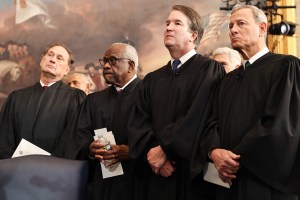
Here’s a brief follow up on yesterday’s post about the corrupt Supreme Court. Yesterday I noticed law professor Steve Vladeck arguing on Bluesky that civic democrats are making a mistake by seeking to “fix” the Court by, as he puts it, “permanently weakening it as an institution.” The gist of his argument is that you constrain the Court by “forcing it to look over its shoulder” as it decides case. In a post on the topic, he writes, “as compared to a time when Congress controlled things like when the Court sits; where it sits; which cases it hears; the Court’s budget; and what the justices must do when not hearing cases (i.e., ride their circuits), today’s Court can do just about whatever it wants, whenever it wants, and all without realistically having to look over its shoulder.”
I told him that I actually agree with the concept of having the court “look over its shoulder” — that you have a series of teeth in place to react to overreach. I’m not sure about the best method of applying that pressure. But I agree with the general principle. Or, rather, I did agree with it — but I think we’ve missed the window for that kind of intervention from Congress. (You can see our brief exchange here.)
Read More
I’ve been talking over the last few weeks about critical reforms that are necessary to make any kind of civic democratic revival in the U.S. even possible. The ending the filibuster and reforming the Supreme Court are high on that list. I want to talk about related topic today that we can only see if we take few steps back from the immediacy of day to day events over the last year and a half. These are tied to the over-mighty nature of the American presidency — or rather, the over-mighty potential of the American presidency, which a mix of Donald Trump’s degenerate personality and the theories of the conservative legal movement have brought to the fore.
The difference I want to note is between administration and ownership. We talk a lot these days about how Donald Trump seems to think he owns the United States – he puts his brand, his likeness, his signature on everything. He talks about his generals, his military, etc. But there’s a more concrete and specific way this is true and it goes to the heart of what needs to be fixed about the American presidency and the whole constitutional system.
Read More
Living as we must, in history, it is always important to distinguish between the mostly contingent events of the moment and the deeper trends that will affect the future. Call it, perhaps, the difference between the libretto and the score. I was thinking about this while I was trying to make sense of the latest jousting over the Strait of Hormuz. Trump remains in the same space, having gotten himself into the crisis with no plan for how to get out of it. He’s now making limited efforts to contest control of the Strait. Iran says it remains completely in control of it. But, in a way, that’s a trap for Trump, because if passage through the Strait requires using military force, it’s precisely the use of military force, the danger and uncertainty it creates, which makes it impossible to use the Strait as a secure and safe means of transit. Force may be the medium-term answer to Trump’s problem. But in the short term it makes things worse. And Trump’s not a delaying-gratification, thinking-long-term kind of guy.
But the deeper impact of this crisis, one entirely of Trump’s own making, has been to convince many countries, especially but not only in East Asia, that oil and gas are too vulnerable to price shocks and supply instability. Meanwhile, renewables like solar and wind have now crossed the threshold where they are not only simply cheaper than fossils fuels but, as a tech product, will continue to get cheaper over time. Wind and solar energy can be produced entirely within your sovereign borders. So the Strait crisis is looking like it may be a turning point in the climate/renewables energy transition.
Read More
I’m hoping to bring you some news on the DOJ-in-Exile front in the not-too-distant future. It was probably simply too early in the spring and summer of 2025. It’s not too early now. But the DOJ-in-Exile idea was and is part of a more general ambition and agenda — to create a baseline record, a predicate and an expectation of future accountability for the Trump administration’s criminal conduct. Some of that effort is a kind of opposition therapy, resisting the authoritarian aim of convincing the public that the law, the ecosystem of criminal accountability has disappeared. It heartens people. It provides a framework of expectation: the law hasn’t disappeared. We’re in an interregnum. It will return, as will accountability. The battle over expectations about the future is a central battle in any authoritarian takeover.
But it’s not solely a matter of heartening, strengthening the morale of the opposition. It is also very directly and literally laying the groundwork for criminal accountability for a renegade executive and all the corrupt actors and criminals who now populate the executive branch.
Read More
Yesterday, Lauren Egan — who authors The Bulwark’s newsletter about Democrats — sent out a newsletter edition entitled “Get Ready for the Dem Court-Expansion Litmus Test.” (Egan tends to be fairly dismissive of Democrats’ intentions, with a kind of mainstream media vibe.) Today Chief Justice John Roberts is complaining that the public is misinformed thinking that the Supreme Court is made up of corrupt political actors. As I’ve written repeatedly, there are deep inertia pools of opposition to Supreme Court reform. It’s a much heavier, though just as critical, lift than contesting the gerrymandering wars or abolishing the filibuster. But these and other hints show that a movement and a coherent push are beginning to take shape.
Read More
Callais, combined with today’s court ruling in Virginia, has jolted Democrats and sent commentators into bemoaning an accelerating “race to the bottom” and, to paraphrase Jeff Zeleny on CNN this afternoon, the end to norms that have organized American politics and redistricting for generations.
I’d like to offer a significantly different view of the situation. What we have seen over recent months is that Democrats have largely abandoned the mode of the last decade plus in which with one hand they fought the partisan battles of the day and with the other assume the mantle of defending the political norms Republicans have already destroyed. In other words, it was the responsibility of Democrats both to be contestants and referees. Republicans violated norms; Democrats tried to uphold them. That of course meant no partisan battle was ever on equal terms and Republicans almost always won them.
Read More
Some of the most consequential and trust-shattering Supreme Court decisions of late have been ones that could have been predicted decades ago. Certainly that’s the case with the Dobbs decision. Callais doesn’t have quite as long a history, in terms of attempts to overturn the precedent. But certainly it’s been in the cards for at least a decade. Still, it’s some of the smaller decisions that tell us just who and what this corrupt court is. Kate Riga notes one of them here: Conservatives on the Supreme Court have previously invoked the “Purcell principle” to rule that a change couldn’t be made to districts on the “eve” of an election. Now it’s fine to do so in states like Louisiana and Alabama where primary elections are actually already underway and tens of thousands of cast ballots must be invalidated.
The message is simple: there are no rules. Only power. It reminds me of my hand tool woodworking shop. There are a big selection of tools. And it’s just a matter of what helps the GOP and the Court in that particular moment. In a way it’s clarifying. Even helpful.
Read More
If you’re not a regular listener to our podcast, I hope you’ll listen to the episode that will come out later this afternoon. It was, I think, a particularly good episode, in large part because we had such critical issues to discuss: Callais, the wave of emergency redistrictings across the southern tier of the old Confederacy and what seems to be a sea-change moment on Supreme Court reform among establishment Democrats. I want to expand today on some points about Supreme Court reform, offering some of the historical background for this present moment.
Every current member of the Supreme Court comes out of what we might call the elite academic-judicial nexus, which is to say they’ve been law professors at elite universities and judges in the federal judiciary. I believe this applies to all the current justices. It didn’t used to be this way. It used to be relatively common to have justices who had never served as judges before and had never been law professors. Frequently they were ex-politicians. Famously, William Howard Taft was an ex-president when he became chief justice. Earl Warren was a popular Republican governor of California who had never served as a judge until president Eisenhower nominated him as chief justice. If you go further back, many justices never even went to law school, though this was more a matter of the evolution of legal education. The last non-law school justice was James F. Byrnes. (In earlier history, you generally learned the law as a kind of apprentice and then passed the bar to practice.) There was a brief boomlet of chatter when Bill Clinton was elected that he should or would try to re-inject this “politician on the Court” tradition back into the system. Of course that didn’t happen. The idea has scarcely been entertained since.
Read More
I want to share with you a letter from fellow TPM Reader DA. He makes a point I fully agree with but didn’t make clear enough in yesterday’s post. I fully agree there is such a thing as legal expertise. I’ve made that clear in my actions over a couple decades by paying for some of the very best (and priciest) legal counsel — mostly though not exclusively on 1st Amendment and libel law. It of course goes beyond this. Law, in its largest scope, is a complex set of rules and practices that we as a society have agreed on — sometimes explicitly, usually implicitly — to govern ourselves by and through which we resolve the countless range of disputes — civil and criminal — that arise among us. But it is in the nature of any specialized and professionalized craft to cast a penumbra of authority beyond its actual area of expertise.
Read More