



I’ve written again and again that reforming the Supreme Court — neutralizing the corruption represented by the current rogue majority — is the sine qua non of any good future for the American republic. I want to give you another example of this centrality.
Recently I was talking to someone very versed in federal employment law, the framework that undergirds the employment of the people who make the federal government run. There’s a neverending stream of proposed regulations and rules. We were discussing some new news on this front, how it might play out in the future, etc. When I have these kinds of conversations with knowledgable people, I’ll generally ask what they are hearing about groups emerging in their area for the purpose of creating Project 2029-like lists of reforms to undo the damage we are seeing today. It’s not just turning things back to the status quo ante, as we’ve discussed. We’re in an era in which it’s critical to make major structural changes when the opportunity arises and build new structures that are more durable than the ones which have fallen so quickly over the last decade and specifically the last year. So you need smart people putting time into this work during the next three years, really thinking it through and having that list of reforms ready, support built them, etc. You get the idea. We’ve discussed this before.
Read More
I want to return to a topic I’ve alluded to in several recent posts. The U.S. Constitution, U.S. law and U.S. civic culture all have a deep resistance to the use of the military in civilian spaces, except under the most extreme circumstances. Even then, we rely almost exclusively on what are in effect state and part-time militias, which are incorporated into the federal U.S. military but still distinct from it, at least largely based in the communities in which they are occasionally deployed. This issue came to the fore early in the second Trump administration with federalized National Guard troops deploying in various blue states and even “hostile” red states at least offering to deploy their guards into blue states. But the real game is Immigration and Customs Enforcement and Customs and Board Patrol and other, increasingly super-sized federal policing forces within the Department of Homeland Security. And they’re not military.
Over time, I’ve realized I’m being too literal about this. As a legal and constitutional matter, these aren’t military forces. They’re civilian policing agencies. But the aversion to military deployments in civilian areas isn’t simply a matter of technical designations, the formal unfreedoms of military service, the different legal code, the focus on war-fighting. There is a substantive reality of the desire to menace and dominate civilian spaces as though they are enemy territory, conquered rather than governed.
Read More
If you’ve been watching reportage and viral videos of immigration raids over the last six months, you’ll remember that often there will be law enforcement officers or agents with uniforms that simply say “DHS Police.” Not Immigration and Customs Enforcement or Customs and Border Patrol, just “DHS Police.” As far as I know, there is no such agency under DHS. DHS employs some 80,000 law enforcement officers spread across nine agencies and offices. So I think that the uniforms just provide a general designation that these are law enforcement officers from within the Department of Homeland Security. That’s a vast amount of coercive power concentrated in this one department, notwithstanding the fact that most of these offices and agencies exist for fairly narrow areas of enforcement, administering points of entry into the U.S., inspecting persons and luggage getting on to commercial passenger jets, protecting federal officials and federal installations.
But what was clear from DHS’s creation was that that power could all be directed and concentrated toward some corrupt or illegitimate purpose. And that, among many other things, is what we’ve seen over the last year.
Read More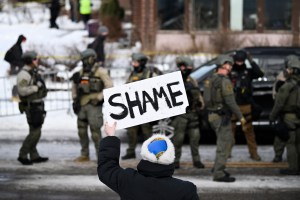
People who don’t like Donald Trump are kinda gun-shy talking about turning points. Turning points of course can mean very many things. But as I watched first the videos of the murder of Renee Nicole Good and even more the official reactions to it I’ve started to think that we’re in the process of seeing one. I don’t mean Donald Trump is doomed politically, though perhaps he is. I mean a turning point in the public perception of ICE (and the Border Patrol) and their newly hyper-militarized role in American cities beginning last summer.
What we see in the videos of Good’s shooting is some mix of a moment of confusion or perhaps minor panic on the part of Good as the driver. And we see this ICE agent draw his weapon in a fairly calm and methodical way and fatally shoot Good in the face.
Read More
Not long after I first moved to Washington, D.C. more than 25 years ago, I was at a foreign policy event and my friend, who was the moderator, talked about “high trust” versus “high fear” international orders. The concept is simple: trust and fear each build on themselves and tend to create their own equilibria. A high-trust environment encourages trustworthy and predictable behavior. A high-fear environment makes trust foolish and dangerous. It makes rapid resorts to violence and force logical and common. What is most important about this observation is the way each environment is self-perpetuating, how each creates a logic which participants are foolish not to follow, even if they wish they were in a different international order altogether.
I’ve been watching the various debates about what the U.S. is doing in Venezuela, and may possibly do in Greenland, Cuba or other Latin American states. Most of them, as I’ve noted, seem wildly overdetermined. You have different factions pushing for various military adventures, often for different reasons. If they can pique Trump’s interest, there’s a good chance the adventure will happen. What the reason is depends on which faction you decide was most important. Whatever you find out from that analysis is probably an illusion. There’s a more general pattern that helps understand this current moment, one that has little to do with formal ideology and quite a lot to do with his business practices before he entered politics.
Read More
On Saturday, a friend and I were comparing notes on the events following the U.S. raid on Venezuela. Setting apart all the questions about just what the White House is trying to accomplish in Venezuela, my most basic takeaway from the events of the last week is this: as President Trump’s popularity and power erode domestically he will respond with more aggressive assertions of power in those areas where his executive and prerogative authorities remain unbounded, where his domestic popularity matters the least. (This applies most obviously, though not only, to his military powers overseas.) Anything else wouldn’t be consistent with Trump’s character, which is inflexible and unchanging, though perhaps hardening with the progress of advanced age. The current situation between the U.S. and Venezuela shows how jagged, unstable and uneven this may become.
Read More
I’ve been getting lots of your emails about Artificial Intelligence and its place right at the center of so many inflection points — alliances in the new world of oligarchs, the global authoritarian movement, the Gulf princes and their money and more. One of those emails was from TPM Reader AO. AO’s central point was that this is principally a technology, productivity and economics question, and really not a political one. People may hate it but mostly because they don’t know what it is. And in any case it doesn’t matter. Because this is a transformative technology being driven by private capital investment and it’s a change that’s coming regardless of what anyone thinks. With that roll out you may think we were off to a bad start. But it was an interesting conversation and it continues. I reiterated various points I’ve made in posts here, etc. But there was one point that I realized I hadn’t made explicitly enough in those posts.
As I’ve said before, I think it’s really important to distinguish between the actual technology — LLM-based AI — and the political formations forming around it. They’re not the same thing. They’re both really important on their own terms. It’s important to give both sufficient room in a discussion of either topic.
So here goes.
Read More
Chris Geidner flags today an appearance by CBS News’ Chief Legal Correspondent Jan Crawford’s attacking Supreme Court critics who call the Court and its current jurisprudence “corrupt.”
“There is a narrative the Supreme Court is corrupt,” she told Face The Nation. “We saw that emerge in the wake of the Dobbs decision that overturned Roe v. Wade and now we see it that they’re in the tank for Trump. Not only is that narrative over-reported, it is patently false, and it is dangerous for the institution and the public’s faith and confidence in the rule of law.”
Chris has more of Crawford’s quotes. And he makes clear the most telling thing about Crawford’s defense is that she doesn’t even address the arguments against the Court’s practices and behavior. She just asserts it in a ‘the King can do no wrong because he’s the King’ kind of fashion. But this one passage is enough to make the point. Not only is the Court demonstrably not corrupt, Crawford claims, it is also dangerous for the Court to have itself be called “corrupt”. And, she claims, what is dangerous or threatening to this Court threatens the rule of law itself. In other words, you might say, the danger to the state is that child in the third row saying the King is naked.
Read More
In a number of recents posts I’ve been trying to make sense of the climate of drift and enervation that now seems to suffuse the Trump administration and, in a way, the country. Making sense of these things isn’t just interesting in the abstract or an opportunity to dunk on the administration. It’s important to know just where we are, what’s possible now that might not have been possible in the Spring or even a few months ago. And that’s important because we’re all kind of worn out. It’s not just the Trump administration. In a way the opposition to Trump is, too, albeit in a very different way. It’s been a really long year.
I first proposed my DOJ-in-Exile idea back in April. If you’re not familiar with the DOJ-in-Exile concept, this post explains the idea. But the main points I’m about to make don’t require knowing those details. As I’ve mentioned a few times here and to a number of you in email correspondence, it was harder going than I anticipated. For a mix of reasons, I did not want to run it myself or even be involved. I wanted to find a group that wanted to do it and hand the idea and the name off to them. But people were scared. Without my really asking, various TPM Readers came forward with soft pledges totaling probably upwards of a million dollars. So money wasn’t going to be a problem. But the kind of people who would run it or take responsibility for it were scared. People in the key do-gooder groups were scared. People who are hard-chargers were scared. Sometimes they wouldn’t quite say as much in calls but I could read their intonations and I realized a conversation wasn’t going to go anywhere.
Read More
I got a host of very interesting responses to yesterday’s post about the tech platforms force-feeding the mass consumer market AI. I learned a lot from your responses, which included both direct personal experiences and expert perspectives on different dimensions of the topic. What is important to me about this moment is distinguishing two or three different very real things happening at once.
The first is a genuine critical mass in the development of LLM-based machine learning. This is a much better description than “AI” to my thinking, since the latter contains a vast range of meanings from simple and accurate to triumphalist and grandiose. But machine learning is real, and in recent years it’s developed real capabilities that are at least transformative in various areas of work and technology. I’m skeptical of what we’ve developed beyond this at this point but really don’t know. It could be a lot. And it will increase. I think this is the best way to understand the technology itself at this moment now.
Read More