

A central grievance motivating today’s conservative legal movement — and the Republican Party more broadly — holds that any measure rectifying the country’s habitual discrimination against minorities actually discriminates against the in-group.
Continue reading “In Supreme Court Land, Fixing Discrimination Against Black Voters Is The Real Racism”Big Talk: Treasury Secretary Declares New War on Terror Against the Left
Treasury Secretary Scott Bessent said on Tuesday that his department is in the process of launching a War on Terror-style campaign against progressive nonprofits.
Continue reading “Big Talk: Treasury Secretary Declares New War on Terror Against the Left”Mystery Solved: Trump US Attorney Was Forced Out For Not Investigating the Investigators
The Retribution: Russia Probe Edition
The NYT had previously hinted at the reason behind the abrupt August resignation of former Virginia Speaker of the House Todd Gilbert as interim U.S. attorney for the Western District of Virginia, but now the newspaper has compiled a fuller accounting of what happened.
Gilbert was forced to resign or be fired, the NYT reports, for refusing to can the top career prosecutor in his office, who had found insufficient evidence to pursue a cockamamie theory for investigating the investigators of Russia’s interference in the 2016 election.
The flimsy allegation is that the investigators themselves mishandled classified documents. FBI Director Kash Patel and deputy director Dan Bongino have seized on burn bags at FBI headquarters that contained classified documents from the case as evidence that senior officials were destroying documents to cover up or protect the former investigators. The more benign and plausible explanation — that the classified materials remain stored in digital form on FBI servers and destroying paper copies is a routine security measure — has been disregarded in favor of elaborate conspiracies that salve President Trump.
The case landed in Gilbert’s office ostensibly because his district includes a FBI classified document storage facility, but that appears to be at least in part a pretext for finding a more favorable jury pool outside of DC or Northern Virginia.
Gilbert was ordered by DOJ higher-ups to open an investigation into the matter shortly after taking over the post, but he “told his superiors that he did not believe there was sufficient evidence to justify a grand jury investigation,” the NYT reports.
From there things “quickly escalated,” as Gilbert put it in a memorable social media post of a meme from Will Farrell’s Anchorman:
Frustrated by that answer, aides to Attorney General Pam Bondi and her deputy, Todd Blanche, blamed a senior career attorney in the office who they believed had swayed Mr. Gilbert: Zachary Lee, a veteran prosecutor with more than two decades of experience involving public corruption and narcotics, among other issues.
Justice Department officials ordered Mr. Gilbert to replace Mr. Lee with Robert Tracci as his deputy, these people said. After Mr. Lee was demoted, senior department officials suspected Mr. Gilbert was still primarily consulting Mr. Lee, whom they came to view as a holdover from the Biden administration, though he had been hired during the George W. Bush administration and promoted during the first Trump administration, these people added. At one point, Mr. Blanche spoke directly to Mr. Gilbert and offered him more resources to pursue the case, according to one person familiar with the events.
When Gilbert still didn’t bend, he was told he’d be fired, at which point he resigned.
Tracci is now the acting U.S. attorney, and Lee has left the office, according to the NYT.
The new revelations about Gilbert’s surprisingly stiff spine — he’s a longtime GOP politician who has walked the party line, to say the least, for years — is another striking example of the weaponization of the Justice Department. It’s an especially remarkable incident because Gilbert had been nominated for the permanent position, but resisted going along to get along and was forced out after just a month on the job.
The Retribution: Jack Smith Edition
House Judiciary Committee chair Jim Jordan on Tuesday sent a letter to former Special Counsel Jack Smith seeking his to testimony. Jordan is seizing on yet another conspiratorial pretext for investigating the investigators: The GOP-driven news that Smith obtained phone records of the calls of some GOP lawmakers around Jan. 6, 2021 as part of his investigation into the failed coup attempt.
Jordan’s move came the same day that video of some of Smith’s first public remarks about his work in the Jan. 6 and Mar-a-Lago investigations — in an interview last week in London with former federal prosecutor Andrew Weissmann — were widely disseminated.
The Worst of the Worst: ‘I Love Hitler’
Politico has the receipts from a Telegram group chat among leaders of the Young Republicans group who exchanged racist, misogynistic, and antisemitic private messages with abandon between early January and mid-August of this year.
US Revokes Visas Over Charlie Kirk Comments
On the same day President Trump awarded the Presidential Medal of Freedom posthumously to Charlie Kirk at the White House, the State Department announced it had revoked the visas of six people who had posted anti-Kirk screeds on social media.
US Lawlessly Attacks 5th Caribbean Boat
President Trump announced on social media another U.S. strike on an alleged drug-smuggling boat off of Venezuela, claiming the strike killed six men. Trump provided no evidence for the allegations that it was a drug-smuggling boat and very little other information about the attack. The administration continues to provide next to no legal rationale for the unprecedented series of attacks.
“Since Mr. Trump and his defense secretary, Pete Hegseth, started the operation last month, a broad range of legal specialists have called the premeditated and summary extrajudicial killings illegal,” the NYT’s Charlie Savage notes. “They noted that the military cannot lawfully target civilians — even criminal suspects — who do not pose a threat in the moment and are not directly participating in hostilities.”
In related news, CNN reports on how the Defense Secretary Pete Hegseth has sidelined the lawyers at the Pentagon, including by applying political litmus tests to top JAG leaders, while pushing the legal limits of military action:
One recent flashpoint for the role of US military lawyers has been the series of strikes on boats in the Caribbean, with multiple current and former JAGs telling CNN that the strikes do not appear lawful. Lawyers specializing in international law within DoD’s Office of General Counsel have also raised concerns about the legality of the strikes, sources familiar with the matter said.
Responding in a statement to CNN, the Pentagon spokesperson threw down a gauntlet (emphasis mine):
The War Department categorically denies that any Pentagon lawyers with knowledge of these operations have raised concerns regarding the legality of the strikes conducted thus far because they are aware we are on firm legal ground. … “No lawyer involved has questioned the legality of the Caribbean strikes and instead advised subordinate commanders and Secretary Hegseth that the proposed actions were permissible before they commenced.
Your occasional reminder that the strikes on alleged drug cartel boats combined with the increased deployment of U.S. military assets to the region seem largely designed as a saber-rattling exercise against Venezuela.
‘Strap Up Cowboy’: A Major Scandal in Any Other Era

A state judge in Florida issued a restraining order against Rep. Cory Mills (R-FL) barring him from coming within 500 feet of his former girlfriend, a state GOP committee woman who is also the reigning Miss United States. The judge in his ruling called her “a victim of dating violence.”
Lindsey Langston ended the relationship earlier this year after the married Mills was linked to the alleged assault of a third woman in Washington, D.C. Mills allegedly continued to contact her after the breakup and threatened to blackmail her with nude photos, NBC News reports:
Mills is alleged to have sent a series of harassing communications to Langston in May and June, which are cited in the judgment, including a message he wrote to Langston on May 15 that she “may want to tell every guy you date that if we run into each other at any point. Strap up cowboy[.]”
Mill did not comment on that latest developments.
Do you like Morning Memo? Let us know!
Trump’s Midcycle Gerrymandering Disease Spreads to North Carolina
The North Carolina GOP is Notorious for Ratfuckery
North Carolina’s Republican leaders in the state legislature announced on Monday that they plan to hold a vote next week on redrawing North Carolina’s district map for U.S. House seats. But in announcing their plans to act on President Trump’s pressure campaign — the White House has forced Republican state legislatures around the nation to redraw maps ahead of the midterms to help their party hold the House — North Carolina Republicans framed the move as some sort of necessary response to Democrats‘ mid-decade redistricting efforts (which, to the extent they have gotten off the ground, are a response to Republicans’ successful Texas gerrymander).
Continue reading “Trump’s Midcycle Gerrymandering Disease Spreads to North Carolina”5 Points on the Trump Admin’s Threatened—And Real—Government Shutdown Layoffs
In an effort to try and make good on their threats and to put more pressure on congressional Democrats, Trump administration departments and agencies laid off around 4,000 federal employees at the end of last week. President Donald Trump himself has threatened more layoffs to come. The Office of Management and Budget called it a “substantial” reduction of the federal workforce.
“The RIFs have begun,” OMB Director Russ Vought wrote in a social media post on Friday, immediately prompting a spate of articles speculating about how far the administration would go.
Continue reading “5 Points on the Trump Admin’s Threatened—And Real—Government Shutdown Layoffs”Louisiana v Callais: The Republicans Justices Are Getting Ready to Finish Off the Voting Rights Act
This article is part of TPM Cafe, TPM’s home for opinion and news analysis. It was originally published at Balls and Strikes.
On October 15, the Supreme Court will hear oral argument in Louisiana v. Callais and Robinson v. Callais, a pair of consolidated cases that threaten what little remains of the federal government’s ability to protect voters from racial gerrymandering under the Voting Rights Act.
The VRA is the 1965 federal law that finally effectuated the Fifteenth Amendment’s guarantee that the government would not deny or abridge the right to vote on account of race. President Lyndon B. Johnson signed the act following years of advocacy from civil rights activists, and decades of violent repression of those rights by white supremacists. Without exaggeration, the VRA allowed the United States to make its first plausible claim to being a multiracial democracy.
Opponents of multiracial democracy, led by Chief Justice John Roberts, have fought against the VRA ever since, misconstruing the act’s substantive protections and making them impossible to enforce. Callais is the conservative legal movement’s latest vehicle to persuade the Court to render the greatest triumph of the Civil Rights Movement a nullity nationwide.
In 2022, Louisiana Republican lawmakers enacted a congressional map that “packed” Black Louisianans into one district and “cracked” them across five others. This means out of six districts, only one is majority-Black, even though 1 in 3 Louisianans are Black.
Under the Voting Rights Act, voters of color must have an equal opportunity to elect candidates of their choice. But voting in Louisiana is racially polarized, meaning that white majorities persistently vote as a bloc to defeat candidates whom Black voters prefer: To date, the state has never had a Black senator, and hasn’t elected a Black governor since Reconstruction, and no Louisiana congressional district other than the single majority-Black district has elected a Black representative. Thus, the only way Black Louisianans would have the equal opportunity the Voting Rights Act requires is if Louisiana were to create a second district in which Black Louisianans make up a majority.
Black voters in Louisiana sued, and federal courts determined that the map indeed violates Section 2 of the VRA, and ordered lawmakers to redraw the map and add a second majority-Black district. But then, a group of self-described “non-African American voters” sued to challenge that map, arguing that a map drawn to remedy an illegal racial gerrymander is itself an illegal racial gerrymander. If the Supreme Court agrees that there is no legal distinction between causing and curing race-based harm, Callais would rob actual victims of discrimination of the legal tools to do anything about it.
The Court heard oral argument in Callais for the first time in March 2025, and considered two main questions: first, whether Louisiana lawmakers let racial considerations “predominate” when they drew the second map, and if so, whether they had a good reason for doing so. Under existing law, these are easy questions to answer: Even if Louisiana lawmakers drew the second map based on race, Supreme Court precedent confirms that “courts told us to fix our illegal racist map” is a damn good reason to do so.
But the Republican justices on the Court do not like the existing law. And now, they are rehearing the cases so they can have the chance to change it. Back in June, the Supreme Court unexpectedly ended its term without deciding Callais, and instead issued an unexplained order putting the cases back on the calendar for reargument.
Justice Clarence Thomas dissented, but only because he didn’t want to wait any longer to hold that the VRA does not “justify” the practice of “race-based districting” under circumstances that are “utterly divorced” from “specific, identified instances of past discrimination.” Basically, in Thomas’s view, any effort to repair racial harm is impermissible unless it is neatly crafted to address a particular instance of 1960s-style racism.
As usual, Thomas was out ahead of his colleagues: On August 1, the Court directed the Callais parties to file supplemental briefing on the question of whether the intentional creation of a second majority-Black district—as Louisiana lawmakers did here, in response to a court order—violates the Fourteenth or Fifteenth Amendments. Louisiana Attorney General Elizabeth Murrill, a Republican, recognized this new framing for the gift that it is, and filed a brief on August 27 declining to defend the second map at all. Instead, she argued that the Voting Rights Act imposes an unconstitutional race-based mandate, and that the Constitution is “colorblind,” which apparently means “unwilling to recognize harm done to people of color.”
If the Court agrees, the result would compound the disempowerment of Black people across the country. With no check against racial gerrymandering, a system in which voters ostensibly pick their elected officials would become one in which elected officials are freer than ever to pick their voters, leaving Black voters with even fewer legal avenues to secure fair representation.
The Fourteenth and Fifteenth Amendments were expressly crafted to grant Black people equal rights as citizens in a democratic society. The Court is preparing to use those very Amendments to deny those rights instead.
In the New Trump Era, the Proud Boys Are ‘Not Apologizing Anymore’
To hear him tell it, Gavin McInnes’ recent return to the site formerly known as Twitter is the result of a collaborative effort that included leading members of the British far right and Elon Musk.
Continue reading “In the New Trump Era, the Proud Boys Are ‘Not Apologizing Anymore’”The Justice Department Is the Tip of Trump’s Retribution Spear
A lot of things happened. Here are some of the things. This is TPM’s Morning Memo. Sign up for the email version.
It’s Only Just Begun
The politicized prosecutions by the Trump Justice Department have only just begun. We have three more years of this. The challenge in covering them will be:
- not to treat them like normal prosecutions, especially not to get lost in the usual minutiae of criminal investigations and trials;
- not to normalize political prosecutions as an authoritarian tool even as they become routinized and repetitive;
- not to let the occasional legitimate prosecution obscure or justify the indefensible politicized ones.
With that in mind, I wanted to catch you up on some of the holiday weekend developments in the three highest profile political prosecutions.
The Retribution: Jim Comey Edition
It’s still early, but a flurry of weekend filings in the political prosecution of former FBI Director James Comey suggest prosecutors are overmatched. In pre-trial procedural matters, the judge in the case twice ruled in favor of Comey, represented by former Chicago U.S. Attorney Patrick Fitzgerald.
It’s no surprise: U.S. Attorney Lindsey Halligan has never been a prosecutor before; the career prosecutors in office case declined to bring charges against Comey; and the two line prosecutors brought from North Carolina in to handle the case don’t have any experience in high-profile national cases like this.
The Retribution: Letitia James Edition
- Halligan’s politicized indictment of Letitia James somehow amazingly caught the attorney general and deputy attorney general off guard, further evidence that DOJ is really being run by the White House.
- The James indictment does not involve the Virginia property everyone expected it to, but a separate Norfolk property.
- Halligan is “likely to bring additional charges against James,” a source told the WSJ.
The Retribution: John Bolton Edition
Former Trump national security adviser John Bolton could be charged as soon as this week by the acting U.S. attorney in Maryland for allegedly improper handling of classified material:
Unlike the widespread resistance career prosecutors in Virginia have shown to Trump’s pressure campaign to charge former FBI Director James Comey and New York Attorney General Letitia James, career prosecutors in Maryland consider charges against Bolton to have some factual merit, the people said.
Still, the Bolton case — originally opened in Trump I, closed under Biden, and reopened under Trump II — comes after loud and direct threats from Trump himself to seek retribution against his former adviser.
Quote of the Day
“This is no longer, the Department of Justice, it’s no longer the premier prosecuting office in America. What it is now is a capo regime who goes out and executes hits when directed by the Don to do so. That’s what it is.”–former New Jersey U.S. Attorney Chris Christie
Federal Judges Warn of ‘Judicial Crisis’
A NYT survey of federal judges found widespread dismay about the Supreme Court’s use of its emergency docket.
‘Living Hell’
WSJ: “Among the last actions by former President Joe Biden before leaving the Oval Office was commuting the death sentences of 37 convicted murderers. Hours after President Trump took over, he ordered the life sentences of these men be made, in effect, a living hell.”
‘A Fully Competent, Utterly Committed Radical Ideologue’
Thomas Zimmer, on what the NYT and so many others get wrong about Trump OMB Director Russ Vought:
Key to understanding Vought’s worldview is the idea that the constitutional order – and with it the “natural” order itself – has been destroyed: The revolution has already happened, “the Left” won. Therefore, conservatives categorically err when they try to preserve what is no more. Vought certainly sees himself in the modern conservative tradition, but he also disdains the conservative establishment for their inability to understand and act upon the radical demands of the moment. Power, Vought claims, now lies with a “permanent ruling class” of leftist elites who control all major institutions of American life and especially the “woke and weaponized” agencies of the state. In order to defeat them, conservatives must become “radical constitutionalists” – and take radical action.
2026 Ephemera
Maine Gov. Janet Mills (D) announced she will enter the crowded Democratic primary to challenge Sen. Susan Collins (R) next year.
Signs of the Times
- President Trump will award the Presidential Medal of Freedom, America’s highest civilian honor, to the asssasinated Charlie Kirk.
- Hell Gate: Adams Administration Quietly Renames the Tombs for Disgraced Criminal Bernard Kerik
Thread of the Day
It’s Just a Matter of When
Donald Trump and Stephen Miller will probably get the blood in the streets they want eventually.
We don’t know when or how it will unfold, or how the public will come to perceive it. But we do know that no matter how it unfolds or is perceived, it is already their fault, and everyone who cares about the future of the country should be prepared to blame them.
Headline of the Day
MAGA Implodes Over Kristi Noem’s “Stare Down” With Man in Chicken Suit
On Bari Weiss, the Free Press and Black Rock
Do you like Morning Memo? Let us know!
‘I Don’t Want to Be Here Anymore’: They Tried to Self-Deport, Then Got Stranded in Trump’s America
This article first appeared at Propublica, a Pulitzer Prize-winning investigative newsroom. Sign up for The Big Story newsletter to receive stories like this one in your inbox.
She desperately wanted to get out of the country.
It was mid-May and Pérez, a Venezuelan mother of two, couldn’t survive on her own in Chicago anymore. She’d been relying on charity for food and shelter ever since her partner had been detained by immigration authorities after a traffic stop earlier in the year.
Pérez, 25, thought it’d be safer to return to Venezuela with her children than to stay in the U.S. Her request for asylum was still open and she had a permit to work legally, but so did a lot of other Venezuelans getting picked up on the streets and taken into custody. Authorities were detaining immigrants regardless of whether they’d followed the rules.
She had also seen how President Donald Trump singled out her countrymen, calling them gang members and terrorists, even sending hundreds to a foreign prison. She was terrified of getting detained, deported and, worst of all, separated from her young daughter and son. They were the reason the family had come to the U.S.
Then she heard about Trump’s offer of a safe and dignified way out.
“We are making it as easy as possible for illegal aliens to leave America,” the president said in a video on social media in May announcing the launch of Project Homecoming.
He spoke about a phone app where “illegals can book a free flight to any foreign country.” And he dangled other incentives: Eligible immigrants wouldn’t be barred from returning legally to the U.S. someday, and they’d even get a $1,000 “exit bonus.” Believing the president’s words, Pérez downloaded the CBP Home app and registered to return to Venezuela with her children.
Months passed. Her partner was deported. In July, Pérez said, she got a call from someone in the CBP Home program telling her she’d be on a flight out of the country in mid-August. She began packing.
But as the departure date neared and the plane tickets hadn’t arrived, Pérez got nervous. Again and again, she called the toll-free number she’d been given. Finally, somebody called back to say there might be a delay obtaining the documents she’d need to travel to Venezuela.
Then there was silence. No further information, no plane tickets. Pérez registered on the app again in August, then a third time in September, as immigration arrests ramped up in Chicago.
Today, Pérez feels trapped in a country that doesn’t want her. She’s afraid of leaving her apartment, afraid that she will be detained and that her children will be taken away from her. “I feel so scared, always looking around in every direction,” she said. “I was trying to leave voluntarily, like the president said.”
The Trump administration’s immigration crackdown is having the intended effect of terrifying people into trying to leave. There have been some 25,000 departures of immigrants from all countries via CBP Home, according to U.S. Department of Homeland Security data obtained by ProPublica.
The data indicates that of those 25,000 people, a little more than half of them returned home with DHS assistance; nearly all the others who left the U.S. ended up returning on their own.
And it’s not just CBP Home. Applications for voluntary departures — an alternative to deportation granted to some immigrants who leave at their own expense — have skyrocketed to levels not seen since at least 2000, reaching more than 34,000 since Trump’s second administration began, immigration court data shows. (The number is higher than in years past, but nowhere near the number of immigrants the administration has deported this year.)
But for many recent arrivals from Venezuela — arguably the community most targeted by the Trump administration, and whose country is now bracing for the possibility of a U.S. invasion — leaving has not been as simple as the president has made it sound.
ProPublica spoke with more than a dozen Venezuelans who said they wanted to take the U.S. government’s offer of a safe and easy return. They signed up months ago on the CBP Home app and were given departure dates. But after those dates came and went, these immigrants said they feel betrayed by what the president told them.
Part of the problem is tied to the lack of diplomatic relations between Washington and Caracas. There are no consular services for Venezuelans in the U.S. Many of the hundreds of thousands of Venezuelans who migrated to the U.S. in recent years seeking asylum or other humanitarian relief entered without valid passports, as Pérez did. But to get on a plane for Venezuela, they’re being told they’ll need a special travel document known as a “salvoconducto,” or “safe passage,” from their government.
And relations between the two countries are getting worse. The Trump administration has pushed for regime change in Venezuela, sent warships to the Caribbean and, in recent weeks, blew up four Venezuelan boats it claimed were transporting drugs to the U.S. Bracing for an invasion, Venezuelan President Nicolás Maduro has said he’s ready to declare a state of emergency to protect his country, which could make it harder for Venezuelans abroad to return home.
The Venezuelans who want to leave the U.S. described how CBP Home representatives told them that their lack of passports wouldn’t be a problem and that the U.S. government would help them obtain the travel documents they needed. Now they are being told that they’re on their own — if they get any response at all.
The Trump administration was aware of the potential challenges from the start. In his May proclamation, the president directed the State and Homeland Security departments to “take all appropriate actions to enable the rapid departure of illegal aliens from the United States who currently lack a valid travel document from their countries of citizenship or nationality.”
In a statement, a DHS spokesperson said the agency is working with the State Department “to acquire travel documents for those who lack safe passage. So far thousands of Venezuelans have already self-departed using CBP Home.” The State Department referred questions to DHS.
The internal DHS records obtained by ProPublica show nearly 3,700 departures of Venezuelans via CBP Home through late September. It’s unclear how many Venezuelans have applied. The DHS spokesperson said the agency could not confirm the numbers and would not say whether the program is meeting projections. (A congressional committee has directed DHS to include information about CBP Home departures in monthly reports the agency previously published, but has not published in this administration.)
An estimated 10,200 Venezuelans were deported between February and early October, according to deportation flight data tracked by the nonprofit Human Rights First’s ICE Flight Monitor.
Many of the Venezuelans interviewed by ProPublica are mothers of young children who say they decided to take the president’s offer after their work permits expired, their temporary protected status was canceled or their spouses were deported. Few are willing to return by land because of the dangers posed by cartel violence and kidnappings in Mexico — dangers many of them experienced when they migrated here.
Nearly all of them, like Pérez, asked not to be identified by their full names because they’re afraid of bringing unwanted attention to themselves and of the potential consequences of such attention. Interviews with Venezuelan immigrants were conducted in Spanish.
Before their departure dates came and went, they had made preparations to leave — turning over the keys to their apartments, pulling their children from school, shipping their belongings to Venezuela. And they have sunk deeper into poverty as the weeks and months pass.


In Los Angeles, a family of four slept in their tiny Toyota Echo for weeks to save on rent as they waited for their departure date. They sold the car and other belongings to pay for bus tickets back the way they’d come. Nearly two months after their return to Venezuela, they said they’re still waiting for the exit bonuses they’d hoped would help them start over.
In Youngstown, Pennsylvania, a mother of two said she didn’t enroll her 8-year-old son in school this fall because she assumed they would be gone by now. She recently moved into a friend’s apartment in New York City and plans to turn herself in to immigration authorities and ask to be deported.
“I don’t want to be here anymore,” the woman said, between sobs. “What am I supposed to do?”
Several immigration attorneys and advocates told ProPublica that they don’t trust the CBP Home app or the Trump administration’s promises to help immigrants self-deport. The National Immigration Law Center recently published a guide explaining some of the potential risks of using the app, such as leaving the country without closing an immigration court case and becoming ineligible for a future visa. Some lawyers said they discourage clients from using the app at all.
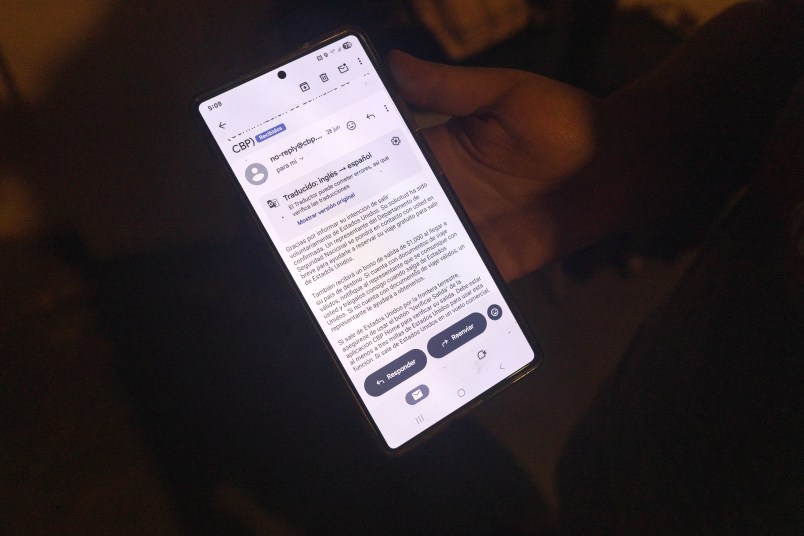
Ruben Garcia, director of Annunciation House, a nonprofit in El Paso that supports migrants and refugees, said in the current climate, he understands why some people might consider the administration’s offer to leave. But, he said, the offer has to be backed by action.
“If you’re going to say you’re going to do this,” Garcia added, “then you damn well better make sure that it’s truthful and that it works.”
CBP Home replaced an earlier app that the Biden administration had promoted to try to bring order to the soaring numbers of migrants attempting to enter the country. Pérez and other asylum-seekers used that earlier version, CBP One, to make appointments to approach the border. Trump, who campaigned on the promise of mass deportations, ended that option on his first day back in the White House.
In March, he reintroduced the app with the new name and function, allowing immigrants to alert the government of their intention to self-deport. It was part of a $200 million advertising blitz meant to encourage immigrants to “Stay Out and Leave Now.” Two months later, Trump unveiled Project Homecoming and the added incentives of free flights and exit payments. The administration moved State Department funds meant to aid refugees resettling in the U.S. to DHS to help pay for the flights and stipends, according to federal records and newsreports.
DHS officials have mentioned the app in dozens of press releases about policy changes and enforcement operations. For example, in the September announcement that DHS was ending temporary protected status for Venezuelans, officials also encouraged Venezuelans to leave via CBP Home. And immigrants who show up for their hearings at immigration court see posters taped on the walls about the benefits they could get if they “self-deport using CBP Home instead of being deported by ICE.”
Emily and Deybis downloaded the app in June, when it seemed as if their life in the U.S. was collapsing. They said they used the earlier CBP One app to approach the border with their two children in January 2024 and were allowed into the country with protections that were supposed to last two years. They settled in Dallas, applied for asylum and got work permits; Deybis found a job in a hotel laundry and Emily at a Chick-fil-A. Then, this spring, the Trump administration ended protections for immigrants like them and canceled their work permits.
They lost their jobs and could no longer afford their rent. On the app’s sky-blue home screen, they saw a drawing of a smiling man and woman holding hands with a child. “Let us help you easily leave the country,” another screen told them in Spanish. They agreed to share their phone’s geolocation, entered personal information and uploaded selfies.
They received an automated email from “Project Homecoming Support” explaining that they would be contacted soon by someone from a toll-free number who would help coordinate their travel. Within weeks, they got a call from an operator at that number who said she worked on behalf of DHS.
Emily said she made clear the family didn’t have Venezuelan passports but was told that wouldn’t be a problem; the U.S. government would procure any necessary documents for them. They said the operator gave them an Aug. 1 departure date and told them to expect their plane tickets by email.

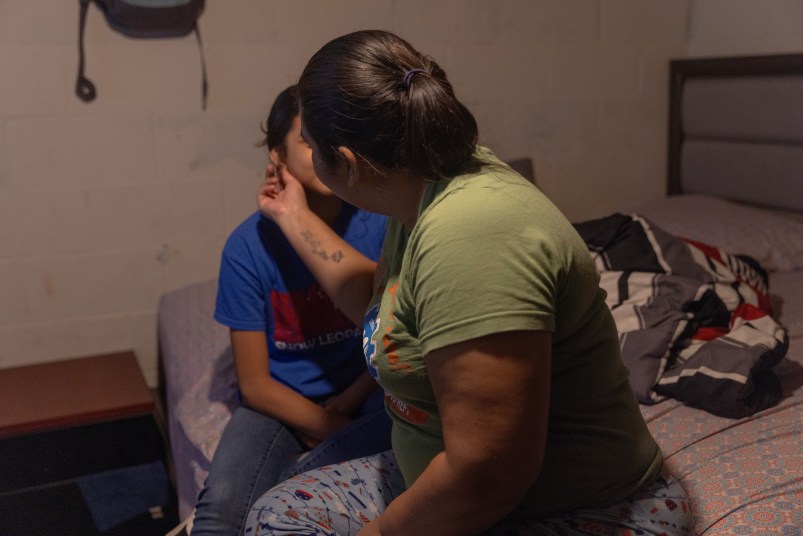
Emily and Deybis sold their car and moved with their children to Columbus, Ohio, where Deybis’ nephew let them stay in his unfinished basement apartment until their departure. The plane tickets never came.
Then the nephew was detained in a traffic stop and deported. Panicked, Emily and Deybis said they called the toll-free number again and again, leaving messages that went unanswered. Emily submitted a new application and sent more emails.
In mid-September, they got an email from the “CBP Home team” telling them to contact the Venezuelan embassy in Mexico to get travel documents on their own.
“We are working very hard on your case,” the email assured.
When they called the embassy, though, the number was busy. They found travel agencies that offer to procure travel documents at a cost but said they were told the Venezuelan government requires an arrival date and proof that plane tickets have been purchased. Emily and Deybis can’t afford them.
“Thank you so much for your patience and we understand your frustration,” they heard back in another email. “Wait for new instructions from DHS.”
As they wait, they worry about how they’ll survive when winter comes. Most days, Deybis visits local food pantries and looks for discarded items in alleys and on street corners that they can resell. A few weeks ago, they sold their daughter’s bed to help pay the rent.
“We’d rather be in Venezuela with our family than suffer here,” he said.
Pérez said her daughter was the family’s main motivation to come; the girl had been born with a heart defect and needed surgery they could not find in Venezuela, where hospitals operate through power outages and have limited capacity for advanced surgeries, not to mention supplies.
“We didn’t come for the American dream, or for a house, or for some life of luxury,” said Pérez. “What we wanted is for our daughter to live.”
She and her partner made the trek to the U.S. in 2023, with her daughter, then 6, and their 4-year-old son. Pérez thought they did it “the right away” by waiting in Mexico for weeks until they got an appointment to approach the border via CBP One. After they were processed, the family headed to Chicago, a city they had heard was a sanctuary for immigrants. At first they took shelter inside a police station, as hundreds of new immigrant families were doing at the time. Pérez said medical workers who visited the station learned about her daughter’s condition and connected the family to a hospital charity care program. The following spring, the frail little girl with dark brown eyes got the operation she needed.
In late 2024, the family moved to South Florida, where Pérez’s partner found work rebuilding homes damaged by hurricanes. Then in February, he was arrested for driving without a license or registration. He spent about two months in jail before he was transferred into immigration custody.
Pérez didn’t feel safe in Florida anymore. She returned to Chicago with her children.
But as the months pass without an answer from the CBP Home program, Chicago doesn’t feel safe, either. This fall, the Trump administration zeroed in on the city for immigration enforcement, sending in the U.S. Border Patrol. Pérez recently downloaded another app that tells her whether there’ve been sightings of federal immigration agents nearby, and she watches videos of other immigrants getting arrested. One day in September, a federal agent shot and killed an immigrant in a nearby suburb. Pérez wonders if she might die, too.
On a sunny September afternoon, Pérez peered down the street outside her children’s school, scanning for suspicious vehicles. Her daughter, who is now 8, bounded down the steps first, wearing a pink bow and a broad smile. Her son, now 6, in a Spiderman shirt and a blue cast from a playground accident, appeared next.
They share their mother’s anxiety. On their walk home, Pérez’s daughter leaned over her brother and chided him for speaking Spanish in public. The girl said her teacher had warned her that federal agents might be listening.
It reminded Perez that she now needs to leave the U.S. for the same reason she came: her children. She plans to register yet again on the CBP Home app.

Jeff Ernsthausen contributed data analysis.
One Appeals Court Gave Us a Taste of the Deference Trumpified Courts Want to Give the President
District judges, including those appointed by President Trump, have been remarkably scrupulous despite overwhelming pressure to accept the administration’s claims that various blue cities are war-torn, burning, deadly.
Continue reading “One Appeals Court Gave Us a Taste of the Deference Trumpified Courts Want to Give the President”