

This and other articles are among the first I’ve seen that make me think there will be prosecutions of individuals involved in the attempted 2020 presidential election coup. This one is from the Post and reports a new round of subpoenas and what appear to be court-ordered searches of various individuals involved in the “fake elector” scheme. Let me note a couple points about that part of the coup conspiracy.
Where Things Stand: DOJ Now Appears Focused On Fake Electors Who Got Wrapped Up In Coup Plot
A new report in the Washington Post today indicates the Justice Department might be expanding the scope of its focus on the fake Trump electors scheme, zeroing in on the people involved in the plot who may have intended to follow through or tried to follow through with the scheme.
Previous reports have revealed the DOJ was looking at the fake electors plot, but the bureau was reportedly mostly in talks with people who sounded the alarm about the scheme — which was a key layer of MAGAland’s campaign to keep Trump in power despite losing the election.
Continue reading “Where Things Stand: DOJ Now Appears Focused On Fake Electors Who Got Wrapped Up In Coup Plot”Johnson is Beatable
Ron Johnson has managed to win two elections in Wisconsin – both of which were races Democrats were optimistic about winning. But this new poll number out of Wisconsin is pretty striking on a number of counts.
Here are the numbers.
Jan. 6 Committee Members Likely To Receive Security Detail Amid Uptick In Threats
Members of the Jan. 6 Select Committee will reportedly likely get a security detail in light of an increase in violent threats against panel members, three people involved with the investigation told the Washington Post.
The news comes after the panel’s fourth public hearing on Tuesday that detailed former President Trump and his allies’ pressure campaign targeting battleground state officials to overturn the 2020 election results.
Continue reading “Jan. 6 Committee Members Likely To Receive Security Detail Amid Uptick In Threats”Raffensperger Calls Out Fox For Not Airing All Jan. 6 Hearings
Georgia Secretary of State Brad Raffensperger (R) chided Fox News on Tuesday over the network’s refusal to air the House Jan. 6 Committee’s public hearings in full – specifically the first one that the panel held during primetime.
Continue reading “Raffensperger Calls Out Fox For Not Airing All Jan. 6 Hearings”Thursday’s Jan. 6 Committee Hearing Will Be Last Until July
The Jan. 6 Committee has rescheduled its upcoming hearings, with more to take place in July, panel Co-Chair Bennie Thompson (D-MS) told reporters on Wednesday.
Continue reading “Thursday’s Jan. 6 Committee Hearing Will Be Last Until July”RonJohn Fakes Phone Call, Blames Intern For Effort To Send Fake Electors To Pence
Sen. Ron Johnson (R-WI) has some explaining to do after the Jan. 6 Select Committee’s public hearing on Tuesday, in which the panel revealed his staff’s apparent involvement in a fake electors scheme to help then-President Trump overturn the 2020 election results.
Continue reading “RonJohn Fakes Phone Call, Blames Intern For Effort To Send Fake Electors To Pence”Why So Bashful?
One of the more interesting things to come out of the Jan. 6th hearings is the greater detail about the involvement of members of Congress. One detail yesterday was the involvement of Sen. Ron Johnson (R-WI) in the fake electors plot. He somewhat lamely passed it off as the rogue behavior of an unnamed intern. Here’s one of several videos of Johnson yesterday rushing away from reporters trying to avoid questions.
Salty Mo Brooks Congratulates Dems After Losing Senate Runoff Post-Trump Snub
Rep. Mo Brooks (R-AL), projected to lose Alabama’s GOP Senate primary runoff against rival Katie Britt after a full slap in the face from ex-President Donald Trump, concluded his rocky campaign with some bitter words in his concession speech on Tuesday night.
Continue reading “Salty Mo Brooks Congratulates Dems After Losing Senate Runoff Post-Trump Snub”SCOTUS Says ‘Yes’ To State Funds For Religious Schools In Maine—With Potential Consequences For Entire Country
This article is part of TPM Cafe, TPM’s home for opinion and news analysis. It first appeared at The Conversation.
For nearly three-quarters of a century, one issue in education has come up before the Supreme Court more than any other: disputes over religion.
Carson v. Makin, a case about Maine’s tuition assistance program for students in districts without high schools of their own, continues the pattern – with potential consequences for schools, families and courts across the country.
On June 21, 2022, the court ruled that parents in rural districts lacking public high schools, but who receive state aid to send their children to private schools instead, can use that money for tuition at schools with faith-based curricula. In a 6-3 order, the court held that Maine’s requirement that tuition assistance payments be used at “nonsectarian” schools violated the free exercise clause of the First Amendment because parents could not send their children to the schools of their choice.
In two recent cases on similar issues, the court ruled in favor of families. Carson continues this trend of allowing more public support to students in faith-based schools, which has been developing for more than 20 years.
To the school choice movement – which advocates affording families more options beyond traditional public schools, but having the government help foot the bill – Carson represents a chance for more parents to give their children an education in line with their religious beliefs.
Opponents fear that cases such as Carson could establish a precedent of requiring taxpayer dollars to fund religious teachings. Based on its most recent judgments, many legal analysts maintain that the current court is increasingly sympathetic to claims that religious liberties are being threatened but, in so doing, is creating too close of a relationship between religion and government.
SCOTUS’ shift in thought
Religion in schools emerged as a significant issue at the Supreme Court starting in 1947’s Everson v. Board of Education, when the justices upheld a New Jersey law allowing school boards to reimburse parents for transportation costs to and from schools, including ones that are religiously affiliated.
According to the First Amendment, “Congress shall make no law respecting an establishment of religion, or prohibiting the free exercise thereof” – an idea courts often interpreted as requiring “a wall of separation between church and state.” In Everson, however, the Supreme Court upheld the law as not violating the First Amendment because children, not their schools, were the primary beneficiaries.
Everson signaled the start of the “child benefit test,” an evolving legal concept that I have written about in my work on education law. According to this test, which has guided many of the court’s decisions about religion, money and education, children who attend faith-based schools are the primary beneficiaries of the state aid they receive, rather than their schools. In other words, this logic reasons that the government is not directly supporting particular religions.
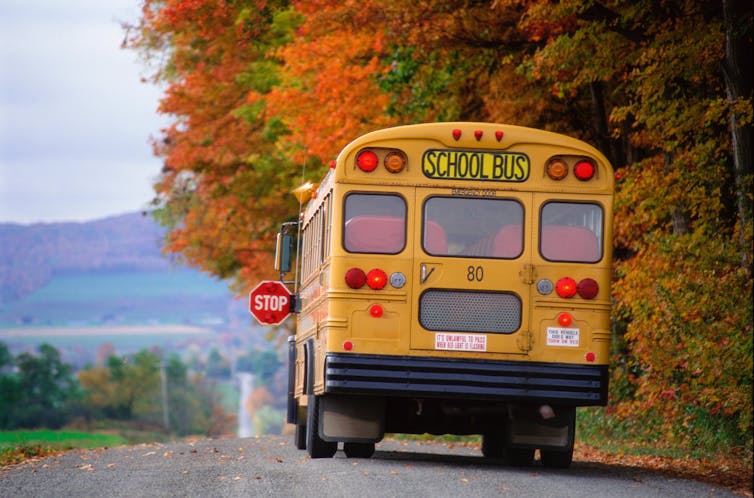
In recent years, though, the court has expanded the boundaries of what aid is allowed – as it has now done again with Carson. The decision extends the Supreme Court’s two most recent judgments on aid to students in faith-based schools: In 2017’s Trinity Lutheran Church of Columbia v. Comer, the Supreme Court reasoned that states cannot deny religious people or religious institutions generally available public benefits simply because they are religious. Three years later, in Espinoza v. Montana Department of Revenue, the court decided the state’s tuition tax credit program cannot bar private, faith-based “schools from public benefits solely because of the religious character of the schools.”
Mainers’ education
Maine’s Constitution mandates the creation of public schools. But many rural towns don’t have their own secondary schools: In fact, of the 260 “school administrative units” in Maine, more than half lack a secondary school.
In areas without access to public schools, Maine law allowed students to attend other public or private schools at public expense, but not faith-based ones. The state requires approved schools to be nonsectarian, “in accordance with the First Amendment of the United States Constitution.”
Carson v. Makin began in 2018 when three sets of parents unsuccessfully filed suit on behalf of their children, arguing that the rule discriminated on the basis of religion. The federal trial court in Maine ruled in favor of the state, affirming that its tuition aid requirements did not violate the rights of the parents or their children. On appeal, the First Circuit unanimously affirmed in favor of the state, rejecting all the parental claims.
The decision
When, as the parents in Carson alleged, state actions limit fundamental rights such as free exercise of religion, courts apply what is called “strict scrutiny,” meaning that public officials must prove they have a “compelling interest” in restricting such a right. When the Supreme Court applies “strict scrutiny,” as it did in Carson, state restrictions typically fail.
Writing for the court, Chief Justice John Roberts declared that the Maine program “effectively penalizes the free exercise of religion.” Relying on Trinity Lutheran and Espinoza, he wrote that “a neutral benefit program in which public funds flow to religious organizations through the independent choices of private benefit recipients does not offend the Establishment Clause.” He also declared that a state’s interest in not violating the establishment clause does not justify excluding people from a public benefit because they are religious.
The previous recent cases dealt with schools’ status as religious schools, rather than whether their actual teaching is religious. Lower courts’ decisions about Carson, on the other hand, looked at how religious schools would actually use the funds: whether they would provide an equivalent education to the one that Maine’s public schools deliver.
But the Supreme Court held that both “status-based” and “use-based” refusals to allow state aid for students at religious schools are “offensive to the Free Exercise Clause.”
As often occurs in such high-profile cases, the dissenters disagreed strongly. Justice Stephen Breyer, joined in full by Justice Elena Kagan and partially by Justice Sonia Sotomayor, wrote of “an increased risk of religiously based social conflict when government promotes religion in the public school system.”
Dissenting separately, Sotomayor expressed concern that Carson is “leading us to a place where separation of church and state is a constitutional slogan, not a constitutional commitment. Today, the Court leads us to a place where separation of church and state becomes a constitutional violation.”
Carson is unlikely to end disagreements over public funds and religion – or religion and schools more generally. But two clear points emerge in Carson’s wake: the court’s ongoing support for the “child benefit test” and its continuing to lower the wall of separation between church and state in education.
Charles J. Russo is the Joseph Panzer Chair in Education in the School of Education and Health Sciences and Research Professor of Law at the University of Dayton.
This article is republished from The Conversation under a Creative Commons license. Read the original article.
