

Elections are hard to predict. But even with that, some of the notional “surprises” we’re seeing tonight are less surprises than a measure of GOP dominance over current press narratives. People were looking for an upset in New Jersey. Nate Silver’s Silver Bulletin speculated that New Jersey might be moving toward becoming the next swing state. In fact, Rep. Mikie Sherrill (D) currently appears on track to crush Republican Jack Ciattarelli. A similar failure of conventional wisdom appears to be unfolding in the Virginia Attorney General’s race. A lot of D.C. insiders had convinced themselves that a controversy over some intemperate texts (not nothing but fairly close to it) had doomed his campaign. As recently as a couple days ago, betting markets (which are proxies for conventional wisdom) gave his opponent Jason Miyares 3-to-1 odds of victory. Jones now appears on his way to a clear though not resounding victory with a 3-to-4 percentage point margin.
Continue reading “DC Conventional Wisdom Goes Down to Defeat in State after State”Mikie Sherrill Demolishes Trump-Backed Jack Ciattarelli in New Jersey Governor Race
Rep. Mikie Sherrill (D) is projected to win a decisive victory against Jack Ciattarelli (R) in New Jersey’s race for governor, one of two closely-watched gubernatorial contests this year. The win leaves Democrats two for two after Abigail Spanberger won her race in Virginia earlier Tuesday evening.
The AP called the race at 9:23 p.m. ET. With 61% of the vote counted, Sherrill led Ciattarelli 56.9% to 42.5%.
Sherrill, a former Navy pilot and assistant U.S. attorney, was only slightly favored in the polls ahead of Election Day — worrying Democrats in what is normally considered a comfortably blue state. The consistent Democratic outcome in presidential contests has not always held true in gubernatorial elections, however: Drumthwacket, the governor’s mansion, has stayed in a single party’s hands for no more than two terms since the 1960s. That pattern has now been broken.
Ciattarelli, a businessman and former state legislator, has run for governor — and, now, lost — three times, and in 2021 came too close to defeating current Governor Phil Murphy for many Democrats’ comfort.
His career tracks that of many once-moderate Republicans. A state and local politician from central New Jersey, he once derided Trump as “a charlatan who is out of step with American values” and “not fit to be President of the United States.”
“Sitting silently and allowing him to embarrass our country is unacceptable,” he said in 2015.
Ciattarelli shifted slowly over the last decade. Running again in 2021, in the wake of Jan. 6, he sought to largely avoid the topic of the then-former president. “I do think Trump’s rhetoric is what led to the riot that took place,” he said during a debate. Ciattarelli lost to Murphy 51 to 48, a strong showing that was among the biggest surprises in U.S. politics that year.
The politics of 2025 are very different, with Trump again in the White House. And Ciattarelli was different too. This year, he fully embraced Trump. Asked to explain the shift, he applauded Trump’s second administration — it deserved an “A” grade, he said — and shrugged off his change of heart with a gesture toward JD Vance, whose comparison of Trump to Adolf Hitler does in fact make such insults as “charlatan” appear tame.
“JD Vance said things a whole lot worse,” Ciattarelli said. “And today he’s the vice president.”
Trump, too, has let bygones be bygones. He endorsed Ciattarelli in the Republican primary and has campaigned for him, holding events and working him into various Truth Social missives. “Jack Ciattarelli is a good man, who understands business, and who will bring down Energy, and other costs, by 50%, and even more,” he declared in one post, denouncing “the unusually named Mikie.” Trump continued campaigning for Ciattarelli through the afternoon of Election Day.
Democrats can, now, breathe a sigh of relief that 2021’s squeaker will not be repeated. The race will inevitably be interpreted as a rebuke to the president via a candidate who bear-hugged him.
Executive branch chaos intruded into the race during a bizarre September episode in which the National Archives and Records Administration (NARA) released Sherrill’s almost entirely unredacted military record, including her Social Security number, to a Ciattarelli campaign ally as Republicans’ dug for oppo research. NARA told CBS News, which broke the story, that the release was inadvertent, and that a technician at the National Personnel Records Center did not follow standard operating procedures. Democrats on the House Oversight Committee called for an investigation, which the acting inspector general for NARA opened that month.
Democrat Abigail Spanberger Cruises to Victory in Virginia Governor Race
Democrat Abigail Spanberger is projected to become the next governor of Virginia, securing a resounding win for her party in one of the most closely-watched races of 2025. The win will help Virginia Democrats move ahead with a plan to redraw congressional maps ahead of the 2026 midterms, an attempt to counter GOP redistricting efforts in red states.
The Associated Press called the race at 7:59 pm ET, just an hour after polls closed, with 54.9% of the vote for Spanberger and 44.9% for her Republican opponent, Winsome Earle-Sears.
Continue reading “Democrat Abigail Spanberger Cruises to Victory in Virginia Governor Race”Schumer Never Endorsed Mamdani
Baffling Political Miscalculation
It is now Election Day in New York, and Senate Minority Leader Chuck Schumer (D-NY) never endorsed Zohran Mamdani, the Democratic candidate for mayor of New York City. He wouldn’t even say whether he voted for him.
Continue reading “Schumer Never Endorsed Mamdani”Time Capsule: Our Dick Cheney Obituary … From 2012
Editor’s Note: I mentioned in today’s Morning Memo that while TPM doesn’t do obituaries, we had for years a draft of one in the can for Dick Cheney. He was too central of a figure in the early years of TPM not to have something substantive to say upon his death. In the end, Cheney managed to outlive our meager draft.
I went looking for it when the first alert of his death hit my phone early this morning. I soon got a text from former TPMer Brian Beutler: “Welp that Cheney obit I pre-filed to you ~15 years ago is finally good to go!”
Unable to find it immediately, I enlisted the help of our tech guru Matt Wozniak, and in a dusty old CMS covered in cobwebs, he found it.
Continue reading “Time Capsule: Our Dick Cheney Obituary … From 2012”Trump Says He’ll Defy Court Order, Withhold SNAP Until Dems Drop Demands and Reopen Gov’t
President Donald Trump said on Tuesday SNAP benefits will not go out to the nearly 42 million Americans who rely on the nutrition program until Democrats vote to open the federal government — despite an order from a federal judge that the administration must fund the program during the shutdown.
Continue reading “Trump Says He’ll Defy Court Order, Withhold SNAP Until Dems Drop Demands and Reopen Gov’t”What We Lost When Condé Nast Unceremoniously Shuttered Teen Vogue
This article is part of TPM Cafe, TPM’s home for opinion and news analysis.
If you just skimmed the press release, you wouldn’t really get the scale of it. On Monday, Vogue.com announced that Teen Vogue would be folded into its parent publication — part of a “transition, in which Teen Vogue will keep its unique editorial identity and mission.”
That’s Condé Nast-ese for “we’re laying off nearly the entire team and stripping the publication for parts.”
Continue reading “What We Lost When Condé Nast Unceremoniously Shuttered Teen Vogue “Pam Bondi Waves Magic Wand to Solve Her Lindsey Halligan Problem
Big Oops Energy
In a remarkable filing in both the Jim Comey and Letitia James cases, Attorney General Pam Bondi submitted a document she signed on Halloween — more than a month after Comey’s indictment — declaring that she was retroactively ratifying everything that interim U.S. Attorney Lindsey Halligan had done to secure the two indictments.
The Bondi filing came in the Trump administration’s response to motions from Comey and James to dismiss their indictments on the grounds that Halligan was unlawfully appointed as U.S. attorney.
Bondi took a belt-and-suspenders approach, claiming she validly appointed Halligan as interim U.S. attorney on Sept. 22 but also purporting to give new and additional authority to Halligan: “For the avoidance of doubt as to the validity of that appointment … I hereby appoint Ms. Halligan to the additional position of Special Attorney” retroactive to the same date.
Not much doubt was avoided. In fact, it was amplified.
The fact that Bondi felt the need to do any after-the-fact cleanup of Halligan’s appointment tended to undermine the rest of the Trump DOJ brief, which attempted to argue that Halligan is a perfectly valid U.S. attorney.
All the magic-wand waving and retroactive appointments seem like a huge concession, perhaps forced by federal judges in New Jersey, Nevada, and California already having found fault with the appointments of other Trump U.S. attorneys under less unusual circumstances than Halligan’s.
Trump DOJ Throws Kitchen Sink at Comey
In a weird new filing, the Trump Justice Department defended against former FBI Director Jim Comey’s claims of vindictive and selective prosecution by dumping into the court record a bunch of tenuously-related private emails between Comey and Columbia University law professor Daniel Richman.
The NYT put it deftly: “The evidence was included in a 48-page filing that appeared to be an effort to construct a narrative that Mr. Comey had leaked information to the news media without actually tying such assertions to the allegations made in the indictment brought against him.”
At times, the filing reads like its target audience is not the judge but the man occupying the Oval Office.
The Retribution: Jack Smith Edition
House Judiciary Committee chair Jim Jordan (R-OH) is “likely to issue a subpoena in the coming weeks” to former Special Counsel Jack Smith rather than accede to his demand for a public hearing, the NYT reports.
Aileen Cannon Gets Smacked by Appeals Court
The 11th Circuit Court of Appeals took the unusual step of telling U.S. District Judge Aileen Cannon to get moving in deciding whether to unseal Volume II of Special Counsel Jack Smith’s report, which deals with the Mar-a-Lago classified documents case.
Citing “undue delay,” the appeals court gave Cannon another 60 days to rule on motions to unseal the report that have been pending since February.
The three-judge panel included Obama, Trump, and Biden appointees.
The Purges: Country Music Edition
- Bloomberg: “The FBI forced out a senior official overseeing aviation shortly after Director Kash Patel grew outraged about revelations of his publicly-available jet logs indicating he’d flown to see his musician girlfriend perform, said three people familiar with the situation.”
- Reuters: The White House ousted Joe Allen, the acting inspector general of the Federal Housing Finance Agency, whose director has been the source of the bogus mortgage fraud claims against New York Attorney General Letitia James, Federal Reserve Governor Lisa Cook, and Sen. Adam Schiff (D-CA). This passage is of particular note in:
Allen received notice of his termination from the White House after he made efforts to provide key information to prosecutors in that office, according to four sources. The information he turned over was constitutionally required, two of them said, while a third described it as being potentially relevant in discovery.
Stay tuned to see what James’ attorney Abbe Lowell does with this juicy morsel.
Good Read
NYT: The Battle in Virginia Over an Activist Who Protested Stephen Miller
Laura Loomer, Pentagon Reporter
The Trump Pentagon has given far-wing pot-stirrer Laura Loomer press credentials to cover the Defense Department, the WaPo reports, completing the ousting of traditional new outlets and their replacement by right-wing entities.
One Year Since Trump’s Re-Election
This week mark’s one year since Donald Trump was re-elected to a nonconsecutive scond term. Thomas Zimmer assesses where we are:
An authoritarian, fascistic movement controls the government; they are trying – and to some extent succeeding – to build an authoritarian state; but they have not been able to extend authoritarian rule across society. A system that is democratic no more, but also not a consolidated autocratic regime yet.
Yet.
Dick Cheney, 1941-2025
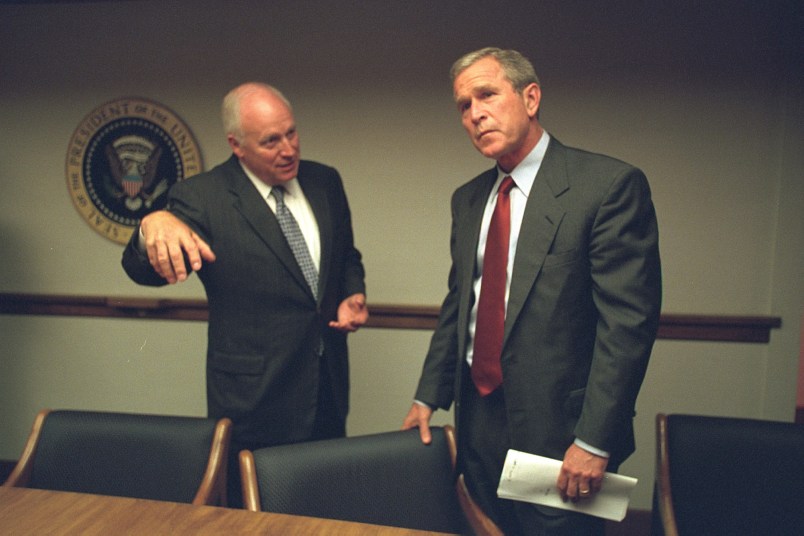
Three initial thoughts on the death of Dick Cheney, President Ford’s White House chief of staff, member of Congress, Bush I’s secretary of defense, and Bush II’s, shall we say, viceroy:
- The Sept. 11 attack happened on his watch. Everything that came afterward —Afghanistan, Iraq, torture, surveillance, and a toxic form of patriotism — was overcompensation for his own initial failure.
- His physical resilience was remarkable. TPM doesn’t do obituaries, but he was such a dominant figure in the early TPM years that we drafted one for him … way back around 2012, when he had his heart transplant. No one expected Cheney, who had the first of his five heart attacks when he was 37, to live to the age of 84.
- Cheney is Exhibit A for why “polarization” is the wrong word to describe the state of American politics in the 21st century. As his Republican Party marched itself off a cliff, even Dick Cheney, a prior generation’s supervillain, was left behind. His full-throated endorsement of Kamala Harris over Donald Trump in 2024 was a last gasp to try to save the constitutional order that he himself had made significantly more brittle during his time in office.
Future generations trying to understand the grip Cheney had on the instruments of government power in the post-9/11 years need only know this: When then-Vice President Dick Cheney accidentally shot a 78-year-old Texas lawyer in a 2006 hunting accident, the victim apologized to Cheney for being shot in the face.
Do you like Morning Memo? Let us know!
Headlines About a Potential Senate Deal?
The insider DC sheets this morning all have news of a coming deal to reopen the government. The outline of that deal is an agreement to hold a future vote on Obamacare subsidies (a name we should really drop), which there’s no certainty Democrats would win, in exchange for another short or medium term continuing resolution. The catch to these reports is that, if you look closely, they seem to be overwhelmingly sourced to Republicans. That, however, doesn’t mean they’re not accurate — though you wouldn’t go too wrong being suspicious. Another dimension of this story is that the Democrats doing informal negotiations — and the potential crossover votes — are heavily stacked with soon-to-be retirees, Jeanne Shaheen (D-NH) and Gary Peters (D-MI) among others.
Continue reading “Headlines About a Potential Senate Deal?”Traditional Media Never Took the Christian Right Seriously
Back in the early 2000s, when we were outraged by the excesses of authoritarian dilettantes George W. Bush and Dick Cheney, a friend suggested I start a blog. I had been a lawyer, but was eager to change careers. Having studied the rise of the Christian right as a college student in the 1980s, I was now watching their aspirations unfold in real time. I wanted to investigate, expose, weigh in on all the things other people were missing. I was accustomed to writing fast. I was built to blog.
I never ended up starting my own blog, but was the very fortunate beneficiary of a serendipitous series of events that made it possible for a person with no entry point or foothold in journalism to find her way into it. Another friend told me about the group blog The Gadflyer (since, sadly, defunct), making its mark in the burgeoning progressive blogging space. They took a chance on me, and I wrote persistently about the Christian right, its assaults on secular law and governance, and the D.C. money and power politics driving it.
The revolution in digital media made my two decades of reporting on the Christian right possible. Not only because it offered expansive space beyond the coveted, exclusive pages of print magazines, but because the best digital journalism — and here I’m talking about reported, edited, fact-checked journalism, although opinion writing is also an essential part of the equation — demands a long-term commitment to the bit. It depends on a reporter consistently drilling down into an important corner of the political world, and continually exposing and contextualizing that world for readers. This type of journalism is fundamentally different from the other kind of online journalism that was born alongside it in the 2000s. Both appear in the digital form, more nimble than print, but that other kind, which still plagues us today, is the inside-the-Beltway, gossip-driven, anonymity-granting, driving-the-day coverage that thrives on access and adrenaline rather than illumination and insight.
Continue reading “Traditional Media Never Took the Christian Right Seriously”