

One of the sham Trump electors brought tech operatives hired by MAGA lawyer Sidney Powell to a Georgia county’s elections office on the day there was a breach in the office’s voting system, surveillance video footage reported by CNN, the Washington Post and the Atlanta Journal-Constitution shows.
Continue reading “Fake Trump Elector Brought MAGA Tech Guys To County Elections Office On Day Of Data Breach, Video Shows”Declaring Who Wins Elections Is Not A Job For Partisans
This article is part of TPM Cafe, TPM’s home for opinion and news analysis.
If the stars align, Congress could soon pass a much-needed overhaul of the Electoral Count Act (ECA), the 19th-century law governing presidential electoral-vote counting, whose ambiguities helped spawn chaos on January 6th. In pushing to reform the ECA, a bipartisan group of senators is acknowledging a dangerous new reality: that any ambiguity in election law, any hint of an opening, could be exploited in this perilous era for democracy.
The same reality threatens another arcane election procedure: certification of results at the state and local levels, a previously routine process now emerging as a stage for electoral defiance. As with the ECA, our current system is vulnerable to manipulation by partisans and extremists that could dangerously undermine election results, voter trust, and civic peace.
After votes are tabulated locally, state election laws designate an individual or board to confirm the totals add up and to certify victory for the winning candidate. A new Election Reformers Network (ERN) analysis finds that in most states, political parties play a major role in selecting the people responsible for certification. That role is now creating a significant risk of subversion.
At the state level, 39 states give partisan-controlled boards or partisan officials exclusive control over certification, and every state except for Hawaii involves party-nominated or partisan-elected or -appointed figures in some manner in the process. By contrast, a parallel ERN study finds that almost all of our peer democracies limit the role of political parties to observing the process and bringing challenges in court. The finalization of results in these democracies is handled by the same (usually nonpartisan) professionals who run the election itself.
Already, we’re seeing efforts by U.S. partisans to exploit certification. In 2020, Republican party representatives in Wayne County, the largest in Michigan, refused for several hours to certify results of the presidential election, briefly throwing the contest in a key swing state into turmoil. One of their counterparts at the state level board — the same panel that last week drew charges of political bias when it rejected, on party lines, a proposed ballot measure to protect reproductive rights — threatened to do likewise. A similar skirmish arose in New Mexico earlier this year. And in Pennsylvania, three county electoral boards for months refused to certify primary results that include ballots they argued should be rejected, despite court rulings to the contrary.
Election law experts like New York University’s Rick Pildes warn of more to come for the midterm elections in November. Meanwhile, the campaign rhetoric of several “Stop the Steal” candidates for secretary of state raises the possibility they, too, may refuse to certify future results not to their liking.
If we don’t take steps to reduce the role of partisans in certification and ensure better understanding of the process, the next January 6 might not happen in Washington, but instead in counties and state capitals across the country.
It’s important to be clear about the nature of this threat. Many state laws confirm that certification is not the venue to address claims of fraud, failed equipment, or other irregularities. Instead, such challenges are usually heard in courts, where evidence can be weighed and authoritative judgment rendered. This means that bad actors are unlikely to be able to use certification to change an election outcome.
But, as with the ECA, public misunderstanding and ambiguities in the law can still be exploited to great harm. As we saw on January 6, partisan denialists and ideologues can use public showdowns over election rules to stoke anger and chaos, damaging trust in elections and potentially triggering violence — even if they don’t succeed in overturning the results.
How do we fix the problem? In the near term, we need much greater public clarity about certification to reduce the risk of flashpoints. Journalists and state officials should emphasize that there is a rightful place for challenges to elections — in court, not during certification.
Longer term, we should shift responsibility for certification to election professionals, ideally selected in nonpartisan processes. Where boards are involved, their membership should be modified to emphasize impartiality rather than party representation, for example by including retired election officials or judges. Parties can fully protect their interests through the roles accorded them in law: observing all processes and taking evidenced-backed concerns to court.
There are a few signs of progress here: Colorado earlier this year passed laws making it harder for local officials to hold up certification, and in Michigan a new effort may be emerging to depoliticize canvass boards. Reformers in New Mexico are looking at ways to avoid a repeat of this year’s standoff. Other states at risk should consider similar measures that reduce the role of partisans in the process, and that remove any ambiguity about the limited authority of those in charge of certification.
With so much work needed on our elections in so many areas, it may be tempting to hope that we can muddle through with our existing certification processes. We shouldn’t risk it. But if we don’t take steps to reduce the role of partisans in certification and ensure better understanding of the process, the next January 6 might not happen in Washington, but instead in counties and state capitals across the country.
Kevin Johnson is executive director of the Election Reformers Network.
Trump Tried To Pay His Legal Bills With A Horse
A lot of things happened. Here are some of the things. This is TPM’s Morning Memo.
Neigh
An upcoming book by New York Times reporter David Enrich includes an amazing story of Trump trying to stiff a lawyer (to whom he owed $2 million) by offering to give him a deed to a stallion that was supposedly worth $5 million instead.
However, the lawyer apparently refused to accept live animals as payment, telling Trump that “this isn’t the 1800s” and “you can’t pay me with a horse.”
Judge Approves Trump’s Special Master Request
Federal District Judge Aileen Cannon, who was appointed by Trump, ordered on Monday that a third-party special master be appointed to sift through the materials the FBI seized from Mar-a-Lago.
- A DOJ spokesperson didn’t say what prosecutors’ next move will be, only that the DOJ would be “examining the opinion and will consider appropriate next steps.”
- Legal experts tore into Cannon’s order, including one lawyer who said the judge “basically did Trump’s lawyers’ work for them.”
The States With Abortion On Ballot
Voters in California, Kentucky, Montana and Vermont will vote on state constitutional amendments or legislative referendums on abortion access this November.
- California: A vote on amending the state’s constitution to confirm that the state “shall not deny or interfere with an individual’s reproductive freedom in their most intimate decisions, which includes their fundamental right to choose to have an abortion and their fundamental right to choose or refuse contraceptives.”
- Kentucky: A vote on amending the state’s constitution to say explicitly that Kentuckians don’t have a constitutional right to abortion care.
- The proposed language: “To protect human life, nothing in this Constitution shall be construed to secure or protect a right to abortion or require the funding of abortion.”
- Montana: A legislative referendum on the “Born-Alive Infant Protection Act,” an anti-abortion law that defines a fetus that was born alive after an attempted abortion as a legally protected person (abortion is still legal in Montana for now).
- Vermont: A vote on amending the state’s constitution to codify the right to an abortion.
- The proposed language: “That an individual’s right to personal reproductive autonomy is central to the liberty and dignity to determine one’s own life course and shall not be denied or infringed unless justified by a compelling State interest achieved by the least restrictive means.”
US Ambassador To Russia Retires
John Sullivan, the U.S. ambassador to Russia, left his post on Sunday due to his wife’s illness, according to Politico. She died of cancer on Monday.
Russia Buying Weapons From North Korea, US Intel Reports
The Kremlin is buying millions of rockets and artillery shells from North Korea to aid its brutal attack against Ukraine, according to U.S. intelligence officials.
Liz Truss To Replace Boris Johnson As UK Prime Minister
British foreign secretary Liz Truss won the Conservative Party’s leadership election to replace scandal-plagued Prime Minister Boris Johnson on Monday. Johnson’s parting gift to her: economic disaster. Welcome aboard, Liz!
Must Read
“Police supervisor chatted up Patriot Front poser who recorded it all” – The Washington Post
Politico’s New Owner Wanted To Hold Group Prayer For Trump To Win In 2020
The Washington Post reports that Mathias Döpfner, the German billionaire who bought Politico last year, sent an email to his closest executives weeks before the 2020 election asking if they wanted to gather on Election Day to “pray that Donald Trump will again become President of the United States of America.”
- “No American administration in the last 50 years has done more,” Döpfner wrote.
- Döpfner publicly claims he’s all ’bout that nonpartisan media life: “We want to prove that being nonpartisan is actually the more successful positioning,” he told the Post.
A Finnish Earthquake
My trip to Finland took place during the height of a massive political scandal that was shaking the nation to its core: Leaked videos revealed that Finnish Prime Minister Sanna Marin had danced at a party, and the tabloids were having an absolute field day:
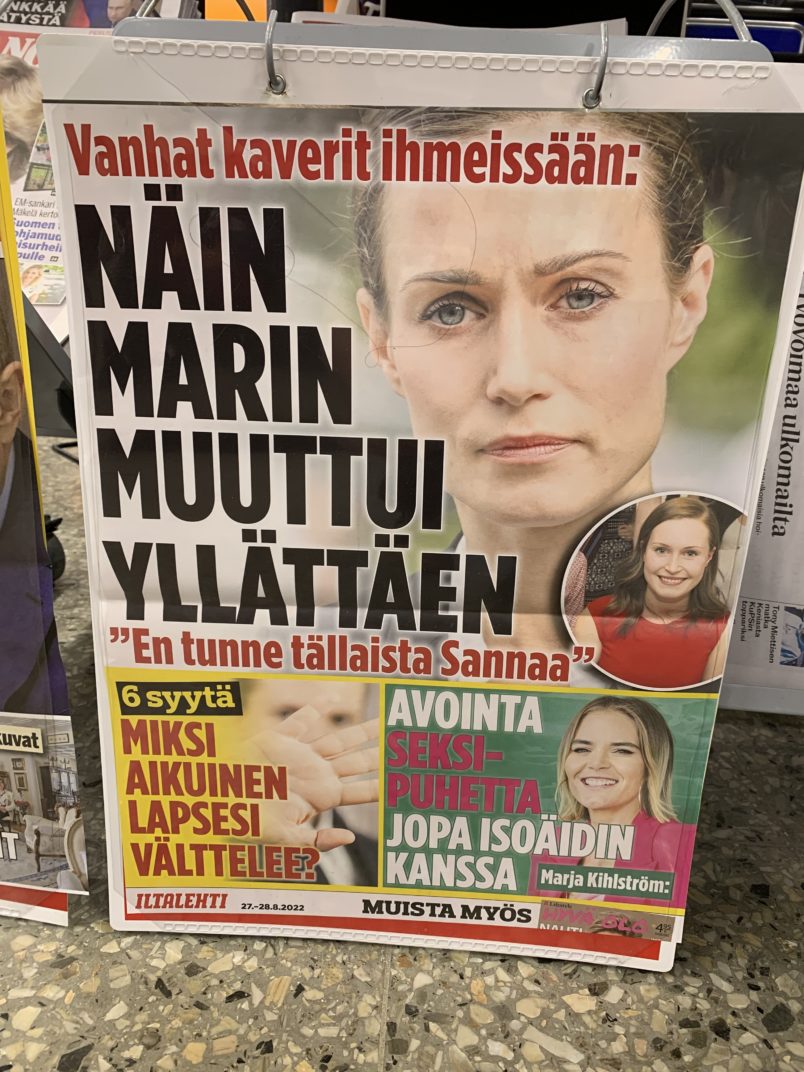
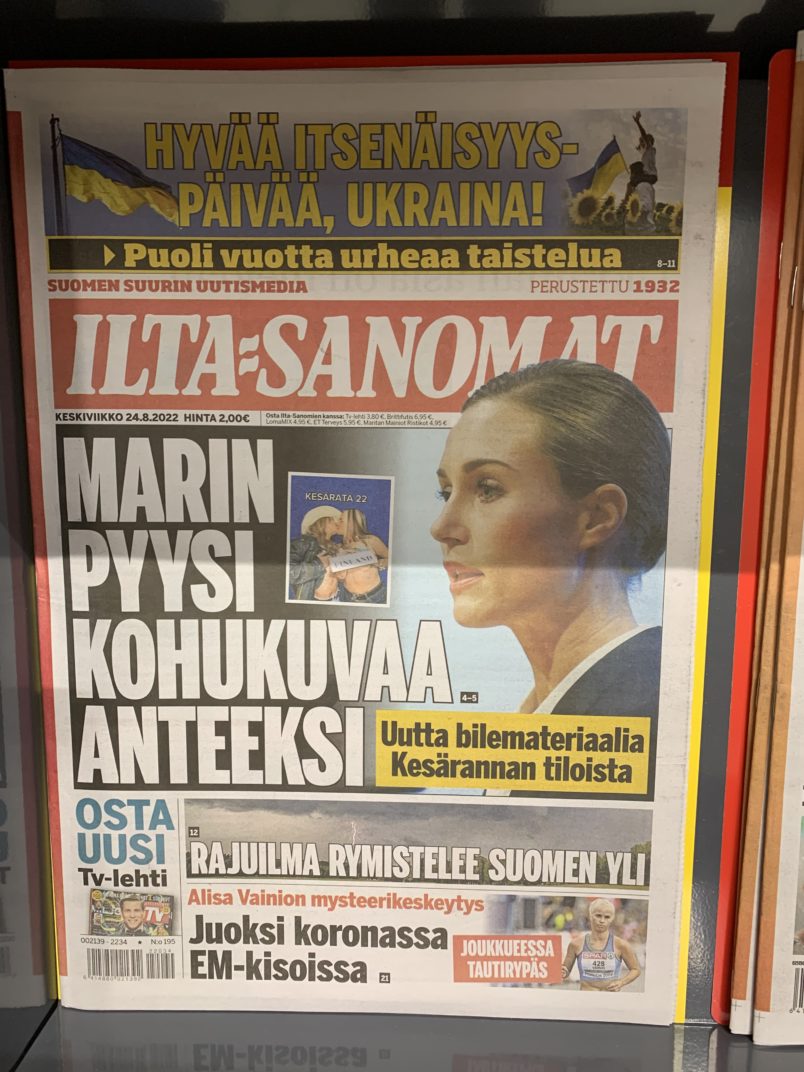

It was just surreal to be in an political environment in which a leader was under fire for dancing while the ex-leader of the country I just had left stole classified government documents and hoarded them at his tacky Florida resort.
Dam!
“It Was War. Then, a Rancher’s Truce With Some Pesky Beavers Paid Off.” – The New York Times
A Cat With Precisely Two (2) Brain Cells
Do you like Morning Memo? Let us know!
Fruit of the Poison FedSoc Tree
As I noted in my previous post, Judge Cannon’s special master order seems most likely to me to simply mean a delay in the progress of the case. But I would be remiss if I didn’t also make clear that her ruling and frankly her presence on the court itself is simply more fruit of the poisoned Federalist Society tree, the taproot of the current corruption of the federal judiciary.
The fact that the case is even before Cannon in the first place is an example of forum shopping that should never have been allowed. But her ruling is a tour de force in strained reasoning, novel theories, special pleading and a simple refusal to treat the man who appointed her to office as a citizen like any other.
Continue reading “Fruit of the Poison FedSoc Tree”GOP Rep Argues Trump Has ‘Different Set Of Rules’ With Classified Docs
Rep. Michael McCaul (R-TX) defended on Sunday ex-President Donald Trump’s hoarding of classified documents at his Mar-a-Lago resort by claiming that Trump isn’t beholden to the same pesky rules as others.
Continue reading “GOP Rep Argues Trump Has ‘Different Set Of Rules’ With Classified Docs”Legal Experts Slam Judge’s Approval Of Trump’s Special Master Request
Legal experts were left reeling on Monday after a judge approved ex-President Donald Trump’s request for a special master to review the documents the FBI seized from Mar-a-Lago as Trump insists the materials are covered by executive privilege (actual sitting President Joe Biden has not claimed executive privilege over them).
Continue reading “Legal Experts Slam Judge’s Approval Of Trump’s Special Master Request”The Special Master Thing
I don’t think we should be too concerned about President Trump convincing a judge to appoint a special master to evaluate the documents seized from his villa in Florida. Mostly this is simply a delay — a boon for the former President but not a huge one. The special master will review the materials for attorney-client privilege documents which the DOJ has already done. There’s no reason to believe the results will be any different.
Continue reading “The Special Master Thing”Judge Approves Trump’s Request For ‘Special Master’ To Sort Through Seized MAL Docs
A federal judge on Monday granted ex-President Donald Trump’s request for a third-party special master to review the documents the FBI seized from his Mar-a-Lago resort that Trump has claimed are shielded by attorney-client and executive privilege.
Continue reading “Judge Approves Trump’s Request For ‘Special Master’ To Sort Through Seized MAL Docs”Trump Rally Speaker Laments Plight Of Alleged Neo-Nazi Convicted Over J6 Role
A speaker at ex-President Donald Trump’s Pennsylvania rally on Saturday painted her nephew, an alleged Nazi sympathizer named Timothy Hale-Cusanelli who was convicted over his participation in the Jan. 6 Capitol attack, as a victim of political oppression.
Continue reading “Trump Rally Speaker Laments Plight Of Alleged Neo-Nazi Convicted Over J6 Role”For Labor Day
In honor of Labor Day weekend I wanted to make sure you saw this Gallup report which shows public support for unions to be at a 57 year high.
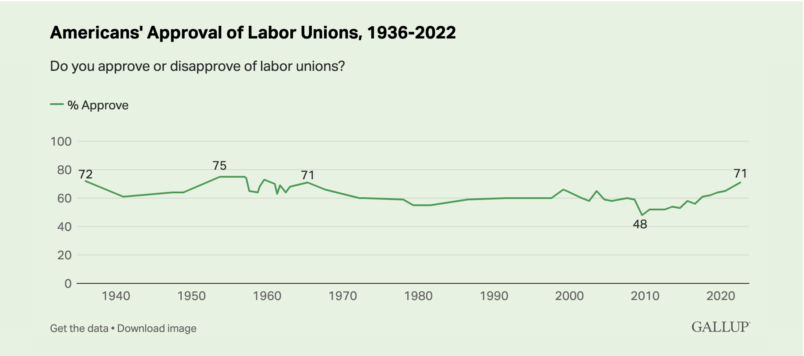
As recently as 1999 and 2003 the number was 66% and 65%. Today it is at 71%, comparable to the 72% in 1936 and 71% in 1965. You can see there’s a nadir in 2009. I assume that was driven in part by the political battles over the auto bailout in which the UAW was routinely portrayed as the reason why U.S. automakers were uncompetitive. The upward trend doesn’t seem to be a blip.