

The U.S. is approaching a newly dangerous phase of its war against Iran. The administration is signaling that it will likely soon commence ground operations in Iran that will yet stop short of a full-scale invasion. Obviously, certainly to many TPM readers, this whole situation and war of choice are very bad things. But I want to point your attention to something specific.
Continue reading “Lacking Any Strategy, Trump Prepares to Escalate”Trump’s Iran War Objectives Have Collapsed. Now What?
Faulty Assumptions and Hubris
The only thing more dangerous than an unbound strongman launching elective wars is when those wars begin to go badly.
There’s no telling what President Trump will resort to doing to save face, create the mirage of victory, and extricate himself from the box canyon into which he so triumphantly galloped.
This is old-style mission creep on steroids.
As Yonatan Touval eloquently writes in a NYT op-ed, the presumptions that undergirded Trump’s lurch into the Iran war have already proven to be incorrect:
The war’s architects appear to have assumed that killing a nation’s leaders, dominating airspace and destroying infrastructure would produce regime collapse in Tehran and strategic clarity in Washington and Jerusalem. Instead, Iran, though badly weakened, has managed to disrupt shipping through the Strait of Hormuz, drastically widen the war’s economic radius and force Washington into the old, unglamorous business of soliciting allied help after entering a war confident that it would be swift and decisive.
Now what? When a mission’s presumptions collapse under the weight of their own overoptimism and the original strategic objectives are no longer attainable, a different kind of self-delusion sets in: that the only way forward is to keep going forward.
To listen to Trump’s increasingly shrill threats, you’d think he was about to go Curtis LeMay on Iran. And he may. But threats like this are also a transparent negotiating tactic, which is to say it’s both announcing a planned war crime and issuing a cry for help.
A back-to-the-Stone-Age bombing campaign is but one example of what is likely to come next: an inexorable slide towards replacing already-abandoned strategic objectives with feel-good tactical wins. What’s always a danger for a bogged-down empire is a heightened risk for a superpower led by a man with a short attention span who is enthralled by military spectacle.
Without re-setting strategic objectives in light of the reality that the old ones are lost, Trump has left Iran holding the better hand, as TPM’s Josh Marshall observes:
The problem is that … the U.S. is escalating with nothing it can call a “win” that isn’t 100% at the discretion of Iran. … Military planners and heads of state who are smart really want goals they can at least realistically try to achieve entirely on their own terms. … But if your goal is entirely at the other guy’s discretion, you’ve got a big problem. And that really seems like what the U.S. is getting into now.
Whatever Trump lurches towards next, his stupidity, racism, hubris, and provincialism will — as it has for past U.S. administrations far less burdened by those weaknesses than he is — prevent him from seeing his avowed enemy clearly or on its own terms.
“[W]ar is never merely a technical contest,” Touval reminds us. “It is shaped by grievance, sacred narrative, the memory of past humiliations and the desire for revenge. Those are not atmospheric complications added to an otherwise technical enterprise. They are what the war is about.”
Playing Word Games Out Loud
The Latest From the Middle East …
- NYT: Strike on U.S. Base in Saudi Arabia Injures 12 American Troops, 2 Seriously
- Reuters: Yemen’s Iran-aligned Houthis launched their first attacks on Israel on Saturday, raising the prospect that they could bottleneck a second key shipping route: the Bab el-Mandeb Strait.
- WaPo: Pentagon prepares for weeks of ground operations in Iran
- NYT: U.S. Special Operations Forces Sent to Mideast
- WSJ: Trump Weighs Military Operation to Extract Iran’s Uranium
Pete Hegseth Watch
- Sen. Jack Reed (D-RI), the ranking member on the Armed Services Committee, said that Defense Secretary Pete Hegseth’s intervention to block the promotion of two Black men and two women to be one-star Army generals was “not only outrageous, it would be illegal.”
- In addition to his interference with Army promotions, Hegseth also intervened to remove a Black colonel and a female colonel from the promotions list in another unspecific branch of the armed services, NPR reports.
- Greg Sargent on the Christian Reconstructionist roots of Hegseth’s bloodlust, featuring some of TPM’s own reporting.
The Retribution: Anthropic Edition
Benjamin Wittes aptly describes the real point of the Pentagon’s attack on the AI company Anthropic:
The underlying issue is simply the lack of submission. And the point is not to win. The point is to emphasize to the next recalcitrant entity, person, company, or institution that it will have to defend itself if it asserts its rights—because the government will relentlessly come at those who don’t submit. … And if you’re a frontier AI company with the temerity not to submit, they will use the opportunity of destroying you to create opportunities for businesses associated with friendlier billionaires who know to stay on side.
Mass Deportation Watch
- A new “facilitate” case: U.S. District Judge Lee H. Rosenthal of Houston has ordered the Trump administration to “facilitate” the return of a man deported to Mexico and at risk of being sent on to Guatemala, where he fears persecution.
- Stressed the fuck out: Acting ICE chief Todd Lyons has been hospitalized twice for stress-related issues during Trump’s mass deportation push, Politico reports.
- Great read: In the first installment of a series about how brazenly DHS lies about its conduct, Radley Balko examines the January raid on the St. Paul home of 57-year-old Laotian immigrant ChongLy Scott Thao.
House GOP Revolts Over Senate DHS Bill
The House rejected the bipartisan Senate bill to partially fund DHS and put an end to the TSA nightmare at the nation’s airports, instead passing its own funding bill late Friday before recessing for Easter. The Senate had already left town for its two-week recess. In a new executive order, President Trump purported to have the authority to pay TSA workers, and the government appeared to be taking steps to issue paychecks even without congressional authorization.
The Corruption: DHS Edition
The DHS inspector general has searched and seized records and a computer in the office of Kara Voorhies, a FEMA contractor, as part of an investigation into a network of aides to former Department of Homeland Security Secretary Kristi Noem and adviser Corey Lewandowski, the WSJ reports:
Another prong of the probe into Voorhies: her compensation. FEMA officials have been unable to locate her contract and investigators are still seeking it, according to people familiar with the matter. Senior FEMA officials were told that Voorhies was getting paid as much as $19,000 a week, some of the people said, which would amount to roughly $1 million a year.
Voorhies was brought into DHS by Lewandowski, who has told people close to him that “he expects the president would pardon him in the event of a criminal case stemming from the inspector general’s probe,” according to the WSJ.
Patel Phished
FBI Director Kash Patel personal Gmail account was hacked by a group linked to Iranian intelligence, Reuters reports. Patel emails from across a dozen years were posted on a website hosted by a computer server in Russia, the NYT reports.
The Retribution: Eric Swalwell Edition
The congressionally mandated release of the DOJ’s Jeffrey Epstein files has created a dangerous precedent that FBI Director Kash Patel is pressing to use as a political weapon against President Trump’s political foes.
Patel recently directed FBI agents in the San Francisco office to redact for potential public release the decade-old investigative files involving Trump nemesis Rep. Eric Swalwell (D-CA) and suspected Chinese intelligence operative Christine Fang (a.k.a. Fang Fang), even though the investigation turned up no evidence of wrongdoing, the WaPo reports. Swalwell is currently running for governor of California.
In a followup report, the NYT adds that the FBI is moving swiftly and that law enforcement officials fear the files full of personal and classified information could be released: “In recent days, scores of F.B.I. agents and other personnel in California were instructed to gather the documents on Mr. Swalwell and Ms. Fang, with the goal of working through the weekend to finish a review by early next week, the people said. Supervisors advised the agents to lightly redact the records to obscure some sensitive information and told them the files would be shared with senior administration officials in Washington.”
Jan. 6 Never Ends
- A federal judge in Georgia heard arguments and testimony Friday in Fulton County’s challenge of the FBI’s recent seizure of ballots and other materials from the 2020 election.
- Jan. 6 defendants have filed a class action lawsuit against the U.S. government in the Middle District of Florida for “indiscriminately” using force against a “peaceful crowd.”
Quote of the Day
“President Trump took on the fake news media and President Trump is winning. Look at the results so far. PBS defunded. NPR defunded. Joy Reid, gone from MSNBC. Sleepy-Eyed Chuck Todd, gone. Jim Acosta, gone. John Dickerson, gone. Colbert is leaving. CBS is under new ownership, and soon enough CNN is going to have new ownership as well.”—FCC Chairman Brendan Carr, bragging at CPAC about Republicans doing to corporate media what they have long falsely accused Democrats of doing
What a Personalist Regime Looks Like
- A rundown of everything that Trump has slapped his name on so far in his second term.
- Graphic of the day:
No Kings




Hot tips? Juicy scuttlebutt? Keen insights? Let me know. For sensitive information, use the encrypted methods here.
No End in Sight to DHS Shutdown After House Refuses to Get Behind Senate Deal
The Department of Homeland Security-specific government shutdown is now the longest in history after House Republicans on Friday refused to get behind the Senate-passed bipartisan package that would have restored funding to all of DHS except Immigration and Customs Enforcement (ICE) and Customs and Border Protection (CBP).
House Speaker Mike Johnson (R-LA) and the Republican caucus refused to vote on the Senate-passed bill, instead taking up a continuing resolution (CR) to fund all of DHS through May 22.
Continue reading “No End in Sight to DHS Shutdown After House Refuses to Get Behind Senate Deal”MAGA’s Infatuation With MMA Is Part Of A Long History Between Combat Sports And The Right Wing
March 2026 was a big month for anyone keeping tabs on the increasingly important intersection between the Trump administration and combat sports.
Continue reading “MAGA’s Infatuation With MMA Is Part Of A Long History Between Combat Sports And The Right Wing”With Airports in Crisis, Trump Sends in the Goons
Hello it’s the weekend. This is The Weekender ☕️
What better way to soothe the barely latent rage of Americans suffering through endless airport security lines than by introducing agents from an agency most of them dislike?
As would-be fliers tap on their phones for three, four, five hours — in lines that stretch out to parking lots — ICE agents are now milling about, avoiding cameras, and generally ratcheting up the tension in a barely contained environment. In San Francisco, ICE agents arrested Angelina Lopez-Jimenez and her nine-year-old daughter in the middle of the airport.
This was President Trump’s masterstroke as the prolonged Department of Homeland Security shutdown has left TSA agents unpaid for over a month. He wrote candidly this week on Truth Social that their deployment is an effort to “[rehab] a fake image given to them by Radical Left Democrat politicians.”
It’s quite a split screen, as ICE agents — currently being paid — stand over the shoulders of TSA agents who are not. In the past couple of days, ICE agents in certain airports have begun scanning passengers’ IDs, per the New York Times.
It’s a telling episode in the absence of a guiding MAGA ideology beyond general lib-owning. Trump knows that parking lot lines and furious fliers are terrible optics; instinctually, he reaches for an easy move that he thinks will upset liberals and delight his base. So he links a radioactive agency, the pride and banner-carriers of his administration, to the most catastrophic airport breakdown in recent memory.
Early Friday morning, Senate Republicans blinked, caving to the Democratic demand to fund TSA separately from the ongoing DHS standoff. House Republicans revolted, putting forward a dead-on-arrival continuing resolution to fund the entire department. Trump, so far failing to strong arm Democrats into folding on the shutdown, on Friday ordered preexisting funds to be shifted to TSA.
— Kate Riga
‘No Kings’: Sweeping Umbrella for Resistance
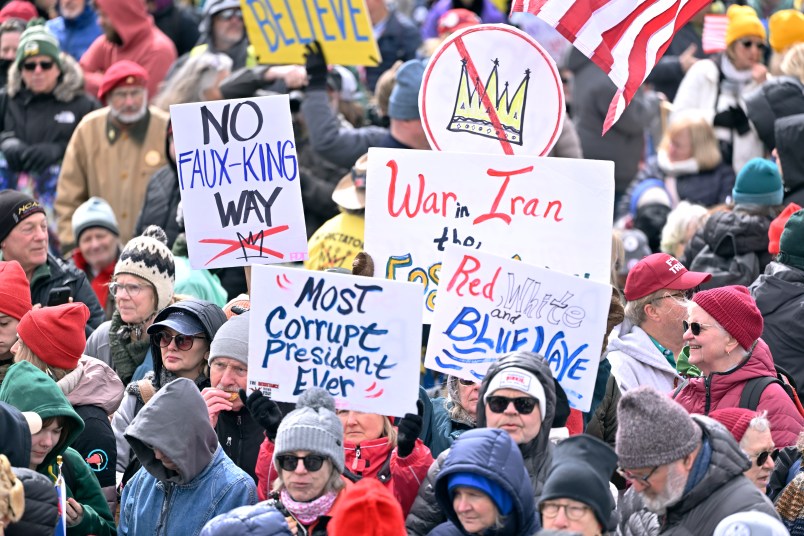
Americans will gather to protest President Trump — and all of the various horrors he has carried out thus far during his second term in office — in cities across the country today, with over 3,100 “No Kings” rallies planned in all 50 states. The demonstration in St. Paul, Minnesota will serve as the flagship event for this round of “No Kings” protests, which are being spearheaded by Indivisible. Organizers chose Minnesota because the state was the target of “some of the most horrific, sadistic behavior you can imagine” so far this year, Indivisible co-founder Ezra Levin told the AP.
The St. Paul protest today will feature a performance by Bruce Springsteen. Over 100,000 people are expected to be in attendance, including Minnesota Gov. Tim Walz.
“We will never forget what happened here and we’re taking action against it,” Walz said of his participation in the nationwide demonstration during an interview with MS NOW’s Chris Hayes.
“Grateful to folks across the country, but [there’s] an understanding that I think Minneapolis and Minnesota provided the template here for pushing back on this guy, and there’s work to be done,” he continued.
Immigration and Customs Enforcement agents killed two U.S. citizens in Minneapolis in January: Renee Good and Alex Pretti. This will be the third country-wide “No Kings” protest since Trump came back to office.
The movement has resonated with millions of Americans and appears to serve as a catchall for the broader Trump resistance. Whether protesters are showing up to march against Trump’s lethal immigration enforcement; his weaponization of the Justice Department; his retribution against political opponents; Republicans’ devastating cuts to Medicaid and health care; the skyrocketing cost-of-living crisis in our nation under Trump’s leadership; the administration’s targeting of left-leaning ideology as terrorism; his attacks on voting rights; or his lawless war in Iran — there’s something for everyone.
Some five million Americans participated in the June 2025 “No Kings” rallies and another seven million marched in the fall of 2025. As gas prices soar amid Trump’s renegade operation in the Middle East continues, today’s demonstrations are expected to be even larger.
— Nicole LaFond
Lindell Served Legal Papers on Live TV
MyPillow CEO Mike Lindell was served legal papers on live TV during an interview at the Conservative Political Action Conference on Thursday.
According to reporting from The Hill, a woman approached Lindell while on air and told him he had been served. As of Friday evening, it was unclear what legal matter the papers were related to.
Responding to the incident, Lindell, in a post on X on Thursday, described the various “attacks” on MyPillow and plugged his organization, the Lindell Offense Fund.
“They surrounded my car and took my phone,” he wrote. “Then came the subpoenas, debanking, and attacks on MyPillow. We lost 90% of our business, I’m not backing down, because if we lose our elections, we lose our country. Please help secure our Election Platforms and Save Our Country!”
— Khaya Himmelman
Republicans Lose Big in Attempt to Gerrymander Utah for Trump
In yet another loss for Trump’s nationwide gerrymandering pressure campaign ahead of the midterms, Utah’s Republican-led petition to repeal a 2018 anti-gerrymandering law will not move forward after it failed to get the requisite number of signatures needed.
The proposal, which failed despite support from President Trump himself and Turning Point Action — a 501(c)(4) group tied to the late Charlie Kirk’s Turning Point USA — centered on a 2018 anti-gerrymandering law that created an independent redistricting commission and guidelines for redrawing district lines. It was passed to guard against the kind of deeply partisan redistricting that Trump has been pushing red states with Republican-controlled legislatures to do for almost a year as part of his effort to predetermine who controls Congress after the midterms.
The latest Republican redistricting failure in Utah follows a Utah judge’s rejection of a GOP-proposed map that was expected to give Republicans two additional districts.
Judge Dianna Gibson rejected the new Republican-favoring congressional map last November. She instead approved a map that will likely allow for a Democratic district around Salt Lake City.
In her ruling, Gibson wrote that the new gerrymandered map did “not comply with Utah law” and that it “fails to abide by and conform with the requirements.”
— Khaya Himmelman
Tell Your State To Pass This No-ICE-At-Our-Precincts Model Law. Now.
I’ve gotten a number of helpful responses to my post from earlier today about the necessity of escalating the question of whether the White House will try to deploy ICE agents to interfere with the 2026 midterm elections. In the course of following up on a few points readers had made, I found a piece of model legislation published on March 9th by the Brennan Center. (If you don’t know about the Brennan Center, they operate at the pinnacle level in terms of competence, expertise, reliability. They are perhaps a bit more conventional in their thinking — in terms of the law — than I am. But that’s not a criticism. You need people working in many different lanes to save a country.) Model legislation is a generic piece of legislation that state legislatures can pass whole or pass with their own fine-tuning. A lot of the drafting legwork is done by the creator of the model. So it can then be implemented quickly and well, so long as the model legislation is good.
This seems very good to me. Let me explain.
Continue reading “Tell Your State To Pass This No-ICE-At-Our-Precincts Model Law. Now.”Rubio: Iran May Own The Strait Now, And That’s a Huge Bummer
Secretary of State Marco Rubio today made some extraordinary comments after briefing G7 leaders about the progress — albeit difficult to call it that — in the U.S.’s Iran War. He seemed to say that the U.S. won’t be able to reestablish freedom of transit through the Strait of Hormuz even as a final war objective, let along doing so in the short term by force or threat. He said he told the G7ers that one of the post-war challenges will be Iran setting up a tolling system for passage through the Strait. In other words, Iran will be so empowered after the war that it will be able to assert or seriously contest sovereignty over the Strait.
This is such a remarkable statement that I want to quote it at length. I had seen more garbled and clipped versions of it. These are from a report in The Hill.
Continue reading “Rubio: Iran May Own The Strait Now, And That’s a Huge Bummer”House Rules Committee Meeting Descends Into Chaos
Emine Yücel has those details, and others, as the Senate attempt to pay TSA falls apart in the House, and Trump (seemingly extralegally) orders that the officers be paid.
House GOP Conjures Up Conspiracy Theories About Senate-Passed DHS Bill
Shortly after President Donald Trump on Friday signed a presidential memo directing the Department of Homeland Security (DHS) to pay Transportation Security Administration (TSA) employees, a key House committee meeting descended into conspiracy theories as it debated whether to take action on a Senate bill that would do the same.
Trump’s executive action, on dubious authority, comes as the Senate-passed bill that would fund DHS without Immigration and Customs Enforcement (ICE) and Customs and Border Protection (CBP) is stalled.
“America’s air travel system has reached its breaking point,” Trump declared in the memo authorizing the payments. “I have determined that these circumstances constitute an emergency situation compromising the Nation’s security.”
House Republican leaders — seemingly upset that the Senate GOP did not consult them before making a deal with Democrats — are refusing to get behind the DHS funding bill that the Senate passed with a voice vote around 2:30 a.m. on Friday morning.
Continue reading “House GOP Conjures Up Conspiracy Theories About Senate-Passed DHS Bill”Escalate on the Trump Admin’s ‘ICE at the Polls’ Plans Now
In recent weeks there’s been a recurring story, albeit with different players. This or that DHS or White House official gets asked about sending ICE to the polls in November. Will they disavow it, promise it won’t happen? The general answer has been no comment, no answer. It’s Tom Homan, or Kristi Noem or Stephen Miller. Yesterday, it was Todd Blanche at DOJ. There’s a general mood of a drip, drip, drip story, with all the vibes of looming danger and the hammer-fall of that danger being in the other guy’s hands. This is all a mistake. It’s a Trumpian sort of conditioning that is being perpetuated even though Trump himself, as far as I can tell, hasn’t addressed this particular question in some time. It’s a kind of watchful waiting in which all the power is being ceded to the hands of the White House when that is not necessary at all.
Being in a reactive mode, having the other guy holding the cards and waiting to know what they’re going to do and reacting when they do it is enervating, demoralizing, even paralyzing. And that’s always Trump’s personal angle: ‘I 100% can do it. Everyone agrees I can do it. But we’ll see what I decide,’ is more or less what he’s said about countless future crimes he’s dangled in front of an often-cowering opposition over the last decade.
Continue reading “Escalate on the Trump Admin’s ‘ICE at the Polls’ Plans Now”