Science Activism Is Surging—Demonstrating A Culture Shift Among Scientists

This article is part of TPM Cafe, TPM’s home for opinion and news analysis. It was originally published at The Conversation.

Hundreds of scientists protested government efforts to restrict educational access to Western science theories, including Darwin’s theory of evolution, in June 2023 in India. Similarly, scientists in Mexico participated in a research strike in May 2023 to protest a national law they claimed would threaten the conditions for basic research. And during the same month in Norway, three scientists were arrested for protesting the nation’s slow-moving climate policy.

As these among many other actions show, scientists today are speaking out on a variety of political and social issues related to their own research fields and in solidarity with other social movements.

We are social scientists who study the relationship between science and society. Through our work, we’ve noticed more scientists seem empowered to advocate for a wide range of policy issues. We’re interested in how the surge in science activism may be changing the norms of scientific research.

With colleagues, we recently reviewed and summarized a growing body of studies examining how scientists are mobilizing for social activism and political protest. We also surveyed 2,208 members of the Union of Concerned Scientists Science Network to learn more about scientists’ political engagement. Here is what we have found so far.

A new wave of science activism

Science activism has long been considered taboo, as many in the field fear that politicizing science undermines its objectivity. Even so, scientist-activists have still managed to shape the U.S. political landscape throughout history. Over the past century, for example, scientists have protested the atomic bomb, pesticides, wars in Southeast Asia, genetic engineering and the federal response to the AIDS epidemic.

More recently, the election of Donald Trump in 2016 triggered a wave of political mobilization not seen in the United States since the Vietnam War era. In the context of the COVID-19 pandemic, climate change activism, Black Lives Matter and the #MeToo movement, scientists have also mobilized, and science advocacy organizations are playing important roles.

Some groups, like March for Science and Scientist Rebellion, are new and claim dozens of chapters and thousands of members around the world. In addition, older organizations like the Union of Concerned Scientists are growing, while once-defunct organizations like Science for the People have reemerged.

Science organizing also happens within universities, graduate student unions and professional associations. These groups use their connections to local communities and larger networks of science professionals to mobilize others in the scientific community.

Many science advocacy groups borrow protest tactics from previous eras, like mass marches and teach-ins. Others are more innovative, including “die-ins” at medical schools to protest police racial violence and data-rescue “hackathons” to protect public access to government data.

Some efforts mirror conventional forms of politics, like 314 Action, an organization that supports political candidates with STEM backgrounds. Others are more confrontational, such as Scientist Rebellion, some members of which blocked roads and bridges to demand action on the climate emergency.

Or, science advocacy can look indistinguishable from typical academic practices, like teaching. A new course taught by an MIT physics professor titled “Scientist Activism: Gender, Race and Power” helps raise student awareness about the political nature of science.

Professional norms may be shifting

We’ll need more research to determine how the resurgence of scientist activism is influencing politics and policy. But we can already point to some effects – the growth of science advocacy organizations, increased media attention to scientist activism, climate-friendly changes in investment policies at some universities, and more STEM-trained politicians. However, we also expect that impending crises, like climate change, may be driving acceptance of activism within the scientific community.

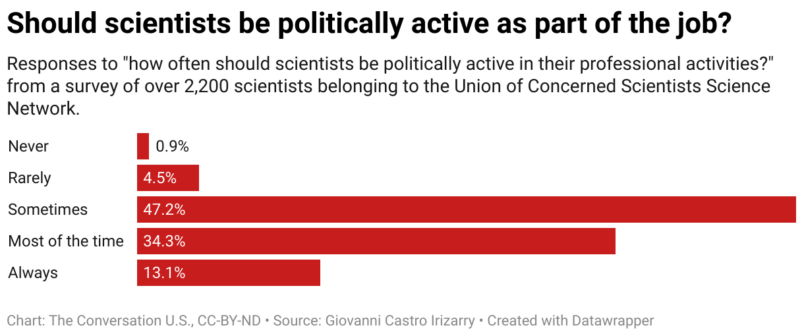
For example, when we asked scientists how often they should be politically active, 95% of our surveyed scientists answered “sometimes,” “most of the time,” or “always.” Our surveyed population is, by definition, politically engaged. But this near-uniform level of support for political action suggests that the professional norms that have long sanctioned scientist activism may be shifting.
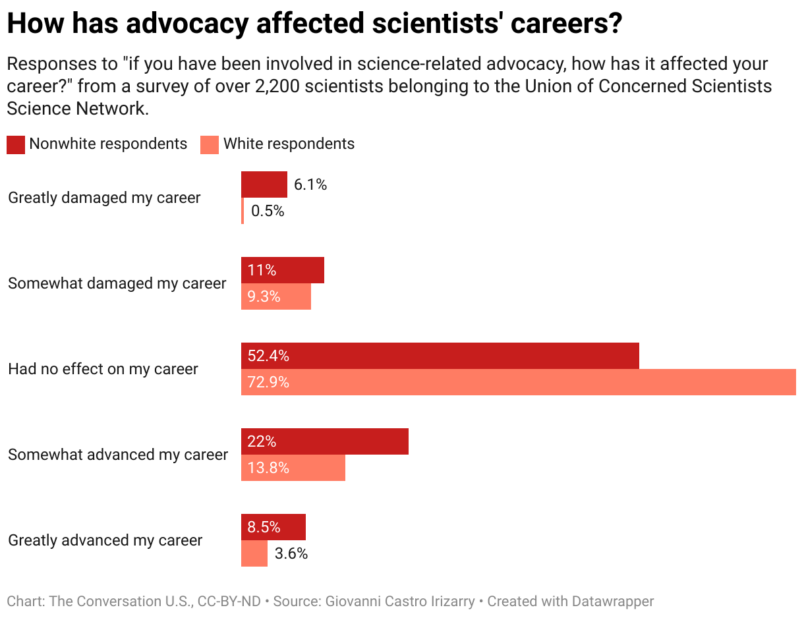
Other findings from the survey strengthen this interpretation. Scientist activism often entails some level of personal or professional risk. But 75% of respondents told us their science-based advocacy had the support of their employers. Most surprisingly for us, respondents were twice as likely to report that activism helped to advance their careers – 22% – rather than damage them – 11%.

Our survey did find, however, that nonwhite scientists are more vulnerable to the risks of engaging in science advocacy. Seventeen percent of nonwhite scientists report negative career repercussions from their science advocacy, compared with less than 10% among white scientists. Yet compared with white respondents, nonwhite respondents are also more likely to engage in science advocacy.

While nonwhite respondents report higher rates of negative career impacts, the percentage reporting higher rates of career advancement from advocacy – 31% – was nearly double that for white respondents – 18%. This difference suggests that science advocacy has deeper career consequences – both good and bad – among nonwhite scientists. Although they are more likely to be rewarded for this activity, they are exposed to greater risk for doing so.
Emerging lessons

Two lessons emerge from our research thus far. First, our findings indicate that science activism may be gaining legitimacy within the scientific community. In this context, social media is helping mobilize and raise visibility among younger researchers. These researchers’ political experiences are informed by the climate justice, Black Lives Matter and #MeToo movements. As this newer generation of science activists moves into the profession, they will continue to shift the cultural norms of science.

Second, because race unevenly structures scientists’ experiences with activism, science activists can build on their current momentum by embracing intersectional solidarity. This means taking actions to center and engage marginalized groups within science. Intersectional solidarity can deepen activist engagement, enhance and diversify recruitment efforts, and increase its impact on social and ecological change.

This article is republished from The Conversation under a Creative Commons license. Read the original article.

The Conversation

Feedback

From TPM Reader DH

I was reading your column about reaching your fundraising goals, and your explanation of the curious attachment many of your readers have formed with respect to TPM. I’m a retired journalist, and somehow, even though I read the NYT, WaPo, Politico, and other sites daily, I don’t feel the same sense of connectivity with these other journalism sites. Something about TPM has always felt more like writers speaking to a community of readers rather than just firing off the day’s shotgun blast of news with clickbait headlines. I don’t really know what the secret is, but watching you guys raise a half a million dollars is uplifting and inspiring.

Officials In California And Texas Call On DOJ To Investigate Florida Over Migrant Flights

California Gov. Gavin Newsom (D), California State Attorney General Rob Bonta and Texas Sheriff Javier Salazar sent a letter to the Department of Justice on Thursday calling for an investigation into the Florida program responsible for transporting migrants to several Democratic-led cities.

Continue reading “Officials In California And Texas Call On DOJ To Investigate Florida Over Migrant Flights”

Guns, A Wealth Tax And War On Regulators: What We’re Watching On SCOTUS’s Docket Next Term 

The Supreme Court term this year ended with an explosion, as the right-wing bench handed down landmark cases rolling back affirmative action, slashing the Biden administration’s student debt forgiveness program and giving a big thumbs up to a potential wedding website designer’s desire not to serve hypothetical same-sex couples. 

Already, the docket for next term is littered with cases that present existential threats to survivors of domestic violence, consumer protections and the administrative state. 

Continue reading “Guns, A Wealth Tax And War On Regulators: What We’re Watching On SCOTUS’s Docket Next Term “

We Did It, Folks! Actually, You Did It.

Overnight we crossed the $500,000 mark. And, as I’ve told you maybe five million times now, that was our goal. That’s amazing. We are all super pumped. We’re really grateful.

It reminds me of a central reality of this organization and this community: the sheet anchor of a robust and resilient news organization is a community of readers who are engaged with and feel personally connected to its work and existence. I wasn’t kidding when I said yesterday morning that I thought we were going to miss this milestone. Yesterday mid-morning we were at about $455,000 and we’d been averaging in the low-teens of thousands on weekdays in the final days of the drive. I figured we’d have some final surge. But the math with two more days was still a stretch. But over the whole day yesterday we ended up raising just under $50,000. So what seemed like a stretch over two days we ended up accomplishing in a single day.

Continue reading “We Did It, Folks! Actually, You Did It.”

Jack Smith Zeroes In On Trump’s Insane Oval Office Meeting

A lot of things happened. Here are some of the things. This is TPM’s Morning Memo.

This Is The Good Stuff

Special Counsel Jack Smith has been asking questions about that off-the-rails Oval Office meeting on Dec. 18, 2020, CNN reports. That crazy confab presaged the Jan. 6 attack and set the stage for a unprecedented run of lawlessness directed from and sanctioned by the Trump White House.

New details from CNN include:

  • Prosecutors have asked witnesses about the Dec. 18 at various times over the last few months, including fairly recently.
  • It came up in Rudy Giuliani’s proffer session with Jack Smith’s team, which we learn from CNN lasted for two days last month.
  • “Prosecutors have specifically inquired about three outside Trump advisers who participated in the meeting: former Trump lawyer Sidney Powell, one-time national security adviser Michael Flynn and former Overstock CEO Patrick Byrne, sources said.”

Just about a year ago, TPM’s Josh Kovensky did a long story about what we then knew about that crazy meeting. It was titled “The White House Meeting That Drove ‘Team Sane’ Insane.”

The meeting reportedly involved hours of screaming and insults, with some participants on the verge of tears from frustration and rage.

At the center of it was a battle to persuade Trump to do one thing: appoint Sidney Powell as special counsel to investigate the election, setting off a chain of events that would include the federal government seizing voting machines.

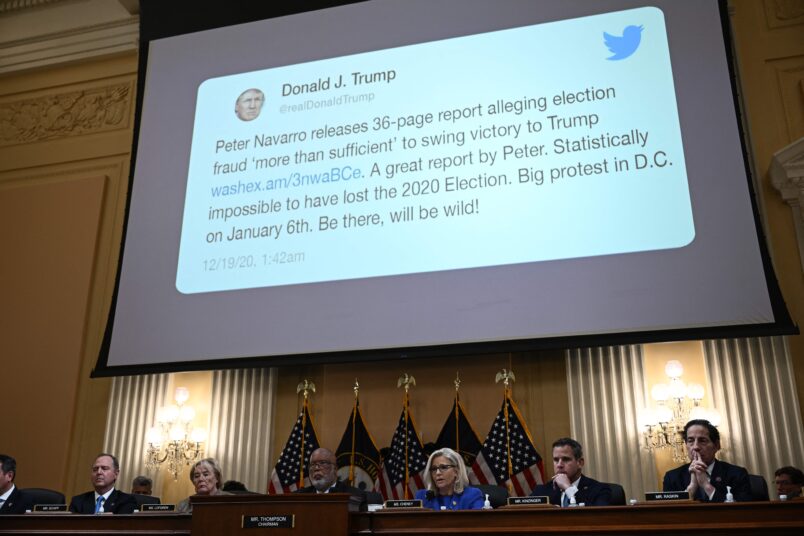
After the meeting that night, which by nearly all accounts was a total shitshow, Trump posted perhaps his most famous tweet:

A tweet by former President Donald Trump appears on screen during a House Select Committee hearing to Investigate the January 6th Attack on the US Capitol, in the Cannon House Office Building on Capitol Hill in Washington, DC on June 9, 2022. (Photo by Brendan SMIALOWSKI / AFP) (Photo by BRENDAN SMIALOWSKI/AFP via Getty Images)

Where Does Jack Smith’s Jan. 6 Probe Stand?

A quick rundown.

Nauta Pleads Not Guilty

Trump valet and co-defendant Walt Nauta finally has himself a South Florida lawyer and after two delayed arraignments entered a not guilty plea in the Mar-a-Lago case.

Nauta’s local counsel is 34-year-old Sasha Dadan, a former public defender with very little experience in federal court. She ran unsuccessfully for a state House seat in 2018 as a Republican.

Correction

Yesterday’s Morning Memo mistakenly reported that Trump’s response to the government’s proposed trial schedule in the Mar-a-Lago case was due July 6. The deadline had actually been previously extended to July 10. Stay tuned.

Trump Prosecutors In MAL Case Face Threats

WaPo:

Far-right Trump supporters are posting the names of prosecutors and government workers online and yelling them at demonstrations, threatening them and sometimes revealing details about their personal lives, the experts said.

At the Justice Department, officials have responded by trying to keep the names of prosecutors and agents working the Trump cases from becoming public in official documents, congressional hearings and less formal conversations about the case.

Seriously

Aaron Blake: Yes, Trump is getting more reckless on social media

Quote Of The Week

Don’t be such a political whore. I have no ide [sic] who you really are but TPM is a propaganda outfit for the Left who hate America. Here’s your quote: “Talking Points Memo are whores for the DNC.”

–former Trump White House official Sebastian Gorka

Biden Admin Seeks Stay In Social Media Case

The Justice Department asked a Trumpy federal judge in Louisiana to stay his controversial injunction preventing various components of the federal government from communicating with social media platforms while it appeals the order.

ATTN: Cable News Fearmongers

Shootings in New York City dropped by about 25 percent in the first half of 2023 compared with the same period in 2022, extending a nationwide downward trend following the pandemic spike in violent crime.

MTG Booted From Freedom Caucus … Last Month?

If the Freedom Caucus votes you out but it never gets announced publicly, does it even count?

2024 Ephemera

Just In …

The unemployment rate in May fell to 3.6 percent.

‘We Are In Uncharted Territory’

WaPo: Why a sudden surge of broken heat records is scaring scientists

Cherrypicking Your Way To An End

Jamelle Bouie: John Roberts and Clarence Thomas Have the ‘Colorblind’ Constitution All Wrong

Race-Based Scholarships Out, Too?

In the wake of the Supreme Court’s decision barring affirmative action in college admissions, the University of Kentucky and the University of Missouri System have said they will remove race as a factor in scholarship programs, too.

Your Weekend Read

This NYT Mag article came out while I was in the midst of the college admissions grind with my kids, and I’ve tried (without much success!) to get them and many other people I know to internalize its meaning and implications.

It’s pre-pandemic so a little dated now, but it remains a crucial perspective on how the economic realities of admissions policies undermine everything we think we know about it being a meritocracy. It’s especially relevant now in light of the Supreme Court ruling on affirmative action and the renewed debate over legacy admissions.

THANK YOU!!!

We’ve hit our goal for the TPM Journalism Fund with an entire day to spare! Overnight, the counter creeped over the $500,000 mark. It was an incredibly ambitious goal, but with your generous help we got there. On behalf of everyone at TPM, thank you for your financial support. It means an awful lot to us. We won’t let you down.

Like Morning Memo? Let us know!

Just When I Think I’m Out You Pull Me Back in!

Okay, admittedly I’m mixing my metaphors and allusions here. But this morning I was thinking we were pretty definitely going to fall short of our goal. We’d gotten close, and obviously close counts in this kind of situation. But again, having had such a successful drive so far it would be kind of heartbreaking to come up just short. But here you go again flipping the script on me, making me believe again! As of this moment we are at $482,790 $490,136. That’s almost $30,000 $42,000 contributed to Fund just today, more than twice three times our recent daily totals. So now hitting our goal is starting to seem very doable again, conceivably even tonight. So let’s do this! We’re totally in final countdown mode. Just click right here!

Where Things Stand: Freedom Caucus Breaks More Norms To Punish McCarthy

QAnon congresswoman-turned-GOP House leadership darling Marjorie Taylor Greene’s (R-GA) membership with the House Freedom Caucus has been in question ever since she laid down her life/remaining dignity to back House Speaker Kevin McCarthy (R-CA) in his speakership race. Since then, she’s been picking fights and at odds with members of the rebellious faction for being too tight with the establishment crowd.

While there’s been speculation for weeks that the Georgia congresswoman may soon get the boot from the fringe group, it turns out that the Freedom Caucus has actually already voted to punish Greene for forgetting where she came from.

Continue reading “Where Things Stand: Freedom Caucus Breaks More Norms To Punish McCarthy”

RNC ‘Ballot Harvest’ Initiative Keeps Making Waves

A new program from the Republican National Committee to encourage early voting and mailed ballots has caused extensive infighting after the party spent years elevating right wing attacks and conspiracy theories focused on similar initiatives from Democrats. The recent drama has included anger from activists and concern from conservative pundits who saw President Trump express support for the idea, only to engage in alleged “backtracking” mere months later. 

Continue reading “RNC ‘Ballot Harvest’ Initiative Keeps Making Waves”