Republicans Launch Two-Pronged Attack Against Voting Rights Act

In their endless quest to further defang the Voting Rights Act and gerrymander their way into permanent control, Republican officials have launched a double-headed attack on the landmark civil rights law. 

The new attacks emerge as Republican politicians attempt to wriggle out of judges’ orders requiring that they draw additional, majority-minority, likely Democratic districts in their states, which could imperil their party’s thin majority in the House of Representatives. 

Continue reading “Republicans Launch Two-Pronged Attack Against Voting Rights Act”

Will New York Again Hold The Keys To Control Of Congress?

Josh Marshall wrote on Friday about a major court decision out of Wisconsin that could have a significant impact on the makeup of that state’s legislature, famous in recent years for being gerrymandered in favor of Republicans to an almost comic degree.

Its one of a number of redistricting fights we’re watching heading into 2024. My colleague Kate Riga will have more tomorrow on how four others — in Georgia, Arkansas, Louisiana and Texas — interact with a long-running effort on the right to chip away at Section 2 of the Voting Rights Act.

With Nicole out on a much-deserved holiday vacation, I wanted to use this space to look at another gerrymandering dispute that we haven’t given much attention to in recent months, but that could be hugely important. New York’s years-long fight over its districts is continuing to play out slowly and convolutedly — but the question of whether the state has new maps by November 2024 may determine control of Congress.

Continue reading “Will New York Again Hold The Keys To Control Of Congress?”

Can Any Centers Hold?

I’ve reading up on those end-of-the-year “what the year meant” columns. 2023 was the year of this; 2023 was the year when that happened. You know the genre. It’s a silly exercise since years aren’t about anything. Or to the extent they are it’s all but impossible for those of us living through them to make any sense of what it might be. But it’s still an interesting canvas onto which people paint an experienced moment. To me it was the year when people seemed to settle into, get comfy with the idea that our present is one of never-ending terribles. Put differently, it was the year that many of you decided that the annus horribilis of 2016 was not a comically bad demolition derby of years or a bad year with several relatedly bad years following it but simply the arrival of a new normal.

(Don’t worry. This post gets better! Follow me after the jump.)

Continue reading “Can Any Centers Hold?”

Mike Lindell Insists He’s Happy Jimmy Kimmel Made Fun Of Him For Christmas 

MyPillow pitchman and noted election conspiracist Mike Lindell is, in his own words, “on a Holiday tear right now!” 

As usual, Lindell is all worked up about voting machines and his thoroughly debunked idea that somehow the internet was used to manipulate these systems to steal the 2020 election from Donald Trump. However, over the long holiday weekend, Lindell also got excited about being mocked by late night television comedian Jimmy Kimmel and insisted he was not mad at all in multiple emails to his supporters.

“While our campaign to save America ramps up–we are also thankful to comedian Jimmy Kimmel’s latest attempt at humor–and his free publicity given to our great crusade to save AMERICA,” Lindell wrote in an email to his supporters on Saturday.

Kimmel lampooned Lindell earlier this month with a sketch that featured ace impressionist James Adomian nailing the MyPillow pitchman’s hoarse voice and refusal to accept Trump’s defeat. The sketch was styled as “Mike Lindell’s MyChristmas Spectacular,” a variety show that included appearances from real and imagined MAGA stars including Jeanine Pirro, the “QAnon shaman,” George Santos, and Rep. Lauren Boebert (R-CO), whose Golden Dukes-nominated “Beetlejuice” scandal made for a memorable punchline. As part of the show, the faux Lindell waits up all night for “rightful president” Trump, who never actually arrives. Following a heartwarming conversation with Kimmel, Lindell admits he feels Trump has been with him “all along,” in his heart and in the hearts of “all who still believe in the magic of Christmas” (and deranged magical thinking about voting machines). 

Lindell has been bombarding his fans with emails selling bedding and soliciting donations for his various conspiracy-related ventures, including the “Election Crime Bureau” and “Lindell Offense Fund.” He collected a slew of addresses from Trump diehards in August as he hosted what he variously dubbed “the most critical Election event we have ever had” and “a landmark Historical Summit.” During that momentous occasion, Lindell unveiled a plan to arm his fellow conspiracy theorists with drones to sniff out supposedly nefarious Wi-Fi connections in the vicinity of facilities involved in vote counting. 

Of course, officials at every level of government — including members of Trump’s own administration and other Republicans — have said there was no widespread fraud in the 2020 race. The idea of a Wi-Fi fueled plot is nonsensical because many election systems are not connected to the internet and incorporate hand recounts. And, of course, most populated areas of the country have nearby Wi-Fi connections, which are not evidence of any sort of illicit activity. 

Even though Kimmel’s sketch aired over two weeks ago, Lindell used his email list to send out at least two messages about it on Saturday and Sunday. In them, Lindell insisted “all of the conspiracies I touted are coming to pass!” He also declared the comedy bit was an example of media acknowledging “what the Lindell Offense Fund has said since day one: Machines are connected to the Internet and Machines can be hacked and Elections can be rigged!”

“In all seriousness, we’re excited to have the earned media–media we don’t pay for–and we’re happy to continue the conversation about rigged elections and stolen votes–no matter what the venue!” Lindell wrote. 

Check out Kimmel’s full sketch below and judge for yourself whether, in Lindell’s case, all publicity really is good publicity. 

Hands-Off Supreme Court Jeopardizes Trump Trial Date

A lot of things happened. Here are some of the things. This is TPM’s Morning Memo. Sign up for the email version.

What You Missed

Since last we visited, two significant developments in the march to hold Donald Trump accountable to the rule of law:

(i) The Supreme Court declined to fast-track Trump’s appeal of his claims of presidential immunity; and

(ii) Trump filed his appeal brief with the D.C. Circuit Court of Appeals, which will now get a first bite at the immunity apple.

Supreme Court Declines To Get Involved Now

With no public dissents or additional comment, the Supreme Court on Friday declined to bypass the appeals court and take up Trump’s immunity claims now. The most immediate impact was to jeopardize the March 2024 trial date of Trump on charges he conspired to overturn the 2020 election. In that context, there was little hopeful about the court’s decision, with one possible exception.

The lack of any dissent from the liberal justices suggests the possibility of some strategic understanding internally about how the court will handle the case going forward. That’s speculative though, and the upshot may simply be as grim as it gets: The federal judicial system is incapable of defending the rule of law or even itself from a criminal defendant determined to take it down.

All Eyes On DC Appeals Court

The Supreme Court’s decision shifted the focus to the DC Circuit Court of Appeals, which already has the immunity appeal on an expedited schedule.

Trump filed his opening brief in the appeal Saturday. University of Texas law professor Lee Kovarsky has a detailed read of Trump’s latest arguments on immunity.

Special Counsel Jack Smith has a Dec. 30 deadline to file his response. Oral arguments are Jan. 9.

A trial date is still possible for Trump sometime between March and the November election, but the window is narrowing dramatically.

Still Awaiting Trump’s Appeal Of Colorado Decision To SCOTUS

Be looking this week for the first indications that Donald Trump is appealing his disqualification from the GOP primary ballot in Colorado to the U.S. Supreme Court.

Former Antonin Scalia clerk Adam Unikowsky offers his probabilities for how the Supreme Court will handle the Colorado Disqualification Clause case:

  • 5%: The Court denies certiorari or the case otherwise goes away before the Supreme Court decides it.
  • 40%: The Court reverses the Colorado Supreme Court, holding that, as a matter of law, Trump isn’t disqualified under Section 3.
  • 40%: The Court vacates the Colorado Supreme Court’s decision in a manner that leaves the door open to future Section 3 litigation.
  • 15%: The Court affirms the Supreme Court of Colorado.

Rule Of Law Under Siege

Law enforcement is investigating threats to Colorado’s Supreme Court justices after they disqualified Donald Trump from the GOP primary ballot.

Consider Yourself Warned

I’m starting to see the emergence of a certain flavor of DC-centric, “moderate,” pearl-clutching and hand-wringing about the Supreme Court taking the 14th Amendment Disqualification Clause out of Colorado that has in the past given ample cover to the high court to make horrendous decisions like Bush v. Gore.

It’s a fine line between the kind of “high politics” considerations that structurally and institutionally only the Supreme Court is in a position to take into account — and improperly allowing those considerations to trump other jurisprudential imperatives like the rule of law, precedence, and the modest work of deciding only the case before you.

This NYT op-ed by Steven Mazie and Stephen Vladeck assiduously walks that line but may trip over it with this paragraph:

A universe in which the court somehow splits the difference — for example, keeping Mr. Trump on the ballot while refusing to endorse (if not affirmatively repudiating) his conduct and spurning his kinglike claim to total immunity — could go a long way toward reducing the temperature of the coming election cycle. Such an outcome could also help restore at least some of the court’s credibility.

Starting with a preferred outcome and working backward toward a solution is not good judging, it’s not conservative or restrained, and it’s an open ticket to judicial overreach and mischief. I’ll have more to say on this in the coming days.

Distemper And Ill Will Toward Men

Donald Trump spreading that Christmas cheer:

THEY SPIED ON MY CAMPAIGN, LIED TO CONGRESS, CHEATED ON FISA, RIGGED A PRESIDENTIAL ELECTION, ALLOWED MILLIONS OF PEOPLE, MANY FROM PRISONS & MENTAL INSTITUTIONS, TO INVADE OUR COUNTRY, SCREWED UP IN AFGHANISTAN, & JOE BIDEN’S MISFITS & THUGS, LIKE DERANGED JACK SMITH, ARE COMING AFTER ME, AT LEVELS OF PERSECUTION NEVER SEEN BEFORE IN OUR COUNTRY??? IT’S CALLED ELECTION INTERFERENCE. MERRY CHRISTMAS!

Donald J. Trump, Dec. 24, 2023

The Perpetual Bullshit Machine

Mother Jones unpacks the emergence of a new batshit crazy conspiracy theory aimed at discrediting Special Counsel Jack Smith:

It claims that Jack Smith, the special counsel who is prosecuting Trump for his attempt to overturn the 2020 election and for his alleged swiping of classified documents, was part of a multimillion dollar extortion scheme when he was the chief prosecutor investigating and prosecuting war crimes in Kosovo. In the past two weeks, this unsubstantiated narrative has started popping up on fringe right-wing sites and social media posts. Michael Flynn, Trump’s former national security adviser and QAnonish MAGA champion, has promoted this tale. These allegations appear to be in the early phase of the right-wing transmission belt that propels false stories and conspiracy theories from less prominent platforms to more established conservative media and toward the mainstream—often facilitated by Republican members of Congress. 

Clarence Thomas’ ‘Extended Family’ Of Law Clerks

The NYT goes deep on Clarence Thomas’ network of former law clerks:

In the 32 years since Justice Thomas came through the fire of his confirmation hearings and onto the Supreme Court, he has assembled an army of influential acolytes unlike any other — a network of like-minded former clerks who have not only rallied to his defense but carried his idiosyncratic brand of conservative legal thinking out into the nation’s law schools, top law firms, the judiciary and the highest reaches of government.

2024 Ephemera

  • Wisconsin Supreme Court overturns GOP-favored legislative maps.
  • Trump makes demonizing immigrants a core message with ‘blood’ refrain.
  • Nevada GOP leaders indicted in pro-Trump ‘fake elector’ case still in charge of caucus planning.

New Arrest Warrant Issued For Ammon Bundy

A state judge in Idaho issued a new warrant for the arrest of right-wing extremist Ammon Bundy after he reportedly failed to show up for trial last week on contempt of court charges arising from a $52 million defamation judgment against him earlier this year by a local hospital. Bundy has been in hiding for days, but popped up in YouTube livestream late last week.

Written In The Wood

A 200-year-old ponderosa pine in southern Arizona tells the story of anthropogenic climate change.

Hang In There This Week

That insufferable pro-Trump uncle, your hopelessly conservative parents, your didactically liberal children — whatever your situation this holiday, Morning Memo will be on a normal schedule for the rest of this week to help you cope.

Do you like Morning Memo? Let us know!

Dictator On Day One: The Executive Orders That Trump Would Issue From The Start

Donald Trump has said that he would be a “dictator” on his first day in office.

And a review of his campaign’s plans and messaging shows part of what that may mean: a sweeping range of day-one executive orders aimed at remaking the Constitution and the federal government as we know it.

Continue reading “Dictator On Day One: The Executive Orders That Trump Would Issue From The Start”

Guatemala’s Democracy Descends Into Crisis, With Implications For The US

This article is part of TPM Cafe, TPM’s home for opinion and news analysis. It was originally published at The Conversation.

Guatemala is in the midst of a democratic crisis so severe that it may prevent the new president from taking office, as planned, on Jan. 14, 2024.

On Dec. 8, 2023, prosecutors and the Guatemalan Congress called for the nullification of the election results. A few weeks earlier, the attorney general’s office in Guatemala tried to remove President-elect Bernardo Arévalo’s immunity from prosecution. The attorney general alleged that the center-left politician, who won the election on an anti-corruption ticket, made posts on social media in 2022 that encouraged students to occupy the country’s public university. In an unprecedented attempt to prevent him from assuming power, officials accused Arévalo of complicity in the takeover of the university, illicit association and damaging the country’s cultural heritage.

During the presidential election in September, the Public Ministry raided electoral offices. These actions “appear to be designed to overturn the will of the electorate and erode the democratic process,” concluded the Organization of American States, a group that represents 35 countries in the region and promotes human rights, fair elections, security and economic development.

These developments follow a democratic backslide in Guatemala that has been going on since 2019, when the government expelled an anti-corruption commission backed by the United Nations.

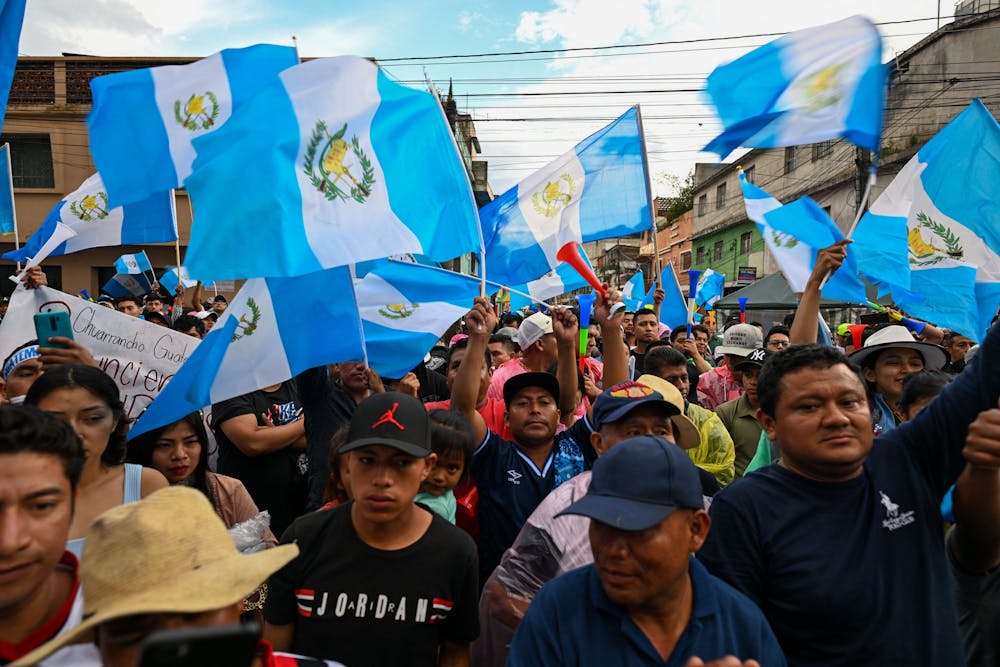
Ordinary Guatemalans, meanwhile, are fed up with rampant corruption and electoral interference. On Oct. 2, 2023, thousands of protesters filled the streets of Guatemala City and blockaded more than 100 roads and highways to demand respect for the election. The demonstrators represented a broad cross-section of urban and rural society, including both Maya and non-Indigenous communities.

As a professor of history who studies social movements in Latin America, I see the current climate of protest as part of a long history of instability and political mobilization in Guatemala. As in the past, these anti-democratic actions will likely lead more Guatemalans to migrate to the United States.

Crowd of protesters waving Guatemala flag
Protesters demand the attorney general’s resignation on Oct. 9, 2023, in Guatemala City. Johan Ordonez/AFP via Getty Images

Civil war and kleptocracy

Guatemala’s recent past is marked by violent political unrest and activism.

Between 1960 and 1996, the country endured a bloody armed conflict between leftist insurgents and the army. About 200,000 Guatemalans were killed – most of them from the Indigenous Maya population.

The armed confrontation, which was rooted in land conflicts and opposition to the military dictatorship, led to mass mobilization in favor of fair working conditions and democratic rule.

Guatemala’s democracy in the post-1996 years was marked by neoliberal policies that favored free market economics and privatization. It also saw the rise of a cadre of careerist politicians who, in the words of the jailed journalist Rubén Zamora, created a “kleptocracy.” This system hinged on corrupt political dealings, nurtured criminal activity and perpetuated high poverty levels.

Guatemalans have taken an active – perhaps even activist – posture toward the kleptocracy.

In 2015, they took to the streets en masse to protest government corruption. Their mobilization bolstered the actions of the International Commission Against Impunity in Guatemala, or CICIG, a U.N.-backed body tasked with investigating and prosecuting crime and strengthening Guatemala’s judicial system.

The commission’s probe led to the prosecution of Guatemalan officials for corruption, including former President Otto Pérez Molina and former Vice President Roxana Baldetti. However, the government expelled CICIG in 2019. In response, the Guatemalan public accused political elites, high-ranking bureaucrats and business leaders of forming a “pact of the corrupt” to thwart the fight against corruption.

Anti-corruption candidate’s surprising win

Guatemala’s 2023 general elections were held amid this fragile political climate.

In the weeks leading up to election day, the constitutional court, on what critics say were questionable grounds, disqualified two rising political outsiders: Thelma Cabrera, an Indigenous leftist candidate, and Carlos Pineda, a conservative businessman and populist who gained a large following on social media.

This judicial meddling in the electoral process, however, opened the way for another political outsider, Bernardo Arévalo of the left-of-center Seed Movement party. An increasing number of Guatemalans, including young voters, saw Arévalo and his anti-corruption platform as an alternative to establishment candidates such as former first lady Sandra Torres, who led most polls in the weeks before the election.

The election results sent shock waves through the political system. Arévalo received 11.8% of the general vote, second only to Torres’ 15.9%. Because no candidate received a majority, a runoff election was held on Aug. 20. Arévalo won handily with 58% of the vote compared with Torres’ 37%.

Arévalo is not a political neophyte. He has served as a diplomat and currently occupies a seat in Congress. He is also the son of Juan José Arévalo, the country’s first democratically elected president.

Guatemalans take to streets

After the election, political elites, including members of Torres’ National Unity of Hope party and President Alejandro Giammattei’s Vamos party, alleged – incorrectly, it turned out – that the electoral software had favored Arévalo’s candidacy. They attempted to stop the results from being made official.

More consequently, the Public Ministry, led by Attorney General Consuelo Porras, accused Arévalo’s party of using false signatures during its registration process. It contended that up to 100 out of the 25,000 signatures required for registration were falsified. On July 21, one month before the runoff election, Public Ministry officials raided the Seed Movement’s headquarters and asked a judge to suspend the party.

Despite Arévalo’s resounding victory on Aug. 20, the Public Ministry continued to try to suspend his party. On Sept. 29, it took the unprecedented action of raiding the offices of the Supreme Electoral Tribunal, the highest electoral authority.

Disgusted by this interference in the electoral process and fearful over the prospect of a coup, Guatemalans took to the streets. The protests that began on Oct. 2 brought the country to a standstill for more than 10 days and united the urban and rural population.

Echoing a long-standing history of Indigenous activism in Guatemala, prominent Indigenous groups such as the Peasant Committee for Development and the 48 Cantones of Totonicapán played a vital role in the protests. Indigenous people, who make up nearly half of Guatemala’s population, face high poverty rates, poor access to health care and environmental degradation of their lands caused by mining and hydroelectric projects.

For many Indigenous voters, the election interference highlighted the relationship between government corruption and their socioeconomic inequality. The central role of Indigenous communities in the protests signaled a new grassroots movement with the potential of replicating the multiracial and multiclass coalitions that had emerged during the armed conflict in the 1970s.

Key driver of migration

U.S. officials and agencies report that political corruption in Guatemala is a root cause of migration. In 2023, the U.S. Border Patrol apprehended more than 200,000 Guatemalans trying to cross the U.S.-Mexico border.

Guatemalans themselves understand all too well how kleptocracy reinforces the country’s social ills. They realize that democratic backsliding not only may prevent Arévalo from assuming the presidency, but it can also rob their communities of resources needed to strengthen health care, improve education, create jobs, reduce malnutrition and fight climate change. Without these improvements, many will continue to migrate, despite the many perils of doing so.

The Conversation

This article is republished from The Conversation under a Creative Commons license. Read the original article.

The Balance Of Power Between Workers And Employers Shifted In 2023. We Don’t Yet Know How Far It’ll Shift.

This article is part of TPM Cafe, TPM’s home for opinion and news analysis. It was originally published at The Conversation.

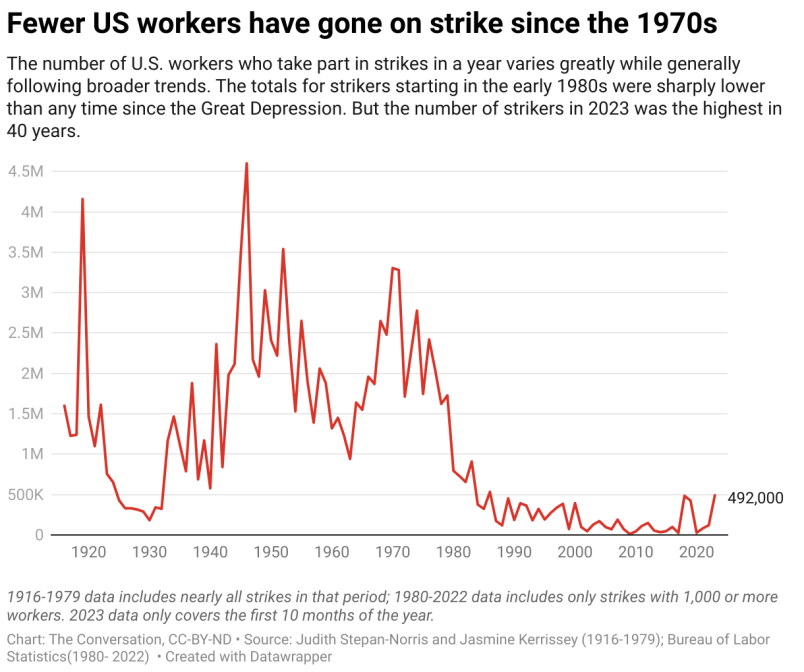
More than 492,000 workers — including nurses, actors, screenwriters, autoworkers, hotel cleaners, teachers and restaurant servers — walked off their jobs during the first 10 months of 2023.

That includes about 46,000 autoworkers who went on strike for about six weeks, starting in mid-September. The United Auto Workers union won historic gains that have the potential to transform the industry in its contracts with General Motors, Ford and Stellantis — the company that includes Chrysler.

In addition, more than 75,000 Kaiser Permanente workers took part in the largest strike of U.S. health care workers to date.

This crescendo of labor actions follows a relative lull in U.S. strikes and a decline in union membership that began in the 1970s. Today’s strikes may seem unprecedented, especially if you’re under 50. While this wave constitutes a significant change following decades of unions’ losing ground, it’s far from unprecedented.

We’re sociologists who study the history of U.S. labor movements. In our new book, “Union Booms and Busts,” we explore the reasons for swings in the share of working Americans in unions between 1900 and 2015.

We see the rising number of strikes today as a sign that the balance of power between workers and employers, which has been tilted toward employers for nearly a half-century, is beginning to shift.

Workers at a rally carrying strike signs.
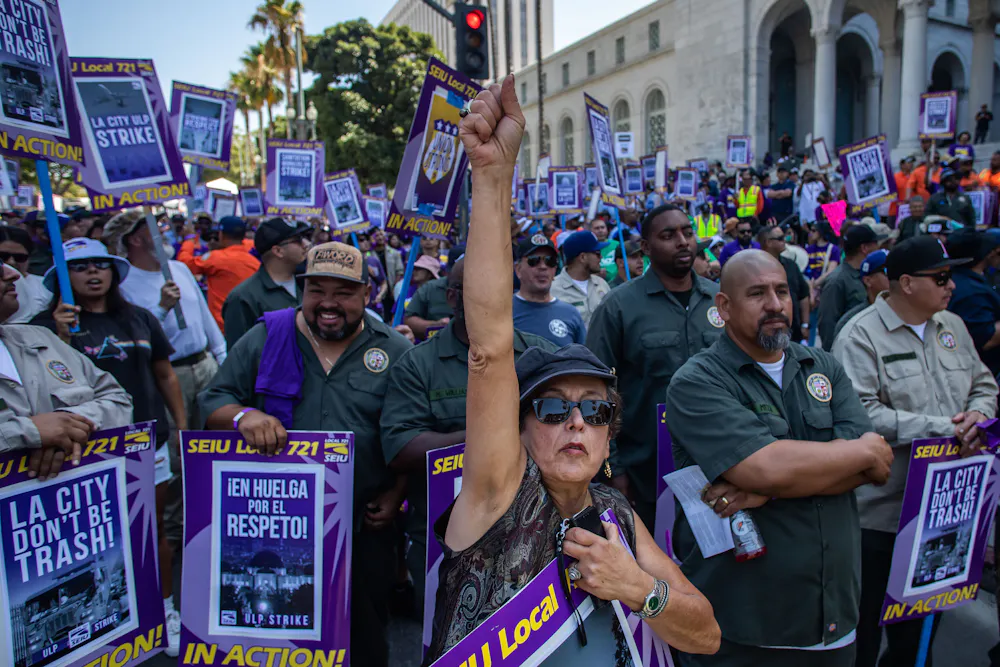
Maryam Rouillard raises her fist on Aug. 8, 2023, while taking part in a one-day strike by Los Angeles municipal workers to protest contract negotiations. Apu Gomes/Getty Images

Millions on strike

The number of U.S. workers who go on strike in a given year varies greatly but generally follows broader trends. After World War II ended, through 1981, between 1 million and 4 million Americans went on strike annually. By 1990, that number had plummeted. In some years, it fell below 100,000.

Workers by that point were clearly on the defensive for several reasons.

One dramatic turning point was the showdown between President Ronald Reagan and the country’s air traffic controllers, which culminated in a 1981 strike by their union — the Professional Air Traffic Controllers Organization. Like many public workers, air traffic controllers did not have the right to strike, but they called one anyway because of safety concerns and other reasons. Reagan depicted the union as disloyal and ordered that all of PATCO’s striking members be fired. The government turned to supervisors and military controllers as their replacements and decertified the union.

That episode sent a strong message to employers that permanently replacing striking workers in certain situations would be tolerated.

There were also many court rulings and new laws that favored big business over labor rights. These included the passage of so-called right-to-work laws that provide union representation to nonunion members in union workplaces — without requiring the payment of union dues. Many conservative states, like South Dakota and Mississippi, have these laws on the books, along with states with more liberal voters — such as Wisconsin.

As union membership plunged from 34.2% of the labor force in 1945 to around 10% in 2010, workers became less likely to go on strike.

Wages kept up with productivity gains when unions were stronger than they are today. Wages increased 91.3% as productivity grew by 96.7% between 1948 and 1973. That changed once union membership began to tumble. Wages stagnated from 1973 to 2013, rising only 9.2% even as productivity grew by 74.4%.

Prime conditions

In general, strikes grow more common when economic conditions change in ways that empower workers. That’s especially true with the tight labor markets and high inflation seen in the U.S. in recent years.

When there are fewer candidates available for every open job and prices are rising, workers become bolder in their demands for higher wages and benefits.

Political and legal factors can play a role, too.

In the 1930s, President Franklin D. Roosevelt’s New Deal enhanced unions’ ability to organize. During World War II, unions agreed to a no-strike pledge — although some workers continued to go on strike.

The number of U.S. workers who went on strike peaked in 1946, a year after the war ended. Conditions were ripe for labor actions at that point for several reasons. The economy was no longer so dedicated to supplying the military, pro-union New Deal legislation was still intact and wartime strike restrictions were lifted.

In contrast, Reagan’s crushing of the PATCO strike gave employers a green light to permanently replace striking workers in situations in which doing that was legal.

Likewise, as we describe in our book, employers can take many steps to discourage strikes. But labor organizers can sometimes overcome management’s resistance with creative strategies.

New economic equations

Between 1983 and 2022, the share of U.S. workers who belonged to unions fell by half, from 20.1% to 10.1%. The COVID-19 pandemic didn’t reverse that decline, but it did change the balance of power between employers and workers in other ways.

The “great resignation,” a surge in the number of workers quitting their jobs during the pandemic, now seems to be over, or at least cooling down. The number of unemployed people for every job opening reached 4.9 in April 2020, plummeted to 0.5 in December 2021, and has remained low ever since.

Meanwhile, many workers have become more dissatisfied with their wages. The strikes by teachers that ramped up in 2018 responded to that frustration. U.S. inflation, which soared to 8% in 2022, has eroded workers’ purchasing power while company profits and economic inequality have continued to soar.

Technological breakthroughs that leave workers behind are also contributing to today’s strikes, as they did in other periods.

We’ve studied the role technology played in the printers’ strikes of the 1890s following the introduction of the linotype machine, which reduced the need for skilled workers, and the longshoremen strike of 1971, which was spurred by a drastic workforce reduction brought about by the introduction of shipping containers to transport cargo.

Those are among the precedents for the actors and screenwriters strikes of 2023, which hinged on the financial implications of streaming in film and television and artificial intelligence in the production of movies and shows.

Working conditions, including health and safety concerns and time off, have also been at the root of many recent strikes.

Health care workers, for example, are going on strike over safe staffing levels. In 2022, rail workers voted to strike over sick days and time off, but were blocked from walking off the job by a U.S. Senate vote and President Joe Biden’s signature.

Time and again, when the conditions have been right, U.S. workers have gone on strike and won. Sometimes more strikes have followed, in waves that have the potential to transform workers’ lives. But it’s still too early to know when this wave will crest.

The Conversation

This is an updated version of an article originally published Aug. 24, 2023, with nearly complete data for the number of strikers in 2023 and additional details about several strikes. This article is republished from The Conversation under a Creative Commons license. Read the original article.
Big News in Wisconsin

It’s not unexpected. In many ways it was inevitable after Republicans (technically the races are non-partisan) lost their state Supreme Court majority with the election of Janet Protasiewicz back in April. But it’s still a very big deal. The Wisconsin state Supreme Court has ruled that the state’s GOP gerrymander is unconstitutional and ordered the legislature to draw new maps for the 2024 general election. If the current gerrymandered legislature can’t agree on a plan with Democratic Gov. Tony Evers, the court said it’s prepared to create its own.

Continue reading “Big News in Wisconsin”