The Trump White House Is Trying to Hide Its Judicial Nominees From You

This article is part of TPM Cafe, TPM’s home for opinion and news analysis. It was originally published at Balls and Strikes.

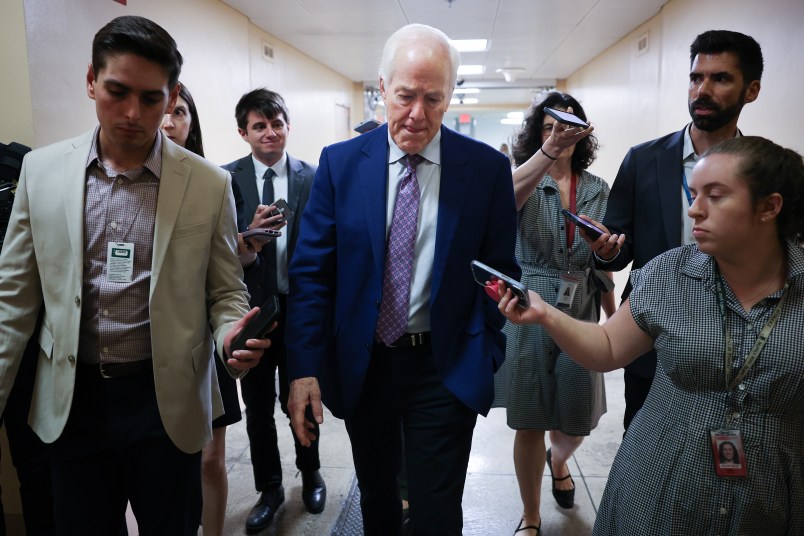
Over the last seven weeks, Senate Republicans have picked up the pace in confirming judges whose unifying characteristic is their desperation to demonstrate their loyalty to President Donald Trump above all else. What’s worse, the Senate is processing them with less public scrutiny than usual and little resistance, even by Senate Democrat standards. And with a new vacancy on the Eighth Circuit, Trump has yet another chance to reinforce Republican dominance on the nation’s most lopsided appeals court.

Continue reading “The Trump White House Is Trying to Hide Its Judicial Nominees From You”

It’s a Big Club, And You Ain’t In It

Risking So Much, Just to Save the Filibuster

Two of the eight centrist Democratic senators who helped end the shutdown this week have now said that keeping the filibuster played a decisive role in their decision.

Sen. Angus King (I-ME), who caucuses with the Democrats, told the Portland Press-Herald that it was Trump touting his newfound enthusiasm for nuking the filibuster after the Democratic sweep in elections last week which pushed him over.

“Don’t forget that Donald Trump’s position on this wasn’t to negotiate, but to end it — entirely on their terms — by pressuring the Senate Republicans to abolish the filibuster, thus eliminating Democratic leverage on this — or anything else — altogether. And I know that this was not an idle threat or negotiating ploy; he meant it and a growing number in the Republican caucus agreed,” King said. “No filibuster and we’d be facing a nationwide abortion ban, voter suppression laws and, quite possibly, the elimination of the Affordable Care Act itself with no tool to stop it.”

Sen. Tim Kaine (D-VA) made a similar remark in an op-ed published this week in the New York Times.

“More likely, the chaos of continuing the shutdown would have led them to eliminate the Senate filibuster so they could pass a government funding bill with no Democratic votes, a dangerous consolidation of one-party rule,” Kaine wrote.

It’s an argument that avoids the broader picture: They gave up a fight that, per polling and this month’s election, they seemed to be winning. In exchange, they protected a procedural tool that would likely hobble future Democratic administrations’ agendas.

This all feeds into a broader question about democracy.

Democrats spent the final weeks of the 2024 election framing it as a contest over the core of our political system. After the first Trump term, January 6, the GOP’s radicalization against democracy and the principle of equality with the other side, that’s understandable. It’s true that abolishing the filibuster would clear the path for the Republican base to badger their senators into, willingly or not, passing the kinds of laws that King mentioned. But, as experts and online pedants alike will remind you, elections have consequences.

When you consider the kind of agenda that a future, pro-democracy and anti-corruption administration might have in mind, it’s very hard to imagine that passing with the current filibuster in place. Even more broadly than that, Democrats spent their growing leverage from the shutdown not on a present-day policy win, but on preserving a perpetual obstacle to the country governing itself.

— Josh Kovensky

Epstein, Epstein, Epstein

Relatedly but far more pruriently, thousands of files from Jeffery Epstein’s email account were released this week. You’ve already seen the headlines. But the way it happened was a funny instance of escalation: House Democrats released a small tranche of emails in which Epstein discussed Trump, including with influential Democratic Party-associated confidantes Kathy Ruemmler and Larry Summers.

House Republicans followed that up by dropping a batch of more than 20,000 emails into the public domain. There’s enough here to tarnish-by-association the reputations of figures across the American elite. Steve Bannon is there, as are Alan Dershowitz and Michael Woff.

But Ruemmler and Summers are particularly interesting, albeit for different reasons.

Ruemmler was President Obama’s White House counsel from 2011 to 2014. She was a candidate for attorney general after Eric Holder, and rose to that level of prestige along with a cadre of federal prosecutors who, under the Bush administration, staffed the Enron Task Force. That group gave rise to several extremely luminous legal careers: Andrew Weissmann, a Mueller investigation prosecutor, worked on the case, as did at least two DOJ criminal division chiefs.

All this is to contrast that prestige with the extremely grubby reality that the emails expose, at least as it pertains to Ruemmler. She comes off as more like one of Epstein’s buddies than anything else. At one point she complains to him about having to “observe all of the people” at a rest stop on the New Jersey turnpike who are “at least 100 pounds overweight,” prompting “a mild panic attack” before resolving to never eat “another bite of food for the rest of my life out of fear that I will end up like one of these people.” Elsewhere, Ruemmler dismisses a news story about the allegations against Epstein as a “novella of rehashed crap.” Like others, they track Trump’s rise, commiserate over his election and note the progress of the Mueller investigation.

Ruemmler, now chief legal officer at Goldman Sachs, has said that she regrets ever knowing Epstein. As the emails show, she knew the accusations he had faced. The exchanges occurred after he, in 2008, pled guilty to soliciting prostitution with a minor. Again, Ruemmler was someone who was seen, at the time of the messages, as a viable candidate for the country’s top law enforcement officer.

Summers cuts a different figure in the messages, seeking advice on relationships with the opposite sex from the disgraced financier.

In one March 2019 exchange, Summers describes a female acquaintance as having told him she was busy after he asked what she was “up to.”

“I said awfully coy u are,” Summers wrote in the message. “And then I said. Did u really rearrange the weekend we were going to be together because guy number 3 was coming.”

“I dint want to be in a gift giving competition while being the friend without benefits,” he added later.

Epstein replied that the unnamed woman was “smart. making you pay for past errors. ignore the daddy im going to go out with the motorcycle guy, you reacted well.. annoyed shows caring., no whining showed strentgh.”

Summers described his relationship with Epstein to the Harvard Crimson as “a major error judgment.”

As with Ruemmler, the point with Summers is less that it’s an error of judgment — these people are smart, sophisticated, and occupy immense positions of influence and public trust. It’s not plausible to treat the exchanges we’ve seen as an isolated mistake.

— Josh Kovensky

How Trump’s Redistricting Push Hit a Wall in Utah

This week, a Utah judge rejected a Republican-led congressional map in favor of a map put forward by the League of Women Voters and Mormon Women for Ethical Government that allowed for a Democratic district around Salt Lake City. The ruling represents a major setback for the Trump administration’s pressure campaign to get red states across the country to gerrymander their maps midcycle in an effort to sway the 2026 midterm elections. 

Katharine Biele, president of the League of Women Voters of Utah, explained in an interview with TPM that Utah’s redistricting effort was met with “perhaps the most impressive grassroots anti-gerrymandering effort in the United States.”

Biele emphasized too, that unlike other redistricting efforts, the map that the League of Women Voters and Mormon Women for Ethical Government put forth isn’t and was never meant to be partisan. She acknowledged that the newly approved map is “not going to make Utah a democratic state,” a notion she described as “absurd.”

“This is a very Republican state, and it will remain a very Republican state. But it’s important to give people a chance to voice their opinion,” she said. “Our districting effort was not politically based. It was all about giving people the right to vote.”

In her ruling this week, Judge Dianna Gibson explained that the Republican maps did not abide by Proposition 4, a ballot amendment passed by Utah voters which puts forth nonpartisan redistricting requirements for the legislature. Republicans are currently trying to put forth a measure for next year to repeal Proposition 4. Biele described this effort as Republicans “working against their constituents.”

Though Republicans are planning to appeal Gibson’s ruling, Biele says she feels confident that the appeal will not be successful.

“I’m pretty sure that the Supreme Court of Utah will deny the appeal because they’ve already, they’ve already ruled in our favor,” she said. “Our Republican legislature is absolutely convinced they are the only people who know anything.” 

— Khaya Himmelman

In Case You Missed It

Today’s big stories:

How the Trump Admin Has Sown Fear Among Progressive Nonprofits

JD Vance Received a Dire Warning About the Groyper Takeover of the GOP From a Strange Source

Dispatch from Court: Pam Bondi Takes a Beating in Court Over Lindsey Halligan’s Dubious Appointment

Morning Memo: The Corrupt Roots of America’s Elite Run Deep

TPM 25: We Tried to Get Big Tech to Pay for Wrecking Journalism. It Didn’t Work Out.

Backchannel: Bringing Guns to Gun Fights: Making Sense of the National Gerrymandering Battle

Yesterday’s Most Read Story

Big Coverup Exposed in Bogus Mortgage Fraud Cases

What We Are Reading

Will People Trust Voting by Phone? Alaska Is Going to Find Out. — Nick Corasaniti, The New York Times

In Matt Gaetz Scandal, Circumstances Left Teen Vulnerable to Exploitation — Michael S. Schmidt, The New York Times

Blurred lines: how Michael Wolff aspired to be part of elite circles he wrote about — Ed Pilkington, The Guardian

‘No! Not Larry Summers!’ Wails Devastated Nation — The Onion

Pam Bondi Takes a Beating in Court Over Lindsey Halligan’s Dubious Appointment

I was in federal court this morning in Alexandria, Virginia, for a hearing on the motions to disqualify interim U.S. Attorney Lindsey Halligan filed by former FBI Director James Comey and New York Attorney General Letitia James.

Continue reading “Pam Bondi Takes a Beating in Court Over Lindsey Halligan’s Dubious Appointment”

JD Vance Received a Dire Warning About the Groyper Takeover of the GOP From a Strange Source

The call warning of a dangerous tide of extremism in Donald Trump’s Washington is coming from inside the house — the vice president’s house. 

Continue reading “JD Vance Received a Dire Warning About the Groyper Takeover of the GOP From a Strange Source”

Bringing Guns to Gun Fights: Making Sense of the National Gerrymandering Battle

TPM’s Khaya Himmelman has a report here on the state of the Trump White House’s national gerrymandering campaign. The upshot is that it’s not going great. Republicans have had a series of reverses of late, each with its own backstory ranging from legal difficulties to lack of legislative votes to resistance from established officeholders in very conservative states. Meanwhile Democrats’ counteroffensive is going surprisingly well. All told, the whole thing may end up as a wash.

There’s a second order part of this story I want to highlight. If you’ve been watching politics for a long time you know of a basic feature or pattern of American politics. Republicans are generally willing to act more boldly, audaciously, or even borderline criminally than Democrats are willing or able to do. The examples are legion. Because of this difference in how the parties operate, Republicans are almost always rewarded for this norm-breaking behavior. That’s how their strong-arm gerrymandering push looked likely to turn out. But now it looks like it won’t. Most analysts figure it will end up as more of a wash. Some of this is due to these contingent setbacks, the most recent of which is an apparently decisive court reversal in Utah. But the game change is how aggressively Democratic governors have moved to gerrymander their own states.

Continue reading “Bringing Guns to Gun Fights: Making Sense of the National Gerrymandering Battle”

We Tried to Get Big Tech to Pay for Wrecking Journalism. It Didn’t Work Out.

The debate over Who Destroyed Journalism borders on theology among journalists and our fellow travelers. Particular fanaticisms often reflect when the believer’s heart first got broken by the Fourth Estate. Popular Satans have included “Craigslist,” “Hedge Funds,” “Fox News” and “the publishers who thought it was a good idea to put news on the internet for free.” Like all the best journalistic controversies, there will never be a declared winner; the argument can last as long as you like.

As a skeptic who isn’t above some self-flaggelating, I’m open to blaming everything and everyone, all the way down to the audiences and journalists ourselves. But as a matter of capitalism 101, it also seems reasonable to blame multi-trillion-dollar tech companies possessing the advertising dollars that once funded tens of thousands of news jobs. Although I rarely advise placing trust in a cliche, follow the money is one of the better coinages to circulate in American newsrooms over the past half-century. And so in 2023 and 2024, I chased the trail of missing journalism cash toward Silicon Valley. Like many of California’s classic detective stories, the pursuit ended in heartbreak. 

Continue reading “We Tried to Get Big Tech to Pay for Wrecking Journalism. It Didn’t Work Out.”

The Corrupt Roots of America’s Elite Run Deep

It’s the Impunity, Stupid

In reviewing a portion of the 20,000-plus Jeffrey Epstein emails released yesterday, I was left astonished not so much by the chumminess he enjoyed with elites even after he’d served time for soliciting prostitution with a minor but by the messages’ flagrantness, their casual disregard, and their indifference to consequence.

It was perfectly captured by political scientist Ed Burmila: “The crisis of elite impunity that is ruining our society cannot be more clearly or convincingly demonstrated than with the fact that all of these people wrote all this stuff into an email and hit Send.”

Impunity. That’s the word I was looking for.

It is the same impunity that got us Trump. Like Epstein, Trump built a career on a transactional chumminess, mutual self-indulgence, and an alarmingly high tolerance level for misbehavior by the layers of political, business, media, and cultural elites surrounding him.

At it’s most extreme, the misbehavior manifested in both men as abusive sexual misconduct. It’s one of the oddities of this whole spectacle that the question is whether Trump — already an admitted pussy grabber, held liable as a sexual assaulter, and prone to traipsing through his pageant dressing rooms to gawk at young flesh — was also engaged in another kind of sexual misconduct, as if stacking revelations high enough will finally overcome the elite impunity that’s cosseted Trump for more than 40 years.

The Epstein Files

Before sampling some of the latest release, one important point: The Epstein emails released yesterday are not the files the White House is fighting so hard to keep from coming out. The only reasonable conclusion is that they must be even worse for Trump than what we’ve seen so far. And so far has been pretty bad:

  • Politico: Jeffrey Epstein, in newly released email, says Trump ‘knew about the girls’
  • WaPo: Epstein wrote that Trump knew of sexual abuse but didn’t participate
  • NYT: After Trump Split, Epstein Said He Could ‘Take Him Down’
  • Politico: Jeffrey Epstein claimed he gave Russians insight into Trump
  • NYT: Epstein Bantered Regularly With Larry Summers

Damage Control Gone Wrong

The tranche of emails released yesterday came from the Epstein estate in response to an August subpoena from the GOP-controlled House Oversight Committee, which sought the emails as a way of tamping down right-wing outrage over the Trump DOJ not releasing its Epstein files. So this started as a damage control effort.

Early Wednesday, House Democrats released three choice emails from the tranche. House Republicans accused them of cherry-picking the emails, and, in an apparent attempt to muddy the waters, released the entire tranche of 20,000+ documents. Another effort of damage control gone very wrong.

What Happens in the Situation Room Stays in the Situation Room

I’m not sure I’ve ever seen a press secretary give away the game more completely than Karoline Leavitt did in her answer to questions about the White House pressure campaign to block the Epstein discharge petition in the House. It’s like the criminal defense attorney inadvertently revealing the defendant’s presence at the crime scene:

Q: "Why are White House officials…meeting with Rep. Boebert in an effort to try to get her to not sign this petition calling for the release of the [Epstein] files?"Leavitt: "I'm not going to detail conversations that took place in the situation room."

The Bulwark (@thebulwark.com) 2025-11-12T18:55:03.678Z

What’s Next in the Epstein Files Saga?

In one of her first acts as a member of Congress, newly sworn-in Rep. Adelita Grijalva (D-AZ) signed the discharge petition to force a vote demanding that the Trump DOJ release the Epstein files. Here’s a primer on how that will play out.

But remember Senate Republicans and the White House won’t go along with the House on this, so the Epstein files aren’t going to suddenly be released. The ultimate “win” here is the damaging floor vote in the House, probably next week. It drives a rare wedge between Trump and House GOPers eager to placate right-wing supporters whose feverish conspiracies about a cabal of elites trafficking in child sex turns out not to have been wrong, just wildly misdirected at Democrats.

Government Shutdown Officially Ends

The House passed the continuing resolution to end the government shutdown, and President Trump signed it late last night in an Oval Office ceremony (where he ignored questions about the Epstein files).

A Rare Display of Bipartisanship

The bipartisan outrage, especially in the House, over the provision in the shutdown deal that allows eight GOP senators to sue because Special Counsel Jack Smith lawfully obtained their phone records wasn’t enough to sink the package, but House Speaker Mike Johnson (R-LA) said he will circle back next week and try to repeal the provision.

McGovern: Buried in this bill is a corrupt kickback for eight Republican senators, a million dollar payday funded by taxpayers, taken from the treasury and deposited directly into their pockets. What the hell is wrong with this place?

Acyn (@acyn.bsky.social) 2025-11-12T21:50:15.404Z

As Politico first reported, the language of the provision was provided by Senate Majority Leader John Thune (R-SD), but according to the WaPo, it was “part of an agreement” between Thune and Senate Minority Leader Charles E. Schumer (D-NY).

The Purges: Miami USAO Edition

Miami is ground zero for the what appears to be the widest ranging retributive investigation against President Trump’s foes dating all the way back to the 2016 election. The precise contours of that investigation of the investigators remains a bit murky, but news reports have it initially focusing on former CIA Director John Brennan and others who investigated Russian interference in the 2016 election.

Miami U.S. Attorney Jason Reding Quiñones, who is leading the probe, is already cracking down on prosecutors who don’t fall in line, Bloomberg reports:

South Florida’s chief prosecutor Jason Reding Quiñones and his leadership team effectively forced resignations of two newcomer assistant US attorneys last week by ordering them to sign statements under criminal penalty of perjury, some of the individuals said.

They both chose to quit rather than disclose in writing—with the threat of being indicted over misstatements—the names of colleagues and others with whom they’d discussed their recent assignment to a national security unit expected to target those involved in past cases against President Donald Trump.

There’s no indication the two junior prosecutors had done anything wrong, according to the report:

The two resigning prosecutors, both Republicans who started at the office in 2024, never communicated with the media or shared classified or top-secret information, the individuals said. Rather, they’d sought professional advice from more senior colleagues in and outside the office about whether to accept a politically charged assignment.

Worth a read.

Trump Is the Easiest Mark

ProPublica: The Misleading Story Fox News Told About Portland Before Trump Sent Troops

Venezuela Watch

  • In a classified memo produced over the summer, DOJ’s Office of Legal Counsel declared that personnel taking part in military strikes on alleged drug-trafficking boats in Latin America would not be exposed to future prosecution, the WaPo reports.
  • French foreign minister says U.S. strikes in the Caribbean violate international law.
  • Canadian foreign minister is emphatic that her country as “no involvement” in the U.S. strikes.

Happy 25th, TPM!

Josh Marshall wrote the first blog post at TPM on this day in 2000.

In addition to last week’s TPM celebration in NYC, a bunch of fine writers helped us to compile an outstanding series on the evolution of new media and the news environment over the last 25 years. If you haven’t checked it out yet, please give it a look.

The Columbia Journalism Review interviewed Josh to mark the occasion.

Thanks to everyone who has supported us over the years and special thanks for helping us over the past few weeks to celebrate a quarter century of TPM.

Do you like Morning Memo? Let us know!

House Votes to End Government Shutdown Following Senate Deal

The longest government shutdown in U.S. history came to an end Wednesday night after 43 days. House Republicans and a handful of House Democrats passed a new continuing resolution (CR) in a largely party-line 222-209 vote.

Continue reading “House Votes to End Government Shutdown Following Senate Deal”