An unusual all-day hearing is scheduled today down in Florida in the Mar-a-Lago case on whether Jack Smith was lawfully appointed as special counsel. That’s weird enough on its own (more on that in a moment), but it comes a day after the NYT published an exceedingly strange article revealing that two federal judges in the Southern District of Florida, including Chief Judge Cecilia M. Altonaga, had previously approached U.S. District Judge Aileen Cannon about relinquishing the case when it was first assigned to her. She refused.
Don’t get me wrong: The NYT article is very good. What’s strange about it is that anyone involved would have spilled the tea to anyone else and that it eventually made its way, one way or another, into print. Here’s how the article obliquely describes that pathway:
… word of the early efforts by her colleagues on the bench to persuade her to step aside — and the significance of her decision not to do so — has spread among other federal judges and the people who know them. …
The two people who discussed the efforts to persuade her to hand off the case spoke on the condition of anonymity to discuss the matter. Each had been told about it by different federal judges in the Southern District of Florida, including Judge Altonaga.
Deviating from the random assignment of cases is an extremely sensitive matter under any circumstance, even more so in a case involving the former president and national security secrets. But it’s even more sensitive than normal given the circumstances, or shall we say, reasons the judges sought to intervene here.
Implicit in the story is that Cannon’s inexperience was a factor. According to the NYT account, the other unnamed judge first reached out urging her to let a judge in Miami take the case because the bigger courthouse was better equipped to handle it. When she declined, the chief judge reached out on her own. That’s where it gets spicy:
The chief judge — an appointee of former President George W. Bush — is said to have made a more pointed argument: It would be bad optics for Judge Cannon to oversee the trial because of what had happened during the criminal investigation that led to Mr. Trump’s indictment on charges of illegally retaining national security documents after leaving office and obstructing government efforts to retrieve them.
To sharpen the point, Cannon’s bungling of the civil case Trump brought to try to thwart the criminal investigation was grounds in the chief judge’s mind for Cannon to relinquish the case, especially after she was slapped around by the 11th Circuit Court of Appeals for how she mishandled the case. Stunning news, really.
The only caution I would add here is that the account of what two judges said to Cannon comes down to one unidentified source.
The Day Ahead In The MAL Case
Devoting a day+ to the argument over whether Jack Smith is legally appointed is bizarre in its own right given that this question has been raised and dispensed within other courts before now. It’s another way in which Cannon is delaying the case, in addition to failing to set a trial date.
We won’t have live coverage from Florida today because of the court restrictions on press coverage. In the meantime, Roger Parloff posted a few days ago a good rundown on the legal arguments in play today, in case you missed it.
Bannon Loses Again
Former Trump White House adviser Steve Bannon lost his emergency effort to get the D.C. Circuit Court of Appeals to delay his prison sentence, which is set to begin July 1. Next stop: Supreme Court.
Can’t Believe We’re Even Talking About This Possibility
An effort to give Jan. 6 rioters a prominent role at the Republican National Convention doesn’t seem to be going anywhere … at least not yet.
On the other hand, when a Jan. 6 defendant is your nominee, who needs to use rioters as props. It speaks for itself.
Reclusive billionaire Timothy Mellon gives $50 million to back Trump.
Michael Bloomberg gives $20 million to back Biden.
Another Shakeup At The WaPo
The British journalist slated to take over as the top editor at the WaPo after the November election is not going to make the jump after all. Weirdly, the news that Robert Winnett will remain at the Daily Telegraph was reported by the WaPo based on an internal Daily Telegraph memo.
Global Fossil Fuel Use Reached Record High In 2023
The growth in renewables is not outpacing the growth in overall energy demand.
My Washingtonian Problem
Last month I mentioned my EV in a Morning Memo item on America’s lagging public charging infrastructure. Two weeks later, it was totaled while parked on the street here in DC. So you’re probably not going to get as much EV news in Morning Memo for a while (since I drove so seldom in my very walkable neighborhood, I’m going to try the carless urban lifestyle for a while and see how it goes, which might yield its own posts).
It was how I found out about the collision that still has me shaking my head. I had finished up my TPM work day and was getting ready to go work out when I happened to check Instagram. The top post was from a popular DC account that offers a buzzy and usually funny snapshot of urban life here … pause … wait, that’s MY car.
By the time I learned of it … on Instagram four hours later … the scene of the accident had been cleared. But piecing it together from the police report and the damage on my vehicle, it appears the flipped SUV used the left front tire of my parked Kia like a ramp, launching it into the air. How the Benz was going that fast in a one-block stretch between two stop signs remains a mystery. The impact drove my car into the curb and into the parked car behind it, neatly damaging all four sides of a previously pristine car with under 20,000 miles on it. Totaled. Sigh.
Speaking Of Wrecks …
NYT: Ancient Shipwreck Preserves a Deep Bronze Age Time Capsule
Preach, Reggie
I try not to inflict sports on you too often, but there’s a lot here for the non-sports fan, so stick with me.
This is a season of reconciliation and recognition in Major League Baseball. For the first time, MLB officially recognized Negro League stats and merged them with its own, elevating decades of segregated baseball to the highest professional tier.
Last night, in that same spirt, a major league game between the St. Louis Cardinals and San Francisco Giants was played at Birmingham, Alabama’s Rickwood Field, which was built in 1910, making it the oldest professional baseball park in America. For those keeping track, that’s two years older than Boston’s Fenway Park.
Rickwood was for a time the home field of the Negro League’s Black Barons, who shared the stadium with the minor league white team, known simply as the Barons. The radio announcer for the white Barons back in the 1930s was Bull Connor. Yes, that Bull Connor. In another historical irony, all-time great Willie Mays played for the Black Barons at Rickwood while he was still in high school, before being signed by the New York Giants in 1950. Mays died two days before the game, which became part a commemoration of Negro League players and part memorial for Mays.
Into this feel-good story stepped Reggie Jackson, the famous slugger from my childhood. Mr. October was, by his own admission, hot-headed, tempestuous, quick to anger, and ready to brawl as a player. Often an asshole, frankly. At 78, he’s mellowed a bit but not entirely. He was on the Fox Sports pregame broadcast and was asked what it was like to return to Birmingham, where he was a minor leaguer some 20 years after Mays. Give this a watch (YouTube version):
Reggie Jackson played in Birmingham when he was in the minor leagues back in 1967.
In his return to Rickwood Field, he shared his experience with racism and discrimination.
Now keep in mind this is Fox Sports, which is more aggressive in wrapping its game broadcasts in ostentatious patriotism — bunting, anthems, flyovers, and troops as visual props — than the other networks, which is saying a lot. So credit the broadcast crew for sticking with this extended answer from Jackson. (For what it’s worth, there are other versions online which don’t bleep the N-word, and Jackson’s words land even harder.)
Maybe it takes a blunt, not-very-subtle, sometimes-asshole like Jackson to cut through the feel-goodism of our “post-racial” yearnings. But I wonder if there’s something else at play, too. Jackson, of mixed Black and Hispanic heritage, wasn’t from the South. He grew up in Pennsylvania. What he encountered in Alabama was different and new to him. Jackie Robinson, who broke the color barrier in baseball, was born in Georgia but he grew up in California. We know they both encountered racism outside the South; it’d be ridiculous to think otherwise. But the South was different.
A few years ago, I had the great pleasure of visiting with a friend of a friend who was a Black major leaguer back in the 1960s, and had spent part of the 1950s and 1960s in the minor leagues, both in the South and other areas of the country. As I snuck glances at his enormous hands, as if his arms had sprouted catchers mitts at their tips, he spoke eloquently but matter of factly about segregation and racism during his minor league days. But here’s the thing: He was from the South. The racism was deeply familiar to him, so in a way he was more struck by the less severe treatment he received outside of the South than what he had grown up with and was accustomed to back home.
It’s not either/or. Jackson’s personality is part of it, where he grew up was part it, and there are other factors at play, too. It was hard for Jackson to return almost 60 years later, despite all of his success and accolades. And he gave voice to it, an aggrieved voice. Not papering it over with a Chamber of Commerce sheen. Respect.
If America’s paranoid style is homegrown and unique, conspiracy theory is universal. By the early 1920s, The Protocols of the Elders of Zion — the Beethoven’s Ninth of conspiracy theory — had been translated into German, Polish, French, Italian, and English. Its first Arab translation appeared in 1925, and it was published in Portuguese and Spanish in 1930. Even after some of its German readers acted on its lessons and exterminated millions of Jewish men, women, and children, it continues to be read and studied around the world. It is explicitly cited in Hamas’s charter and was the basis of TV miniseries in Egypt and Syria and several documentaries in Iran. But, as deplorable as it is that the Protocols would have the propagandistic currency that it does in the Middle East, it’s not surprising, as the Arab-Israeli conflict has been inescapable for the past three-quarters of a century and more. It’s also understandable that conspiracy theories would be as rife as they are in countries that really are groaning under nonmetaphorical tyrannies, or that did in the not-so-distant past.
But the gap between reality and the stresses that give rise to paranoid fantasies is much larger in the United States than in much of the Muslim world today. For all of America’s longstanding racial, ethnic, and religious enmities, most of its citizens — including many who claim to have been dispossessed — enjoy a relatively high standard of living, and its laws still protect the press from censorship. Unless you are poor, undocumented, incarcerated, or Black, the hand of the government lies much lighter on U.S. citizens than it does on those of many other countries.
So why here? Exactly what are America’s many conspiracy theorists so afraid of?
I covered a conference of Richard Spencer’s alt-right National Policy Institute in 2011. The last speaker I heard was the well-known white nationalist Sam Dickson, David Duke’s lawyer and a former candidate for lieutenant governor of Georgia, who described his life’s journey from youthful Goldwater activist to a true believer in the ethno-state. His words, spoken in a courtly southern drawl, left an indelible impression on me.
Movement conservatives, the Tea Party, all of them miss the point, he said. While they talk about “taking America back,” they forget that the Constitution was poisoned at its inception by “the infection of the French Enlightenment.” White people haven’t controlled America’s government for 150 years, he alleged. In fact, the constitutional republic is the white race’s greatest enemy. “Our government hates us, degrades us, and seeks to destroy us,” he said. “We cannot save America. We need to let go and think of something new. America is the God that failed.”
Dickson’s frankness, of course, is not the norm among conservatives, even if some of his sentiments are more widely shared than most care to acknowledge. Repressed desires, like the forbidden hope that America will end its experiment with democratic republicanism and replace it with an authoritarian Christian regime like Hungary’s, give rise to the same kinds of painful dissonances that irrational beliefs do. One way to manage the discomfort is to project those beliefs onto your enemies: Obama despises America. Biden is a tyrant. Democrats want Republicans dead and they have already started the killings.
As wrong as they are about everything else, the conspiracy theorists seem to be right about one thing. A great many of America’s problems share a hidden factor. The conspiracy theorists may not identify it correctly — it isn’t Jewish chicanery, satanically inspired homosexuals, or space aliens. Nor is it critical race theory or drag queens. It is racism and bigotry, whether acknowledged or unacknowledged, de jure or de facto, an active principle or a lingering vestige of a willfully misunderstood past.
The conspiracy theorists are right about something else as well: things are not always what our parents and teachers and pastors taught us to believe they are. America has often failed to live up to its exceptionalist ideals. That’s not to say that America is exceptionally wicked. As nation-states go, the United States is better than many, and its founders’ ideals are mostly admirable, even if they and we have often failed to live up to them.
But like they do in most places, America’s financial, political, and social elites really do keep a tight grip on the reins of power — that’s why they’re called elites — and they work hard to protect their interests. Despite what they tell us, what’s good for them is not always what’s good for everyone else. While it’s true that capitalism has raised living standards across the board, from a child mill worker’s perspective 150 years ago or a part-time minimum-wage worker’s today, owners continue to enjoy all kinds of unfair advantages. Does the capitalist class routinely hold secret ceremonies in which they ritually rape and murder children? Of course not. Most of their energies go into union busting and political lobbying to keep their taxes low and regulations at a minimum. The owner class constantly tests the limits of what they can get away with, and they get away with a lot.
Our great national myth — that America is a crucible of equality, tolerance, and boundless entrepreneurial opportunity — has never been our national reality. Critical race theory doesn’t explain everything (no one theory could), but it surfaces a painful and undeniable truth: that our liberal humanist traditions were not only erected on a rickety scaffolding of race supremacism, religious bigotry, land theft, involuntary servitude, and toxic masculinity, but were compromised by them from the very beginning, as surely as Sam Dickson said they were by the egalitarian values of the French Enlightenment.
Which isn’t to say that things haven’t improved — I personally believe that what Dickson diagnosed as an infectious agent was the antibody for toxins like himself, and I suspect that he knows that too. I further suspect that what has driven so many white American Protestants (Dickson also spoke about his pride in his Huguenot roots) into right-wing extremism is the realization that the implicit promise of white, Protestant, male hegemony no longer holds. That’s to our credit.
Some of the American dream is real, of course. As a second-generation Jew, I’m a beneficiary of it, as are the descendants of many of the other immigrant groups that came here voluntarily. Many Americans — including Black ones — really have pulled themselves up by their bootstraps, and for all of its many failures in practice, our system leans toward more rather than less liberty and opportunity. But America’s past, like most countries’, is not just marred by but defined by force and violence and fear and hate; worse still, as William Faulkner put it in Requiem for a Nun (a novel whose plot turned on the legacies of race and rape), “it’s not even past.”
Among the fiercest of America’s old hatreds, I would argue, is the hatred of Catholics. The first colonists brought it with them from England.
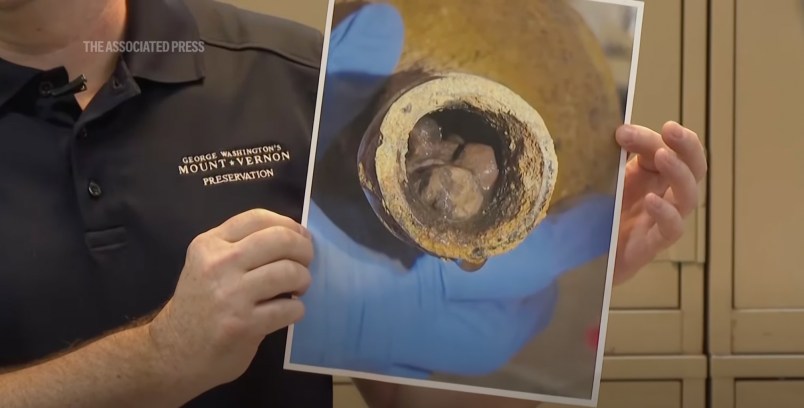
A recent archaeological find sheds new light on this. In 2013, the remains of four men were discovered at the site of a chapel in Jamestown. One of them, Captain Gabriel Archer, had been buried with a silver box that a CT scan showed contained bone fragments and a lead ampulla. It was almost certainly a Catholic reliquary, and it was, in the words of The Atlantic’s Adrienne LaFrance, “a bombshell,” potential “proof of an underground community of Catholics.” They would have had to have been secret because Catholic worship had been banned in England since 1559, when Queen Elizabeth issued the Act of Uniformity.
The English Protestants who colonized the New World feared hunger, illness, and childbirth, which killed one out of eight expectant mothers and a third of their children who were born alive by their fifth birthdays. They feared the raw wilderness and its indigenous inhabitants, who they knew were servants of the Devil, and the witches and other minions of Satan that dwelled among them, disguised as their wives, children, neighbors, servants, and enslaved people. They feared their own sinful natures and Antinomianism or “Free Grace” Protestantism, the radical doctrine that once they were saved, Christians were no longer bound by the moral law, a philosophy, they believed, that could not but lead to licentiousness and attacks on property and the political order. Most of all, they feared Catholicism, which they had been at war with since the time of Henry VIII. The Catholic French had forged alliances with native tribes in the north and west. The Catholic Spaniards controlled the south. The threat of internal subversion was real as well; the Gunpowder Plot conspirators had been executed less than a year before the Jamestown settlers departed England.
Many of those Puritans’ descendants still see the world much as their ancestors did, though their great enemy is no longer godless papists and savages but depraved liberalism, or at the conspiracy theorist extreme, some differently titled ism that in practice looks and sounds an awful lot like Catholicism. Illuminism perhaps, or “cultural Marxism.” Or Zionism, the philosophy, they believe, of an ancient, fabulously wealthy elite whose power transcends national boundaries and whose leaders invisibly bend the world to their wills using the power of propaganda and finance. The Davidic superstate of the Protocols is a fantasy, but the Vatican was and is very real. (“You know, I am not antisemitic, and I am not anti-Black; that’s a complete misunderstanding of what I am,” Tucker Carlson recently, reportedly, said. “I am anti-Catholic.”)
Practicing Catholics were explicitly banned from Massachusetts, Connecticut, and New Hampshire. Roger Williams founded Rhode Island as a refuge for religious dissenters in 1636, but virtually no Catholics lived there to enjoy the privilege of freedom of worship at the time. Pennsylvania and Delaware also tolerated Catholics, but few lived in either colony until much later. Virginia expelled priests from its territory in 1641. Georgia offered freedom of worship to all “except papists.” New York banned Catholicism in 1688; New Jersey passed its first formal anti-Catholic law in 1691; in 1701, it granted liberty of conscience to all “except papists.” South Carolina enacted similar legislation in 1697 but dropped its religious test in 1790; Catholics were not allowed to hold public office in Massachusetts until 1833, in North Carolina until 1835, and in New Jersey until 1844. Maryland’s chief sponsor, Lord Baltimore, had envisioned the colony as a refuge for Catholics like himself, but it didn’t go as planned. Though the Maryland Toleration Act, which became law in 1649, granted the right of free worship for any “professing to believe in Jesus Christ,” it was overturned in the early 1650s when Puritans briefly seized control of its government. It was restored a few years later, only to be overturned again in 1692, when Catholicism was formally banned in the colony.
As Robert Emmett Curran wrote in his book Papist Devils: Catholics in British America, 1574–1783, anti-Catholicism was “an effective unifying force, both in England and in British America, in defining a society by an ‘other’ that contradicted all that that society stood for and whose very survival the ‘other,’ by its very presence, threatened.”
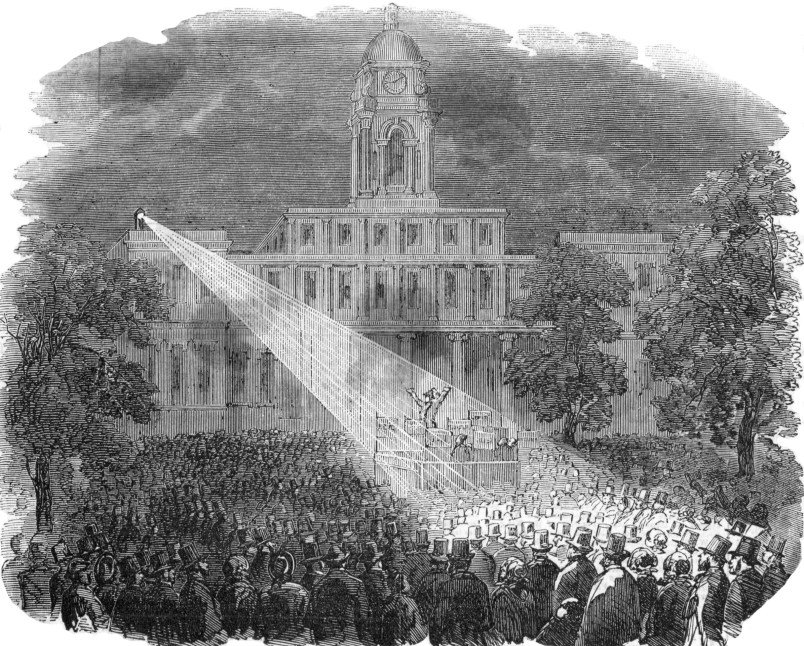
A number of anti-Catholic secret societies arose during the high tide of Irish Catholic immigration. The American Brotherhood (which quickly changed its name to the Order of United Americans) was founded in New York City in 1844 with a mission “to release our country from the thralldom of foreign domination.” The Order of United American Mechanics began in Philadelphia a year later, and in 1850, the Order of the Star Spangled Banner was founded in New York with the explicit goal of driving Catholic immigrants from public office and organizing boycotts against their businesses. The New York Tribune’s Horace Greeley dubbed the groups “Know Nothings” because of their oaths of secrecy, but also because of their ignorant narrowmindedness. The name caught on, and like so many other pejoratives, was adopted as an honorific by their members.
While the Know Nothings opposed so-called papism on moral grounds, they were pragmatic in practice; their chief aims were to reverse the downward pressure on wages caused by immigration and the rising corruption of the Catholic-dominated urban political machines. The owner class was more ambivalent. While they were happy to replace American workers with hungry immigrants who would work harder for less, they worried about the revolutionary spirit of 1848 sweeping Italy, Germany, and Ireland, among other countries, which some of those immigrants carried with them from abroad.
By 1855, the Know Nothings had coalesced into a full-blown political party, the American Party, which filled some of the void left by the collapse of the Whigs. “As a nation,” the former Whig Abraham Lincoln wrote to his friend Joshua Speed at the time, “we began by declaring that ‘all men are created equal.’ When the Know-Nothings get control, it will read ‘all men are created equal, except negroes, and foreigners, and catholics.’ ” Nonetheless, eight governors, more than one hundred U.S. congressmen, and the mayors of three major cities had been elected on American Party tickets by the end of the decade.
Wood engraving of a torchlight meeting of the Know Nothings at New York City Hall, 1855. (Photo by Library of Congress/Corbis/VCG via Getty Images)
Compared to the monstrous injustice of slavery, the decades of sectional strife it caused, and the cataclysmic disasters of secession, the war, Reconstruction, and the Jim Crow era that followed, the clamor over Catholic immigration was little more than background noise. That said, as John Higham, author of the seminal study Strangers in the Land: Patterns of American Nativism, 1860–1925, put it, the American Party provided a rare opportunity for the fraying republic to come together around a different shared hatred during the decade of Bleeding Kansas.
That hatred has had a lasting impact on American conspiracy culture. Picture this classic conspiracy theorist tableau: in a dungeon beneath a gloomy mansion, a group of immensely rich and powerful men, draped in silk robes, utter incantations in a strange tongue while sipping libations of human blood. Clouds of incense hang in the air.
Whether those celebrants are believed to be Elders of Zion, Illuminated Masons, billionaire apparatchiks of the New World Order, the elites of the QAnon believers’ imagination, or all of them working together, the image’s ur-source is Roman Catholic priests celebrating the Mass, as refracted through the distorting lenses of biblical End Times prophecies, the geopolitics of the Reformation, middle-class Americans’ resentments of the opaque and sometimes questionable practices of bankers and financiers, and, ironically, Catholicism’s own long-standing fears of Illuminism and Freemasonry.
For the Puritans, Catholics were the Romans, the ancient enemy the early Christians defined themselves in opposition to (along with the pharisaical Jews). For the Catholics, the enemy was not just the Jews who rejected Christ, but heterodox Christians who denied that the Catholic Church is the body of Christ, and the forces of Marxism, scientism, nihilism, atheism, secularism, and all of the other isms that have been eating away at the one true church’s authority and power.
Of course, real Jews and Masons, as opposed to the Jews and Masons of the conspiracy theorist imagination, don’t practice magic or worship Satan; most Jews don’t believe in the literal Devil, and while many Masons are Christians, few are superstitious. Neither drinks blood — figurative, real, or transubstantiated — in their ceremonials. But conspiracy theorists nonetheless imagine that their enemies celebrate Black Masses, because they think in Manichaean binaries — good versus evil, Christian versus Jew, Protestant versus Catholic, American versus non-American, civilization versus barbarism — and perhaps because they guiltily project the aspects of themselves that they are ashamed of onto their enemies. The Christian blood that Jews were accused of mixing into their Passover matzos, the adrenochrome that QAnon believers say the elites extract from children, is the Eucharist defiled.
Protestant conspiracy theorists look at their enemies and see Catholics. So do Catholic conspiracy theorists, at least when they are looking at the Masons, another group that captured Americans’ imaginations and attracted their hatred, animating today’s conspiracy theories. And it’s no wonder, because so many of the Masons’ secret rituals evoke their society’s fanciful connections with medieval Catholicism.
Beyond the Masons’ specific references to the Knights Templar and Jacques de Molay, the Templars’ last grand master (he was burned at the stake in 1314), the Gothic cosplay that figures in so many of their rituals is also characteristic of a lot of the Romantic art, architecture, landscape design, and literature of the late eighteenth and early nineteenth centuries. The Ku Klux Klan, which recruited many of its members from Masonic lodges, also adapted Catholic rituals and robes. The capirote, the pointed hood that Spanish and Italian penitents have worn since the Inquisition, was the likely source for the headpieces the Klan riders wore in D. W. Griffith’s Birth of a Nation, and that the revived KKK then adopted (the regalia of Reconstruction-era Klansmen was less formalized).
Unlike the Klan, the Freemasons were never organized around exclusion and hatred; their ideal was and is enlightenment. According to their founding myth, Hiram Abiff, the chief architect of the Temple of Solomon, was martyred when he refused to reveal the stonecutters guild’s occult secrets. In truth, Freemasonry is only a few centuries old, and like the American Constitution, is very much a product of the Enlightenment. The first Masonic Grand Lodge was founded in England in 1717; the first American lodge opened in Philadelphia in 1731 with Benjamin Franklin as a charter member. There are numerous varieties of Masonry (the York Rite, the Ancient and Accepted Scottish Rite, the Knights Templar, the Order of the Eastern Star, Royal Arch Masonry, and more). Some, like the Knights Templar, are explicitly Christian, but the ethos that most subscribe to is best described as humanistic deism. And if the Masons have a consistent class identity, it is bourgeois.
It’s not surprising that George Washington and Benjamin Franklin were Masons. Both were non-churchgoing men of affairs, devout republicans who were good with money and conversant with science (especially Franklin, though Washington studied and applied the agronomy of his day, experimenting widely with new techniques in planting, plowing, manuring, and crop rotation). Other prominent American Masons of the period were Paul Revere, John Marshall, John Hancock, and James Monroe. Among Europe’s well-known eighteenth-century Masons were the Marquis de Lafayette (an aristocrat to be sure, but something of a class traitor), and Goethe, Mozart, and Voltaire. In South and Central America, Simón Bolívar, El Libertador, was a Mason. There have been very conservative and racist Masons too. Albert Pike, for example, was a leader and major theorist of the Scottish Rite, one of the most speculative and esoteric varieties of Freemasonry; he was also a Confederate general, an avowed white supremacist, and active in the early KKK. But most were progressive-minded representatives of the rising Protestant middle class.
Esoteric Masons’ engagement with arcana like Greco-Egyptian hermeticism, Gnosticism, Kabbalah, the Koran, and alchemy came from the same place as their interest in science — a wide-ranging curiosity unfettered by religious dogma, and the confidence that human beings are inherently perfectible, that anyone can work and study their way toward wisdom, happiness, and spiritual integration as they ascend through the degrees of the Craft. This is a very different view of the human condition than Catholicism’s or Calvinism’s, which maintain that mankind is inherently depraved and cannot earn grace, but only be granted it by Christ, either directly or via the church’s intercession. That is why the pope condemned Masonry in 1738, a ban that was reaffirmed as recently as 1983 by Cardinal Ratzinger when he was prefect of the Congregation for the Doctrine of the Faith, formerly known as the Roman Inquisition (in 2005, he would become Pope Benedict XVI).
Freemasonry came under fire in the United States in the 1820s, after William Morgan, a former brewery owner and veteran of the War of 1812, disappeared after he’d written an exposé of Masonry and sold it to a publisher. If the Masons murdered him to protect their secrets, as was widely supposed, their plan backfired spectacularly. Morgan’s book was published posthumously as The Mysteries of Freemasonry, Containing All the Degrees of the Order Conferred in a Master’s Lodge. The controversy surrounding the disappearance snowballed into a full-blown national political movement with the formation of the Anti-Masonic Party, whose bête noire was Andrew Jackson, the former grand master of Tennessee.
Jackson is remembered today as a populist and an avowed enemy of the permanent Washington establishment. Donald Trump declared himself a Jacksonian during his first presidential campaign in 2016; after he was elected, he hung Jackson’s portrait in the Oval Office and visited his grave. But in Jackson’s own day, his enemies castigated him as an elitist and would-be despot. Some of that animus was likely personal. John Quincy Adams had eked out a win against Jackson in 1824, but lost the presidency to him in 1828 after an especially vicious campaign. Though Adams enjoyed a long and consequential ex-presidency as a lawyer, abolitionist, and member of Congress, he devoted a surprising amount of his energies in the 1830s to anti-Masonry, even writing a book, Letters on Freemasonry, in which he attacked the Masons as “a conspiracy of the few against the equal rights of the many” and “a seed of evil, which can never produce any good.” Freemasons take oaths binding them to their order instead of to the republic, Adams said — so how patriotic could they be?
His book exhaustively cataloged the ghoulish tortures that Masons supposedly visited on disloyal members like Morgan, lovingly detailing the cuttings of throats, tearing out of hearts, and “smiting off the skull to serve as a cup for the fifth libation” that were the penalties for disloyalty. And he called explicit attention to Masonry’s resemblance to Catholicism, which was also accused of torturing its apostates and putting loyalty to the pope before loyalty to the nation (much as Jews are accused of doing with Israel today).
If I seem to be downplaying the potency of anti-Black racism and anti-Semitism, I’m not. Remember, my topic is not prejudice per se, but paranoid conspiracy theorism. For much of American history, racism has been openly acknowledged and supported by the force of law. As such, Blacks themselves weren’t so much the objects of conspiracy theorist thinking as their non-Black allies in the Abolition and the civil rights movements were.
As for anti-Semitism, once The Protocols of the Elders of Zion began to be widely translated after the turn of the 20th century, conspiracy theorists of every stripe off-loaded the wicked attributes of Catholics, Masons, Illuminists, anarchists, robber barons, bankers, and revolutionaries onto Jews. Judaism was said to have co-opted the Masons, just as it had labor unions and other progressive movements, to undermine the power of the state. “Gentile masonry blindly serves as a screen for us and our objects,” says Protocol 4. “Until we come into our kingdom ,” Protocol 15 adds, “we shall create and multiply free masonic lodges in all the countries of the world, absorb into them all who may become or who are prominent in public activity, for these lodges we shall find our principal intelligence office and means of influence.”
The Holocaust was the culmination of 2,000 years of successionist theology, the belief that Christianity completed and nullified both the Judaic law and Judaism itself, and of a century of political and social resentment as Jews throughout western Europe were finally made citizens of their countries.
But Jews were relative latecomers to the global conspiracy theories that formed the basis of Nazism, and that they still feature in so largely today. The person who gave American anti-Semitism its biggest platform ever was the industrialist Henry Ford. “There is a race, a part of humanity,” he wrote of the Jews in The Dearborn Independent, the newspaper he purchased in 1918 and mostly used to promote The Protocols of the Elders of Zion, “which has never yet been received as a welcome part, and which has succeeded in raising itself to a power that the proudest Gentile race has never claimed, not even Rome in the days of her proudest power.”
Though the Jews were still nationless, Ford and his White Russian ghostwriters cast them as the world’s most rapacious imperialists. Though most of the Jews who had begun pouring into America from eastern Europe toward the end of the nineteenth century were penniless, they were presumed to be fabulously wealthy. “The Protocols do not regard the dispersal of the Jews abroad upon the face of the earth as a calamity, but as a providential arrangement by which the World Plan can be the more certainly executed,” Ford wrote. The Diaspora was a punishment the Jews not only deserved but had freely chosen; as such, they should not be pitied but despised and feared. Ford’s anti-Semitism was monstrous, but you can at least understand where it came from. He had heard it proclaimed from the pulpit by Protestant ministers as a child, and he read it in the tracts of the agrarian populists.
Ford had a sentimental attachment to the rural America that formed him, which caused him no end of cognitive dissonance, because if he couldn’t find someone else to blame for its decline, he might have had to take a critical look at himself. Economists still use the term “Fordism” to describe the standardized, mass-production consumer economy that transformed small-town America into a patchwork of look-alike cities and suburbs. Mass-produced automobiles literally and figuratively released rural people from their ties to the land. Underemployed farm laborers moved to Detroit to work in Ford’s factories, and the cars Americans bought on credit not only made them mobile but provided young people and adulterous marrieds with trysting places.
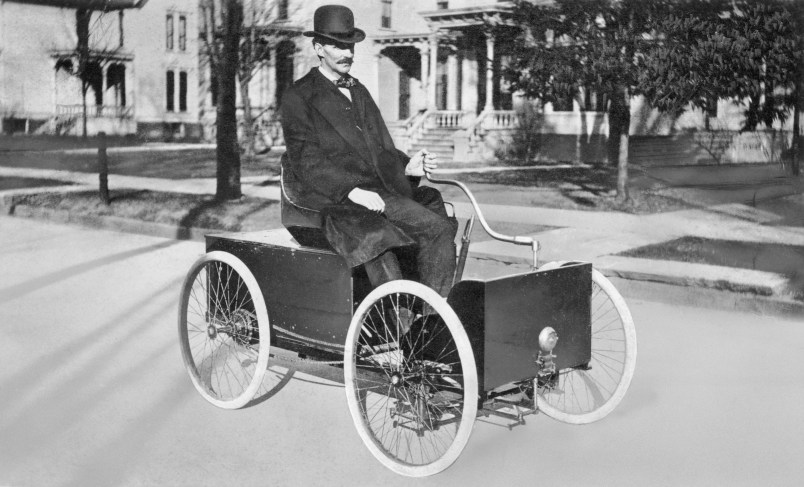
Henry Ford driving in his first automobile, the Quadracycle, on Grand Boulevard in Detroit, Michigan. (Getty Images)
Ford’s anti-Semitism exonerated him not just for the ruination of the wholesome way of life that he remembered, but the ruthlessness of the capitalism that he practiced. That which we call capitalism, he explained in The International Jew, is an illusion, because “the manufacturer, the manager of work, the provider of tools and jobs — we refer to him as the ‘capitalist’ himself must go to capitalists for the money with which to finance his plans.” The common enemy of both labor and capital, he wrote, is “super-capitalism, a super-government which is allied to no government, which is free from them all, and yet which has its hand in them all.” To save America, to save the world, those super-capitalists must be crushed. “If the Jew is in control,” Ford asked, “how did it happen? This is a free country. The Jew comprises only about three per cent of the population. Is it because of his superior ability, or is it because of the inferiority and don’t-care attitude of the Gentiles? Unless the Jews are super-men,” Ford concluded, “the Gentiles will have themselves to blame for what has transpired.” Where is the modern Haman who will do what must be done? he might as well have asked.
Even after spending years parsing the paranoid style, the genocidal implications of Ford’s logic stuns me — as does the fact that he continues to be held up to schoolchildren as a model American entrepreneur. It really is no wonder that Germany’s rising fascists looked on “Ford as the leader of the growing Fascisti movement in America,” as a reporter from the Chicago Tribune put it in 1923. “We admire particularly his anti-Jewish policy which is the Bavarian Fascisti platform. We have just had his anti-Jewish articles translated and published,” Hitler told him. “The book is being circulated to millions throughout Germany.” The article goes on to note that Ford’s “picture occupies the place of honor in Herr Hittler’s [sic] sanctum.”
If you are seeking the origins of the American Paranoid, there are many places to look. For Protestants in the colonial era, the great historical adversary was Satan, as embodied in the Catholic Church. The dread this transnational superstate inspired was virtually hardwired into their psyches, like the fear of snakes. At the same time, I suspect, they felt an unconscious, largely unacknowledged nostalgia for its certainties. The lineaments of that primal hatred live on in contemporary conspiracy theorists’ fever dreams about the all-powerful Illuminati, the Elders of Zion, and the hidden leaders of the Deep State, who feed themselves with children’s blood and injections of adrenochrome and interfere with the sovereignty of nations.
Both Catholic and Protestant doctrine demand that its believers repudiate Freemasonry’s values, but few Americans do, because our political institutions grew out of the same soil that Freemasonry did, which is the practical, empiricist, tolerant, and secular ethos of the Enlightenment that Sam Dickson believes poisoned the American experiment at its birth.
Religious tolerance, if not indifferentism, is what underlies Madison’s and Jefferson’s wall of separation between church and state. “It does me no injury for my neighbor to say there are twenty gods, or no god,” Jefferson famously wrote. But despite the mountains of evidence that show that religious pluralism encourages rather than harms religious belief (56 percent of Americans say they believe in God as described in the Bible, as opposed to just 27 percent of western Europeans), an influential minority of religious Americans would just as soon tear it down. Many have their doubts about democratic republicanism as well. The only sure guarantor of their freedom, they say, is power — specifically, the ability to wield power against religions, ideas, and people they don’t like.
As Senate Republicans put forward toothless, bad faith legislative alternatives to Democrats’ bill to protect in-vitro fertilization at the national level last week, the extent to which they are struggling to message on the issue as a party was on full display.
Yesterday I opened my inbox to an Axios email with the subject line: “Dems Fear Biden Loss.” Needless to say, versions of this story have become almost a stock piece of the 2024 campaign. And, look, I fear a Biden loss as well. He could totally lose and that would be really, really bad. But I got the sense that the import of this item was a bit more totalizing than that. And well … I was right. The item presents a picture of a campaign cocooned from outside input, intolerant of dissenters who aren’t confident of a win and largely the work of Biden and top advisor Mike Donilon, who is portrayed as having a strategy that is little more than a preciously naive hope that in the end voters will “do the right thing.”
But the heart of the piece comes at the top with a quote (emphasis added) from someone described as a “Democratic strategist in touch with the campaign.”
“It is unclear to many of us watching from the outside whether the president and his core team realize how dire the situation is right now, and whether they even have a plan to fix it. That is scary.”
The Supreme Court Thursday ruled not to redefine “income” — a move, pushed aggressively by Justice Neil Gorsuch during oral arguments, that would have headed off various wealth tax proposals that have gained steam on the left, and been a gift to the very wealthy and corporations.
Justice Brett Kavanaugh wrote for the majority, in which all of the liberals joined. Justice Ketanji Brown Jackson also wrote a solo concurrence; Justice Amy Coney Barrett concurred in the judgment, joined by Justice Samuel Alito.
Gorsuch and Justice Clarence Thomas dissented.
The case centers on a couple’s, the Moores’, attempt to wriggle out of a one-time tax on gains from a foreign company, which they were required to pay under a provision imposed by the Trump tax cuts of 2017. But there’s a reason such forces on the right as Wall Street Journal’s opinion pages, right-wing nonprofits and Alito’s favorite interviewer-turned-lawyer for the Moores got in on the action: redefining income like the Moores wanted would be a boon to ultra-rich people and institutions who benefit from alternative revenue streams.
Redefining income this way also would have required the Supreme Court to both ignore Congress and overturn its own precedent (something it has proven very willing to do on the right cases).
“Congress’s longstanding practice of taxing the shareholders or partners of a business entity on the entity’s undistributed income reflects and reinforces the Court’s precedents,” Kavanaugh wrote.
The case also put the Moores in the difficult position of arguing that the specific tax making them cough up around $14,000 (on over $500,000 in gains) was unconstitutional, while the many other taxes operating similarly are not.
“The Moores have advanced an array of ad hoc distinctions to try to explain why those longstanding taxes are constitutional and why those precedents are correct, and to simultaneously try to explain why those taxes and precedents do not eviscerate their argument that the MRT is unconstitutional,” Kavanaugh wrote, referring to the tax governing the case, the mandatory repatriation tax. “But the Moores’ effort to thread that needle, although inventive, is unavailing.”
“The upshot is that the Moores’ argument, taken to its logical conclusion, could render vast swaths of the Internal Revenue Code unconstitutional,” he added.
He echoed points made by Solicitor General Elizabeth Prelogar during oral arguments, noting that agreeing with the Moores’ elimination of all of those taxes would shift the burden to “ordinary Americans,” or those of us not huffy because we had to pay a fraction of our giant investment gains. Gorsuch (occasionally joined by Alito), during his oral argument performance, had taken great pains to repaint the case as one that posed an existential threat to the more meager wealth of the American everyman — clearly clocking the case’s unsympathetic main characters.
In a footnote, Kavanaugh hastened to say that Thursday’s decision should not be read as a ruling on or a judicial endorsement of a wealth tax, something the Court would consider in the future if Congress passed it. Coming down the opposite way, though, likely would have made imposing one virtually impossible — though foreshadowing in Moore positions many of the conservatives as preemptively hostile to such a tax.
In her concurrence, Jackson issued a mild warning to the Court, seeming to look to a future where Democrats may successfully pass one of the burgeoning wealth tax proposals.
“I have no doubt that future Congresses will pass, and future Presidents will sign, taxes that outrage one group or another — taxes that strike some as demanding too much, others as asking too little,” she wrote, adding that previous cases teach the justices “that this Court’s role in such disputes should be limited.”
Thomas and Gorsuch, the dissenters, also looked towards a future wealth tax — but as a frightening congressional power grab to which the Court has now made itself vulnerable.
“Even as the majority admits to reasoning from fiscal consequences, it apparently believes that a generous application of dicta will guard against unconstitutional taxes in the future. The majority’s analysis begins with a list of nonexistent taxes that the Court does not today bless, including a wealth tax,” Thomas wrote. “Sensing that upholding the MRT cedes additional ground to Congress, the majority arms itself with dicta to tell Congress ‘no’ in the future. But, if the Court is not willing to uphold limitations on the taxing power in expensive cases, cheap dicta will make no difference.”
Decoding The Cloaked Language Of The Supreme Court
While we await the Supreme Court’s decision on Donald Trump’s claim that he enjoys presidential immunity from prosecution, let me run through the various forms of disingenuousness to be on the look out for when the ruling eventually comes down. That could be as soon as this morning, or as late as early July. If the court’s slow-rolling of the case thus far is any indication I would expect it later than sooner. But your guess is as good as mine.
Before we get to the fun stuff, it’s important to acknowledge that while Trump’s claim of more or less absolute immunity is completely bogus and detached from the reality of the Constitution, history, and legal precedent, some form of lesser immunity for the president is not on its face ridiculous or absurd.
What gets tricky in the Trump case is that the more the Supreme Court decides to explore and weigh in on lesser forms of immunity (rather than saving that for another day given that immunity for unlawfully remaining in office past the end of the president’s term is out of the question), the greater the chance that it creates insurmountable obstacles to holding a Trump trial before the election. It already has made such a trial nearly impossible. So while in the abstract, a fulsome exploration of presidential immunity could be warranted, it also runs the risk of being a smokescreen.
With that out of the way, here are some of the tells that commonly pepper controversial rulings and the multiple competing opinions they often yield:
Raising The Specter Of Chaos As A Strawman. Many judges, especially conservative ones, fancy themselves as bastions of stability and order amidst universal chaos. That creates all sorts of weird incentives and outcomes, but in controversial cases (see, e.g., Bush v. Gore), judges will decry the prospect of chaos as a justification to take extraordinary steps that defy precedent, stretch legal arguments beyond reason, and achieve desired outcomes. Beware of warnings of hypothetical chaos.
Oversimplifying Complex Issues By Claiming Some Things Are “Obvious.” Often the most glaring sign of a poorly reasoned decision reaching for a preferred outcome is when a judge declares “obvious” things that are clearly not obvious but have the effect of walling off disfavored outcomes right off the bat. Think of it as defining away the problem. In the immunity case, it might look like, “Obviously, the president is entitled to some immunity, so we must decide the scope and extent of that immunity.” Things are rarely obvious in Supreme Court cases, and the more a judge protests that they are, the more suspicious you should be.
Whinging About Being Stuck With A Hard Decision. The whinging is a tell because it often ends up with the judicial branch blaming others (usually, the executive and legislative branches) for making it do its job. Elevating how difficult the decision is, like raising the specter of chaos, is another way of enlarging the rhetorical space in which to deviate from precedent and norm, reach for a decision you want to make anyway, and excuse yourself from having done anything out of the ordinary.
Butchering History. Others have written at length about judges vastly overestimating their skills as professional historians, leading to cherry-picked historical artifacts as justifications for today’s decisions. So you get the gist. The immunity case is ripe for butchering history. But beyond the immediate problems with bad misinterpretations of history is that it lends itself to all of the above tells, too. A case with “great” historical significance can be used in the same way as invoking the specter of chaos to enlarge the options available to the court for doing what it wants to do. Many recent decision have declared historical facts to be “obvious” that are anything but. And many Supreme Court decisions that rely on historical interpretation note how difficult it is to parse history before proceeding to do it anyway, the whinging about the difficulty scale providing another way out to do the thing it wants to do anyway.
There are others, but that’s probably a sufficient cheat sheet for the immunity case. Now we wait. For how long, no one outside the court knows.
SCOTUS Decisions Coming Today And Tomorrow
Still a huge number of Supreme Court decisions to be issued before the end of the term, so expect a flood over the next two weeks. Decisions will be coming at 10 a.m. ET today and tomorrow.
Keep An Eye On Amy Coney Barrett
Supreme Court Justice Amy Coney Barrett has already shown signs of taking a different path as a jurist than had been expected. What we’re seeing doesn’t neatly fall into a liberal v. conservative analysis or originalist v. not originalist prism. It’s more subtle and complicated than that. Some of it I suspect is merely generational, but either way I think it’s too early to label it. Still, it’s worth keeping an eye on.
Here are two installments in the early effort to figure out what she’s doing and why, both tied to a recent Supreme Court decision in a trademark case:
Politico: Amy Coney Barrett may be poised to split conservatives on the Supreme Court
The New Republic: Amy Coney Barrett Breaks With Supreme Court Originalists
Rudy Rudy Rudy, Tsk Tsk Tsk
TPM’s Josh Kovensky: Rudy Giuliani Is Running The Risk Of Blowing Up His Own Bankruptcy Case
Great Read
WSJ: This Judge Made Houston the Top Bankruptcy Court. Then He Helped His Girlfriend Cash In.
Expecting A Recount In VA-05
Since we checked in yesterday, the tiny lead that state Sen. John J. McGuire III (R-VA) holds over Rep. Bob Good (R-VA) in the GOP primary in the VA-05 has narrowed from 327 to 321 votes. A GOP-on-GOP recount between two MAGA-loving Trumpists in the Big Lie era is gonna be a hoot. Pull up a chair and pass the popcorn.
2024 Ephemera
Fox News poll: In a hypothetical two-candidate race, Biden leads Trump among registered voters nationwide 50%-48%, a three-point swing since last month.
NBC News: Mystery fundraising firm takes in millions from the Trump campaign
Confirmed: The qualifying deadline for the first presidential debate next Thursday has passed and no one qualified other than Biden and Trump.
If you are interested in how the American right went insane, TalkingPointsMemo.com is your actual publication of record, compiling a bountiful archive of the ways “extremism” and “mainstream” merged in the history of the Republican Party from the dawn of President George W. Bush to the present. It was born, in 2000, at a time of new vessels and styles of writing about American politics. It could have become a model for the rest of the news media. It did not.
All in all, Rick offers a distinct take on TPM’s history.
Abortion Watch
WSJ: Abortion-Rights Advocates Deploy a New Red State Playbook
Louisiana has enacted a new law requiring the 10 Commandments to be displayed in all public school classrooms. The ACLU has already announced that it is suing to block the law as a violation of the Constitution.
Not Something You See Every Day
A Vermont Republican lawmaker who was surreptitiously recorded repeatedly pouring water into a Democratic colleague’s tote bag – tormenting behavior that went on for five months – has apologized for her “disrespectful conduct.”
Here’s a an interesting look at the history of TPM, and its origin story, from Rick Perlstein at The American Prospect. It’s not exactly my take, despite being based on an interview with me. But I found it very interesting and enlightening and you might too.
Incomplete disclosures. Concealing the details of a coffee startup. Blown deadlines. Paying the credit card of a girlfriend. Ignoring pleas from creditors.
This article is part of TPM Cafe, TPM’s home for opinion and news analysis.
Ahead of the November presidential election, voters are navigating changing electoral maps, changing state voting laws, and an unprecedented and deeply troubling situation our country has yet to face: one candidate for president has been convicted of a felony in state court and three more felony criminal cases are pending against him. Fully 48 percent of voters say reaching a verdict in Donald Trump’s federal election interference trial is critical before November. But thanks to the Supreme Court, they will enter the voting booth without knowing if Trump has been found guilty of a federal crime.
The Supreme Court has slow-walked Trump’s criminal cases at every turn. In December 2023, the Court denied the Department of Justice’s request to hear Trump’s claim that he is absolutely immune from criminal prosecution, opting to instead let the question make its way up to the justices through the lower courts. After the D.C. Circuit heard Trump’s argument and decided unanimously against him within 28 days, the Supreme Court waited 22 days before it announced it would indeed hear Trump’s claim of presidential immunity, scheduling oral arguments for the last day of its term, 57 days later. The ultra-conservative Supreme Court has weaponized time to delay accountability for their friend Donald Trump and influence the November election.
The immunity question stemming from Trump v. United States isn’t the first time the Supreme Court has heard a crucial electoral case. In past cases, the justices acted with the swiftness and urgency that those cases demanded. It only took the Court three days to hand down a decision in Bush v. Gore. A decision only took two weeks in U.S. v Nixon. But today’s 6-3 conservative Court introduced significant delay and procedural hurdles to give Donald Trump what he needs most for his legal defense: time. Friendly justices have given him nearly five months of it — so far. This delay comes despite the fact that the justices are hearing fewer cases today than at almost any other time in the Court’s history. The Roberts Court has been consistently deciding fewer cases each term.
It is increasingly obvious to Americans who are paying attention that the Supreme Court is no longer a neutral arbiter of the law, but a partisan outfit willing to protect its political allies and overturn long-established precedents like Roe v. Wade for ideological reasons. Nearly 6 in 10 of Americans view the Court negatively. In the 2000s and much of the 2010s, the Court enjoyed approval ratings above 50 or 60 percent. This new scrutiny comes as Americans have been given a front row seat to numerous ethical scandals on the Court. Trump v. United States presents an obvious conflict of interest for Justices Clarence Thomas and Samuel Alito. Ginni Thomas’ efforts to overturn the 2020 election are well known. Rather than recuse himself and despite the Court’s new sham of a code of conduct, Justice Thomas ignored calls from legal experts and Democratic lawmakers. After revelations that a ‘Stop the Steal’ flag flew at Samuel Alito’s residence, Justice Alito joined Justice Thomas in disregarding calls to remove himself from the case, thumbing his nose at Congress and federal laws requiring justices to recuse themselves when their “impartiality might reasonably be questioned.” We simply cannot trust the justices to rule without bias and uphold the integrity of our elections when they’re so clearly aligned with Donald Trump.
Congress has the power to rein in the Supreme Court through robust legislation. The Supreme Court Ethics, Recusal, and Transparency Actwhich would require the justices to abide by a code of conduct with actual enforcement mechanisms. Nearly 7 in 10 Americans support a real code of conduct for the Supreme Court.
Congress also has critical legislation in the Supreme Court Tenure Establishment and Retirement Modernization Act, which was re-introduced by Rep. Hank Johnson (D-GA). The TERM Act would create 18-year terms for current and future Supreme Court justices. By an overwhelming 40-point margin — 64 percent to 24 percent — voters favor congressional action to set 18-year term limits. With that level of support, one may ask, what’s Congress waiting for?
Americans should be able to trust Supreme Court justices to carry out their duties impartially and ethically, but their undemocratic decisions and delaying tactics clearly demonstrate they’re not working on behalf of the American people. Months before the November election, we’re already seeing the immense impact these politicians in robes will have on the 2024 election. It is ludicrous to sit by and wait for another scandal or another decision that reeks of extremism and partisanship. The Supreme Court has proven numerous times it will not reform itself. Congress must step up and reform this unchecked Court.