

A new episode of The Josh Marshall Podcast is live! This week, Kate and Josh discuss Senate Democrats’ tactics on House Republicans’ continuing resolution, as well as the tanking stock market and potentially looming recession.
Continue reading “Listen To This: Democrats’ Big Test”Federal Judge Slams Trump Executive Order Targeting Perkins Coie
A lot of things happened. Here are some of the things. This is TPM’s Morning Memo. Sign up for the email version.
‘It Sends Little Chills Down My Spine’
In a closely watched emergency hearing in Washington, D.C., U.S. District Judge Beryl Howell quickly recognized the threat to the rule of law posed by President Donald Trump’s executive order targeting Seattle-based law firm Perkins Coie – and moved immediately to issue an order blocking key portions of it.
“I am sure that many in the legal profession are watching in horror at what Perkins Coie is going through here,” Howell said. “The order casts a chilling harm of blizzard proportions across the legal profession.”
Howell is not alone. Duke law professor Samuel W. Buell, a former prosecutor, told the NYT: “This is certainly the biggest affront to the legal profession in my lifetime.”
The executive order, among other things, sought to terminate government contracts with Perkins Coie or “with entities that do business with Perkins Coie”; denied Perkins Coie employees access to federal buildings and officials; and stripped them of security clearances.
In an unusual twist and a possible sign that career DOJ lawyers want nothing to do with the case, the executive order was defended in court by Chad Mizelle, the Justice Department’s chief of staff who is also serving as the DOJ’s acting No. 3.
Mizelle struggled to allay Howell’s concerns about the constitutionality of the executive order.
“This may be amusing in ‘Alice in Wonderland’ where the Queen of Hearts yells, ‘Off with their heads!’ at annoying subjects … and announces a sentence before a verdict,” Howell said, “but this cannot be the reality we are living under.”
Meanwhile, the NYT reported that other big law firms were hesitant to defend Perkins Coie, which was “rebuffed” by at least one firm before Williams & Connolly rose to the occasion.
“I have enormous respect for Williams & Connolly,” Howell said in court, “and enormous respect for them taking this case when not every law firm would.”
What We Don’t Know About Ed Martin’s Shenanigans
Acting D.C. U.S. Attorney Ed Martin has been up to far more mischief than has been publicly revealed so far, the WaPo suggests (emphasis added):
The letter is the latest among an estimated 20 inquiries that people close to Martin estimate he has sent since taking office Jan. 20 as the top federal prosecutor in the nation’s largest U.S. attorney office. Among those that have become public, Martin has demanded information from figures such as Senate Minority Leader Charles E. Schumer (D-New York), Rep. Robert Garcia (D-California), the legal disciplinary counsel’s office over the D.C. Bar and the dean of Georgetown University’s law school.
Chutkan Slams Gov’t Conduct In Crazy EPA Case
The Trump administration’s over-the-top effort to claw back Biden-era EPA grants was tested in open court for the first time, and U.S. District Judge Tanya Chutkan was having none of it.
To orient you a bit, this case is a civil lawsuit brought by one of the grant recipients seeking to unfreeze monies it was due, so the case doesn’t directly touch on the Trump DOJ’s baseless effort to use the criminal process to freeze the funds and intimidate the bank holding them and the grant recipients. Those corrupt efforts by acting D.C. U.S. Attorney Ed Martin, you’ll recall, led to the forced resignation of a senior prosecutor who refused to go along with it.
But even in the confines of the civil case, Chutkan said the government needed to provide some basis for freezing the funds: “Can you proffer any evidence that [the grant] was illegal, or evidence of abuse or fraud or bribery — that any of that was improperly or unlawfully done, other than the fact that Mr. Zeldin doesn’t like it?” Chutkan asked the DOJ lawyer, referring to EPA administrator Lee Zeldin, who purported to terminate the entire $20 billion program the day before the hearing, the timing of which also chagrined Chutkan.
Quote Of The Day
“My ethical duty as a Department of Justice employee — and now a former one — is to the laws of the United States and the people that I was entrusted to serve. It is not to the bullies who are currently running the Department of Justice.”–Elizabeth Oyer, the U.S. pardon attorney fired by the Trump DOJ after not agreeing to restore Mel Gibson’s gun rights
The Pattern Isn’t Hard To Detect
President Trump has pardoned a Republican former Tennessee state senator in prison for his conviction in a campaign finance scheme. Brian Kelsey, who at one point was represented by Trump White House Counsel David Warrington, was released from prison after serving two weeks of a 21-month sentence.
DOGE Watch
- U.S. District Judge Tanya Chutkan became the first judge to order Elon Musk to produce documents in a court challenge to DOGE’s slash-and-burn attack on the federal government.
- DOGE is making its latest errors harder to find.
- Rep. Marjorie Taylor Greene (R-GA), the chair of the House DOGE subcommittee, called for the Trump DOJ to investigate recent attacks on Tesla properties.
The New Spoils System
Don Moynihan: “Trump and Musk are engaged in a broad-based downsizing of government, using that downsizing to selectively target their enemies, while expanding their political power by trading exceptions to the downsizing.”
Social Security Is Suffering Under Trump
- ProPublica: Recording Reveals Head Of Social Security’s Thoughts On DOGE And Trump
- WaPo: Social Security scraps far-reaching cuts to phone services after Post report
The Purges
- FLRA: In a new ruling, U.S. District Judge Sparkle Sooknanan ordered the reinstatement of Susan Grundmann to her post on the Federal Labor Relations Authority.
- DoE: The Trump administration is gutting the Education Department’s Office for Civil Rights.
- HHS: The workforce at the Substance Abuse and Mental Health Services Administration could be slashed by as much as half as soon as this week.
Corporate America Avoids Standing Up To Trump
The WSJ has a very good anecdote on the gap between the private dismay corporate CEOs express over President Trump’s economic policies, particularly tariffs, and what they’re willing to say publicly to his face.
Senate Dems Getting Squeezed
The House-passed continuing resolution has put Senate Democrats in a tough spot. Sen. Minority Leader Chuck Schumer (D-NY) is trying to massage his way out of it with procedural and messaging maneuvering, TPM’s Emine Emine Yücel reports:
The short-term CR and the push for a bipartisan spending bill are believed to be part of a messaging effort by Democrats who want to be able to say they did not roll over and accept the MAGA funding bill that House Republicans and President Donald Trump are shoving down their throats.
Punchbowl runs through the most likely scenarios.
Khalil Still Detained In Louisiana
In a brief hearing Wednesday, U.S. District Judge Jesse Furman of Manhattan did not immediately order the return of Palestinian activist Mahmoud Khalil from detention in Louisiana but did allow his lawyers to have access to him by telephone.
In the jurisdictional fight over whether Furman can hear the case, the government said for the first time that Khalil was already in New Jersey by the time his lawyers filed court papers in New York to secure his release. No ruling yet from Furman on jurisdiction.
The government still hasn’t provided in open court its legal basis for detaining Khalil, but the WaPo obtained the Notice to Appear given to Khalil and it cites only a unilateral decision by Secretary of State Marco Rubio that Khalil’s presence in the United States could have “potentially serious adverse foreign policy consequences.”
Meanwhile, the journalism school at Columbia, where Khalil led protests, warned its international students not to publish anything on Gaza, Ukraine, or the Khalil case. “Nobody can protect you,” Dean Jelani Cobb said. “These are dangerous times.”
Trump EPA Rolls Back Environmental Regs
EPA administrator Lee Zeldin declared that his agency’s new mission is to “lower the cost of buying a car, heating a home and running a business,” making no mention of protecting the environment or public health, the NYT reports.
RIP Mark Klein
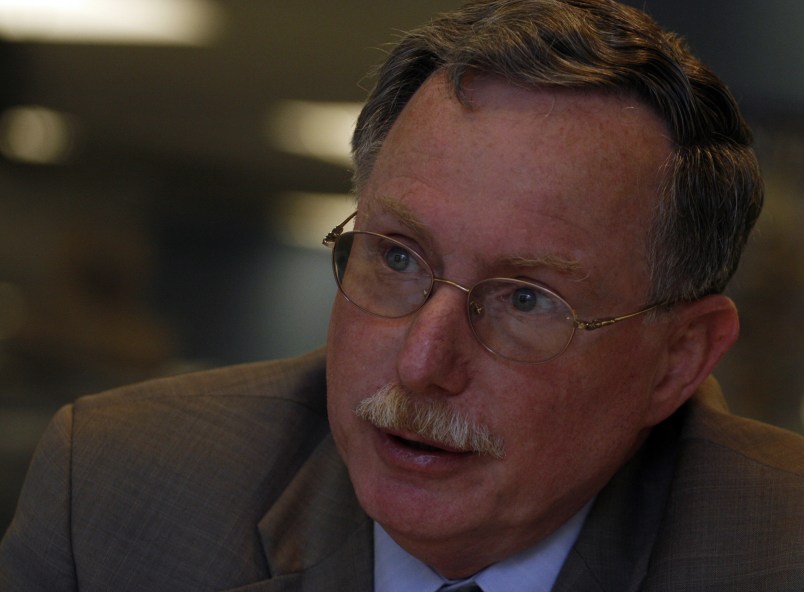
Mark Klein, the AT&T whistleblower who revealed the National Security Agency’s bulk electronic surveillance during the presidency of George W. Bush, has reportedly died.
Do you like Morning Memo? Let us know!
Biggest Federal Employee Unions Says Shutdown is Preferable to Elon/Trump CR
Federal workers obviously don’t like government shutdowns. Most of them are furloughed. Others are forced to continue working without pay. But in a letter addressed to members of the Senate, which I obtained, Everett B. Kelley, head of what I believe is the country’s biggest federal government employee union — the American Federation of Government Employees (AFGE) — asks senators to vote “no” on the House-produced continuing resolution, and says that a shutdown is actually preferable to passing the bill.
“AFGE is particularly struck that even as the Senate prepares to debate and vote on [the continuing resolution], the Trump administration has announced its intention to effectively destroy the Department of Education regardless of whether Congress approves or disapproves of that decision,” it reads. It also says they categorically reject the idea that voting against the CR means voting for a shutdown. They then go on to discuss that the administration just unilaterally canceled the collective bargaining agreement with TSA workers and declared the agency “union-free.”
Continue reading “Biggest Federal Employee Unions Says Shutdown is Preferable to Elon/Trump CR”This Was My Idea Pre-Kabuki
In the half-hour or so that I thought Dems were actually going to go to the mat over the continuing resolution, it occurred to me that, if it were up to me, my opening offer would be this: We’ll actually vote for a clean continuing resolution. We’ll even let you have all your DOGE cuts … with one condition. Write up exactly what the end state for each department and agency is. And then we’ll hold a vote for each department. Each department or agency individually. But it’s a bill. And it’s binding. We’ll even give up the right to filibuster. Straight majority votes in both houses. You’re the majority. How can you refuse that? Just put each one to a vote.
The Kabuki Cave
As you could see from my comments here and some occasional comments on Bluesky, I felt pretty confident for most of the day that Senate Dems were in the process of caving. Then I had to go offline for a couple hours in the late afternoon. I was a bit stunned and more than pleasantly surprised when I saw clips of Chuck Schumer’s floor speech saying that Senate Dems had the votes to block cloture. Wow, I thought: things were turning out better than I realized. I mean, if you have the votes to block cloture, you block cloture, right? Pretty quickly I heard from multiple sources what was actually happening. This was a deal between Schumer and Thune to allow a brief performative episode to throw Democratic voters off the scent while the Democratic caucus allowed the bill to pass. The deal is this: Democrats agree to give up the 60-vote threshold in exchange for being allowed to offer amendments to the House bill. The “amendment” or “amendments” will likely be some version of Sen. Murray’s 30-day CR. It doesn’t even matter what they are. But this is all for show. Once you give up the 60-vote threshold the whole thing is over.
Senator Kaine put it with great clarity: “Democrats had nothing to do with this bill. And we want an opportunity to get an amendment vote or two. So that’s what we are insisting on to vote for cloture.” Again you’re giving up “cloture,” the 60-vote threshold, in exchange for the ability to offer amendments that will certainly fail.
Continue reading “The Kabuki Cave”Marjorie Taylor Greene’s ‘DOGE’ Subcommittee Rushed To Defend Elon Musk’s Car Company
Tech billionaire Elon Musk’’s electric car company, Tesla, has faced a recent wave of protests, vandalism, and stock price drama related to anger over his “DOGE” efforts to reshape government agencies. But MAGA is coming to the company’s aid. President Trump on Tuesday delivered a sales pitch from the White House lawn. And, now, Rep. Marjorie Taylor Greene (R-GA), the chairwoman of the House DOGE subcommittee, has rushed to help by demanding a federal investigation from top Justice Department officials.
Greene’s letter, which was addressed to Attorney General Pam Bondi and FBI Director Kash Patel, was also signed by the other seven Republican members of the subcommittee. It was, however, written in the first person, as though it came from an individual.
“I am writing in regard to the recent wave of organized attacks targeting Elon Musk and Tesla car dealerships, charging stations, and vehicles across the country. These attacks, which seem to involve coordinated acts of vandalism, arson, and other acts of violence, seriously threaten public safety,” the letter said.
Along with the letter, the eight DOGE Republicans also issued a statement calling for an investigation into the matter.
“We are urging the Department of Justice and the FBI to prioritize a thorough investigation of these attacks,” the members said.
In the less than two months since Trump took office earlier this year, Musk has become one of the most visible and controversial parts of his administration, thanks both to his Inauguration-Day “seig heil” salute and the massive cuts, purges, and questionably legal access to Americans’ data undertaken by DOGE. Musk is apparently overseeing the DOGE effort, despite not officially filling the role of administrator. The initiative, which took over the U.S. Digital Service, is nominally focused on “efficiency,” but it has fallen far short of advertised savings while targeting diversity programs that represent a fraction of the federal budget.
The House DOGE subcommittee launched last month. Greene began the first hearing by declaring, “This committee will be laser-focused on bringing full transparency to the waste, fraud, and abuse within the federal government and presenting the plans to fix the tremendous problems we expose.”
TPM reached out to Greene’s office to ask how pressing for an investigation into “attacks” on Tesla, which is a private company, fits with that mission.
“The attacks are directly in response to DOGE, so of course it falls under the committee,” Nick Dyer, who is Greene’s deputy chief of staff, wrote in an email. “This is political violence meant to deter us from that mission.”
A spokesperson for Rep. Melanie Stansbury (D-NM), the ranking Democrat on the subcommittee, did not immediately respond to a request for comment. Musk also did not immediately respond to a request for comment from TPM.
Acts of vandalism have hit Tesla vehicles and facilities across the United States and overseas. Tesla has also been the focus of peaceful protests.
The letter from the DOGE subcommittee attempted to tie liberal and left-wing organizations to the anti-Tesla wave. It also cited “Antifa,” a frequent right wing bogeyman. While individuals who identify as “Antifa,” which is short for antifascist, have been a consistent presence at protests in recent years, there is no single, clear organization behind the phenomenon.
“Reports suggest that groups like Antifa, known for their history of domestic terrorism, including throughout the summer of 2020 following the death of George Floyd, may be involved in the recent Tesla attacks,” Greene’s letter said. “I urge the Department of Justice and the Federal Bureau of Investigation to prioritize a thorough investigation into these matters.”
Dyer, Greene’s deputy chief of staff, did not respond to questions asking which reports were cited in the letter. Greene, who has previously peddled blatant conspiracy theories related to “antifa,” also pointed to Musk, who has an extensive history of amplifying questionable information, as a source for the idea that liberal and left-wing organizations might be linked to the violence.
“There have been several attacks of this kind in recent days, with reports, including from Elon Musk himself, linking various Democrat-affiliated non-governmental organizations (NGOs) to them,” the letter said.
Greene’s letter concluded by asking the DOJ to identify “the individuals and groups responsible” and to answer whether there is “a link between NGOs and the organizers of these attacks.”
Trump himself has launched threats at anyone who might be linked to the anti-Tesla activity. The president, whose administration has already detained at least one political activist without evidence of criminality, has vowed harsh retribution against anyone who crosses his ally’s car company. As he touted the car company from the White House on Tuesday, Trump issued a stark warning.
“You do it to Tesla and you do it to any company, we’re going to catch you and you’re going to go through hell,” Trump said.
Judge Temporarily Blocks Trump’s Vendetta Against Law Firm
A federal judge blocked parts of Donald Trump’s executive order targeting the law firm Perkins Coie from the bench Wednesday, saying that aspects of it sent “little chills” down her spine.
Continue reading “Judge Temporarily Blocks Trump’s Vendetta Against Law Firm”After Heated Dem Meeting, Schumer Says Dems Will Push For Vote On Short Term CR First
With less than three days to go before government funding runs out, Senate Minority Leader Chuck Schumer (D-NY) is calling for a vote on the 30-day continuing resolution that top Democratic appropriators unveiled Monday night.
The guidance from the Democratic leader comes as Senate Democrats struggle with how to move forward after House Republicans shoved through the Trump-backed seven month continuing resolution on Tuesday. Some Senate Democrats have expressed a willingness to work with Republicans to avert a shutdown, while most of the party is opposed to helping Republicans as the Trump administration and Elon Musk continue to flout congressional spending appropriations, rescind funding for federal programs and shutter agencies.
Continue reading “After Heated Dem Meeting, Schumer Says Dems Will Push For Vote On Short Term CR First “‘The President Wanted It And I Did It’: Recording Reveals Head Of Social Security’s Thoughts On DOGE And Trump
This story first appeared at ProPublica. ProPublica is a Pulitzer Prize-winning investigative newsroom. Sign up for The Big Story newsletter to receive stories like this one in your inbox.
Since the arrival of a team from Elon Musk’s Department of Government Efficiency, Social Security is in a far more precarious place than has been widely understood, according to Leland Dudek, the acting commissioner of the Social Security Administration. “I don’t want the system to collapse,” Dudek said in a closed-door meeting last week, according to a recording obtained by ProPublica. He also said that it “would be catastrophic for the people in our country” if DOGE were to make changes at his agency that were as sweeping as those at USAID, the Treasury Department and elsewhere.
Dudek’s comments, delivered to a group of senior staff and Social Security advocates attending both in person and virtually, offer an extraordinary window into the thinking of a top agency official in the volatile early days of the second Trump administration. The Washington Post first reported Dudek’s acknowledgement that DOGE is calling the shots at Social Security and quoted several of his statements. But the full recording reveals that he went much further, citing not only the actions being taken at the agency by the people he repeatedly called “the DOGE kids,” but also extensive input he has received from the White House itself. When a participant in the meeting asked him why he wouldn’t more forcefully call out President Donald Trump’s continued false claims about widespread Social Security fraud as “BS,” Dudek answered, “So we published, for the record, what was actually the numbers there on our website. This is dealing with — have you ever worked with someone who’s manic-depressive?”
Throughout the meeting, Dudek made alarming statements about the perils facing the Social Security system, but he did so in an oddly informal, discursive manner. It left several participants baffled as to the ultimate fate of the nation’s largest and most popular social program, one that serves 73 million Americans. “Are we going to break something?” Dudek asked at one point, referring to what DOGE has been doing with Social Security data. “I don’t know.”
But then he said, in a more reassuring tone: “They’re learning. Let people learn. They’re going to make mistakes.”
Dudek embodies the dramatic whipsawing of life as a public servant under DOGE. For 25 years, he was the ultimate faceless bureaucrat: a midlevel analyst who had bounced between federal agencies, ultimately landing at the Social Security Administration and focusing on information technology, cybersecurity and fraud prevention. He was largely unknown even within the agency. But in February, he suddenly vaulted into the public eye when he was put on leave for surreptitiously sharing information with DOGE. It appeared that he might lose his job, but then he was unexpectedly promoted by the Trump administration to the position of acting commissioner. At the time, he seemed unreservedly committed to the DOGE agenda, writing — then deleting — a bellicose LinkedIn post in which he expressed pride in having “bullied agency executives, shared executive contact information, and circumvented the chain of command to connect DOGE with the people who get stuff done.”
Now, only weeks into his tenure, he was taking a far more ambivalent posture toward not just DOGE but Trump. On multiple occasions during last week’s meeting, according to the recording, Dudek framed the choices that he has been making in recent weeks as “the president’s” agenda. These choices have included planned cuts of at least 7,000 Social Security employees; buyouts and early retirement offered to the entire staff of 57,000, including those who work in field offices and teleservice centers helping elderly and disabled people navigate the program; cuts to disability determination services; the dissolution of a team that had been working to improve the user experience of the ssa.gov website and application process; a reduction of the agency’s footprint across the country from 10 regional offices to four; the terminations of 64 leases, including those for some field office and hearing office space; proposals to outsource Social Security customer service; and more.
“I work for the president. I need to do what the president tells me to do,” Dudek said, according to the recording. “I’ve had to make some tough choices, choices I didn’t agree with, but the president wanted it and I did it,” he added later. (He didn’t name specific actions that Trump did or did not direct.)
At still another point, Dudek said that “I don’t want to fire anyone” but that “a lot of the structural changes that you’ve seen me make at headquarters, I’ve had long conversations with the White House about, and the DOGE team. … And that’s not to say I don’t have some more hard choices to come. The president has an agenda. I’m a political appointee. I need to follow that agenda.”
Dudek also more than once dismissed Trump’s claims about Social Security fraud, which the president amplified just hours after Dudek’s meeting in a speech to Congress in which he implied that millions of probably-dead people over the age of 100 are receiving Social Security benefits. There are indeed 110-year-old and older people in one of the Social Security databases that the DOGE team has been looking at, Dudek said, but those people are “not in pay status” — they’re not actually being paid benefits. “These are records we never bothered with,” he explained.
Still, Dudek and two of his deputies, who also spoke intermittently at the meeting, seemed hesitant to more publicly resist Trump’s misstatements. A spokesperson chimed in to say that they were proud of a recent press release in which, in mild language, they’d obliquely contradicted some of the false claims. The other official said that DOGE’s narrative about dead people receiving benefits “got in front of us” but that “it’s a victory that you’re not seeing more [misinformation], because they are being educated.”
Spokespersons for Dudek and the Social Security Administration, the White House and Elon Musk did not respond to requests for comment.
Dudek’s remarks come at a time when many Social Security employees are feeling confused about Dudek, his role versus DOGE’s and what it all means for the future of the Social Security Administration, according to ProPublica’s conversations with more than two dozen agency staffers. Many said that because the recent cuts at the agency have been carried out in a piecemeal fashion, the public doesn’t seem to be grasping the totality of what is happening to the program, which is having its 90th anniversary this year.
The layoffs — and the looming specter of potentially thousands more employees taking a buyout by a Friday deadline — have meant even less attention to the complicated casework of low-income elderly people and people with physical and intellectual disabilities, as ProPublica has reported.
Meanwhile, DOGE, which Musk has portrayed as a squad of techno-efficiency geniuses, has actually undermined the efficiency of Social Security’s delivery of services in multiple ways, many employees said. Under DOGE, several Social Security IT contracts have been canceled or scaled back. Now, five employees told ProPublica, their tech systems seem to be crashing nearly every day, leading to more delays in serving beneficiaries. This was already a problem, they said, but it has gotten “much worse” and is “not the norm,” two employees said.
And under a policy that DOGE has applied at many agencies, front-line Social Security staff have been restricted from using their government purchase cards for any sum above $1. This has become a significant problem at some field offices, especially when workers need to obtain or make copies of vital records or original documents — birth certificates and the like — that are needed to process some Social Security claims, one management-level employee said.
“Elections have consequences,” Dudek wrote in a March 1 email to the agency’s staff.
In the meeting last week, Dudek was asked about many of these organizational changes, according to the recording. Regarding the closure and consolidation of regional offices as well as the cuts to the part of the agency that helps evaluate disability claims, which is already severely backlogged, he said: “It certainly was done at the administration level. That would have not been my first preference. I think we need to see what’s going to happen in terms of fallout.”
“Again,” he said, “I work for the president. DOGE is part of that.”
Dudek, who had been scheduled to speak for only 15 minutes, according to a copy of the agenda, instead spoke for around an hour, talking about everything from his upbringing by a disabled mother who’d depended on Social Security, to a 1989 book titled “Bureaucracy” that mentions Trump. He continued to vacillate between sharing advocates’ concerns for vulnerable Social Security recipients and sticking up for some of what DOGE has been trying to do at his agency.
“I actually like having the kids around,” he said, adding that although they were unfamiliar with the “nuances” of Social Security, he was trying to get them to be more thoughtful. “They’re thinking about work differently.”
He confirmed that the DOGE team members had broad access to Americans’ Social Security numbers and other personal data, but he claimed that if they were to do anything illegal with that information, he’d have them investigated and potentially prosecuted. He said he wanted to bulk up resources for field offices and customer service, even as front-line workers received buyout offers just like other staffers.
Throughout, Dudek emphasized that he wanted constructive feedback and open conversation, because he cares deeply about the Social Security Administration and the people it serves. He was honest about his shortcomings: “I’m in a role that I did not expect to be in,” he said. “I am an IT guy and a fraud guy.”
Dudek will eventually be replaced by Frank Bisignano, Trump’s long-term pick to run the Social Security Administration. At times, Dudek sounded fatalistic.
“I’m the villain,” he said in the recording. “I’m not going to have a job after this. I get it.”
The Last Day
I feel pretty certain that today is the last day to have any impact on what Democratic senators will do on the upcoming vote on the House-produced “continuing resolution.” There was apparently a pretty intense argument yesterday in a caucus meeting about what to do. (I’ll say more about that shortly). But I think Democratic senators have made a collective decision to keep their constituents in the dark about what they plan to do. That is part of a larger culture of opacity that has seemed to me to be an increasingly consequential part of the failure of civic governance in the country as the drama has played out. If you’re able to get any answers from your senator, please let me know.
Continue reading “The Last Day”