

I got a fascinating array of responses to my Tuesday post about the 21st century nabobs, striding over politics and society with their unheard of wealth and indifference to the rules we once imagined bound us. One of the big questions was, What happened to the original nabobs? Were they brought to heel? And several of you asked, Okay, so what are we going to do about this? I wanted to discuss these and other topics.
Trump DOJ Desperate to Keep Its Lawyers From Testifying In Contempt Inquiry
A lot has been flying around today in some of the key mass deportation/rule of law cases, but I want to tee up for you another major clash that is brewing:
Continue reading “Trump DOJ Desperate to Keep Its Lawyers From Testifying In Contempt Inquiry”BREAKING: Judge Blocks ICE From Re-Detaining Abrego Garcia
Sua Sponte and Nunc Pro Tunc
In a dramatic series of overnight developments, the Trump administration took extraordinary steps to try to re-detain Kilmar Abrego Garcia within hours of his court-ordered release, but a federal judge stepped in and blocked the move.
U.S. District Judge Paula Xinis of Maryland issued a temporary restraining order at 7 a.m. ET today barring the Trump administration from taking Abrego Garcia back into custody after she ordered his release yesterday. Her emergency order came after ICE directed Abrego Garcia to report to its Baltimore field office at 8 a.m. ET today. Fearing that Abrego Garcia would be re-detained when he showed up at ICE offices, his lawyers filed an emergency motion overnight imploring Xinis to intervene.
All of this unfolded only hours after Abrego Garcia was released from ICE custody on order from Xinis.
The highly unusual series of late-breaking events was punctuated by a remarkably cynical move by a Baltimore immigration judge, an executive branch official.
But first some context: The basis of Xinis’ order to release Abrego Garcia was that ICE had never issued an order of removal against him — itself an extraordinary development because his wrongful deportation in March to El Salvador and his subsequent detention since he was returned to the United States were entirely predicated on the supposed issuance of an order of removal in 2019.
After Xinis ruled Thursday morning that no such order of removal existed, Philip P. Taylor, the acting regional deputy chief immigration judge in Baltimore, rushed out a new order around 7 p.m. ET that purported to fix the “scrivener’s error” in ICE’s records on Abrego Garcia and retroactively create an order of removal. Taylor’s order was comically subtitled: “Immigration Court’s Sua Sponte Order Correcting Scrivener’s Error.”
Taylor’s sudden intervention is procedurally flawed in myriad ways, but that didn’t stop him from purporting to make a number of “corrections” to the record in Abrego Garcia’s 2019 case, waving it all away with a breezy: “These corrections are hereby issued nunc pro tunc to the Immigration Court’s written decision and order of October 10, 2019.”
In her emergency order this morning, Judge Xinis gave all of this such an aggressively arched eyebrow that she might have pulled a muscle:
The ICE Order of Supervision also states that Abrego Garcia was “ordered removed” on October 10, 2019, despite no such order having issued on that date. Instead, the ICE Order of Supervision seems to rely on an “order” issued last night from Immigration Judge Phillip Taylor. The Court does not opine on this newest “order” here. But the Court does note that this “order” was issued nunc pro tunc, effective October 10, 2019.
It was clear months ago that Abrego Garcia is being punished by the Trump administration for having the temerity to challenge his wrongful deportation to El Salvador in violation of a separate immigration judge’s order. Abrego Garcia’s unlawful incarceration in El Salvador, his return to the United States under a ginned-up criminal indictment, and his subsequent ICE detention have been among the most egregious rule-of-law violations of the Trump II presidency.
On top of that, the Trump administration has repeatedly defied Xinis’ orders in the Abrego Garcia cases, a fact not lost on Xinis herself, who writes in her emergency order:
[T]he public retains keen interest in ensuring that government agencies comply with court orders, especially those necessary to protect individual liberties. … For the public to have any faith in the orderly administration of justice, the Court’s narrowly crafted remedy cannot be so quickly and easily upended without further briefing and consideration.
The matrix of orders that Xinis now has in place should in theory protect Abrego Garcia from immediate detention and deportation — but so far the Trump administration has exhibited a sadistic willingness to do anything to torment him, including violating Xinis’ orders.
The Retribution: Letitia James Edition
Last Thursday, the Trump DOJ failed to re-indict New York Attorney General Letitia James on bogus mortgage fraud charges when a federal grand jury in Norfolk, Virginia returned a no-true bill. So yesterday, they brought the case to a new grand jury in Alexandria, Virginia — and got the same result. With each effort, the vindictive prosecution claim James has grows stronger.
Fake Pardon Alert
President Trump purported to pardon former Mesa County (Colorado) clerk Tina Peters, who is currently jailed for her state conviction for tampering with voting machines to try to prove the 2020 Big Lie. Peters has never been charged federally, and her state conviction is beyond the reach of a presidential pardon. I could pardon Peters on the state charges and have the same effect.
2026 Ephemera
MyPillow Founder Mike Lindell — a Big Lie devotee — launches a 2026 bid for governor of Minnesota.
Indiana Rebuffs Trump Redistricting Scheme
Enough GOP state senators in Indiana resisted White House entreaties to block the GOP-friendly mid-decade redistricting plan that would have added a couple of more House seats to the Republican column.
Great Read
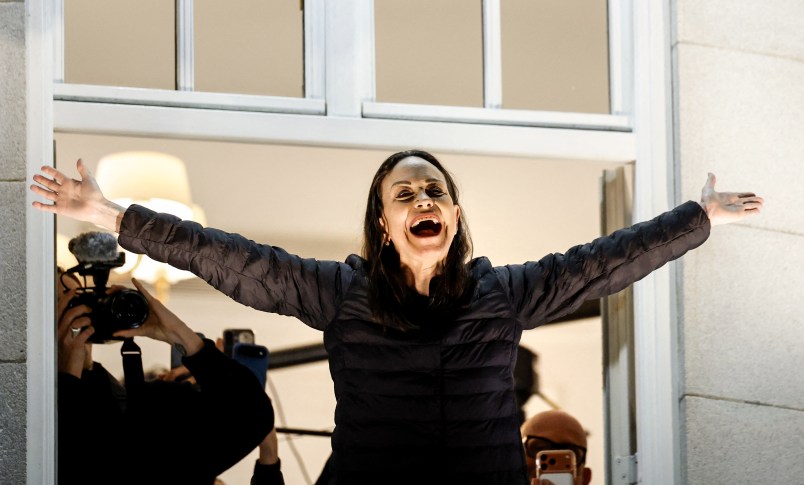
The WSJ has a riveting account of opposition leader María Corina Machado’s escape from Venezuela this week to receive the Nobel Peace Prize in Norway. At one point, she was lost and adrift at night in the Gulf of Venezuela before being found by an extraction team in a mission dubbed Operation Golden Dynamite. If you know, you know.
Hot tips? Juicy scuttlebutt? Keen insights? Let me know. For sensitive information, use the encrypted methods here.
The Undocumented Underground Is Fighting Back Inside New York’s Notorious Immigration Court
One day last month, a Peruvian mother and her daughter went into Manhattan. They were both dressed in their best. The girl, who could not have been more than 10 years old, had a pink backpack shaped like a cat and matching bows in her hair. It was an important day: they were due at the immigration court at 26 Federal Plaza for a hearing related to their effort to obtain lawful residency.
But while these courthouses are theoretically the gateway to American justice and citizenship, in recent months they have played host to horrifying scenes where many of those who hope to experience the best of this nation are instead forcefully rounded up in the halls by federal agents.
Since President Donald Trump retook the White House in January, he has sought to bring his vision for “mass deportation” to life by expanding the budget for the Immigration and Customs Enforcement agency, instituting drastic removal quotas, expanding detention facilities with little concern for alleged human rights abuses, and staging dramatic raids with heavily armed officers from multiple federal agencies. In New York City, the masked footsoldiers of Trump’s deportation machine have set up shop in three immigration courts where they regularly detain people who show up for hearings and mandatory check-ins.
When these agents pull immigrants from the halls of these Manhattan courthouses, they are also ripping them from their shot at citizenship. Often those who are being dragged away have further court dates and appeals. Traditional due process is being snatched from them. Even for those who are not taken, the daily spectacle has left them with a profound fear. Each person who comes to these courts knows they could be next.
Continue reading “The Undocumented Underground Is Fighting Back Inside New York’s Notorious Immigration Court”Indiana Guv Vows to Help Trump Challenge His Own State’s GOPers Who Rejected Gerrymander
Just moments after 21 Republican members of Indiana’s state Senate voted with Democrats to reject President Trump’s aggressive attempt to force the state to draw a new congressional map, one that would have dramatically reduced Indiana Democrats’ chances of holding seats in the U.S. House next year, Gov. Mike Braun went on Twitter to demonstrate his support for … Trump.
Continue reading “Indiana Guv Vows to Help Trump Challenge His Own State’s GOPers Who Rejected Gerrymander”Indiana Senate Republicans Defy Trump Admin and Reject Gerrymandered Maps
Despite months of mounting and concerted pressure from the Trump administration, the Indiana Senate rejected a proposal for a new gerrymandered congressional map ahead of the 2026 midterm elections.
Continue reading “Indiana Senate Republicans Defy Trump Admin and Reject Gerrymandered Maps”Both Dem and GOP Messaging Bills on Expiring ACA Subsidies Fail in Senate As Expected
The Senate voted on two competing health care plans to address the expiring Affordable Care Act (ACA) subsidies on Thursday. Both were largely messaging votes that gave both parties something to point to when constituents are hit with skyrocketing health care costs after the subsidies expire at the end of the year.
Both failed to meet the 60 vote threshold on the Senate floor.
Continue reading “Both Dem and GOP Messaging Bills on Expiring ACA Subsidies Fail in Senate As Expected”Fetterman Writes Letter Asking Israel’s President to Pardon Netanyahu
Sen. John Fetterman (D-PA) prepared a letter in recent days asking Israel’s president for a favor.
Continue reading “Fetterman Writes Letter Asking Israel’s President to Pardon Netanyahu”The Cruelest Irony of the Abrego Garcia Case
In the convoluted, never-ending saga of the wrongfully deported and then indicted Kilmar Abrego Garcia, a federal judge in Maryland this morning ordered his immediate release from ICE custody — on grounds that are tinged with the bitterest of ironies.
Continue reading “The Cruelest Irony of the Abrego Garcia Case”Pam Bondi Is Low-Key Defying Federal Judges Over DQ’d US Attorneys
The Zombie U.S. Attorney Problem
While the Trump administration has repeatedly lost in court for invalidly installing interim U.S. attorneys, it has not yet backed down and relinquished the appointment power to federal judges.
A quick backgrounder on the law: Recent court decisions have reaffirmed that until the Senate confirms a U.S. attorney, the attorney general can only appoint an interim U.S. attorney for a term of 120 days. After that initial term expires, the interim U.S. attorney must be appointed by the federal judges in the district, under one statutory scheme.
In two of the high-profile cases where Bondi tried to sidestep the judges and lost, she continues to try to come up with workarounds to control the appointments herself, rather than ceding the power to the district judges.
In New Jersey — even after the Third Circuit Court of Appeals affirmed in the Giraud case that Alina Habba was not validly appointed as U.S. attorney and she resigned this week — Bondi took the unusual step of appointing a troika of attorneys on Monday to run the U.S. attorney’s office.
In a Dec. 8 memo approved by the Office of Legal Counsel, Henry C. Whitaker, who serves as counselor to the attorney general, wrote that the appointment of three lawyers who hold titles as special attorney, special counsel, and executive assistant U.S. attorney would be in compliance with the Constitution’s Appointment Clause: “This proposed order would divide the responsibilities of the United States Attorney among three officials so that the district may have continuity of leadership while the Department considers next steps in the Giraud litigation.”
On one level, you can understand why the administration would not want to cede appointment power to judges before it has decided whether to appeal the Third Circuit’s decision on Habba. Once it gives up that power and an interim U.S. attorney is appointed by the judges, the administration can’t get it back. But when you step back a bit, the pattern of refusing to yield to the statutory scheme that gives federal judges a role in naming interims after 120 days becomes more clear.
In the Eastern District of Virginia, Lindsey Halligan’s name continues to appear on government legal filings as interim U.S. attorney despite a court ruling that she was invalidly appointed. Federal judges in the district have called her out in recent days, and one judge went as far as saying Halligan should resign like Habba did. “That’s the proper position, in my view,” U.S. District Judge Leonie M. Brinkema said during a hearing Tuesday.
Another federal judge outside Halligan’s district drew attention to Halligan’s zombie status in an order yesterday. In a case related to the Trump administration’s dismissed prosecution of former FBI Director James Comey, U.S. District Judge Colleen Kollar-Kotelly of D.C. noted that Halligan’s improperly filed notice of appearance didn’t include her name but that of Deputy Attorney General Todd Blanche:

Kollar-Kotelly also expressed concern about the implications of the misfiled notices of appearance, noting they function “[t]o ensure that counsel who are accountable for the Government’s representations and legal positions in this matter are accurately identified in the official record of this case.” She gave the DOJ attorneys until this morning to file properly their notices of appearance in the case. In response, Halligan filed a new entry of appearance.
Bondi is using similar-in-spirit workarounds in two other districts, where the circumstances are different and probably legal under a different statutory scheme that allows first assistant U.S. attorneys to fill vacancies for 210 days (plus extensions under certain conditions). In Nevada, Bondi made Sigal Chattah the first assistant U.S. attorney and a special attorney after she was disqualified. In the Central District of California, Bondi made Bill Essayli the first assistant U.S. attorney after he too overstayed his term as interim.
So far, there’s no sign the judges in New Jersey or the Eastern District of Virginia are moving to confront Bondi’s defiance directly.
BREAKING: Judge Orders Abrego Garcia Released From ICE Custody
U.S. District Judge Paula Xinis of Maryland granted Kilmar Abrego Garcia’s petition for a writ of habeas corpus and ordered his immediate release from ICE custody.
All Part of His SCOTUS Audition?
An ethics complaint has been filed against appeals court Judge Emil Bove for his appearance at President Trump’s Tuesday rally in Pennsylvania.
The Corruption: Pardon Edition
- WSJ: A Visual Breakdown of Trump’s Pardon Spree
- Bloomberg: Almost 400 people pardoned or granted clemency by President Donald Trump in connection with the Jan. 6 attack are now seeking millions of dollars in damages from the federal government. They are represented by Attorney Mark McCloskey of St. Louis, whom you might remember as this guy:

Quote of the Day
U.S. District Judge Charles Breyer, in a ruling that blocked President Trump’s federalization of the California National Guard as unlawful:
The Founders designed our government to be a system of checks and balances. Defendants, however, make clear that the only check they want is a blank one. Six months after they first federalized the California National Guard, Defendants still retain control of approximately 300 Guardsmen, despite no evidence that execution of federal law is impeded in any way—let alone significantly. What’s more, Defendants have sent California Guardsmen into other states, effectively creating a national police force made up of state troops. In response to Plaintiffs’ motion to enjoin this conduct, Defendants take the position that, after a valid initial federalization, all subsequent re-federalizations are completely, and forever, unreviewable by the courts. Defendants’ position is contrary to law.
Venezuela Watch
President Trump trumpeted the U.S. seizure of a sanctioned oil tanker off the coast of Venezuela. While the move is provocative in the context of Trump’s saber-rattling toward the Maduro regime, it doesn’t appear to be directly connected to the anti-drug-trafficking pretext the Trump administration has used for its aggressive recent actions in the region. The tanker is reportedly part of a global shadow fleet that transports sanctioned oil.
This Is What Our Friends Are Saying
The Danish Defense Intelligence Service released a new report that warns the United States can no longer be counted on not to use military force against its own allies.
“The United States uses economic power, including threats of high tariffs, to enforce its will, and no longer rules out the use of military force, even against allies,” the report said.
Hot tips? Juicy scuttlebutt? Keen insights? Let me know. For sensitive information, use the encrypted methods here.