

A Texas law that bans all abortions after six weeks of pregnancy went into effect Wednesday after the Supreme Court let the midnight deadline to stop it pass.
Continue reading “As Of Midnight, Texas Is Living In A Post-Roe World”
A Texas law that bans all abortions after six weeks of pregnancy went into effect Wednesday after the Supreme Court let the midnight deadline to stop it pass.
Continue reading “As Of Midnight, Texas Is Living In A Post-Roe World”
Since the pandemic reached our shores last year, the right has been extremely vocal about its deeply held opposition to any type of government regulation that impacts personal health choices.
Continue reading “Where Things Stand: Pro-Choice When They Like Your Choice”
In May, a Michigan judge dismissed a Trumpy lawsuit over the 2020 election results in Antrim County, Michigan, where a clerk’s error had briefly resulted in a miscount of the vote. “Expert” witnesses in the suit had seized on the discrepancy, which they claimed was the result of Dominion voting machine technology “purposefully designed” to tamper with vote totals.
Continue reading “Election Truthers Are Spilling Sensitive Data Everywhere, And They’re Not Sorry”
Rep. Liz Cheney (R-WY) thinks every member of Congress ought to condemn Rep. Madison Cawthorn’s (R-NC) recent remarks in which he referred, among other things, to busting Jan. 6 insurrectionists out of jail and potential “bloodshed” over “rigged” and “stolen” elections.
Continue reading “Cheney Calls On McCarthy To Condemn Cawthorn’s Talk Of Political ‘Bloodshed’”
The “Maderna” vaccine won’t get you into Hawaii.
Continue reading “Cops Nab Woman Carrying ‘Maderna’ Vax Card To Enter Hawaii”
Benjamin Eugene Dagley, who local police say is the man seen angrily confronting MSNBC correspondent Shaquille Brewster during live coverage of Hurricane Ida in Mississippi, was also charged in Ohio in 2017 for nearly causing what one Cleveland newspaper described as a “potential environmental disaster.” Continue reading “Man Who Disrupted Reporter’s Ida Live Shot Almost Caused ‘Environmental Disaster’ In Ohio”
With the American war in Afghanistan and the American withdrawal from Afghanistan now definitively over, I’ve been trying to put the entirety of the last four weeks into some perspective. As you can see I’ve been fairly dug in on the proposition that the great majority of the criticism we’ve seen amounts to ignorance and deflection. Pulling the plug on a failed or misconceived mission isn’t pretty. But it is inevitable. The ugliness is built into the failure rather than a consequence of recognizing it. Most of what we’ve seen is an attempt to deny the failure (mostly hawks) or imagine that withdrawing would be orderly and free of consequences. But with all this reasoning, what parts were handled poorly? What could have been better organized or cleaner?
Perhaps this is only a matter of stepping back and with the benefit of clear eyes and more perspective and, well … agreeing with myself. But honestly, I think I really agree with myself. The airlift evacuation appears to have transported well over 110,000 people out of the country, an astonishing feat under any circumstances and probably unprecedented for a civilian airlift in a kinetic military context and in the context of state collapse.
Continue reading “Taking Stock Of The Great and Cowardly Press Freakout Of August 2021”
All the latest on the new Texas anti-abortion law that went into effect at midnight.
A reporter in Traverse City, Michigan was allegedly assaulted during an anti-mask rally, and now the sheriff’s office is seeking information on one of the two men potentially involved.
This article is part of TPM Cafe, TPM’s home for opinion and news analysis. It first appeared at The Conversation.
The U.S. invaded Afghanistan in late 2001 to destroy al-Qaida, remove the Taliban from power and remake the nation. On Aug. 30, 2021, the U.S. completed a pullout of troops from Afghanistan, providing an uncertain punctuation mark to two decades of conflict.
For the past 11 years I have closely followed the post-9/11 conflicts for the Costs of War Project, an initiative that brings together more than 50 scholars, physicians and legal and human rights experts to provide an account of the human, economic, budgetary and political costs and consequences of the Iraq and Afghanistan wars.
Of course, by themselves figures can never give a complete picture of what happened and what it means, but they can help put this war in perspective.
The 20 numbers highlighted below, some drawn from figures released on Sept. 1, 2021, by the Costs of War Project, help tell the story of the Afghanistan War.
On Sept. 18, 2001, the U.S. House of Representatives voted 420-1 and the Senate 98-0 to authorize the United States to go to war, not just in Afghanistan, but in an open-ended commitment against “those responsible for the recent attacks launched against the United States.” U.S. Rep. Barbara Lee of California cast the only vote opposed to the war.
In other words, the U.S. Congress took 7 days after the 9/11 attacks to deliberate on and authorize the war.
At 7,262 days from the first attack on Afghanistan to the final troop pullout, Afghanistan is said to be the U.S.‘s longest war. But it isn’t – the U.S. has not officially ended the Korean War. And U.S. operations in Vietnam, which began in the mid-1950s and included the declared war from 1965-1975, also rival Afghanistan in longevity.
U.S. President George W. Bush told members of Congress in a joint session on Sept. 20, 2001 that the war would be global, overt, covert and could last a very long time.
“Our war on terror begins with al-Qaida, but it does not end there. It will not end until every terrorist group of global reach has been found, stopped and defeated. … Americans should not expect one battle, but a lengthy campaign, unlike any other we have ever seen,” he said.
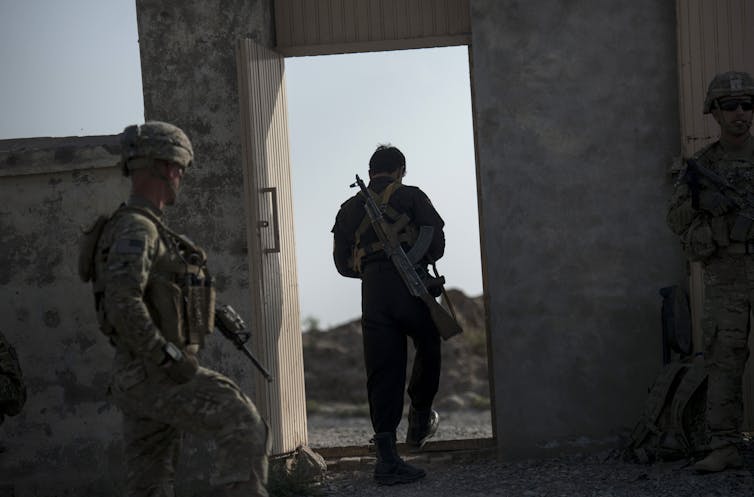
Neta C. Crawford, Boston University
The U.S. started bombing Afghanistan a few weeks later. The Taliban surrendered in Kandahar on Dec. 9, 2001. The U.S. began to fight them again in earnest in March 2002. In April 2002, President Bush promised to help bring “true peace” to Afghanistan: “Peace will be achieved by helping Afghanistan develop its own stable government. Peace will be achieved by helping Afghanistan train and develop its own national army. And peace will be achieved through an education system for boys and girls which works.”
The global war on terror was not confined to operations in Iraq and Afghanistan. The U.S. now has counterterrorism operations in 85 countries.
Most Afghans alive today were not born when the U.S. war began. The median age in Afghanistan is just 18.4 years old. Including their country’s war with the Soviet Union from 1979 to 1989 and civil war in the 1990s, most Afghans have lived under nearly continuous war.
There are, according to the U.S. Bureau of Labor Statistics, 980,000 U.S. Afghanistan war veterans. Of these men and women, 507,000 served in both Afghanistan and Iraq.
As of mid-August 2021, 20,722 members of the U.S. military had been wounded in action in Afghanistan, not including the 18 who were injured in the attack by ISIS-K outside the airport in Kabul on Aug. 26, 2021.
Of the veterans who were injured and lost a limb in the post-9/11 wars, many lost more than one. According to Dr. Paul Pasquina of the Uniformed Services University of the Health Sciences, of these veterans, “About 40% to 60% also sustained a brain injury. Because of some of the lessons learned and the innovations that have taken place on the battlefield … we were taking care of service members who in previous conflicts would have died.”
In fact, because of advances in trauma care, more than 90% of all soldiers in Afghanistan and Iraq who were injured in the field survived. Many of the seriously injured survived wounds that in the past might have killed them.
In all, 2,455 U.S. service members were killed in the Afghanistan War. The figure includes 13 U.S. troops who were killed by ISIS-K in the Kabul airport attack on Aug. 26, 2021.
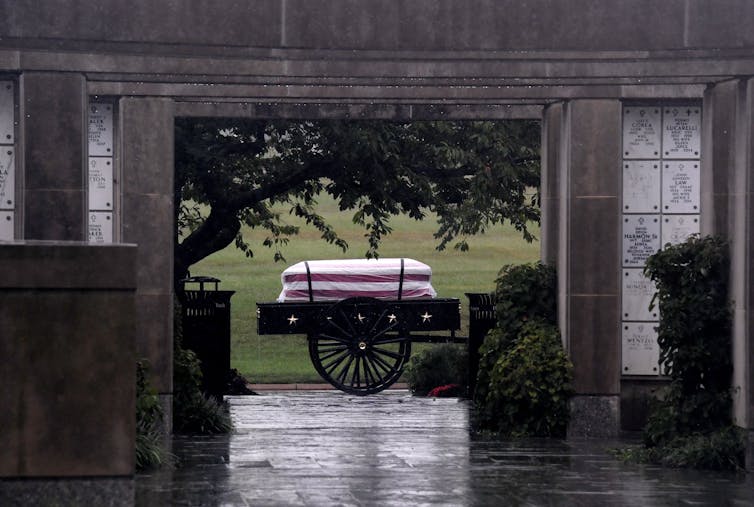
U.S. deaths in Operation Enduring Freedom also include 130 service members who died in other locations besides Afghanistan, including Guantanamo Bay in Cuba, Djibouti, Eritrea, Ethiopia, Jordan, Kenya, Kyrgyzstan, Pakistan, Philippines, Seychelles, Sudan, Tajikistan, Turkey, Uzbekistan and Yemen.
The U.S. has paid US$100,000 in a “death gratuity” to the survivors of each of the service members killed in the Afghanistan war, totaling $245.5 million.
More than 46,000 civilians have been killed by all sides in the Afghanistan conflict. These are the direct deaths from bombs, bullets, blasts and fire. Thousands more have been injured, according to the United Nations Assistance Mission in Afghanistan.
And while the number of Afghans leaving the country has increased in recent weeks, more than 2.2 million displaced Afghans were living in Iran and Pakistan at the end of 2020. The United Nations Refugee Agency reported in late August 2021 that since the start of that year, more than 558,000 people have been internally displaced, having fled their homes to escape violence.
According to the United Nations, in 2021 about a third of people remaining in Afghanistan are malnourished. About half of all children under 5 years old experience malnutrition.
The human toll also includes the hundreds of Pakistani civilians who were killed in more than 400 U.S. drone strikes since 2004. Those strikes happened as the U.S. sought to kill Taliban and al-Qaida leaders who fled and sheltered there in late 2001 after the U.S. invasion of Afghanistan. Pakistani civilians have also been killed in crossfire during fighting between militants and the Pakistani military.
In terms of the federal budget, Congress has allocated a bit over $1 trillion to the Department of Defense for the Afghanistan War. But all told, the Afghanistan War has cost much more than that. Including the Department of Defense spending, more than $2.3 trillion has been spent so far, including increases to the Pentagon’s base military budget due to the fighting, State Department spending to reconstruct and democratize Afghanistan and train its military, interest on borrowing to pay for the war, and spending for veterans in the Veteran Affairs system.
The total costs so far for all post-9/11 war veterans’ disability and medical care costs are about $465 billion through fiscal 2022. And this doesn’t include the future costs of all the post-9/11 veterans’ medical and disability care, which Harvard University scholar Linda Bilmes estimates will likely add about $2 trillion to the overall cost of care for veterans of the Iraq and Afghanistan wars between now and 2050.
The war in Afghanistan, like many other wars before it, began with optimistic assessments of a quick victory and the promise to rebuild at war’s end. Despite Bush’s warning of a lengthy campaign, few thought then that would mean decades. But 20 years later, the U.S is still counting the costs.
Neta C. Crawford is a professor of Political Science and Department Chair at Boston University.
This article is republished from The Conversation under a Creative Commons license. Read the original article.
This article was updated on Sept. 1, 2021 to correct the total death gratuity paid to survivors of service members killed in the Afghanistan war to $245.5 million.