


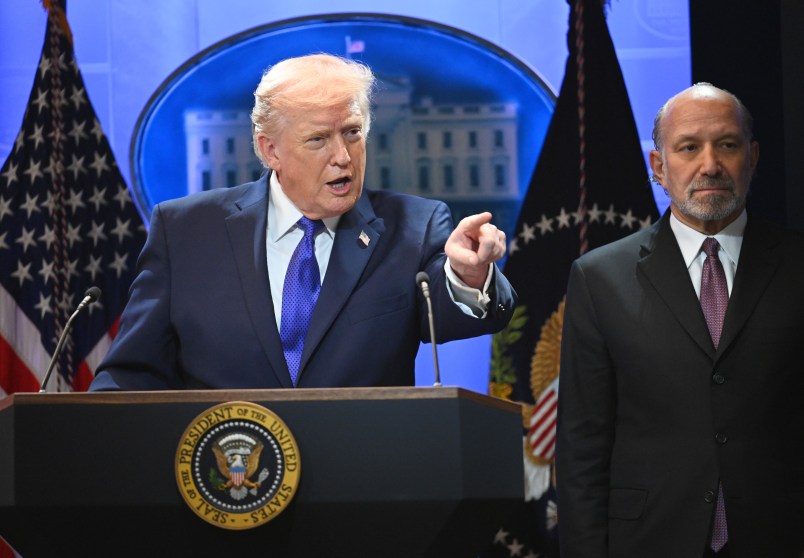
President Donald Trump’s signature economic policy hit another brick wall Thursday evening when the Court of International Trade overturned new tariffs Trump enacted to replace the tariffs blocked by the Supreme Court.
The Court of International Trade Chief Judge Mark A. Barnett and Judge Claire R. Kelly ruled Trump’s Section 122 tariffs were unlawful. They ordered a permanent injunction to begin within five days and directed the government to refund the small businesses that sued the Trump administration for any tariffs they’ve already paid, plus interest. Senior Judge Timothy C. Stanceu dissented.
On a press call Thursday evening, the plaintiffs’ attorney, Jeffrey Schwab of the Liberty Justice Center, said he expects the Trump administration to appeal. Schwab also said on the call that while the decision applies to plaintiffs with standing, it’s unclear whether importers who were not party to the case have to continue paying the duties because the court ruled it did not need to decide whether to enter a universal injunction.
Trump announced a new set of blanket 10% tariffs on February 20, the same day the Supreme Court overturned Trump’s tariffs levied under the International Emergency Economic Powers Act, or IEEPA, beginning in February last year. Notably, the president excluded several imports from his February 2026 order. The tariffs have been in place and paid by U.S. importers since February 24 and were expected to remain in effect until July 24. Trump levied the tariffs using a presidential proclamation.
By early March, the Liberty Justice Center sued the administration on behalf of two small businesses — a New York-based spice distributor called Burlap & Barrel and a Florida-based toy company called Basic Fun! At issue was whether the Trump administration satisfied and could prove it was addressing the “large and serious” “balance-of-payments deficits” requirement outlined in Section 122 of the Trade Act of 1974.
In addition to the small businesses, 24 states were plaintiffs in the case. The court ruled the small businesses and the state of Washington had standing because they were able to prove they were directly impacted by paying the tariffs. The other 23 states did not prove they directly paid tariffs and were denied standing.
During oral arguments in April, judges struggled to understand exactly what “balance-of-payments deficits” were and attorneys on both sides struggled to define them. That lack of clarity at the time led plaintiffs’ lawyer Schwab to suggest the judges strike down the tariffs based on the major questions doctrine, since the tariffs had “vast economic and political significance” that perhaps Congress hadn’t explicitly defined.
Legislative history shows Congress was intentional when it described Section 122 tariffs as applicable to address “large and serious” “balance-of-payment deficits,” according to Thursday’s decision. The government failed to meet the letter of the law, the court found.
“Rather than identifying ‘balance-of-payments deficits’ as that term was intended in 1974, the Proclamation relies upon current account deficits, and a discussion of ‘a large and serious trade deficit,’” Barnett and Kelly wrote in the majority decision. “Nowhere does Proclamation No. 11012 identify balance-of-payments deficits within the meaning of Section 122 as it was enacted in 1974.”
Further, the court found that the administration’s interpretation of the congressional statute “would raise a non-delegation issue, which in turn would prompt a constitutional question.”
Instead of an expansive interpretation, the court found congressional deliberations sought to limit presidential overreach on tariffs through specific language and definitions.
“[T]he legislative history chronicles a series of efforts to carefully cabin Presidential discretion,” the judges wrote.
Judges also referred to that February Supreme Court decision overturning Trump’s IEEPA tariffs and pointed to the fact that the president does not have unilateral tariffs powers without explicit congressional approval and without having met the very specific criteria outlined in the law.
“The United States has a trade deficit, not a balance-of-payments deficit, and does not have international payments problems,” Schwab said in a press release following the decision. “The President cannot impose these tariffs under Section 122.”



“The President cannot impose these tariffs under Section 122.”
Since the court threw out 23 states for lack of standing, and only included WA state and 2 businesses, does this verdict apply only to these 3 entities, or is it a blanket nullification for all?
Whatever the scope of this ruling, if it’s bad for Shitler, it’s good for the United States of America.
Wow: I didn’t realize that balance of payments was the underlying basis for Mr. Trump’s arbitrary tariffs. If so, it is a really stupid idea. An analogy given by an economist is where a poor country imports agricultural products to the U.S. What would we expect to happen: they export bananas to us and then import supercomputers from us? Of course, there would be a huge trade imbalance with that country, but it would be hard to argue that obtaining cheap bananas was somehow harming U.S. companies or consumers.
Of course I try to keep up, but this has me confused–is this a game-changer or is this another situation where Alito will come to Trump’s rescue?
Depends, Alito most likely would like to help Trump, but if it affects one of his billionaire friends… it’s a tough one