


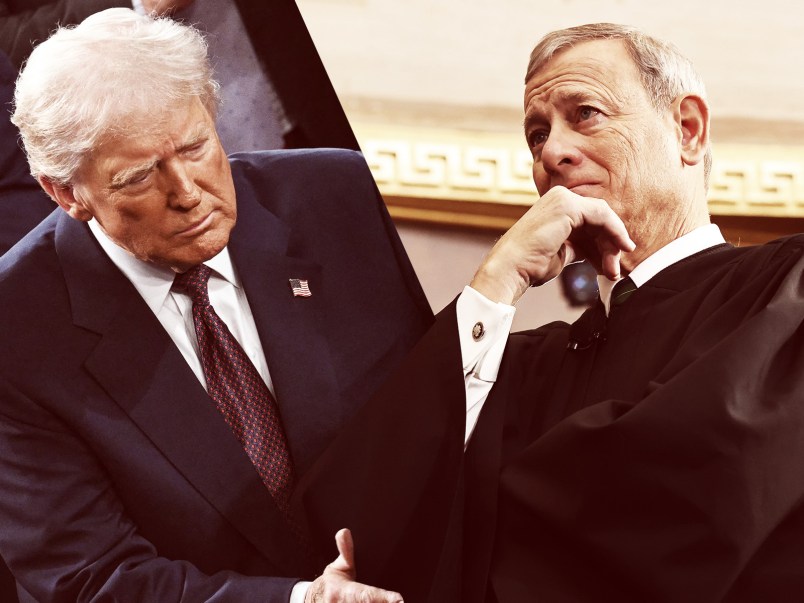
You wouldn’t know it from the right’s ongoing social media tantrum, but the Supreme Court turned in another slate of decisions this term that gave Republicans nearly everything they wanted.
The upholding of birthright citizenship — the cause of much of the angst — was less a defeat for the right and more a revelation that four justices do not believe that everyone born on American soil automatically becomes a citizen under the 14th Amendment. Many court watchers anticipated a 9-0 ruling reinforcing the right, or at least a 7-2 with the typical crank allotment for Justices Samuel Alito and Clarence Thomas.
But otherwise, the right-wing majority delivered on almost all of Trump’s priorities: mass deportation, destruction of the administrative state and giving Republicans an artificial electoral advantage. The only major cases the Court decided against Trump, other than birthright citizenship — preventing him from firing a Federal Reserve governor and blocking tariffs — were ones in which a victory for the administration would existentially threaten the economy.
Justice Brett Kavanaugh said as much in his concurrence in Trump v. Cook, which created a carveout in the Court’s expansive view of executive power for the Federal Reserve: the Court, Kavanaugh explained, was preventing Trump from taking over the Fed now less for a legal reason and more because it didn’t want to upend the global economy.
“Leaving that question open would create significant uncertainty about whether the Court might soon eliminate the Federal Reserve’s independence, and thereby expose the Federal Reserve to political influences and jeopardize the efficacy of U.S. monetary policy,” he wrote. “Even temporary uncertainty about the status of the Federal Reserve could spark political upheaval, including confusion about whether the President could immediately remove multiple Governors at will, as well as turmoil in the U.S. and world economies.”
“I would not risk destabilizing the U.S. economy just so that we can further mull over an issue that, in various permutations, we have been thinking about for many years,” he added.
The Fed case was the starkest, delivered at the same time as another Roberts-led majority in Trump v. Slaughter, which eliminated removal protections for agencies constituted like the Fed, but whose work the justices felt less compelled to preserve. Most of them are primarily regulatory bodies, including the Consumer Product Safety Commission, the Chemical Safety Board and the Nuclear Regulatory Commission.
The preservation of the Fed’s independence wouldn’t be so stark if the Roberts Court hadn’t so single-mindedly degraded the protections of every other independent agency in the executive branch, the better to funnel all the power to the presidency.
“Perhaps most strikingly, the Court today also makes clear that, whatever the logic of its decision, there are some ad hoc historical exceptions to its totalizing view of Article II, at least for the Federal Reserve,” Justice Sonia Sotomayor wrote in her Slaughter dissent, adding: “What is unclear is why these principles should be limited only to agencies, like the Federal Reserve, that in some respects influence ‘monetary policy.’”
In the tariff case, Learning Resources, Inc. v. Trump, the Court also broke with its usual practices. Under Trump, it has nearly always enhanced the power of the presidency, molding the role in accordance with the unitary executive theory. That has manifested in the criminal immunity decision and the many rulings bringing executive agencies under the president’s direct command.
In Learning Resources, though, the Court ruled that Trump had gone too far.
“…the Government reads IEEPA to give the President power to unilaterally impose unbounded tariffs and change them at will,” Chief Justice John Roberts wrote for the majority. “That view would represent a transformative expansion of the President’s authority over tariff policy.”
He added that the tariffs “extend beyond the President’s ‘legitimate reach.’”
As Sotomayor put it, this Court is willing to make “ad hoc exceptions” to its war on executive branch agencies and creation of an all-powerful presidency. They just happen to usually be in service of shielding U.S. capitalism from Trump-imposed turmoil.




It’s money that matters.
PFFT… SAY WHAT? TRUMP has raked in over 2 Billion in Term 2… IF that’s not messing with money I don’t know what is.
Even the Supreme Court knows you don’t give the keys to vault to someone who bankrupted 5 casinos.
SCROTUS…body unclear, is it a complete sentence?
Trump has more power than a king and is essentially a dictator because Congress under the MAGA cult has surrendered its authority. The Supreme Court has enabled massive lawless with the immunity decision and stripped away hundreds of laws pass by Congress to protect formerly independent agencies.
What does this all mean? It means the U.S. is a corrupted semi democracy. The courts won’t stop the Trump regime. The only protection are the November and later the 2028 contests.
The Congress would need to be unusually aggressive after this Fall’s election (assuming the Trump regime doesn’t steal it). No more timidity. No more pretending things are normal. No more treating Trump and his criminal regime as anything other than lawless thieves who need to be stopped at all costs.
Are Chuck Schumer and Hakeem Jeffries up to this task?