


The Supreme Court’s right-wing majority ruled Thursday that courts cannot review non-constitutional challenges to the Department of Homeland Security’s decision to terminate Temporary Protected Status for refugees fleeing particularly dangerous countries.
They did not reach a conclusion on whether the Court can review constitutional challenges but dismissed clear evidence of racial animus as a motivating factor, making it likely that they’d ultimately bar court review altogether.
In effect, this means that thousands of Haitian and Syrian refugees can, and likely will, be sent back to places so dangerous that, in Haiti’s case, the State Department recommends leaving behind dental records to help identify remains.
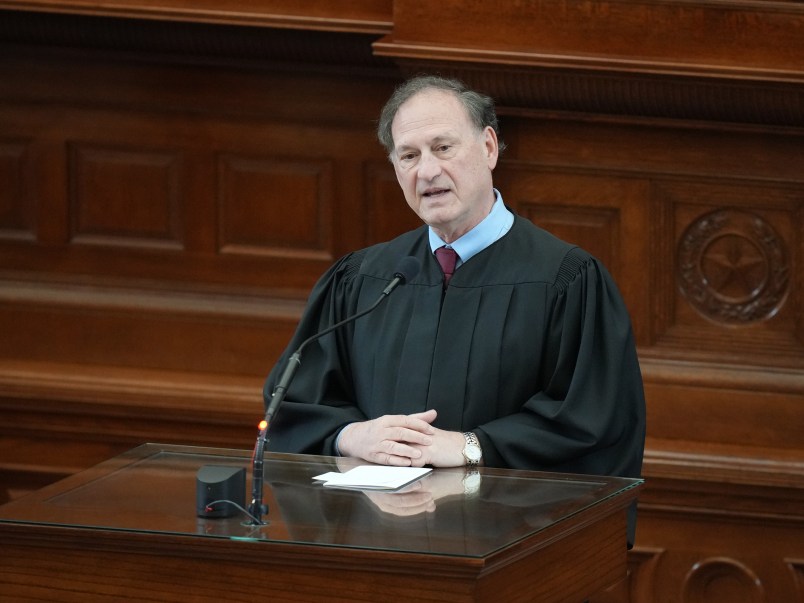
Justice Samuel Alito, writing for the majority, waved away the refugees’ argument that the administration’s racial bias against Haitians, so visible during the 2024 campaign, played a part in the decision.
“Ironically, respondents themselves offer a race-neutral explanation for the Government’s action: namely, that the current administration, which has terminated every TPS designation that has come up for renewal, simply opposes the TPS program as it has been implemented in the past,” he wrote.
The decision was fractured: Alito wrote most of the opinion of the Court, except for one unsigned section about courts’ jurisdiction over Equal Protection claims. Justices Neil Gorsuch and Amy Coney Barrett, too, signed on to all but the unsigned section. Chief Justice John Roberts and Justices Clarence Thomas and Brett Kavanaugh joined the full opinion. Thomas also wrote a concurrence. Justice Elena Kagan wrote the dissent, joined by Justices Sonia Sotomayor and Ketanji Brown Jackson.
The respondents had argued that only the secretary’s ultimate decision on the TPS status was non-reviewable, but that courts could rule on whether she followed the mandated steps to make that decision, including conferring with other officials.
Kagan agreed in her dissent, lampooning the majority’s ruling that courts’ inability to review the secretary’s “decision” also encompasses every part of the required process leading up to it.
“‘[V]ery broad’ might be one description for that reading of the term ‘determination’; very strange is another,” she quipped.
She also took aim at the Court’s holding that the secretary’s duty to “consult” with relevant agencies about country conditions only requires her to reach out to the State Department, even if she never hears back or they talk about something unrelated.
“If your doctor tells you, ‘After consulting with a specialist, I’ve determined that you should have this procedure,’ you would think he had an exchange with an expert about your condition,” she wrote. “If it turned out the doctor emailed a specialist but never heard back, or the specialist’s reply was about a baseball game, you would think the doctor had lied.”
The Court did not decide whether constitutional challenges to TPS status — including the respondents’ claim that the administration was motivated by racial bias — are reviewable by courts. In the strange unsigned section agreed to by Roberts, Thomas and Kavanaugh, it said that the racial bias challenge is unlikely to succeed, so the Court doesn’t have to decide the question of reviewability (seeming, in a contradiction, to review the claim in coming to the assessment that it isn’t likely to succeed).
Alito dismissed the administration’s record of denigrating Haiti — including President Donald Trump’s infamous comment about Haiti and African nations being “shithole” countries — by saying that many Americans likely feel the same way, then adding a dash of moralizing as he smooths the way for Haitians to be sent into a deadly environment.
“It is a very poor country, and living conditions there are unquestionably difficult,” he wrote of Haiti. “Many Americans of all races would surely find those conditions intolerable. But poverty and deprivation are no reflection on character, and there is no justification for denigrating the character of Haitians who suffer from and bear no responsibility for their country’s ills.”
Kagan rebutted in favor of the racial bias argument: “The evidence they have offered includes statements by the President so repellent and racially inflected that the majority declines to put them in print.”
Technically, Thursday’s decision only robbed the refugees of preliminary relief while the litigation on the merits plays out. In effect, hundreds of thousands of Haitians and Syrians who have been in the United States for years could immediately lose their legal status and be sent back to the countries they fled before the Court ever reaches its final conclusion.
Read the ruling here:




America the beacon of freedom and democracy? Ha!
Great way to celebrate the 250th.
From the ruling
Held:
Pp. 12–18.
(a) Section 1254a(b)(5)(A) provides that “[t]here is no judicial review
of any determination of the [Secretary of Homeland Security] with re-
spect to the designation, or termination or extension of a designation,
of a foreign state.” The term “determination” may mean either an in-
dividual decision or the process leading to a decision. Under either
understanding, §1254a(b)(5)(A) bars all of respondents’ non-constitu-
tional claims. Further, the phrase “with respect to” “generally has a
broadening effect, ensuring that the scope of a provision covers not
only its subject but also matters relating to that subject.” Patel v. Gar-
land, 596 U. S. 328, 339 (internal quotation marks omitted). Pp. 12–
So because she “consulted” with another department, judicial review is impermissible? The comments regarding the consultation were that she and/or one of her minions sent emails and received a “laconic” reply, so she met the regulations that bar judicial review. Am I reading that right?
@txlawyer
I do not believe in a vengeful and retributive hell as an after life.
But I do wonder what it would be if it did exist for Alito and the other conservative SCOTUS justices.
Such a hateful country we live in now! Sad.
Neither is wealth and privilege.
However, lying and cheating one’s way onto a court does.