

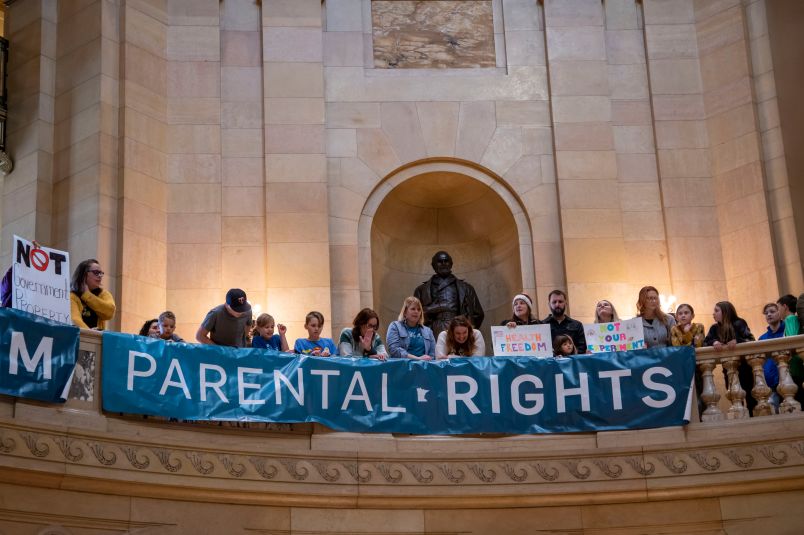
This story is part of TPM Cafe, TPM’s home for opinion and news analysis.
My partner and I homeschool our four kids. We chose it for reasons that will sound familiar to many families who educate at home: flexibility, the ability to tailor instruction to each child’s interests and pace, and the chance to foster a learning environment that is more curious, humane, and inclusive than the one we experienced growing up. For my kids, homeschooling means learning real history in a global, interdisciplinary context, exploring niche interests and how they tie into broader issues, and using experiential education to understand different ideas and cultures, all among an intergenerational, diverse community dedicated to supporting one another as we all grow. It’s one of the most rewarding decisions our family has made.
Which is why I find the modern parental rights movement — now the loudest political voice in homeschooling — so disturbing. In response to instances of parents using alleged homeschooling as a means to hide child abuse and neglect, several states across the country have recently considered modest proposals related to homeschooling, such as basic enrollment notices so states know which children are being educated at home, limited academic reviews, or simple information-sharing rules.
None of these proposals come close to banning homeschooling or dictating curriculum, and most would not affect the overwhelming majority of homeschool families at all. Yet, to hear many homeschooling advocacy groups describe them, these measures represent an existential threat to the American family. Parents are warned that they will be placed on watchlists, that the government will monitor their homes, that bureaucrats will indoctrinate their children, and that ordinary parenting will be criminalized. None of this is true. But the panic is real — and increasingly powerful.
Just this month, opponents narrowly defeated a West Virginia bill simply requiring a 10-day period for Child Protective Services to finish any ongoing abuse or neglect investigations before a child may be withdrawn from school.
Connecticut is one of only 12 states that do not require parents to notify the state or school district that they are homeschooling their children. When lawmakers introduced a bill that provides a mechanism for the Department of Children and Families to know when children under court-ordered protective supervision are withdrawn from school, it was met with harsh criticism from opponents. The National Home Education Legal Defense called it “a total destruction of liberty and of our current system of government,” and an “attempt to destroy…the rights of parents.”
This kind of rhetoric, prioritizing extreme anti-government ideology over child safety, is not unusual for parental rights absolutists in the homeschooling community. Homeschooling politics has long been shaped by organizations like the Home School Legal Defense Association and a network of state-level advocacy groups. For decades, these organizations have framed homeschooling as a fundamental right constantly under siege from government intrusion. The strategy is straightforward: turn every policy debate into a civilizational battle over parental freedom and drive opposition by terrifying homeschooling families about having their kids taken away on a government whim. A simple notification requirement becomes a “registry.” Information-sharing between schools and child welfare agencies becomes “surveillance.” Basic academic accountability becomes “government indoctrination.” The details of the policy matter less than the emotional narrative.
That narrative has become especially potent since the onset of the COVID-19 pandemic. The chaos of sudden remote schooling pushed some families toward homeschooling for practical reasons. Some were inspired to get more involved as they gained more flexibility at work. Some disagreed with COVID-19 prevention measures, while others did not want to put their children back into crowded classrooms when schools ended restrictions. Families of color, particularly Black families, started homeschooling in greater numbers in response to pervasive racism, unevenly applied discipline, and the feeling that traditional schools were failing their children. Regardless of what brought them there, these parents found themselves suddenly immersed in a political ecosystem that had already spent decades perfecting the language of government persecution. Now even modest proposals generate apocalyptic rhetoric, and many homeschooling families find themselves without a voice in advocacy for home education.
But the story these organizations tell about homeschooling — and about American educational history — is deeply misleading. One of the most common claims in homeschooling politics is that education was once a purely private matter, beyond the reach of government. According to this view, state regulation of education is a modern innovation tied to the rise of public schools in the nineteenth century. That claim is historically false.
Long before the United States existed, colonial governments treated education as a matter of public concern. In 1642, the Massachusetts Bay Colony passed a law requiring parents and masters to ensure that children could read and understand both religious teachings and the laws of the colony. Local officials were authorized to investigate households and intervene when children were not being educated. Five years later came the 1647 “Old Deluder Satan” Act, which required towns to establish schools so children would learn to read and avoid ignorance. The law’s religious language reflected its time, but its legal principle was unmistakable: literacy was essential to civic life, and the government had authority to ensure it.
Other colonies followed suit. Connecticut’s 1650 legal code imposed similar duties on parents. By the time of America’s founding, the idea that education was essential to self-government had become a political axiom. Thomas Jefferson argued that citizens must be educated so they could understand their rights and resist tyranny. James Madison warned that a people who intended to govern themselves had to “arm themselves with the power which knowledge gives.” Education was never treated as a purely private matter. Parents controlled how their children were educated, but they were not free to deny education altogether. The modern mythology of an unregulated golden age simply does not exist.
What makes the current homeschooling debate so troubling is the way the parental rights movement flips the moral stakes of this long-standing balance. American law has always recognized both parental authority and the state’s responsibility to protect children. Parents are trusted to direct their children’s upbringing, but the state acts as a backstop when that trust is fundamentally breached. The parental rights movement rejects that balance. In its most extreme form, it treats parental authority as nearly absolute. Even minimal state involvement in family life becomes presumptively illegitimate unless harm is catastrophic and undeniable.
That framework produces a strange moral inversion. Policies designed to ensure that children are educated and safe are portrayed as assaults on liberty. The absence of oversight to ensure a child’s right to education is framed as freedom. In reality, it simply creates blind spots where abuse can go unchecked. Most homeschooling families would never allow such things to happen, but the law cannot assume every parent acts in good faith. That’s why societies create basic safeguards in the first place.
The political success of the parental rights narrative is already reshaping policy. In some states, modest regulatory proposals have collapsed under intense pressure from homeschooling advocacy groups. In others, the movement is going further by rolling back oversight that already exists. In New Hampshire, for example, the state House of Representatives recently passed legislation dismantling long-standing homeschooling safeguards. The bill eliminates requirements that parents notify the state they are homeschooling and removes rules requiring periodic academic evaluations or work portfolios. Supporters say the measure restores freedom for homeschool families. Critics argue it removes the few mechanisms the state had to ensure children were actually receiving an education. Whatever its outcome, the bill reflects a broader shift: the debate is no longer just about resisting new oversight. It’s about eliminating existing accountability altogether.
None of this criticism is an argument against homeschooling itself. Homeschooling can be an extraordinary educational environment. It allows children to pursue deep intellectual curiosity, learn at their own pace, and build strong relationships with parents and community members. For many families — including mine — it works beautifully. But homeschooling does not exist in a vacuum, and children are not the property of their parents. They are individuals with their own rights, whose well-being matters to the broader society they will one day inherit. Acknowledging that reality does not threaten homeschooling. It simply recognizes that freedom and responsibility must coexist.



PFFT… Only TRUMP homeschooling will be allowed, which continues the 40+ year old Republican Tradition of keeping American students down.
It’s child abuse, no matter what parents say. Sprinkle in religious overtones, plus the us against “them” paranoia , and good luck kids.
Our school district has, for more than 30 years, committees on just about everything in the District. They basically beg people to join the committees - curriculum, staffing, facilities, etc. Very few bother.
Bring in a loud mouthed parental rights candidate demanding that parents have input and they win the election. Does anyone in local media - or even their opponents - point out they could have joined in on any of these committees and been involved from the planning states.
You lost me at “I homeschool.” It’s child abuse.
When you homeschool you are tunneling your child’s education through you, thus narrowing your child’s mind. Rather than learning to socialize in a real world, the children are limited to choice of one or two people who many may observe, are scared of the real world. A child going through the public education system is exposed to at least 12 teachers, likely more, who are trained educators and teaching concepts their parents are blind to.