

Antifascists were fighting with their far-right rivals. An anti-immigrant group with surging membership took to the streets and clashed with the police. And a member of the Trump family was at the center of it all.
The year was 1927.
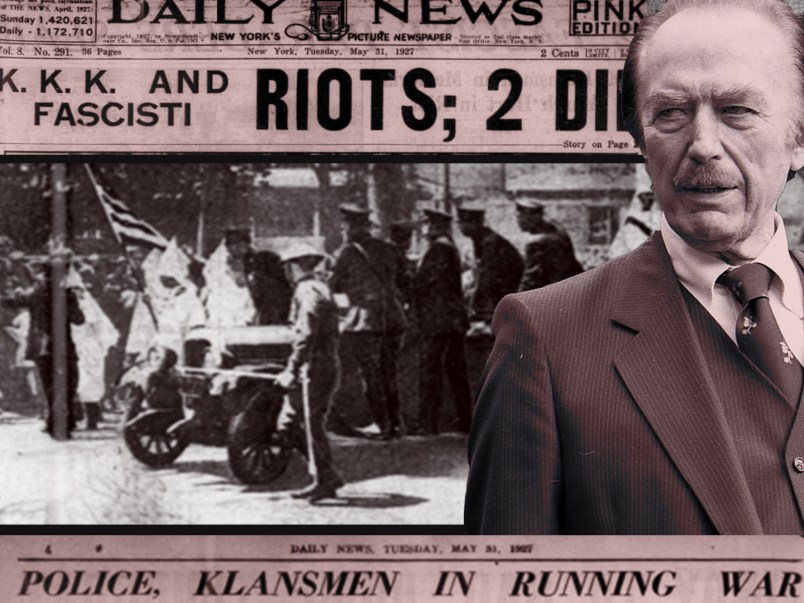
On Memorial Day, 99 years ago, the celebrations in New York City turned violent. The chaotic scenes, which involved the Ku Klux Klan rioting in Queens and black-clad Fascists who stormed Times Square after shots were fired by their antifascist rivals in the Bronx received renewed attention during President Donald Trump’s two White House bids. And the reason this bloody day refused to fade from memory is that one of the men arrested amid the melees, according to newspaper reports from the time, was the future president’s father, Fred Trump.
Despite the recent scrutiny, the episode remains shrouded in mystery and clouded by nearly a century of time. Multiple fact checks have confirmed the arrest based on articles about the incident that identified Fred Trump by name and described him as living at an address that matched his residence in the 1930 census. However, those modern reports have also stressed that it is unclear whether Fred Trump was part of the Klan crowd or simply caught up in the broader brawl. That hasn’t stopped swirling online accusations that Fred Trump was part of the hate group. Those rumors were fueled by the fact Fred Trump reached a settlement in the 1970s after he and the future president were sued by the Justice Department for engaging in systematic racial discrimination at the family’s real estate firm.
When President Trump was initially asked about the incident during his first campaign in 2015, he attempted to brush it off as something that “never happened” even though his denial blatantly contradicted the historical records. With much still unanswered about the events of that day and its relation to the most powerful man in the world, TPM has thoroughly analyzed newspaper archives containing coverage of the event. While there is no definitive indication of whether or not the elder Trump was part of the Klan contingent, we found some signs he may have been separate from the hate group. And the moment still has ongoing resonance beyond Trump’s involvement.
The riots that broke out on the streets of America’s largest city nearly a century ago show that our current climate — with the looming threat of authoritarianism, periodic outbursts of political violence, and raging anti-immigrant sentiment — is not entirely unprecedented in American history. In truth, these dark currents have been with us for generations.
The chaos surrounding Memorial Day 1927 began in the days leading up to the annual festivities. On May 24, 1927 — several days before the holiday — a report in the Brooklyn Eagle newspaper described how a meeting of the Citizens Memorial Day Association in Jamaica, Queens descended into a “row” and “barrage of arguments” after the group announced it would permit a delegation of Klansmen from the local “Major Emmet D. Smith Klan Post” to take a place in the parade, which was set to take place on May 30.
Today, Queens, which is one of the five boroughs of New York City, is one of the most ethnically diverse places in the world. At the time, it was a rapidly growing and relatively suburban community. Then, as now, Queens was a haven for immigrants. In the early 20th century, the newcomers were heavily European, including Italians, Irish, and Germans. The area of Jamaica was also home to a growing Black population. Each played a role in the events that would unfold.
Much of that community, it seems from press coverage, was not eager to welcome an anti-immigrant, anti-Catholic, and white supremacist hate group onto its streets. The Brooklyn Eagle report described “a crowd of approximately 150 persons” turning up at the local meeting amid alarm that the Ku Klux Klan was set to parade. On May 25, one day after the report on the announcement, the Eagle said the Knights of Columbus, a Catholic group that had participated in the local Memorial Day parade for a dozen years, held its own meeting and decided to “withdraw” from the event as a result of the KKK participation. That article also noted that a “negro delegation” expected to include about 300 people planned to remain in the parade “despite Ku-Klux.”
The uproar over the Klan joining the Queens Memorial Day parade came less than nine years after the end of World War I, and the memory was still fresh. Black soldiers had participated in that fight, as they have in every American military conflict. At the time, segregation was still in effect throughout much of the U.S. and many of the Black servicemembers who joined the war effort saw it as an opportunity to earn respect and improve their position. They were honored and important figures in their community when they returned home. In the Eagle, George W. Hunkins, the “marshal” of the Black parade contingent, was quoted explaining why his group wanted to assert itself in the celebration, regardless of the circumstances.
“I have been assured that our men and women will attend, rain or shine, because it is as much their parade as any other organization,” Hunkins said.
Historians view the Klan, which has sharply declined in size and membership in recent years, as having three major eras. The “First Klan” was formed in the South during Reconstruction and fought against Black civil and voting rights. Similarly, the “Third Klan” was a largely southern organization that fought for segregation and against Black political participation. However, it was during the “Second Klan” of the 1920s when the group had its largest membership and a nationwide presence.
Dr. Felix Harcourt is a professor at Austin College who has written extensively about the Klan’s growth during this decade. In a conversation with TPM, Harcourt explained how the group achieved “national reach” and grew beyond the South by “diversifying its hatreds” and increasingly focusing on immigrants and Roman Catholics. Klan members also cast themselves as defenders of Prohibition.
“What that looks like is anti-immigrant sentiment, particularly anti-Catholic, Southern European Catholics, and particularly anti Eastern European, particularly Jewish Eastern European immigrants,” Harcourt said. “Then on top of that, still appealing very much to a kind of anti-Black component.
Fred Trump, who was born in 1905, was part of the wave of immigration that was transforming New York and the rest of the country in the first part of the 20th Century. His father, Frederick Trump, the president’s grandfather, was born in a German village that was then part of the Kingdom of Bavaria before moving to the U.S. and Canada where he operated real estate ventures and a brothel in the late 1800s. This was the foundation of the family’s real estate empire. When Frederick died during the 1918 Spanish Flu pandemic, the family had moved to New York and he had just begun to acquire properties in Queens. After his father’s death, Fred Trump lived in Ridgewood, a German enclave in the borough where he worked for the family firm. It was then that, as a 21-year-old man, he found himself in the midst of the drama and violence when the Klan came.
Tensions continued to simmer in Queens for days after the announcement of the KKK’s intention to participate in the parade. A “flaming cross 12 feet high was discovered late last night” at the intersection of what is now 84th Drive and Queens Boulevard, the Eagle reported on May 28. The article said the traditional Klan symbol appeared “on high ground and the flames from the cross could be seen from a long distance.” Area residents soon “tore down the cross and extinguished the flames.”
“This demonstration … gives rise to a suspicion that trouble may mar the usual calm of the memorial day parade,” the Eagle reported.
That fear would ultimately prove prophetic.

The day before the parade, Jamaica was “flooded with K.K.K. signs” that came “under cover of darkness” the same night the cross was burned, according to a subsequent article in the Eagle, which was published on May 29. The paper further described the display as “a number of small stickers bearing the letters K.K.K.” that were placed on telegraph poles and train platforms in the neighborhood. Some were also arrayed in the form of a cross on a pillar adjacent to Presentation of the Blessed Virgin, a Roman Catholic church that is still open today on 89th Avenue. These various Klan demonstrations brought the atmosphere in the area to “a high peak of intensity,” according to the paper.
On May 30, Memorial Day itself, all of the political tension came to a head.
“The tribute of the city to the heroic dead of the nation’s wars was marred … by three outbreaks of violence,” recounted the New York Times in a front page dispatch published on the morning after the holiday.
Violence first broke out about 15 miles away from Jamaica, Queens as supporters of Italy’s Fascist Party, which was created and led by the then-prime minister, Benito “Il Duce” Mussolini, clashed on the streets of the Bronx with their antifascist rivals. Both the Times and the Eagle had detailed accounts of these skirmishes, which began on Third Avenue, where 15 Fascists were boarding an elevated train. The group, which included multiple members clad in their signature black shirts, was setting off for its headquarters in an office building in Manhattan, on West 45th Street next to Times Square. From there, they planned to join a large Fascist contingent in Manhattan’s Memorial Day march.
According to the news reports, as the crowd moved towards the train, two men rushed one of the Fascists who had lagged behind his comrades. The attackers wore red windsor neckties, which signified allegiance to the antifascist Italian Nationalist party, They stabbed their blackshirted target and left him bleeding in the street.
Before succumbing to his wounds, the Fascist shouted for help and his companions rushed down from the train platform to chase after his assailants. The two antifascists shot and stabbed one of their pursuers, who also died on the scene.
The violence did not stop in the Bronx. According to the Times, about 400 members of the Fascist delegation participated in the Manhattan parade before returning to their headquarters where there was another clash with antifascists. According to a report in the Daily News, the Fascists, who were “armed with clubs and whips,” threw Times Square into a “wild state of excitement” as they “milled furiously” through the area seeking revenge before being dispersed by police.

These clashes are a strange reflection of the current era, which has been marked by political violence in American cities from Charlottesville, to Washington D.C., and Los Angeles. This more recent wave of turbulence and violence has again featured uniformed right-wing groups and an antifascist movement that has risen up against them. And President Trump, with his own signature red tie, is often described as borrowing from the Fascist model both in his distinctly authoritarian aesthetics and efforts to undermine American democracy — including his recent move that established a slush fund to pay out street fighters who engaged in violence on his behalf. And, while the White House has described the president as being firmly against fascism, he has cast the antifascist movement as a grave terror threat and used draconian measures to launch a wave of prosecutions against these so-called “antifa.”
On that Memorial Day in 1927, the violence continued with another outbreak that has its own resonance in our present moment — both because of the instigating role of anti-immigrant sentiment and because the future president’s father was on hand for the wild scene.
The Queens Klan riot was linked to the Fascist fighting in Times Square and the Bronx in multiple contemporaneous news reports. However, as the Times noted, the KKK chaos was the day’s “most serious disruption” in terms of both “numbers and disorder.” The newspaper’s writeup noted how the violence included a mix of police, Klan members, and paradegoers who were caught up in the fray.
“Spectators from the 20,000 along the route of the Queens parade took sides. Women fought women and spectators fought the policemen and the Klansmen, as their desire dictated,” the Times article said. “Combatants were knocked down, Klan banners were shredded, and at one point, the Stars and Stripes, unwittingly, was trampled under foot.”
The Times, the Eagle, and another paper, the Brooklyn Citizen, had the most detailed accounts of the riot in their editions published the following day, May 31, 1927. According to the Times, the Klan group consisted of over 1,000 people including hundreds of women. The Eagle identified these female KKK loyalists as the “Klavana.” Both papers said the group was led by Edward A. Watkins, a Baptist minister from Manhattan, who was accompanied by aides on horseback. According to the Times, they were joined by “100 of the Nassau County Rangers,” a group that was apparently from Long Island and was described as a “semi-military organization that performs police work” for the Klan. There was also a large KKK band that played “Onward Christian Soldiers” as they marched.
This group was stopped by over 100 policemen as it attempted to join the Memorial Day procession. Officers reportedly demanded that the Klansmen remove their trademark white robes and hoods. Much of the coverage of the debates and protests leading up to the parade noted that the Klan had agreed to participate without their masks, but would keep the rest of their uniforms. The police apparently wanted to take this further and tried to block them from the route.
Reports describe the Klan brawling with officers and repeatedly pressing through the police lines. At one point, a Klan marshal dramatically jumped over a car on his horse. After the cops were overwhelmed, the Times said they “commandeered” a large bus that was being used by “negro picknickers” who were headed out for a day at the beach. The Black passengers were apparently left in the street “indignant.”
In 1927, the New York City Police Department were natural opponents for the Klan. At the time, the force was predominantly Irish with a growing Italian population. That meant they were overwhelmingly Roman Catholic, which made them targets for KKK hate. In multiple reports following the parade clashes, Police Commissioner Joseph Warren was quoted saying the order to stop the Klan from marching in their robes came from a chief inspector who had received a letter expressing concerns about their presence from an editor of the Tablet, a Catholic newspaper with coverage that crusaded against the KKK. A Times report published in the aftermath of the riot included a copy of the letter, which warned the Memorial Day celebration could be “the first time the Ku Klux Klan ever attempted to parade in the city.”
With its heavily diverse, immigrant population, New York, then as now, would not seem like a natural hub for Klan activity. And, while the fighting in Queens showed the group had managed to make some inroads within the five boroughs in 1927, multiple newspaper reports characterized the marchers as mainly coming from outside the city. In his letter warning police about the event, the Tablet editor claimed “most of the Klan marchers are to be imported from different parts.” The Eagle dispatch from May 31 said the police viewed them as “‘ringers’ from up-State and Long Island rather than bona-fide Queens klansmen.”
Harcourt, the professor and expert on the 1920s era Klan, said the organization believed it was gaining strength in the state ahead of the parade.
“The New York Klan was emboldened due to its belief that it had played a major part in preventing the reelection of Senator James Wadsworth in 1926 due to his attempts to weaken some of the 1924 immigration restrictions,” Harcourt said.
That perception was likely somewhat inflated. Harcourt went on to add that Wadsworth’s defeat “was probably more due to growing popularity of Democrats in the state.” He also pointed out that, in spite of whatever ambitions they may have had in the city, Long Island was the KKK’s “New York hotbed.”
Indeed, along with the police resistance, the Citizen described how many local Queens residents attempted to thwart the Klan. The paper reported the Klansmen were confronted with a “volley of stones” and a “series of street fights.” Police also found “a crate of rotten eggs and another of spoiled vegetables” that had been set up along the route. The Eagle claimed the eggs were rigged with a box and string to allow them to be dumped on the Klansmen.

In the end, in spite of the various clashes, some members of the Klan delegation were reportedly able to pass the parade’s reviewing stand. Others, who rode in a car, managed to place a flowered wreath with an American flag and the letters “KKK” at the base of a war memorial that stood near the end of the route. With these goals completed, the Citizen said the group “dispersed to nurture their cuts and bruises and repair their torn regalia.”
Several casualties resulted from the fracas. The Times reported that one man was “run over by a police car” and had to receive surgery for an “injured leg.” There were also multiple arrests — including Fred Trump.
Only two articles reviewed by TPM named Fred Trump in conjunction with the Memorial Day Klan riot.
On June 1, 1927, the Eagle reported, “Fred Trump of 175-24 Devonshire rd., Jamaica was dismissed on a charge of refusing to disperse from a parade when ordered to do so.” That story included Trump at the end of a list of seven people who had been arrested and charged following the event. The Times similarly identified a “Fred Trump” living at that address as one of “seven men arrested in the near-riot of the parade.” That report, which was also published on June 1, 1927 said Fred Trump “was discharged.”
There are several aspects of the coverage that signal Fred Trump was separate from the Klansmen who were arrested in the riot.
Fred Trump was the only person identified by the two papers as having charges against him dismissed or discharged. While articles from immediately after the chaos contained a few contradictory reports about the total number of people arrested at the parade — including multiple that identified the injured man among the group and another that indicated newspaper photographers were also detained — subsequent coverage of the court cases that emerged from the clashes only includes the other six men listed by the Times and Eagle and not Fred Trump. Of those six, five were repeatedly identified as Klansmen who were being represented by an attorney working with the hate group. The other man, who was the only one from Queens, was described as a member of the Knights of Columbus. Those details are important because much of the initial reporting describes five Klansmen as having been arrested and descriptions of the trial indicate that Fred Trump was not included in that group.
Along with what the Springfield Republican described as a “Klan Trial” that played out before a judge and large crowds of spectators, the violence resulted in a battle that unfolded in the court of public opinion. In the days following the parade, the Eagle reported that “handbills” were distributed in an “unknown manner” to mailboxes in Queens. They were headlined “Americans Assaulted by the Roman Catholic Police of New York City.”
“The Roman Catholic police force did deliberately precipitate a riot and did tear down American flags and did unmercifully beat and club defenseless Americans who conducted themselves as gentlemen under trying conditions,” the flyers said.
At the base of the handbill, readers were invited to request “proof” of these charges via a P.O. Box address in Jamaica. The Eagle went on to report the local postmaster, Skidmore Petit Jr., “refused” to reveal who held the box in question. However, he did admit the existence of the address was a sign of some local Klan support in Queens.
“To get a box it is necessary to have the indorsement [sic] of two prominent citizens,” Petit told the paper. “In this case, two of the most prominent citizens of Jamaica indorsed the request.”
The Klan’s effort to cast themselves as victims of rampaging Catholic policemen and defenders of, as the handbill put it, “native-born Protestant Americans” also included a bizarre episode where Brooklyn Daily Times reporter John Franz was blindfolded, driven around over “rough road” in a “curtained touring car,” and deposited at a KKK meeting. Franz reported that they initially confirmed he was Protestant and asked if he wanted to join.
At the meeting, which Franz said was held in a windowless “long, low frame hall,” there were about 500 men. While he was unaware of the location, Franz said they assured him it was within Queens. On stage, Klansman Paul Winters, who wore his robes, discussed distributing pamphlets about the parade and framed the event as one that had led to the Klan being “the most discussed persons in the City of New York today” and seen as victims of “brutalism” by the police.
Winters also presented a decidedly moderate version of the Klan’s supposed outlook on various minority groups.
“He said that if a person of Jewish faith accepts the Christian religion he is eligible to membership in the Klan. He said the Klan does not fight the Catholic as an individual,” Franz recounted.
Franz also quoted Winters declaring, “We only oppose negroes marrying white people. In all other things we stand to protect and help the negro.”
Harcourt, the professor, author, and expert on the Klan said the entire episode showed off the hate group’s typical “PR tactics” of the time. This included staging a march in an area where they were likely to be attacked “so that they can then portray themselves as the aggrieved parties” and trying to “dazzle” a reporter with a “really crude form of access journalism.” The more moderate version of the organization’s actual principles was also part of their promotional push.
“Those are the public talking points of the Klan in the ’20s: that they don’t hate anybody, they are just looking out for the interests of native-born white Protestant Americans, and if the Catholics can have the Knights of Columbus, and if the Jews can have the B’nai Brith, then the white Protestants can have the Klan,” Harcourt explained. “That is a very, very standard talking point in the ’20s Klan, especially as they work to try to accrue cultural, but particularly political, power.”
That type of public-facing moderation has also been a feature of extremist groups in the more modern far-right resurgence. Harcourt referenced the work of author Kelly J. Baker, who has described the phenomenon as “white-collar supremacy.”
“It’s this means of promulgating these various hatreds, but under the guise of respectability,” Harcourt explained. “So, we could see this kind of as a bridging mechanism between the ’20s Klan and, say, the ‘alt-right.’”
Of course, then as now, the reality behind the scenes was far darker. The Klan continued to engage in racial violence, terror, and lynching during throughout the 1920s. Harcourt also said Winters’ contention that a converted Jew would be easily welcomed into the group was almost certainly false.
And even amid the charm offensive and in full view of a reporter, Winters’ pitch about the Klan carried a distinctly ominous overtone.
“He who is not with the Klan is against it,” Winters said.
Along with the indications Fred Trump was separated from the Klansmen arrested at the parade, the newspaper coverage includes another group he was more likely to have been associated with that day. The Eagle’s initial report about the Knights of Columbus pulling out of the parade also noted “the Steuben Society made up of Americans of German ancestry would have about 500 members in line” for the event.
In the aftermath of the riot, another Eagle article published on May 31 described the Klan as being in the “Seventh Division” of the parade. It further identified the Steuben Society as being among the groups in the adjacent “Sixth Division” that were heavily disrupted by the KKK conflagration.
While Fred Trump was a second-generation immigrant, Harcourt said he could have been eligible for some degree of Klan affiliation.
“He is a native-born Protestant American. He would’ve been perfectly welcome in the Klan at the time. In fact, again, this is a particular thing to the 20s Klan, but they actually tried to even create auxiliary organizations that catch members who aren’t eligible for membership in the main Klan. So, if you are somebody who is a white Protestant, but wasn’t born in the United States, then they try to create an auxiliary,” Harcourt said.
However, while he said it was “logistically possible” for someone with Fred Trump’s “demographic profile” to have joined the Klan, Harcourt felt it is far more likely the president’s father was parading with the Steuben delegation.
“Does it make even more sense that they would be a member of the Steuben Society? Oh, yeah. That would make perfect sense,” said Harcourt.
The White House did not respond to requests for comment on this story, including questions about whether there is any record of Fred Trump being involved with the Steuben Society.
While his family reportedly did not embrace its German heritage in the aftermath of WWII, President Trump later participated in events linked to the Steuben Society. In 1999, he served as the grand marshal of the annual Steuben Day Parade. The Steuben Society is one of the leading partners behind that celebration. Trump also filmed a video for the event in 2011 where he referenced his grandfather’s emigration from Germany.
After speaking with TPM, Anita Radske, the correspondence secretary for the Steuben Day Parade, reached out to members of the society to see if there was any record of Fred Trump being a member. In an email, Radske noted two people she spoke to “said they know nothing.” The response made her question whether any records had been kept.
“Seems a little strange for Germans,” Radske quipped.
While there is currently no definitive answer to the question of whether Fred Trump was ever involved with the Steuben Society — or if that’s who he was with at the 1927 parade — Fred was certainly on the younger Trump’s mind when he served as Steuben grand marshal in 1999.
Karin Gloistein Tsokanos was named “Miss German-America 1999” in conjunction with the event. She and her mother, Ellen, met Trump at a gala celebration the night before where they were photographed together. In a conversation with TPM, Ellen said that the future president was discussing how his father had passed away less than three months earlier.
“I remember exactly Donald Trump saying, ‘I’m going to be very proud to be walking down Fifth Avenue and remembering my father, my dad.’ He actually vocalized that,” Ellen said. “He said he will remember his German heritage.”
While Ellen remembered Trump connecting his father to the event, she couldn’t recall if he specifically described Fred Trump a member of the Steuben Society. However, there was something else the future president said to her and her family that she never forgot.
“He just said to my husband … ‘you have a very attractive, beautiful family,’” Ellen said.
As he watched the future president mingle with his wife and daughter, Ellen’s husband offered a response indicating he was well aware of Trump’s behavior around women.
“My husband’s comment to him, I’ll never forget it … was, ‘I’m just here to keep you honest,’” Ellen recalled with a laugh.



Well, I guess we know what side of World War II Fred Trump was on. I wonder how bad were the things that Fred Trump didn’t get arrested for..?
Excerpt from: He’s Alive, The Twilight Zone, 1963. Dennis Hopper, Paul Mazursky.
https://www.imdb.com/title/tt0734572/?ref_=ext_shr_lnk
From the article:
“…the Klan, which has officially sharply declined in size and membership in recent years but whose sympathizers are ever more public…”
Fixed that (bolded) for you.
Good article for Memorial Day weekend.
This is what I believe and I do not expect anyone to agree with me.
After helping to care with Vietnam wounded for 3&1/2 years and seeing the graves of our wars and not one has a POS Trump on a tombstone.
During our 250 years not one fucking Trump did nothing for our Country except take what others sacrficed for.
To the 70 millon+ who voted for this asshole don’t ever say you believe in our Country. You suck!
There may be more empathy for your position than you suspect.
[The very end of the (very good) article]
Keeping the patient honest?
He’d have to start out that way, first.
Either way, it would be a labor worthy of Hercules.