


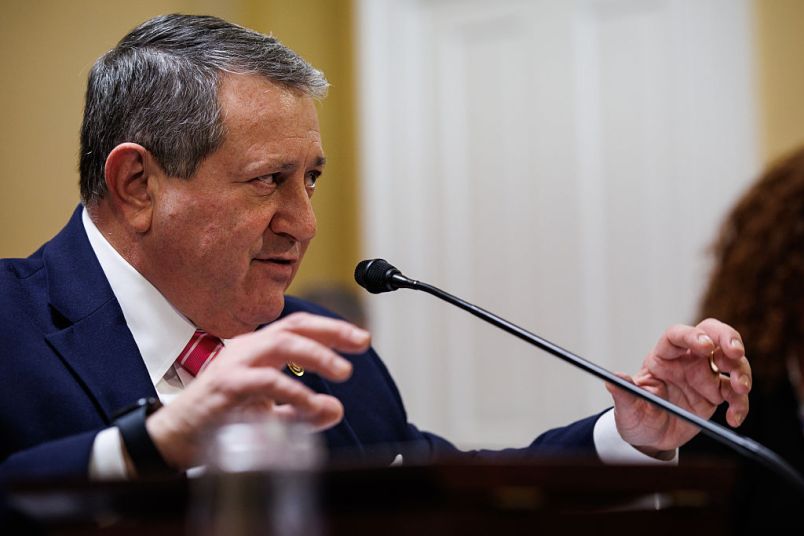
Weeks after the Iran War began, Rep. Joe Morelle (D-NY) predicted to TPM that it would become a billion-dollar-a-day “mess.” Now, with Secretary of Defense Pete Hegseth taking to Capitol Hill to request almost $67 billion in supplemental war funding, Morelle says his fears have been confirmed. And though Morelle is a member of two key committees with oversight of the Pentagon, he claims Congress has been given little information about where all the money is going.
“We had Hegseth in front of the Appropriations Defense Subcommittee and he couldn’t give us an accounting and wouldn’t give us an accounting. They still haven’t given us an accounting,” Morelle said in a conversation with TPM on Tuesday afternoon. “It’s unfathomable.”
Morelle is vice-ranking member of the House Appropriations committee and a member of its defense subcommittee. Despite these positions, Morelle said Trump administration officials haven’t offered any detailed insight into their funding requests.
“Usually if you’re in a classified setting, they should be prepared to give you information, but they haven’t done that,” he said.
Hegseth on Tuesday told the Senate Appropriations Committee that the “urgent” supplemental war funding was necessary to avoid “critical shortfalls” in combat pay and munitions supplies that could be caused by military operations. As he made his case, Hegseth said the war, which began on February 28, had cost $37.5 billion so far.
That figure announced by Hegseth is far below internal cost estimates that have been reported on by NBC News and expert analyses, which are in line with Morelle’s initial projection and amount to approximately $150 billion overall. Given that staggering total and the spike in gas prices that has come along with the conflict, the economists at Moody’s say the Iran War has cost U.S. households about $1,100 each.
All of this war funding is coming in the wake of President Trump nearly doubling defense spending overall. The latest supplemental funding request totaled almost $88 billion including the money Hegseth said was specifically needed for the war.
As the administration has sought this increased funding, it has turned to three separate avenues: standard congressional appropriations; reconciliation legislation, which can avoid the filibuster; and the supplemental request. Morelle said this approach, which is unprecedented, has added to the overall lack of transparency since reconciliation funding can bypass appropriations committees. And he claimed the administration has not answered questions about why they have placed various requests in each different “bucket.”
“That doesn’t come to the appropriators. It goes to the authorizing committees. So the appropriators and the authorizers aren’t even together,” Morelle said, adding, “There’s no answer. There’s no rhyme or reason to it.”
That behind-the-scenes chaos is taking place as Trump and his team have made continually shifting statements about their objectives in Iran.
“We still don’t know what the goal here is,” Morelle said. “It changes all the time.”
When Hegseth previously appeared before the House Appropriations Committee, Morelle chastised him for being less transparent and up to date in his requests than America’s founding military leader was in the days of quill pens and correspondence conducted via horseback. Morelle reiterated that point in his conversation with TPM.
“General Washington was more timely and more accurate in his reports to the Continental Congress in 1776 than the current Department of Defense Secretary is with the United States Congress,” Morelle said.
The increase in government spending is only one aspect of the war’s cost. Morelle noted the conflict will also impact other government programs and the national debt.
“The whole thing is alarming because, look … there’s finite resources. And the United States government needs to make decisions about where we’re gonna place our priorities, where we’re gonna invest our money,” he explained. “If everything were just defense, we could argue about that number and that number alone, but every time you make a decision about increasing defense and security spending by $600 billion, which is a 60% increase virtually over last year, it means something else isn’t getting funded or alternatively, you’re borrowing more money.”
Along with the financial questions, there are legal concerns surrounding the war in Iran. The War Powers Resolution of 1973 requires a president to obtain congressional approval for a military conflict or withdraw troops within 60 days of hostilities beginning. With the Iran War going far beyond that mark, the Trump administration has argued various informal and unsuccessful ceasefires marked an end to the fighting and effectively restarted the clock. Administration officials have also suggested that rebranding and renaming the military operation triggered a reset. Morelle flatly rejected those arguments and said it “clearly stretches credibility.”
“This is all part of [a] chain of events directed at one single adversary, one single set of circumstances,” Morelle said, adding, “It would have been absurd to have put [the War Powers Act] in place if all you had to do was change the name of the operation.”
In June, War Powers resolutions urging the president to end the conflict passed both the House and Senate. House Democrats are currently mulling similar legislation and already have some GOP support.
Hegseth faced withering questioning from both Democratic and Republican senators during his testimony on Tuesday. Morelle predicted more and more Republicans could oppose the administration’s funding requests or get behind future War Powers votes due to the broad unpopularity of the war.
“I think they’re starting to really worry about this in some quarters. It’s an unpopular war, which has driven up gas prices and … the price of other things, which people are paying for. They can see that every time they go to the gas pump,” said Morelle. “So you’re paying more money, you’re getting fewer services, whether it’s Medicaid or SNAP benefits or all the other things that they’ve cut. And you’re now seeing, we have now 18 service members who’ve lost their lives in this, which is beyond tragic. And you still haven’t, have the president be able to articulate what in God’s name we’re doing there.”
Recent polling has shown just 29% of Americans approve of the war. That’s in line with some of the worst figures from the Vietnam War.
“I think this is historic in terms of numbers. … 29% approval wrote for the conduct of the war,” Morelle said. “I mean, that’s not even the MAGA base.”
Given that math, Morelle predicted that, whatever happens in Congress, the conflict will be brought to an end when voters have their say in November.
“It is happening. It’s not happening at the speed with which we’d like it, but it’s going happen one way or another. It’s either going to be the Republicans are going to say, ‘Okay, that’s it, Mr. President,’ or they’re going to lose their seat,” Morelle said. “The American people have a way of ultimately being in charge here, which is the whole point of the thing, right?”
Despite his political optimism, Morelle believes there will be serious consequences before this fight is brought to a conclusion.
“Unfortunately,” he said, “In the interim while they’re making those decisions, more money is being spent, the lack of accountability continues, and it’s really — it’s deeply disconcerting.”





Seems to me the Department of WAR!!! should learn to live within its means, just like the rest of us. Maybe it should cut back on coffees and avocado toasts.
First-degree treason if anybody has their fingers in the public till.
What’s the limit to what our country can spend, Republicans? Hello… Republican Party? …hello, anybody there?
Sure there is. It’s military build-up for war.
Or, in Donald’s case, “pretend war” so his family can skim money off the budget and out of our pockets. Unfortunately, there’s a real aspect to his strategy.
"And they let you! --Donald Trump, 2005
We need to see articles like this every day:
Pete Hegseth’s leadership leaves the Pentagon in financial and moral crisis
We are fighting a war over an issue that wasn’t an issue before we started the war.
Forrest Gump might be the only person who could explain why.
I don’t know how you put this genie back in the bottle, but no way in hell should we be spending $1 billion / day to to ineffectively do it.