


With a hard deadline bearing down on them, Trump and his allies are scrambling for a way to argue that contrary to the shooting, ship boardings, and an ongoing naval blockade, the U.S. is not engaged in hostilities with Iran.
These increasingly fantastical rhetorical sleights of hand are coming because of the War Powers Resolution of 1973, a law mandating that a president must withdraw from a conflict 60 days after notifying Congress that American forces are fighting. The administration will slam into that 60-day deadline on Friday.
It’s a rare example of the White House and the Republican-controlled Congress colliding on a high-profile issue, and it’s not happening because of any action or intention by GOP leadership. Trump launched the war on Feb. 28 without congressional authorization and seemingly without much planning. Congressional Republicans have largely avoided questions around the war’s legality.
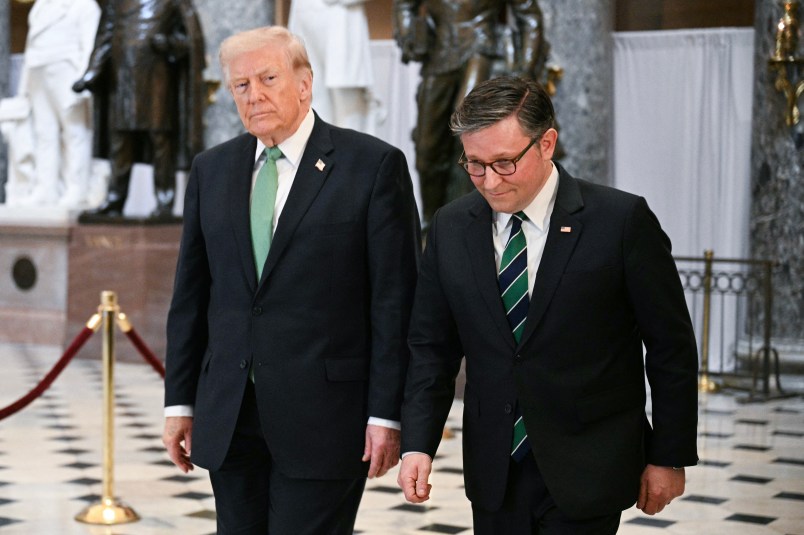
But now, with that 60-day clock up, Trump and congressional Republican leadership need a way out. Speaker of the House Mike Johnson (R-LA) said on Thursday that the U.S. is “not at war” with Iran; other reports suggest that the White House is speaking with congressional leaders about the deadline.
“There’s some serious questions about whether this war was legal anyway. Any ability to go to war without Congress’ approval is limited to urgent threats, which were pretty clearly not present here,” David Super, a professor at the Georgetown Law School, told TPM. “But even if you disagree about that, once we pass the 60–day point without any approval from Congress, then this will be an indisputably illegal action.”
Some Republicans have been pointing to language in the law, claiming the president can punt the deadline for another month. Super disagrees.
“There is a provision in the War Powers Act that allows a 30-day extension if it is necessary to withdraw U..S. forces,” Super added. “But I don’t see how that would apply here, because the president has given no indication he has the slightest interest in withdrawing anything.”
Sen. Rand Paul (R-KY) also pointed to the 30-day extension on Wednesday, saying that it is specifically for winding down hostilities.
“It’s 30 days to say, ‘Hey, we haven’t authorized war and we’re going to wind down the troops,’” Paul said, per NOTUS. “That doesn’t have to be in a day, but I don’t think this is like, oh, you get another 30 days.
Beyond the Legal Deadline
If the administration misses or ignores the deadline, holding the administration accountable for their illegal action will be top of mind for those who oppose the unpopular Iran war.
“Congress’ job is to make the laws, not enforce them. Ironically, it is the executive branch that is in charge of making sure that the laws be faithfully executed,” Super said. “So the question is: what do you do when the executive branch — that is supposed to execute the laws — doesn’t?”
The most obvious answer, Super said, is to sue. But, he added, the question then becomes who has standing.
“The traditional answer would be people who are being asked to participate in this war — the soldiers and sailors and Air Force personnel,” Super said.
He cautioned, however, that he “would expect that the Supreme Court would be very uncomfortable with the notion that individual members of the services could challenge the legality of an action that they were part of.”
“The next option would be Congress,” Super continued.
Congressional Democrats are reportedly exploring a lawsuit against Trump if he continues the war in Iran beyond Friday’s deadline without obtaining congressional authorization.
“Legal action has to be explored,” Sen. Richard Blumenthal (D-CT), a member of the Senate Judiciary and Armed Services committee, told TIME.
“I’m absolutely in favor of a lawsuit,” Rep. Ted Lieu (D-CA), vice chair of the House Democratic Caucus, told TIME. “I believe we would have a very strong argument that we would have standing.”
“But, the Court has not been enthusiastic about recognizing Congress’s ability to sue, and has said that Congress should use its own powers to deal with this sort of situation — presumably meaning cutting off funding,” Super told TPM.
“If we don’t have standing,” Lieu added, “then it would mean that, basically, this law could never be enforced.”
Though the Courts may encourage Congress to use its power of the purse to hold the Trump administration accountable for its actions, Super questioned how effective that would be amid the Trump administration’s ongoing and lawless actions impounding federal funds approved by Congress.
The problem with, for example, relying on cutting funding, is “that the president is already spending money without congressional appropriation,” Super said. “So it’s not clear that cutting off funding matters. And that leaves the very real potential that both the War Powers Act and Article One of the Constitution are being pretty overtly violated, and that the court would not allow anyone to raise that and would not enforce Congress’ ability to solve the problem itself by cutting off funding.”
What Justification?
Experts in the law of war expect the administration to provide a rationale that would allow it to claim that the 60-day clock does not apply to Iran.
It made the same move with the ongoing boat strikes on people that the administration claims are smuggling drugs. There, DOJ lawyers reportedly argued in a briefing to Congress, the campaign does not qualify as “hostilities” under the law because U.S. service members were not in harm’s way. Most of the strikes were being conducted by drones, officials reportedly told Congress. The groundwork for that argument was laid partly by President Barack Obama during the U.S. air campaign in Libya. There, the Obama Administration submitted a report to Congress arguing that because no troops were on the ground, the campaign did not qualify as “hostilities.”
To Brian Finucane, a senior adviser with International Crisis Group’s U.S. Program, it’s a serious affront to Congress’ constitutional authority to wage war.
Trump officials could argue that the current state of the war —— a naval blockade in which the navy has shot at Iranian merchant vessels and the marines have boarded others —— does not amount to hostilities under the law.
“Hostilties is not defined in the law,” he said, adding that the “legislative history makes clear that Congress wanted it to be broader” and to include “armed confrontations where there haven’t been any shots fired.”
In this case, Finucane noted, shots have been fired — even after the ceasefire with Iran began this month.
Speaker Johnson on Thursday put forth a similar kind of reasoning when he said that it’s not necessary for Congress to weigh in on the military action in Iran because it’s not a war.
“I don’t think we have an active, kinetic military bombing, firing or anything like that. Right now, we are trying to broker a peace,” Johnson said the day before the legal deadline. “I would be very reluctant to get in front of the administration in the midst of these very sensitive negotiations, so we’ll have to see how that plays out.”
When pressed about the 60-day clock, Johnson said: “We are not at war.”
Finucane doubted that the administration would invoke the 30-day grace period for withdrawing forces, largely because it would concede to Congress the authority to curb hostilities under the War Powers Resolution.
That “would amount to a recognition that the 60 days have expired, the clock has run out,” he added.




When is dropping bombs on a adversary not a war?
Their argument seems to be that because we’re not bombing right now, all is sweetness and light.
According to international law, a blockade, such as the one imposed by us on Iranian shipping, IS an act of war.
Mike Johnson is a complete waste of three-dimensional space.
To me the interesting dynamic is that when POTUS has a majority in Congress then Congress caves to POTUS. This scenario is giving DonOLD more kingly powers what the War Powers Resolution allows.
Like a lot of the mid-level enablers in the Trump administration, (e.g. BOEM), there is only an acting agency head. So it was that the Pentagon’s acting Comptroller, Jules W. Hurst III, reported that the Iran War has cost a mere $25 billion to date. This is an amount nowhere near the $67 billion of the Iran War Tracker from Brown University’s climate lab, and an amount that roughly aligns with the NYT estimate of $1 billion a day (approaching 60 as the article notes). Linda Bilmes, a Harvard economist, was saying weeks ago that the total cost of the war could reach $1 trillion.
China must find the gullibility of Americans quite amusing, but, following the rule of Napoleon, it must never interrupt an enemy when he is making a mistake.
“The misuse of language induces evil in the soul.” – attributed to Socrates