


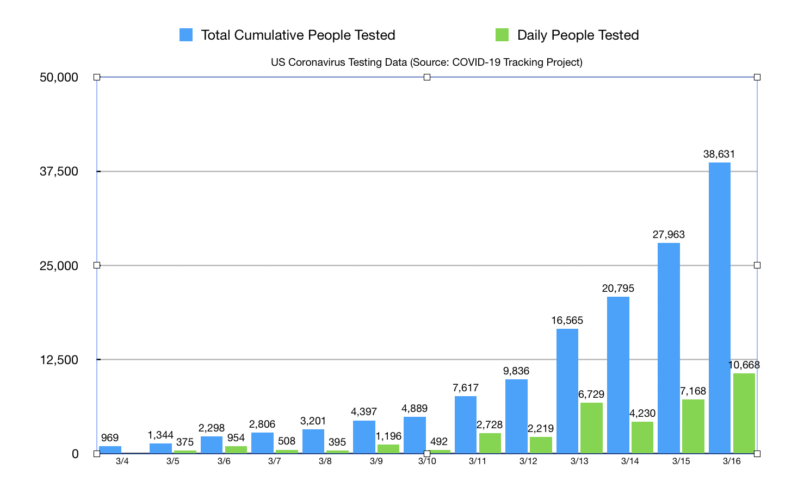
We’ve all learned the critical role of testing capacity for the current national crisis and how far behind we are. There is some tentative good news on this front. The number of tests being conducted is rising rapidly. They are moving into the ballpark of daily testing numbers in South Korea, though of course the US has a population roughly six times greater than South Korea. Here are the very latest numbers compiled by the COVID-19 Tracking Project.
Today’s White House press conference with the President and other members of the COVID-19 team just concluded. It seems like someone had a serious talk with the President or perhaps he had a serious talk with himself. Because his affect seemed significantly different from what we’ve seen in other appearances. More orderly, less stupid, more candid. For the first time he shifted to the message that we’re not focused right now on the stock market – which lost 12% of its market today on the S&P. Once we’re through the health crisis the market will rebound, he said. Whether that’s true or not, it’s at least the right message.
This is a brief note about adding a new data source to the COVID-19 Crisis links you now find below every Editors’ Blog post. It’s more for the record and to refer back to. No big need to read unless you’re interested in evaluating data sources in general.
As folks struggle to get their heads around how long the fight to “flatten the curve” might have to last to be truly effective, Josh Kovensky has a new story out framing up how to think about an essential paradox of the fight against COVID-19.
All else being equal, a successful mitigation strategy will tend to require sustaining extreme measures for longer than if we simply endure a short, fast, and brutal blitz of cases that overwhelm the health care system. As Josh puts it, it’s the difference between a tsunami and an extended high tide. Understanding that dynamic helps to begin to come to grips with how long the current disruptions may have to last.
That said, some expert readers responded to the story noting some other advantages to slowing COVID-19 down. They make some good points.
As we’ve moved into the shocking events of March one of my central experiences has been what I would call time dilation. My experience of the passage of time has changed radically. Some of this is the mundane fact that many of the markers of my daily life are falling away or shifting — getting the kids out the door in the morning, getting up and going to work, hitting the gym in the afternoon, various small trips around my neighborhood. Far more though it is what I suspect many of you have experienced: an escalating series of events none of us have any lived experience with and which most of us, I think, could scarcely imagine would ever happen. What’s unthinkable Thursday is quaint by Sunday. Such rapid shifts in our perceptions of the world and reality we’re living in are profoundly disorienting. I suspect more disorienting than many of us yet understand simply because there’s no respite from the rush of events.
From the Atlanta Journal Constitution:
Phoebe Putney Health System’s flagship hospital in Albany, a city anchoring southwest Georgia, has exploded with possible COVID-19 patients in the last five days. The hospital now houses 65 patients who’ve either been diagnosed with the disease or are waiting for tests to confirm the diagnosis. That’s just the inpatients; 115 more with less severe symptoms are at home, waiting for test results. The hospital released the numbers along with a plea to speed up testing.
Read More


The show will go on for least three of the four states originally scheduled to hold primary elections tonight, with the Ohio Supreme Court on Tuesday morning ruling in favor of closing polls amid the coronavirus outbreak.
JoinLong-time reader/subscriber, first time writing in. I work in the leadership of a local government unit that has a pretty significant number of COVID-19 cases, but isn’t one of the biggest national hotspots. We have been progressively locking the area down since last week, with changes the last few days that basically shut the doors on all public life.
As we begin to grapple with the economic fallout from COVID-19, don’t forget the severe strain this could place on state and local governments, in ways both direct and indirect. Another TPM reader report:

Barring a personal tragedy, Joe Biden will be the nominee. My preference, given the difficulty of holding primaries during the pandemic and the need to focus on defeating Donald Trump in November, is for Sanders to concede – and I voted for him in 2016 and would have done so again. If Sanders continues to campaign, it should only be around his issues. No attacks on Biden for stands he took 10, 20, or even 30 years ago. I can think of no worse (possible) fate for the country than Trump’s re-election. Here are some final thoughts about the primaries and what comes next: