


A friend of mine ran an analogy by me which really resonated. Perhaps others have drawn the comparison.
In the late 18th century, what would later evolve into the British Raj was coalescing into full British domination of the Indian subcontinent — especially after two key battles in 1757 and 1764 waged not by Britain but a private company called the British East India Company. That made it possible for what were often British men of relatively modest origins to build almost unimaginably large fortunes. Life in India was a matter of extremes for British operatives of the East India Company, a joint stock company which owned what were in effect Britain’s Indian colonies. Countless young Brits went out to India and died in short order. But if they could avoid dying, in a relatively few years they could build these unimaginable fortunes. None of them wanted to stay. Virtually no Britons died of old age in India at the time. The whole point was to make as much money as possible in as little time as possible and get back to Great Britain while they were still alive. Then they would pour that money into an estate and land.
They were called “nabobs,” a corruption of “nawab,” a title in the Mughal Empire which originally referred to a provincial governor but evolved into something more like a hereditary lord as Mughal rule disintegrated.
The nabobs were not popular. And my friend compared the nabobs to today’s tech lords, that small crop of centibillionaires who now loom so large over American society and politics. They were viewed as crass arrivistes who had built their fortunes on pillage and murder, which in very basic ways they had. The brutality of the East India Company’s rule in India was actually quite unpopular back home, something that can seem kind of surprising in that period of history. Lurid descriptions of East India Company rule were published in vast quantities in Britain. And while they were kind of over the top in ways that pamphlet literature usually are, a lot of it was really true. This early period of company rule was wild and barbaric even by the standards of formal crown rule after 1857 and by the standards of almost any other British or English colonial venture aside from perhaps the sugar plantations of the West Indies during their most profitable periods.
But the key issue was this: the nabobs were so rich that people in Britain feared they were destabilizing the whole of society itself. Many of the returning nabobs were so wealthy they simply bought seats in Parliament. Besides the purchase of seats, East India Company wealth was so vast, dwarfing a lot of existing British wealth — or most of the wealth that wasn’t really spoken for — that it wasn’t clear whether Parliament would withstand it. The big lords and other members of the high nobility had vast wealth too. But it was mostly tied up in land. The nabobs had cash. The analogue to tech lord money is obvious and apt.
Nor was it just that the nabobs had wealth on a wholly new scale and were sitting on so much cash. They used it differently. They didn’t respect rules. And that made sense because they followed no rules in India. They acted like pirates. Most came out with the Company as “writers,” basically the clerks and bookkeepers that managed the Company’s business ventures. But they could also trade on their own account. That’s where they could make their fortunes. And they got the connections and the relationships through the work for the Company. From top to bottom, life in India for employees of the East India Company was every bit a move-fast-and-break-things kind of gig.
Back in Britain, there was a kind of slow-running rebellion against the East India Company, both on an emotive scale because of its actions in India but really because of the power of the nabobs in Britain. There was even a big elite displacement and cost of living dimension to it. The nabobs had so much money they were driving up the cost of everything. You couldn’t just be rich in England anymore because they’d driven up the cost of being rich dramatically. And this was felt up and down the social scale. But again the real issue was that it seemed like the Company was actually more powerful than the government itself, which in some key ways it was. Finally, I would be remiss if I didn’t note that the Tea Act, the legislation that led to the Boston Tea Party and in ways lit the fuse that led to the American Revolution was in key ways a bailout of the British East India Company. The details of how that was so are complicated. But the Tea Act was really a bailout of the British East India Company. So you see how this analogy is quite inviting.
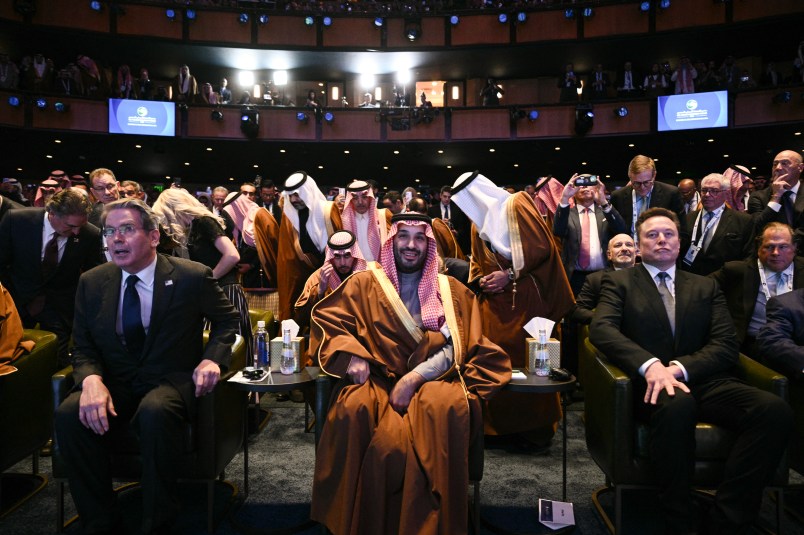
One of the reasons it is so compelling to me is that for a number of years I’ve been thinking about the decline of the nation state as an organizing force in world affairs. I discussed some of this back in the spring with a series of posts on so-called “overmighty subjects”, private individuals that become so wealthy and powerful that they begin to pose an inherent threat to the sovereignty of the monarch or, in our case, the American people. We could see this under the Biden administration, when you have Elon Musk essentially too powerful to touch, running a whole echelon of the state’s economic and technological and military might as one of his private possessions (SpaceX). There was that watershed moment when the full force of the American republic was committing vast public expenditure and no little danger to the defense of Ukraine but Musk was running his own private and corporate diplomacy on the side, leveraging his control over near-earth satellites to impose his will in ways the U.S. felt unable to stop.
The platforms do this in more general ways. And that’s one of the reasons I was always much more skeptical than other non-conservatives about speech moderation and companies like Facebook talking about “governance” and the digital public square. These companies were and are so big and have such a dominating grip over communication that they have this kind of natural urge to colonize and take over public goods. Even back before Facebook and Mark Zuckerberg did their more overt pro-Trump heel-turn, I didn’t like the idea of their having even what seemed like a benign role in speech regulation. Facebook is not only a private company governed by profit maximization. It’s business model is sustaining addictive economies of attention. It wouldn’t be able to govern civic participation in any positive way if it wanted to.
Some of this decline of the state was umbilically connected to the end of the Cold War. One of the defining features of the last 30-odd years is too much capital sloshing around the globe, hunting after too few productive investments. It’s the root cause of the repeated cycle of bubbles and busts. One driver of that excess is the way that a vast amount of capital was tied up in the communist states of the world. The end of those regimes caused this vast welling up of this frozen capital, almost as though it were fossil fuels welling up out of the earth, which in fact in many cases it was. It all got doled out into the hands of oligarchs in most post-communist regimes. The timing in China was different and the state maintained the upper hand. But the same basic story prevailed.
We see this decline of the state even more powerfully in the world of 2025. Even in something in something as “small” as the attempted Warner Bros-Paramount merger, we see that line up of the Trump family and one of its inner circle centi-billionaire families hooking up with each key princely family in the Gulf. A strongly China-adjacent fund is also in the mix. When I mentioned a few weeks ago that only Trump was in a position to enforce a purported peace deal in Gaza it was the same story: he could do that because the global billionaire network has, in many ways, become stronger than the states. And Trump has personally embedded himself in that network.
None of this is even secret or disputed. What amounts to the fantasy life of the tech lords are things like “network states” or floating “sovereign” islands out in the ocean that will take everything to the next step, creating new fake states in which the CEOs are quite literally the kings.
So yes, in a very basic way we today have something that is at least an echo of the nabob era. The billionaires have outgrown the husks of the states which nurtured them and made their gargantuan wealth possible. We see it in the Gulf, in Silicon Valley, in the oligarchic regimes of Eurasia. And the question we see across the whole civic and political horizon is in some ways not only or perhaps even mainly a crisis of democracy as a crisis of state power, or more specifically accountability to democratic publics. Who exactly has the upper hand? Who is in charge? That’s the basic subtext that runs through almost all of our public debates. Will the new unheard-of levels of wealth dismantle states and accountability to publics before those publics are able to bring the oligarchs and their untrammeled power to heel?