


Just before I began writing this post, I saw this article from The Washington Post about the rise of billionaires in American politics. Given Bezos’s ownership and the recent shift in its editorial policies I’m mildly surprised they published it. The key points aren’t terribly surprising. But it brings them together in one place — the vast growth in billionaire giving over the first quarter of this century, the rapid trend from a relatively even partisan split to overwhelming giving to Republicans. It is among other things the story of billionaires becoming increasingly class conscious. It’s always been true that money buys influence in American politics. In some ways, it was even greater and more brazen in the past since there wasn’t even the pretense of limits on giving or disclosure.
But the role of billionaire ownership of the political process has not only grown rapidly in recent years. Public recognition of that fact has, too, which has — perhaps paradoxically or perhaps not — spurred the drive for even tighter ownership. It’s no exaggeration to say that the deca-billionaire or even centi-billionaire class — setting aside those who might command a mere few billion dollars — act now as a kind of post-modern nobility, a class which does not rule exclusively but interacts with politics in a fundamentally different way from the rest of society.
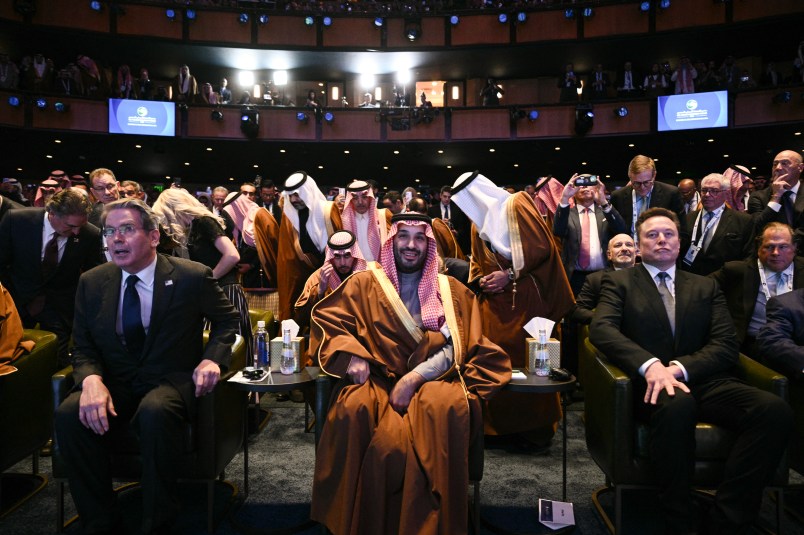
This article meshes with a different New York Times article I read yesterday and which I had already planned to mention. It pivots off the big Mohammed bin Salman shindig in Washington. We’re used to the standard story about how Saudi wealth brings all the boys to the yard. That’s still mostly true. This article notes that it’s not quite as true. Or to put it more specifically, bin Salman is actually running tight on cash to finance his genuinely audacious and ambitious plans for his country.
Bin Salman has been running Saudi Arabia for a decade. His rule, whatever its horrors, has been genuinely revolutionary in a Saudi context. It’s a genuine revolution from above. He’s trying to leverage Saudi’s vast oil wealth to build a post-carbon, high-value-add first world future for the country. And a big part of that is not just buying up assets that are still domiciled abroad, like buildings, teams, and equity assets in foreign companies. A lot is supposed to be invested in building new industries, heavily tilted toward tech and emerging technologies, in Saudi Arabia.
But that requires huge sums of money, and the returns from the last decade have been hit or miss at best. There have been a lot of boondoggles that are going nowhere. There’s a futuristic, high-tech robot city in the desert which seemed bogged down in delays and cost overruns. The Times doesn’t make the point quite explicitly but a number of the key investments have been in things that key players think are cool. The sovereign wealth fund’s governor, Yasir al-Rumayyan, has invested a huge amount of money in building an international golf league in part, the Times implies, because he’s super into golf. The article similarly suggests that Saudi’s recent acquisition of a controlling interest in game maker Electronic Arts is in part because bin Salman is hugely into video games.
Saudi Arabia’s attempt to buy its way into a high-tech future not wedded to extraction economies is a complex subject that is far from exhausted by any one article or my limited understanding of the topic. But there’s a common thread between these two articles, and that is the insecurity of ultra-wealth which lurks behind and drives its increasingly aggressive ventures into the political world. It’s a topic I’ve come back to again and again over the years, most notably in a series (“The Brittle Grip”) which started in this post from mid-2012. A major way many of us understand the current moment is as an authoritarian assault on civic democratic government in the United States and indeed around the world. And it’s very much that. But it’s also an effort by those who have had a vast run-up in wealth over the last quarter century wanting to use that wealth to lock in that wealth by the acquisition of direct political power. This is absolutely the arc of the titans of Silicon Valley, almost all of whose leaders have now become either supporters of the oligarchic right or decided to make common cause with it in order to avoid having lawless political power attack them and their assets. This is overwhelmingly driven by the wealth generated by network effects lock-in, which produces vast levels of surplus wealth which look unbreakable by anything but government anti-trust intervention. It is sort of common knowledge, or common assumption, that the current mad dash for the commanding heights of AI represents the final goal of lock-in. Whatever one thinks of AI, it’s critical to see how tightly the Trump White House is allied with the tech companies in clearing the way for the current incumbents to dominate the future AI economy.
None of what I’ve said here is terribly new. But I note it as a way to place back at the center of our attention the insecurity of ultra-wealth as a core driver of our current politics, the tightly bound together mixture of insecurity and aggression which is at the center of everything.