


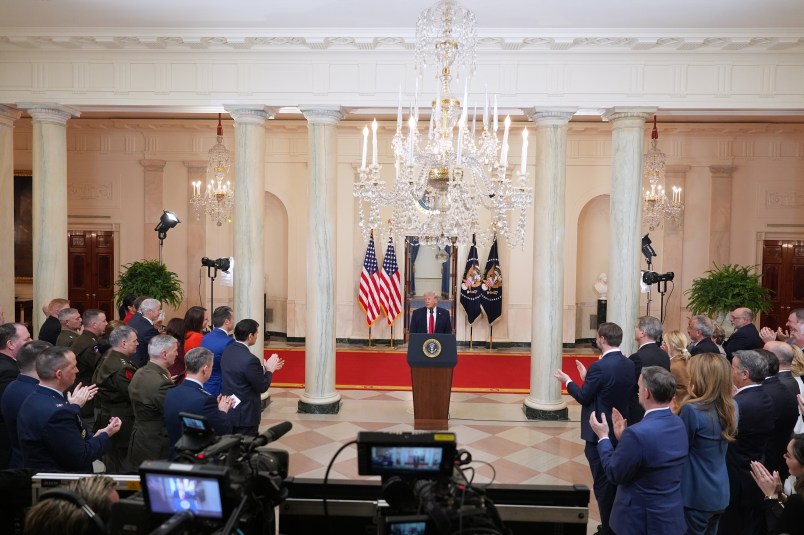
I want to reiterate all the points I made about Trump’s speech last night. Just for the sake of his own political standing, the whole idea was a mistake. It wasn’t a good speech. It wasn’t delivered well. And it didn’t either make favorable news or actually address the issues that have the public or energy markets upset. I didn’t realize as I was watching the speech that his vague “two to three weeks” prediction of when the war will end was really just a restatement of what we might call the Trumpian Constant, the prescribed duration after Trump will, purportedly, always have gotten things worked out and awesome. The time before the Obamacare replacement plan is released, when infrastructure week will finally arrive. I mean, two weeks is genuinely a cliche with Trump or, in more modern parlance, a meme. Trump just tacked on another week. As you might have seen there are lots of charts floating around showing how the price of oil and oil futures spiked pretty dramatically during his speech.
This piece from Semafor reminded me that there’s really only one part of that speech that probably meant anything to energy markets: Trump’s evolving and coalescing decision that free passage through the Strait of Hormuz isn’t Trump’s problem. It’s up to a handful of importer nations in Asia, almost all of which have small regional navies and would, in any case, face vast coordination problems if they tried to reopen the Strait of Hormuz by force. When Trump says that — not our problem, up to those guys — everyone knows that means it’s not going to happen. And Trump has made the decision that what his war caused isn’t his problem to fix. So expect oil prices to go a lot higher. Because it’s that throttled oil supply that is responsible for all the international economic fallout. Apart from that and the other ways tanker stoppages send shocks through the global economy, no one would care about any of this more than they care about a bunch of other regional wars.
There’s a sentence from that Semafor piece by Tim McDonnell. After a bunch of pretty dismal news about energy prices and maritime insurance rates he writes this: “Another important, and possibly more reassuring, signal is the far end of oil price futures. Crude oil to be delivered in December 2028 is now about $66 per barrel, a bit higher than it was before the war but a good 40% below the price for deliveries today.”
As he suggests, this isn’t necessarily that reassuring. Certainly not to anyone in the world of electoral politics who is on the line for these numbers. It’s a reality check to everyone in the world of politics, which has mostly been in denial about all of this. Just on the basis of what has already happened and even with a fairly quick resolution of the conflict, this is already baked in not just for this election cycle but for most of the next one.
I am curious to read more about what regional analysts make of all this. But we know that Iran wants to exercise control over the Strait of Hormuz going forward and probably exact some kind of tolls on passage. If the U.S. doesn’t try to undo that either by force or diplomacy, it seems highly unrealistic in the near term that any coalition of states with small regional navies is going to do anything about it. It seems far more likely that countries will make one-off deals with Iran for the passage of ships heading for their ports. Or perhaps China (the biggest importer of Iranian oil) will make some arrangement with Iran and thus become the guarantor of a big chunk of the global oil supply, and vastly increase its geopolitical power in the Gulf and throughout Asia.
The upshot remains a massive geopolitical defeat for the United States regardless of how much stuff the U.S. military may have blown up during the course of the war.