


Over the weekend I noticed an example of one of the most significant features of the last decade-plus in American politics, though it’s one that still remains too little remarked upon. Lauren Egan writes a newsletter covering the Democratic Party for The Bulwark. Sunday night’s edition was about pundit and political analyst Stuart Rothenberg, “He Was a Legendary Independent Pundit. Then Trump Arrived.” Basically, How did Stuart Rothenberg come down with, as MAGA puts it, Trump Derangement Syndrome? Toward the end of the piece, Egan gets at what I think is the underlying issue here and some of the commonality I’m about to note.
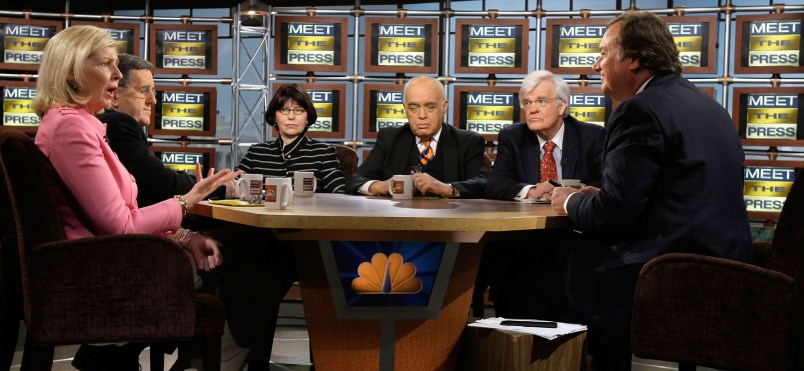
Let’s start this story in the late ’80s and early ’90s. At the time, there were a handful of men — pretty much all men, as I recall — who played a very specific role in the political-journalistic ecosystem. They were rigorously, perhaps obsessively, non-partisan and were go-to people on basic questions of politics. They’d appear on shows, be on call for quotes for journalists at the big papers. Rothenberg and Charlie Cook played that role in the electoral analysis and predictions space. Larry Sabato also occupied that space, though he also played in the political analysis one. In the latter space were Norm Ornstein (AEI) and Thomas Mann (Brookings). I think they were on PBS Newshour for a long time as a pair. Their analysis was on the mechanics of governing, less the explicitly political stuff and generally not electoral stuff.
These guys played a key role as arbiters in the journalistic-political ecosystem. They were analysts, not reporters. So they brought presumably some deeper thought, some historical perspective to the matter. But the key was the neutral arbitrator-ness. In a sense they were referees, and the point of their role was that their views were sort of like a currency that was accepted on both sides of the aisle, as it were.
This all began to break down during Barack Obama’s presidency. And I tie it in my mind to a column Mann and Ornstein wrote in April 2012 in The Washington Post: Let’s just say it: The Republicans are the problem. It’s difficult to overstate the impact of this rebellion against the orthodoxy that in many ways had defined each man’s career and prominence. They later expanded on this piece in a book called It’s Even Worse Than It Looks. The gist of both was that it’s not polarization, extremism, the decline of comity, the breaking of norms. The issue is the GOP, a party which already then was essentially a revanchist party of the sectarian right masquerading as a center-right party of government. Of course, this doesn’t mean there aren’t issues with Democrats. But the big structural issue is the GOP. This has been a constant TPM theme for many years and the subject of countless posts. So I don’t want to dwell on that point but rather the effect on these analysts and political journalism more generally.
The business model of modern journalism, or now rather legacy journalism, is one based on balance. People often think this is about the evolution of modern journalism. It’s not. It’s part of the business model of post-war journalism. As the parties diverged in the late 20th century this put increasing tension on that model. And Republican operatives increasingly saw it as a system they could game. Broadly, anything that represented the Republican “position” had to be reported at face value and placed on equal terms with whatever the Democrats’ one was. We know this story. In the late Bush years and early Obama years, you could feel this model coming under growing strain; that opinion piece above was a case of the model just snapping. The model had to break or people like these would be forced to say things that were absurd, treat absurd things as though they were real.
So yeah, you have these exemplars of neutrality, dispassion, not taking sides. And I’m sure they would have liked it to stay that way. But it didn’t. The world of politics changed. And you could prioritize balance and neutrality but that would likely mean becoming a liar on someone else’s behalf. And this same breakdown happened in the more general news environment as well. It’s the origins of “bothsidesism” and all the rest.
As I was writing this though, I wanted to step back and ask myself a different question. Usually when we talk about there not being “two sides,” we mean that one position is based on factual information and the other is not. But it’s not like there aren’t two political sides. There’s a chaotic authoritarian nationalist “side” and there’s a kinda civic democratic side. Those are two real and definable things. So why can’t there be two sides in a broader civic debate? I was thinking about this this morning. And I think broadly there are two reasons. One is that, broadly speaking, these kinds of journalist/commentator elites are bought into the broad definition of American democracy. They struggle to treat attacks on the foundation of the democratic system as a legitimate “side.” But the broader issue goes to something like empiricism or civic debate itself. The essence of Trumpism and probably all authoritarian nationalism is that the leader is right. “Trump is right” trumps any policy prescription or any political goal. You can either operate within that set of rules and framework or you can’t. And most people from the old system can’t.
This goes to part of the broader crisis of journalism at the moment. There is a pervasive billionaire assumption that mainstream legacy journalism is “liberal,” and there’s a big market for news that gets outside of the liberal bubble, has views from both sides of the spectrum, is as welcoming to the MAGA right as to the Democratic left. As my friend Eric Alterman wrote in his book about liberal bias and the media wars, there was a time when something kind of like this was somewhat true. (Basically in the 1960s when a certain kind of Cold War liberalism did broadly inform the values of news media at the national level.) But that hasn’t been the case for decades. That billionaire view is simply wrong, inasmuch as most of what you get in legacy media is a huge effort to inoculate against charges of “media bias.” What there is though is a basic commitment to that empirical/civic mindset and set of values. And the nature of our current political moment is that the American right today is anti-empirical and anti-civic. That’s why when the Post or now CBS News goes searching for these underserved viewers hungering for journalism outside the liberal bubble, they fail. Because in a basic sense the current American right simply isn’t interested in news or journalism as most of us conceive it. Look at Fox or OANN or any of the other TV news clones and you can see that. When the Post or CBS try to do this, they don’t find any new viewers and lose a lot of their existing ones who feel insulted.
Obviously this isn’t to say that legacy media doesn’t have its shortcomings. Of course it does. Indeed, it’s another perverse part of our current moment that those who are invested in the future of civic democracy sort of have to speak for “legacy media” as something we’re either responsible for or like or want to speak up for. But the basic reality remains this. Our new political world in the U.S. and around much of the globe is no longer simply right vs. left but authoritarian vs. civic democratic. And those two poles involved not just different policy positions but different ideational systems, different ways of thinking about research, facts, power and more. Journalism as most of us understand it, the way most journalists understand it, is inextricably located in the civic democratic space, though it isn’t inherently liberal in the old sense of the word. Without knowing that basic fact, you can’t understand much of anything about contemporary politics and journalism and the big fights about our future that we are all, intentionally or not, involved in today.