


I had some further conversations this afternoon about the Dems’ strategy on the coming shutdown fight. They basically just confirmed the outlines of what I discussed in the two posts I did earlier today, but with some additional detail and color. One point I heard from one of my colleagues is how much Senate Dems seem to be unified on this strategy — even Elizabeth Warren, who recently had been arguing that there was no point participating in budget negotiations if the White House is not following the budget. She too seems to have shifted to the “give us back the Obamacare subsidies” position.
So what are Senate Democrats thinking exactly? How can this make sense?
I got asked this this afternoon. And I think it’s actually pretty clear what they’re thinking if you look at all the pieces on the playing board. There’s actually a decent logic to it. I just think it’s a bad logic.
Read MoreI’ve gotten some rather heated responses to today’s Backchannel. The one point which I think merits a response is people saying that I’m not proposing any alternative. I saw that as implicit. But fair enough. Some say I’m just saying shut things down permanently. That latter claim isn’t true. But the first point is fair so let me address it.
Donald Trump is currently governing far outside the constitutional order. We’re operating in a constitutional interregnum. The constitutional order may and I think will come back into force. But right now we’re operating far, far outside of it. The president has seized the power of the purse from Congress. He is depriving states of their sovereignty and liberties by invading them with the U.S. military. He is threatening budgetary cutoffs to assert policy control over areas of governance the president has zero authority over. I could list 10 other forms of extra-constitutional rule and I would still leave many out.
Read MoreKate and Josh discuss the short-lived Trump death rumors, the end-of-year shutdown decision for Democrats and some eyebrow-raising GOP retirements.
Read More
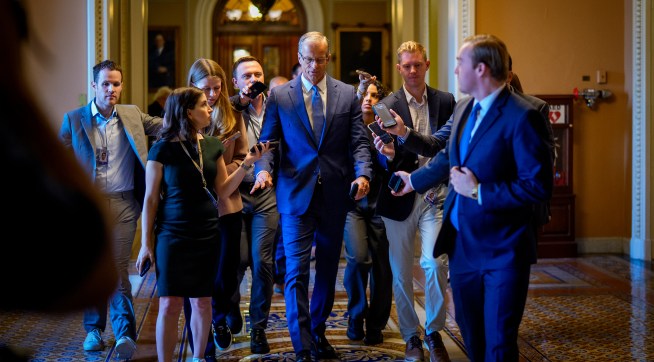
I agonized for a bit about the point I’m about to discuss. But I didn’t agonize for long because I decided there was not much to agonize about. The topic is the September federal budget showdown, essentially a replay of the March “continuing resolution” drama in which Democrats had their first shot at real leverage against Donald Trump. As you’ll remember, Democrats under Chuck Schumer’s leadership decided to hold out for nothing. This was not only a missed opportunity. It’s fair to say it drove a catastrophic collapse of confidence in the Democratic Party’s elected leadership in Washington, DC., an impact that has been reverberating through national and opposition politics ever since.
Now we have a literal replay of that moment. The White House again needs Democrats’ vote in the Senate for a continuing resolution to keep the government open. Democratic leaders have been insisting they won’t make the same mistake again, and recent reports suggest President Trump’s increasingly aggressive attempts to seize budget authority from Congress all but assure a government shutdown at the end of the month. But a closer look suggests that Senate Democrats will insist on no meaningful brakes on Trump’s lawless actions and may, perversely, help him hold Congress next year.
Join
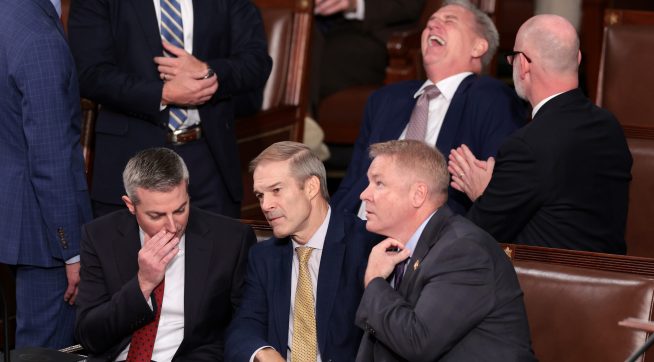
One big threat that looms over free and fair elections for president is that a tie in the Electoral College or a disputed race gets thrown to the House. That could be a real dispute or, far more likely, a manufactured dispute as part of stealing the presidency. Critically, in this situation, the House does not vote as a majority. It votes by state delegation and the assumption is that the GOP holds the majority of state delegations because of their advantage in low-population Republican states. That’s all true and it leads to lots of bad scenarios. But it’s worth focusing on because it’s not a total done deal. This 2023 piece from the Kyle Kondik at the Center for Politics at UVA goes through the different delegations and the possibilities in each one. A bit of luck and focus could close off this path to a stolen presidency.
JoinAn email from TPM Reader PK on yesterday’s post about seating a new Congress in 2027.
Your post was dead on today. I can easily see a scenario where [T]rump GOP majorities in both houses refuse to seat enough Democrats to retain control. There’s actually some examples of this back in the 19th Century where the clerk of the House refused to acknowledge various members-elect. In any event, there could be several Ds elected in states where the GOP SecState refuses to certify the election based on bogus fraud charges—all helped along by bogus DOJ/FBI investigations. And even if the vote is certified, sore loser GOP candidates could ask the House to determine the winner in their races. Again a GOP majority could then seat the losing GOP candidates by a simple majority vote.
In any event, congressional Dems need to figure out how they will handle such a scenario.
The last point is key. This isn’t a call for dooming but rather preparation.
The whole call of “will there be free and fair elections” is simply the wrong question to the degree it is framed as a binary question or of something that Trump will “do.” Under the present circumstances you need to battle to ensure the votes are counted and the results enforced as much as you need to turn people out and get them, as best you can, to vote the right way. This part of the equation shouldn’t be a contest. But under the present circumstances it is a contest.
You have to take it as a given that Trump will exploit every power he has to corrupt the elections in his favor. In the executive branch, where the Constitution gives him a lot of power — and the corrupt Court wants to give him unlimited power — he’s taken all of it. The key with elections is that the forces of opposition actually have quite a lot of power, starting with the key fact that states run elections and the federal government has very little practical access into the process let alone legal authority over it. States have large bundles of executive sovereign authority. January 6th is a very helpful and very instructive example. You need to be red teaming every link in the chain to know what the possibilities are and be prepared for them.
The two key issues I see, from an initial review, is the certifying authorities in the various blue and purple states (usually but not always governors and secretaries of state) and the Clerk of the House. The Clerk of the House is the fulcrum of House continuity in the interregnum between the expiration of one House’s authority and the seating of the next one. That’s usually a pretty no-nonsense career person. We got some preview of this during the Speaker votes for Kevin McCarthy. If that person is a GOP toady that’s very bad. Because the Clerk is the person who — like they wanted of Pence in 2021 — could simply decide to accept some certificates of election and reject others. They have zero authority to do it. But they could.
Again, it’s a matter of thinking through all the possibilities and being prepared.

I’ve written a number of times about the central role of state sovereignty in resisting Trump’s growing tyranny and the critical fact that states control the administration of elections. With that in mind, I want to flag what I think is a key part of that equation. It’s not meant to be alarmist. It’s simply a matter of preparation.
As we’ve discussed, states control the administration of elections, subject to Congress setting standards for the administration of elections. This critical fact isn’t just a matter of law. It’s about the machinery of government. The states are there and the federal government isn’t. Trump can dash off a million executive orders but that doesn’t make them real or meaningful. More dangerous, he might try to use Immigration and Customs Enforcement agents or federal troops to create a climate of intimidation at the ballot box. That threat is real. But because of the structure of our elections, the key danger point likely comes later. Let’s assume the 2026 election or more likely the 2028 election goes more or less unmolested. Now in January 2027 the new representatives and senators show up for the new Congress. Are they seated? Or do congressional Republicans somehow refuse to seat them, arguing that their elections were somehow illegitimate, that they didn’t follow one of Trump’s legally meaningless executive orders?
Join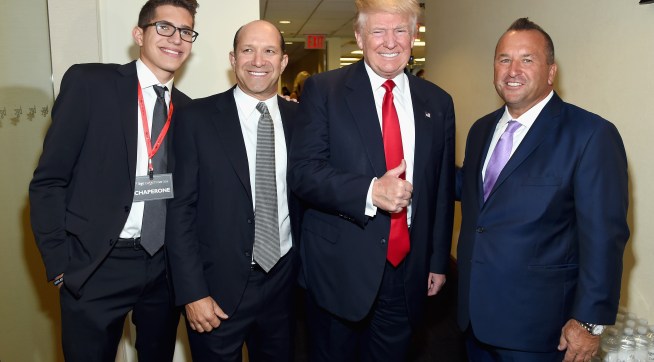
This is not new. But I at least hadn’t heard any of these dots connected. I wasn’t even aware of the dots. A friend mentioned to me over the weekend that he’d heard about Wall Streeters buying up the rights to tariff refunds from big corporate importers. So the idea is that a Wall Street firm goes to an importer and says, you’ve now paid $10 million in tariffs. I’ll pay you $2 million right now for the right to collect the refund if courts ever end up deciding the tariffs were illegal. My friend had also heard that one of the most aggressive buyers was Cantor Fitzgerald, the firm until recently headed by Commerce Secretary Howard Lutnick and now run by Lutnick’s sons. Twenty-something Brandon Lutnick, pictured above on the left in a 2016 photo, is the current chairman of Cantor Fitzgerald. (He must be hella talented!)
Read MoreGOP Rep. Jeff Hurd of Colorado was apparently just a no-show at his own town hall on Wednesday. Technically it wasn’t a town hall but rather a public meeting in which Hurd would meet with members of the Montezuma County Commission. Point being, it wasn’t one of these things where Democrats put on a town hall because the member won’t call one. It was one he was involved in organizing. Anyway, apparently Hurd found out shortly before arriving that more than a hundred people had shown up because just after the event began, Montezuma County Commission Chair Jim Candeleria announced that Hurd wouldn’t be able to make it because an aide he was traveling with had a “medical emergency”.
No word on how the dog is doing after it ate Hurd’s homework.