


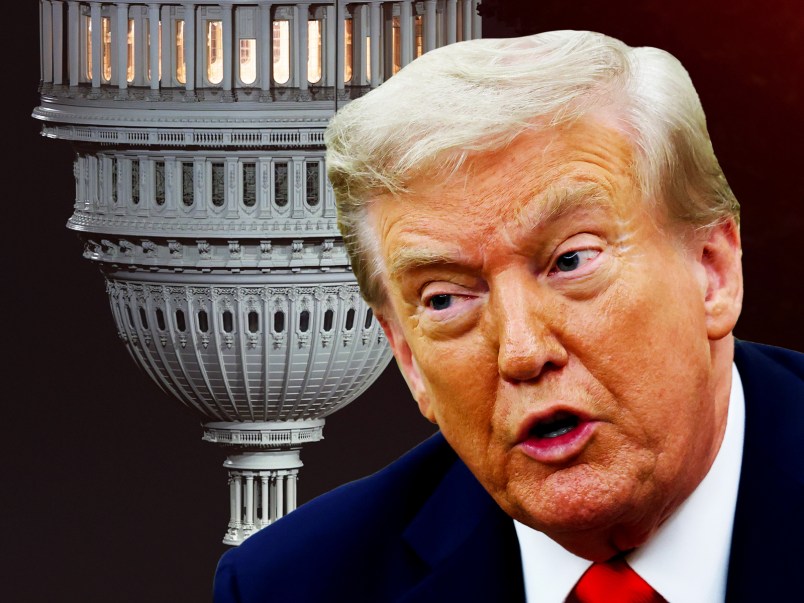
Since President Donald Trump reentered the White House in January, his administration has, in part, been defined by its blatant effort to seize power from the legislative branch.
That’s come in the form of freezing, withholding and in some cases — as the watchdog Government Accountability Office (GAO) declared — illegally impounding congressionally approved funds. The White House even pushed a constitutionally backwards rescissions package — a maneuver they used to force Congress to swallow Department of Government Efficiency funding cuts that the administration had already lawlessly frozen — through Congress in July. And the Office of Management and Budget has indicated they are considering pushing for so-called pocket rescissions to claw back even more funds that lawmakers have already authorized.
Experts tell TPM that all of these moves signal a significant shift in the relationship between the executive branch and the legislative branch — one that may have impacts beyond the second Trump administration.
“This is a huge shift in power from Congress to the President,” David Super, a professor at Georgetown Law School, told TPM. “It is rewriting decades, centuries, of understandings of who has the power of the purse.”
The Constitution says Congress has the power of the purse — that includes writing appropriations laws that direct how the government will be funded and how federal dollars will be spent. The executive branch then executes on the spending as Congress appropriates it. That is, of course, how the co-equal branches of government are meant to function in America.
But the Trump administration has turned that process upside down in picking and choosing what funds to spend and, in turn, forcing Republicans in Congress to cede their authority over legislating to the White House. It has created an unofficial shift with serious consequences, experts tell TPM.
“It’s shifting not only because the administration has this very, sort of expansive view of executive power, but also because the Congress is sort of acquiescing to it,” Philip Joyce, a professor of public policy at the University of Maryland, told TPM.
“It is not unusual for the minority party in Congress to not have the power to push back on a president of the other party,” he continued. “But I have been struck, and surprised by the fact that even the Republicans in Congress are so afraid to challenge the Trump administration … If we get to a place where Congress appropriates money, the president signs the appropriations bill, and then the president can pick and choose which things he wants to spend money on and which things he doesn’t, I can’t think of a more significant shift in power from the legislature to executive.”
Congressional Republicans have largely kept quiet when it comes to the Trump administration’s efforts around impoundments and freezing of funds previously appropriated by Congress, with a few exceptions. Sen. Rand Paul (R-KY) was one of the first and only Republicans to acknowledge earlier this year that DOGE’s rampage through the federal government is not how things are supposed to work. Sens. Susan Collins (R-ME) and Lisa Murkowski (R-AK) have each repeatedly vocalized their concerns with the DOGE cuts, as well as the rescissions package the White House sent over this summer. Beyond that, Republicans haven’t engaged much on the matter.
“It’s surprising that the Republicans have no spine about this at all,” Wendell Primus, who was the senior policy advisor on health and budget issues to House Speaker Emerita Nancy Pelosi (D-CA) for almost two decades, told TPM. “This is the most unlawful administration we’ve ever had.”
Experts tell TPM that by going along with the Trump administration’s decisions, congressional Republicans are effectively ceding their own power of the purse to the executive branch.
“If you were a congressional institutionalist, you’d be saying ‘We need to make sure that Congress maintains its power relative to the president,’” Joyce told TPM. “But if your concern is just that you maintain your own position as a member of Congress, then you might have a sort of different view. In the process, you are actually weakening your position as a member of Congress. Because at the point at which Congress becomes a less important institution, it’s not rocket science to think that means every member of Congress now has less power because their power has been shifted to the president.”
Super pointed out that the lack of pushback from congressional Republicans is a measure of the political reality we are living through now.
“Congressional Republicans were very forceful in challenging President Nixon over his impoundments,” Super told TPM, referring to President Richard Nixon’s refusal to spend certain federal funds while he was in office, which led Congress to ultimately pass the Impoundment Control Act in 1974.
“A huge majority of congressional Republicans voted for the Impoundment Control Act and other laws to rein in President Nixon. That’s because they saw themselves as senators or representatives first and Republicans second,” Super said. “And that’s really been reversed. Partisan loyalties have gotten much stronger, and the institutional loyalties have faded.”
Experts said the fundamental principles of separate but equal branches of government work best when all three branches stand up for themselves.
“The simple definition of the Constitution is that the Congress writes the law, the administration is supposed to faithfully execute, and the courts are to resolve constitutional and statutory disagreements,” Primus said.
However, the framers also built the system with the understanding that at any point in time one of the branches could “misbehave,” Super added.
“The framers understood that people are human and flawed. Humans will get in charge of one or another of these branches from time to time, and the other two are equipped to rein them in,” Super told TPM.
“So it is an anticipated — not desirable, but anticipated — situation to have one of the branches breaching its limits. The problem we have right now is that the framers assumed that judges would be loyal to the judiciary and cabinet members would be loyal to the president, and members of Congress would be loyal to Congress. And at this point, people are becoming more loyal to their political party than to the office that they hold.”
Any attempt to mess with the fragile balance separation of powers is built on will have severe consequences, experts told TPM.
“Congress is not going to be able to write statutes giving presidents Emergency authority in the future with any expectation that it will be limited just to emergencies. Congress is not going to be able to give presidents flexibility on how to spend money in the hope that it will be used for carrying out Congress’s purposes, because it’s very clear now it will be used for disagreeing with Congress’s purposes,” Super told TPM. “So we’ll end up having a much more rigid legal regime. And I think that’s going to be true whether the next president is Democratic or Republican, but Congress is going to give presidents much less flexibility.”
On top of everything, Joyce emphasized, the inaction by congressional Republicans “are particularly shortsighted.”
“Once you shift power from the legislature to the executive, it’s not just shifted for a president that you agree with or for a president of your own party. This could be a permanent shift,” Joyce said. “Republicans in Congress are not thinking toward a time when there might be a Democratic president, and that Democratic president also has the same kind of power.”



I’m not sure the cited experts recognize the IOKIYAR rule. In theory, a Dem president would keep all these new powers. But in practice it wouldn’t happen.
“People are becoming more loyal to their political party than to the office that they hold,” Georgetown Law professor David Super said of congressional Republicans’ willingness to cede their authority to the executive branch.
No Shit, Sherlock! That has been the case for Republicans for at least 20 years.
Chalk up another win for Putin thanks to his stooge TOOLSI!
So what happens when the opposing party takes over congress and re-asserts its authority on appropriations? Would the Supremely Corrupt Court rule that congress no longer has appropriation authority, that the president always gets final say? It would be extraordinary for the Six Court Clowns to author such an opinion, in essence completely contradicting clear language in the constitution, but I guess that is becoming more and more common under Roberts. I suspect they would try to configure their ruling so that republicon presidents can ignore congress, but not democratic presidents. Either way I think such a ruling would signal the end of the US. I mean, we were founded in part on the battle cry of “No taxation without representation” and this would mean exactly that. Not sure how the country could hold together if congress and the president go to war against each other.
“Republicans in Congress are not thinking toward a time when there might be a Democratic president…"
Hmmm…I wonder what would make them think like that.