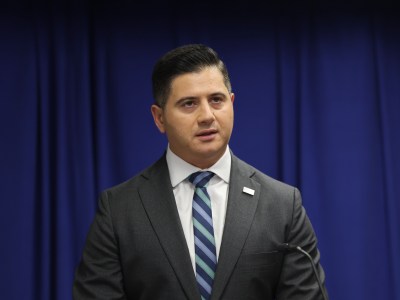
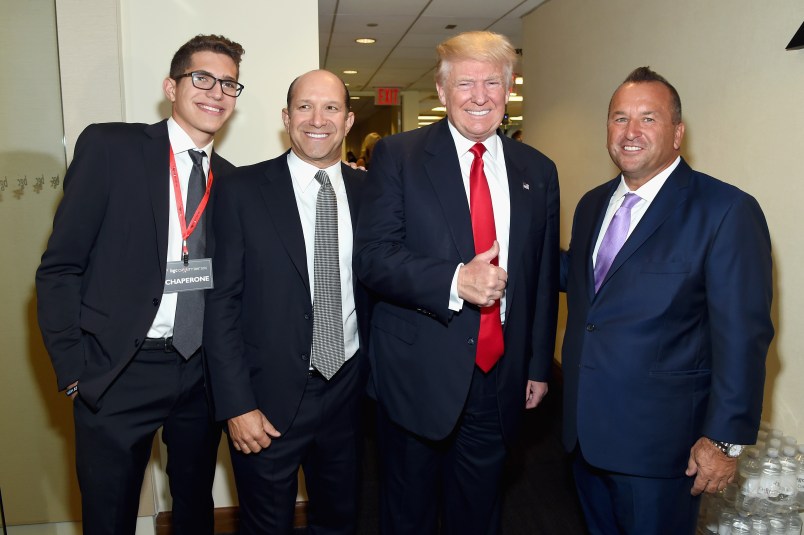
This is not new. But I at least hadn’t heard any of these dots connected. I wasn’t even aware of the dots. A friend mentioned to me over the weekend that he’d heard about Wall Streeters buying up the rights to tariff refunds from big corporate importers. So the idea is that a Wall Street firm goes to an importer and says, you’ve now paid $10 million in tariffs. I’ll pay you $2 million right now for the right to collect the refund if courts ever end up deciding the tariffs were illegal. My friend had also heard that one of the most aggressive buyers was Cantor Fitzgerald, the firm until recently headed by Commerce Secretary Howard Lutnick and now run by Lutnick’s sons. Twenty-something Brandon Lutnick, pictured above on the left in a 2016 photo, is the current chairman of Cantor Fitzgerald. (He must be hella talented!)
Damn, I thought: That’s a hot story, crooked as the day is long. But I’m not sure how I or we would track it down without better finance world sources. Still, it was worth some quick googling. It turns out this is happening and Cantor’s role has already been reported. Wired and others reported this more than a month ago.
In mid-July, according to Wired, Cantor was buying up the rights to your potential tariff refund at between 20 and 30 cents per dollar. Needless to say, I bet that price has gone up a lot since last Friday’s federal appellate court upheld the lower court ruling that almost all of Trump’s tariffs are illegal. So in paper terms Cantor has probably already made a ton of money on this.
Now, before going any further I want to make clear that in itself this transaction is fairly unremarkable. A huge amount of modern finance is about making bets on uncertain outcomes, bets which can be structured in various ways. It might be commodities futures. In this case, it’s the right to collect a refund that may never happen. The sale of debt — a ubiquitous feature of modern finance — is similar. Purchasing debt, whether it’s a government bond or your home mortgage, is fundamentally a bet on the likelihood of repayment. I don’t want to belabor the point, only to make clear that the transaction in concept is neither outlandish or suspect, at least no more than any other part of modern finance.
All that said, it’s hard to imagine anything more emblematic of the Trump Era than what is for all intents and purposes still the Commerce Secretary’s company (yes, yes, arms length hand off to his twenty-something sons) making bets on something Lutnick himself has significant influence over. Indeed, far more important than whatever influence Lutnick has over tariff policy is that significant visibility he has into the bet’s probable outcome.
Lutnick can’t be certain what’s in a judge’s mind any more than Trump can. But he’ll have lots of visibility into what the government’s lawyers think, how they rate their odds of success, what their arguments will be. On top of that, given the immense corruption of the current Supreme Court, I would say there’s at least a 50%-50% shot that Trump and thus Lutnick will gets signals from one or more of the justices about how the Court will rule. Any way you look at this it’s corrupt as hell. And on a more metaphoric level it typifies the heads-I-win-tails-you-lose rules that the billionaire class and their sub-billionaire toadies live by.
What’s not clear is how much of this stuff the Lutnick Boys have actually purchased. In July the U.S. government brought in $29.6 billion in tariff revenue compared to $8.7 billion in July 2024. So that’s more than $20 billion in probably illegal tariffs before many of them had even kicked in. The current market for these refund rights is already in the tens of billions and could hit the hundreds of billions by years end. According to Wired, Cantor said in July that it had “the capacity to buy the rights to hundreds of millions of dollars” of tariff refunds. So the amounts we’re talking about, both at risk and in potential windfalls, is very, very big.
In mid-July Cantor was buying for about 25% of the face value of the refunds. Just looking at the logic of the situation, I’d be shocked if you couldn’t sell that today for 50% of the face value and quite possibly substantially more. The initial court decision and Friday’s appellate decision (tariff cases have their own set of courts) have both gone decisively against the White House and the legality of the tariffs. In any normal universe SCOTUS’s decision would be all but a fait accompli. The only thing weighing in the White House’s favor is SCOTUS’s propensity to give Trump almost everything he wants. But even in this degenerate timeline, the odds for these tariffs don’t look great. If Cantor was able to buy up a lot of tariff refund rights at 20 or 30 cents to the dollar the payoff could be vast.
It’s good to be the King, or even the King’s toady.
Late Update: I did a little more poking around on the details of Lutnick’s “divestment” from Cantor Fitzgerald. The Journal reported in May that on his confirmation as Commerce Secretary he turned over the leadership of Cantor Fitzgerald to his sons. Brandon became chairman and Kyle became executive vice chairman. He turned over his equity interest in Cantor Fitzgerald to a trust to benefit his adult children — that is, Brandon, Kyle and whatever other children he has. Meanwhile, two businesses which are owned by Cantor will buy back from Lutnick the equity he personally owns in those businesses. The two purchases together will total just over $360 million. Under government ethics rules, since Lutnick has to do this sale as part of his government ethics agreement, he will pay no capital gains tax on it so long as he places the money in something like a mutual fund. I don’t think we know what counted as gains on those buy-backs. But that has to have been a massive tax savings. Meanwhile, Lutnick’s divestment from Cantor — his sons run it; his equity in the company is now in a trust for his sons — seems extremely nominal.